The Season of Hiding — Winter Neijing
Have you ever felt it? That deep, gravitational pull in January, not toward a new gym membership, but toward your own couch? In a world that screams "New Year, New You!" at the top of its lungs, the simple urge to slow down can feel like a personal failing. But what if it isn't? What if that instinct to burrow, to rest, and to do less is actually a profound form of seasonal wisdom? A 2,000-year-old Chinese medical classic, the *Huangdi Neijing* (Yellow Emperor's Inner Canon), argues that it is. This is the final chapter in our four-part series exploring the *Neijing's* advice for living in harmony with the seasons. We've seen spring's explosive birth, summer's radiant growth, and autumn's graceful letting go. Now, we arrive at winter, the season the ancients called 闭藏 (*bì cáng*) — "closing and storing." And we'll be guided again by Ollie, the blog's resident screech owl — a creature built for cold nights, who will nevertheless be the first to admit that even an owl burrows down in January. Ollie's Take
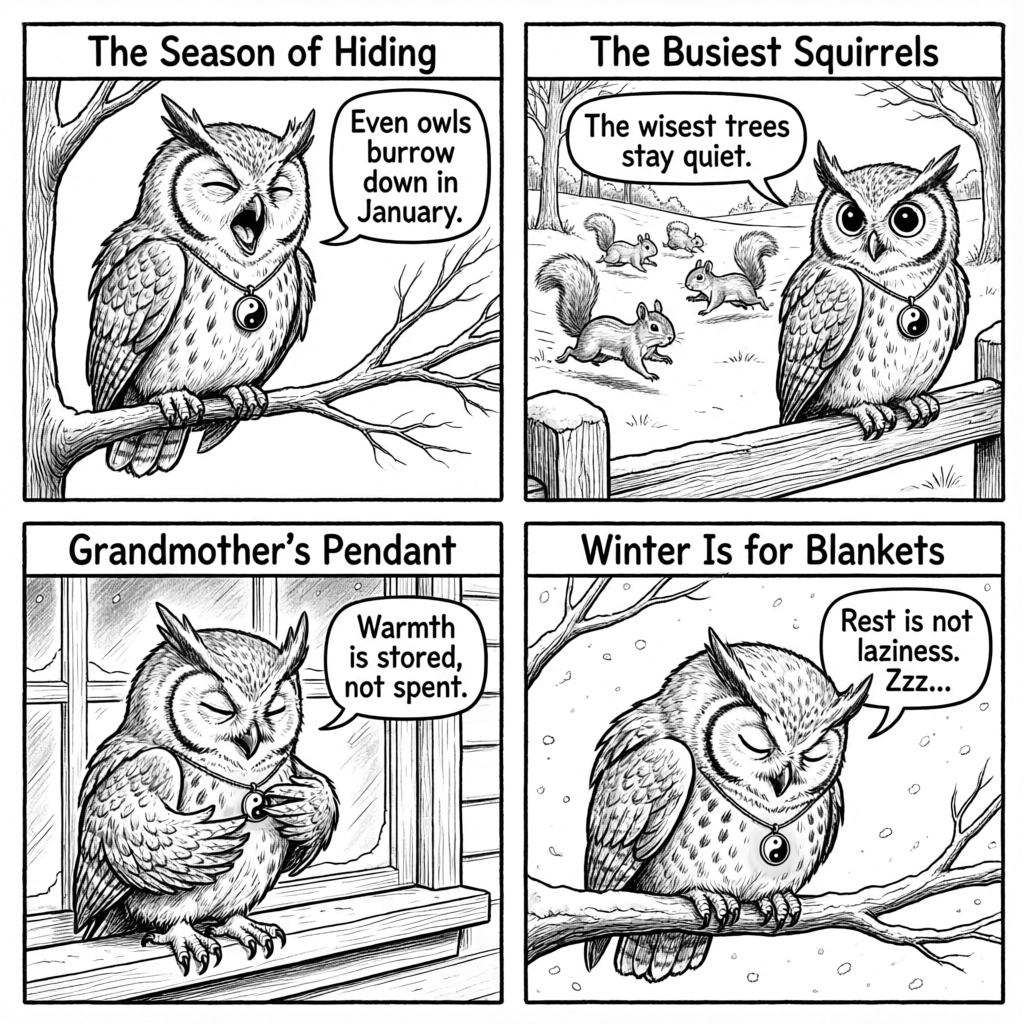
Ollie's take: Hoo-hoo! Every creature in my woods is doing the same thing right now — storing, resting, waiting. The squirrels think they're busy, but watch them in January: even they slow down. Winter isn't a season to fight. It's the one time of year when doing less is doing it right. I'm going to sit on this branch and let the snow do its thing. You should try it — one early night, candlelight, no agenda. The world will still be here in spring.
When a 2,000-Year-Old Text Gives You Permission to Rest
The *Neijing* doesn't mince words. It sees the natural world as our primary teacher. When the world outside is frozen solid, it suggests we should probably take the hint. Chapter 2 of the *Suwen* (Basic Questions) section lays out the blueprint for winter with poetic clarity: > 冬三月,此谓闭藏。水冰地坼,无扰乎阳。早卧晚起,必待日光。使志若伏若匿,若有私意,若已有得。去寒就温,无泄皮肤,使气亟夺。此冬气之应,养藏之道也。 > > *Dōng sān yuè, cǐ wèi bì cáng. Shuǐ bīng dì chè, wú rǎo hū yáng. Zǎo wò wǎn qǐ, bì dài rì guāng. Shǐ zhì ruò fú ruò nì, ruò yǒu sī yì, ruò yǐ yǒu dé. Qù hán jiù wēn, wú xiè pí fū, shǐ qì jí duó. Cǐ dōng qì zhī yìng, yǎng cáng zhī dào yě.* > > "The three months of winter are called 'closing and storing.' Water freezes, earth cracks; do not disturb the Yang. Sleep early and rise late, waiting for the sunlight. Let your intentions lie hidden and still, like a private thought, like something already attained. Avoid cold, seek warmth; do not let the skin sweat and leak, so the Qi is not snatched away. This is the response to winter Qi — the way of nurturing storage." This short passage is a radical prescription for modern life. It’s an official, time-honored permission slip to cancel your plans and get cozy.What "Closing and Storing" Actually Looks Like
Let's break down this ancient advice. It’s not about being lazy; it's about being smart with your energy. First, "Sleep early and rise late, waiting for the sunlight" (早卧晚起,必待日光, *zǎo wò wǎn qǐ, bì dài rì guāng*). This is the direct opposite of the advice for summer. The *Neijing* is telling us to align our sleep schedule with the sun. In winter, that means more sleep. Simple as that. Here in Shanghai, where I live, the winters are a damp, penetrating cold (湿冷, *shī lěng*) that gets into your bones. The first year I tried consciously following this advice — just going to bed when I felt tired instead of pushing through — it felt surprisingly natural. My body already knew what to do; I just had to listen. Next, "Avoid cold, seek warmth; do not let the skin sweat and leak" (去寒就温,无泄皮肤, *qù hán jiù wēn, wú xiè pí fū*). In the TCM framework, your pores are like little gates. In summer, they open to release heat. In winter, they should remain closed to protect your inner warmth and conserve your Qi. Excessive sweating in winter is seen as "leaking" precious energy that you're supposed to be storing. This doesn't mean you can't exercise, but it suggests choosing gentle movements that warm you from the inside out, rather than intense, sweat-drenched workouts that leave you depleted. Think gentle yoga, Tai Chi, or a bundled-up walk in the crisp air — not a marathon in the freezing rain.Ollie Speaks: Look, I'm a screech owl. I fly at night for a living — my ear tufts are built for this weather. The cold is supposed to be my thing. But even I have to admit, there's a point in deep January when I'd rather sit on my branch, feathers puffed up tight, wings tucked in, and zero drama. My grandmother passed this jade pendant down to me — on cold nights I tuck it under my chest feathers to warm it. She always said the cold was for sleeping through, not arguing with. Winter is for blankets, period. — Ollie
Your Inner Bear Was Right All Along
This idea of a winter slowdown isn't just an Eastern concept. Nature all around us is doing the exact same thing. Bears hibernate, trees pull their energy deep into their roots, and the very earth seems to hold its breath. Modern science is catching on, too. Researchers have noted that humans, even with artificial light, have a natural tendency to sleep slightly longer in the winter. And many people experience the "winter blues" or the more pronounced Seasonal Affective Disorder (SAD), a feeling of lethargy and low mood that coincides with the darker months. While this is a complex condition, it points to a deep biological reality: our bodies are profoundly affected by the lack of light. Think of the Scandinavian concept of *hygge* — that cultural embrace of coziness, candles, warm drinks, and comfortable clothes. It's not about fighting winter; it's about surrendering to it and finding the beauty in the quiet, dark months. It’s the *Neijing*'s "closing and storing" in a wool sweater. Ollie has a theory about this, from watching his own woods. On the coldest nights, he says, the squirrels are the busiest — and the wisest trees are the quietest. The ones that survive winter best aren't the ones fighting it. They're the ones that stored well in the fall and now rest on purpose. One honest note, though: none of this is a diagnosis. The *Neijing* describes a seasonal rhythm, and if winter sluggishness ever feels heavier than a rhythm — if it weighs on you day after day, no matter the season — that's a conversation worth having with a healthcare professional. Seasonal rest and real exhaustion are different things, and the difference matters.Let Your Ambitions Lie Hidden and Still
Perhaps the most challenging piece of advice for our hyper-productive culture is this line: "Let your intentions lie hidden and still, like a private thought, like something already attained" (使志若伏若匿,若有私意,若已有得, *shǐ zhì ruò fú ruò nì, ruò yǒu sī yì, ruò yǐ yǒu dé*). What does this mean? It means winter is not the time for shouting your goals from the rooftops. It’s not for launching big, bold, energy-draining projects. The pressure to map out your entire year with aggressive New Year's resolutions runs completely counter to this principle. Instead, the *Neijing* suggests a quiet, internal confidence. It's the feeling of holding a treasure in your pocket. You know it's there. You don't need to show it to anyone. Winter is a season for incubation. It's for letting ideas, plans, and dreams gestate in the quiet dark, gathering strength before they're ready to sprout in the spring. It’s a call to turn inward, to reflect, to journal, and to simply *be* with your thoughts without the pressure to immediately act on them.Eating for the Deepest Season
So, how do we fuel this process of storing? With food that is warming, nourishing, and deeply comforting. The TCM tradition recommends shifting away from the raw, cooling foods of summer toward slow-cooked, hearty meals. Think of root vegetables like carrots, parsnips, and sweet potatoes — foods that literally store their energy underground. Think of rich bone broths, hearty stews, and warming spices like ginger (生姜, *Shēng Jiāng*), cassia cinnamon (桂皮, *Guì Pí* — the bark that's probably already in your spice rack), and cloves. This is the season of 冬令进补 (*dōng lìng jìn bǔ*), a cultural tradition of "winter nourishing." It's the practice of eating specific tonic foods and herbs to replenish the body's reserves. A classic example is a simple, slow-cooked lamb soup with Dang Gui (当归, Angelica Sinensis Root) and fresh ginger, a dish traditionally used to build blood and warm the body from the inside out. Winter is the time to fall in love with your slow cooker, to let the scent of a simmering stew fill your home, and to understand that a warm meal is a form of self-preservation. The cycle is complete. Spring births, summer grows, autumn releases, and winter stores. Each season has its own unique energy, its own task. By fighting winter, by trying to force summer's high-energy output onto the year's darkest days, we exhaust ourselves and miss the point. Winter isn't an obstacle to be overcome. It's a necessary and beautiful part of the cycle. It's the great cosmic exhale, the time when the world recharges. And it invites you to do the same. So this week, try one small experiment. Go to bed thirty minutes earlier than usual, with no agenda other than to rest. Turn off the overhead lights and light a candle instead. Notice the quiet. See what happens when you give yourself permission to simply store, to be still, and to honor the season of hiding.FAQ
Why is sweating considered bad in winter from a TCM perspective?
In the framework of Traditional Chinese Medicine, your Qi is the vital energy that animates your body. Your Wei Qi (Defensive Qi) circulates on the surface, acting as a protective shield against external factors like cold and wind. The pores are seen as gateways that regulate the interaction between your internal and external environment. In winter, the goal is to conserve Yang Qi—your inner warmth and metabolic fire. Excessive sweating opens the pores wide, allowing this precious Yang Qi to "leak" out, leaving you more vulnerable to cold and feeling depleted. It's like leaving the front door open during a snowstorm.
Does this mean I shouldn't set New Year's resolutions in January?
Not necessarily, but it suggests a different approach. Instead of launching ambitious, public, high-energy goals on January 1st, the Neijing's wisdom encourages a quieter, more reflective process. Winter is an ideal time for introspection—for journaling, meditating, and clarifying what you truly want. Think of it as the "incubation" phase. You can absolutely set intentions, but hold them gently, "like a private thought." Let them gather strength internally before you burst into action with the rising energy of spring. It’s about planting the seed in the dark soil of winter, not demanding it to sprout immediately.
What are some simple warming herbs I can add to my winter cooking?
You don't need to find an esoteric herb shop to start warming your winter meals. Many common kitchen spices are considered warming in the TCM tradition. Fresh ginger (生姜, Shēng Jiāng) is a fantastic start; add a few slices to tea, soups, or stir-fries. Cinnamon — specifically cassia bark (桂皮, Guì Pí), the kind most spice racks already hold — is deeply warming and wonderful in oatmeal, stews, or mulled drinks. Star anise and cloves also bring a warm, pungent energy to broths and braised meats. Even black pepper has a warming quality. These spices are traditionally used to stimulate circulation and gently stoke your internal fire during the cold months.
Sources
- Huang, T. (2021). The Yellow Emperor's Classic of Medicine: A New Translation of the Neijing Suwen with Commentary. Shambhala Publications. (Chapter 2, "Great Treatise on the Regulation of the Spirit According to the Four Seasons")
- Beinfield, H., & Korngold, E. (1991). Between Heaven and Earth: A Guide to Chinese Medicine. Ballantine Books.
- Simoons, F. J. (1991). Food in China: A Cultural and Historical Inquiry. CRC Press.