Moxibustion vs. Your Heating Pad: The Deeper Kind of Warmth
Your new heating pad arrives in the mail. Plug it in, drape it over your lower back, and sink into that steady warmth. It feels good—a modern solution to a modern problem. We spend hours hunched over glowing screens, sitting in rigid desk chairs, and grinding through long commutes. Eventually, the body complains. Your gadget answers with instant, soothing heat. From his perch on the upper bookshelf, Ollie the screech owl shifts, his ear tufts flicking forward as he watches you settle in. He cocks his head, his big yellow eyes tracking the black cord snaking to the wall socket. He ruffles his mottled gray feathers, as if considering another kind of warmth entirely. He is thinking of something earthier, something smokier, and something far older than the electrical grid. Meanwhile, in a quiet treatment room, a practitioner lights what looks like a fat brown cigar and holds it an inch above a patient's knee. No cords. No settings. Just smoke, an ember, and two thousand years of refinement. One took an engineer six months to design. The other took two millennia. Guess which one works deeper. Ollie's Take
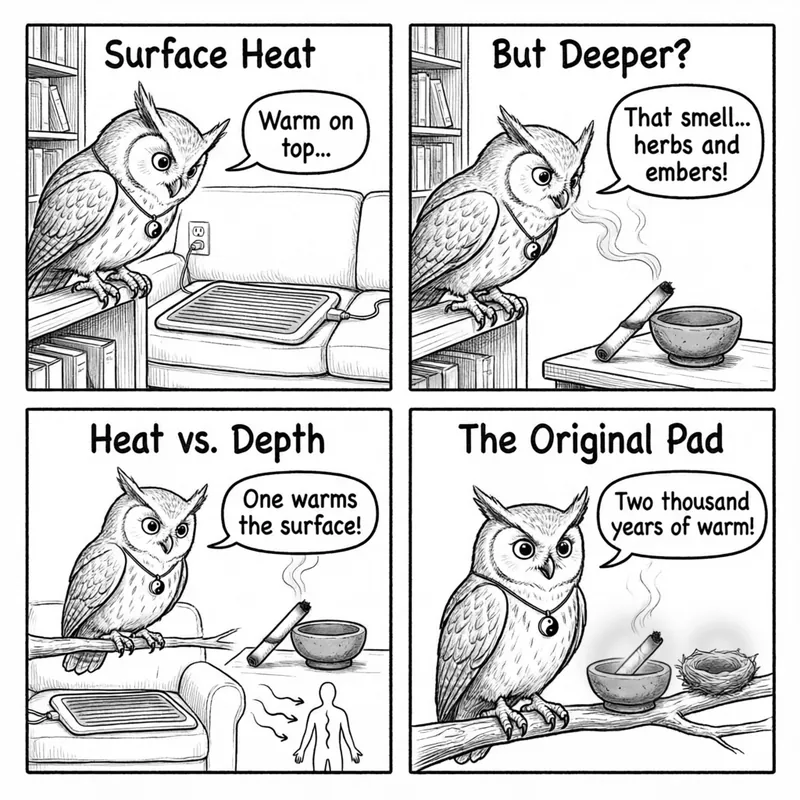
Ollie's take: Hoo-hoo! The humans plugged a warm blanket into the wall and called it progress. Nice, but my nest has been doing the deep-down version for centuries. Surface heat dries the feathers; the good warmth gets into the bones.
The Honest Truth About Your Heating Pad
Let's be clear: heating pads have their place. When you have overdone it doing yard work, or spent eight straight hours staring at spreadsheets, that gentle, consistent heat can feel like a lifesaver. Your heating pad works through conduction. The electrical current heats the coils inside. Those coils warm the fabric, and that warmth transfers directly to your skin. This localized surface heat temporarily increases blood flow to your skin and the tissue just below it. That sudden rush of circulation can ease basic muscle tightness. It can reduce your immediate perception of pain by distracting your nerve endings. Simple concept, effective design, generally safe. But that simplicity is also its limitation. The warmth from a typical heating pad is shallow. Think of it like placing a warm plate against your lower back. It heats the surface, but rarely reaches dense muscle tissue, let alone the joints or the body's deeper energetic pathways. And that's all it is: heat. Pure thermal energy with no other active component. A wonderful, accessible blunt instrument, but a tool that provides only broad, surface-level warmth.So, What's This Smoldering Stick Doing?
That smoldering stick of tightly packed herbs is called a moxa roll, and the practice itself is known as moxibustion. At first glance, it just looks like a primitive way to apply heat. But the magic, as is so often the case in Traditional Chinese Medicine, is found in the subtle details. Moxa works on three distinct levels that your electric heating pad simply cannot touch. First, there is the specific nature of the heat itself. The warmth from a standard heating pad is mostly conductive heat and near-infrared radiation. Smoldering mugwort, however, emits energy in the far-infrared (FIR) spectrum. Why does this matter? Far-infrared wavelengths penetrate much more deeply into the body's tissues. While your heating pad warms your skin and the very top layer of fascia, the FIR energy from traditional moxa can send warmth deep into the muscles, joints, and even toward the internal organs, according to TCM principles. But the deeper reason TCM prizes moxa is its nature. Mugwort is considered Yang and acrid-warm (辛温, xin wen), with a natural affinity for the channels. The Nei Jing teaches that moxa is used when Yang Qi is deficient or when Cold obstructs the channels — conditions where needles alone cannot restore warmth and movement. The Ling Shu states, "针所不为,灸之所宜" — where needles cannot reach, moxibustion is appropriate. Second, there is the botanical element. Moxa is not just any random collection of dried leaves. It is made from a very specific plant: Artemisia argyi. This is a distinct species of mugwort known in Chinese as 艾叶 (Ai Ye). This particular herb has been highly prized for this purpose for centuries. High-quality moxa is harvested in the spring, dried under the sun, and then meticulously processed. The stems are removed, leaving only the soft, fuzzy undersides of the leaves. This creates a fluffy substance known as moxa wool. This wool is often aged for three to five years before use. Aging the mugwort allows the volatile oils to mellow. Fresh mugwort burns too hot and erratic, but properly aged moxa burns with a slow, steady, and intensely therapeutic heat. As it smolders, it releases essential oils, fragrant smoke, and other unique chemical compounds. Modern researchers are studying these botanical components. They are investigating how these organic substances, when absorbed by the body through the skin, might work directly alongside the physical thermal effects. This introduces a biochemical dimension that a copper electric coil wrapped in polyester simply cannot offer. Third, and perhaps most importantly, there is the targeted application. You do not just wave a smoking moxa stick haphazardly over a general area. A trained practitioner applies that deep-penetrating, herb-infused heat to very specific anatomical locations. They target the acupoints. These are the same points used in acupuncture. In traditional theory, they are considered gateways to the body's network of channels (经络, jing luo) — pathways that circulate Qi and Blood. By warming a specific point like Zusanli (ST36), located just below the knee, a practitioner aims to bolster the whole body's Qi and support digestive function. The name translates to "Leg Three Miles." Folklore claims soldiers moxaed this point to march another three miles; classical texts valued it for strengthening Qi and supporting the Stomach and Spleen. By warming Guanyuan (CV4) on the lower abdomen, often combined with CV8 (Shen Que) for deeper constitutional warming, the goal is to strongly support the body's core energy. Shen Que is located directly on the navel, a place considered a profound energetic center. This is precision-guided thermal therapy, designed to create a specific effect within the body's system.Ollie Speaks
Hoo, now. [Adjusts the little brass acorn pendant hanging from his neck with one talon] This is interesting. Sun on wet feathers? Nice. Dries me off. But it doesn't touch the cold that gets into my bones on a long winter night. For that, I need the deep-down warmth of my nest cavity, insulated by the very heart of the old oak tree. One kind of heat is strictly on you; the other kind of heat gets in you. You humans found a way to send heat exactly where it needs to go. That's not just clever—that's useful. Took you long enough. [Yawns, showing the pale interior of his beak] I need a nap.
Two Millennia of Practice, and a Fresh Look from Science
The specialized use of moxibustion is not a fleeting wellness trend. It is one of the oldest foundational therapies in the entire TCM toolkit. As medical historians Gwei-Djen Lu and Joseph Needham document in Celestial Lancets, ancient medical texts fully describing moxibustion were discovered in the Mawangdui Tombs in China. Those tombs were permanently sealed in 168 B.C. That archaeological evidence means this practice has been in continuous, highly documented use for well over two thousand years. The Huang Di Nei Jing (Yellow Emperor's Inner Classic) established the theoretical foundation, describing how moxa warms the channels and expels Cold. Later, the Zhen Jiu Jia Yi Jing systematized point locations and indications — the clinical blueprint still used today. For centuries, practitioners observed its effects and refined the technique. They spent generations meticulously recording which specific points and application methods worked best for different physical presentations. It was kept in the medical repertoire for two millennia because traditional practitioners, and the millions of people they helped, found it effective. Today, modern clinical science is finally beginning to take a closer look. Researchers are attempting to understand the exact physiological mechanisms behind these long-observed effects. And the findings are compelling. A 2024 meta-analysis published in a major medical journal reviewed ten different randomized controlled trials involving 987 individuals dealing with chronic low back pain. The researchers found that the groups receiving professional moxibustion showed more significant improvements in pain markers and daily physical function compared to the standard comparison groups. Scientists are exploring several biological avenues to explain how it might work. They are looking at how the intense, localized heat from the mugwort might stimulate the body's natural production of "heat shock proteins" (HSPs). These specific proteins are known to play a major role in cellular repair processes and biological stress resistance. Researchers are also measuring increases in peripheral blood circulation and monitoring the release of specific neurotransmitters that can modulate the body's pain signals. Science is attempting to reverse-engineer a 2,000-year-old traditional technology to figure out exactly why it performs so well.The Right Tool for the Job: Your Pad vs. The Practitioner's Pole
So should you throw out your heating pad? No. Each tool has its place. Your standard heating pad is your perfect go-to for quick, convenient comfort. Did you have a stressful day and now your shoulders are tight? Did a long car ride leave your mid-back feeling stiff? The heating pad is practically perfect for this. It easily covers a large physical area, provides gentle and controllable warmth, and requires zero training to use safely. Moxibustion is a trained specialist's tool reserved for a much more specific purpose. It is traditionally chosen for physical conditions that possess a distinctly "Cold" or "Damp" quality within the traditional TCM framework. In TCM theory, Cold congeals and obstructs the flow of Qi and Blood in the channels, causing pain (不通则痛 — "no free flow, pain"). Dampness weighs the body down and impairs the Spleen's ability to transform and transport, bringing heaviness and stiffness. Moxa's warming, drying nature directly counters both. This is called 温通 (wen tong) — warming to promote free flow. Deep joint aches that won't quit. A cold lower back no amount of layering can fix. Morning stiffness that spikes when the weather turns damp — these are the conditions moxa was designed for. Moxa is traditionally avoided in patterns of Excess Heat or Yin Deficiency with Heat signs — fever, intense thirst, red face, rapid pulse, or a red tongue with little coating. Adding heat to Heat worsens the imbalance. Certain points (like SP6 and LI4) are also avoided during pregnancy because of their strong moving effect on Qi and Blood. A practitioner always distinguishes these patterns before reaching for the mugwort. Because traditional moxibustion involves managing an open ember and requires highly precise application to specific acupoints, moxa is absolutely not a casual DIY therapy you should try to learn from a quick internet video. Your first sessions should be with a licensed acupuncturist or trained TCM practitioner. They can carefully evaluate your specific constitution. They know the correct points to target, the exact right distance to hold the glowing stick, and the proper duration for the thermal treatment. They can also teach you how to perform it safely at home, if they determine it is appropriate. It is highly important to let your practitioner know if you are pregnant, have neuropathy, or possess very sensitive skin, as they will expertly adjust the technique accordingly.A Different Kind of "Advanced"
When we walk down the modern gadget aisle, "advanced" usually means more tiny wires, more complicated software, and a significantly higher price tag. We have infrared saunas that connect to our home Wi-Fi. We have specialized PEMF mats that cost more than a reliable used car. But ancient moxibustion invites us to pause and consider a very different definition of advanced. Is a technology advanced because it's new and electric—or because it's been perfectly refined for one specific purpose over two thousand years? A properly aged moxa stick is a brilliant piece of elegant, low-tech, bio-thermal engineering. It reliably delivers a precise spectrum of deeply penetrating heat. It combines that thermal energy with the unique chemical properties of a carefully chosen, aged botanical herb. It is then applied with the full diagnostic weight and historical knowledge of a 3,000-year-old traditional medical system. It is a scalpel of warmth, whereas a heating pad is more like a warm blanket draped over the problem. Both are incredibly useful to have in your house, but one is undeniably far more sophisticated in its traditional application. Ollie blinks slowly, head swiveling to track an imaginary ember. His ear tufts flatten as he considers. One heat sprawls; the other targets. Sometimes the most advanced thing is just a better fire. He ruffles his feathers, clacks his beak once, and settles in.FAQ
Is moxibustion safe to do at home?
Starting moxibustion at home without professional guidance is not recommended. It involves a smoldering ember and requires care to prevent burns. A licensed practitioner will perform the treatment safely and can teach you proper technique for home use if it fits your needs. They will show you how to hold the moxa stick, gauge the correct distance from the skin, and safely extinguish it. More importantly, they will diagnose which acupoints are most beneficial for your specific pattern.
What does moxa smell like? Is it a lot of smoke?
The smell of traditional moxibustion is distinct, earthy, and often compared to burning sage or a fragrant campfire. Many people find it pleasant and deeply relaxing. The amount of smoke depends on the type of moxa used. Traditional, pure moxa rolls produce noticeable smoke, making good ventilation important. For those sensitive to smoke or practicing in apartments with smoke detectors, practitioners often use smokeless moxa sticks made from charcoalized mugwort, which produce significantly less smoke and milder odor while still providing effective heat.
Can moxa burn you?
Not when done right. A trained practitioner keeps the moxa moving and checks in constantly. You should feel deep warmth, not pain. Minor redness is normal; a blister is not. The goal is never a burn. With indirect moxa, the most common method, the glowing stick is held a safe distance from the skin. The practitioner ensures your comfort and safety, moving the stick to avoid overheating any single spot. Constant communication is key. An actual burn is not an expected or desired outcome.
Sources
- Lu, G.-D., & Needham, J. (2002). Celestial Lancets: A History and Rationale of Acupuncture and Moxa. Routledge.
- Zhang, Q., et al. Moxibustion for Chronic Low Back Pain: A Systematic Review and Meta-Analysis of Randomized Controlled Trials, Medicine (Baltimore), 2024.