
Meridians Aren't Energy Lines. They're a 2,200-Year-Old Map.
Hoo-hoo! Ollie here. From my perch high in the sycamore, I see you’ve stumbled upon one of the biggest myths in Chinese medicine. You’ve seen the chart, right? The one with the human figure covered in a web of dotted lines and strange codes. Most people look at that and think, “Ah, mystical energy channels.”
I ruffle my wing feathers and settle in. That single idea? It's the biggest mix-up I see. People hear "energy channels" and the whole thing starts to sound like magic. It’s a simple mistake, born from a single translation choice made in the 1600s. But it misses the real story, which is far more practical and, in my opinion, far more interesting.
Those lines aren’t invisible pipes carrying energy the way plumbing carries water. They are the key to a 2,200-year-old map of the human body. A functional map. And like any good map, it doesn’t show you what the territory is; it shows you how to get around.
 Ollie's Take
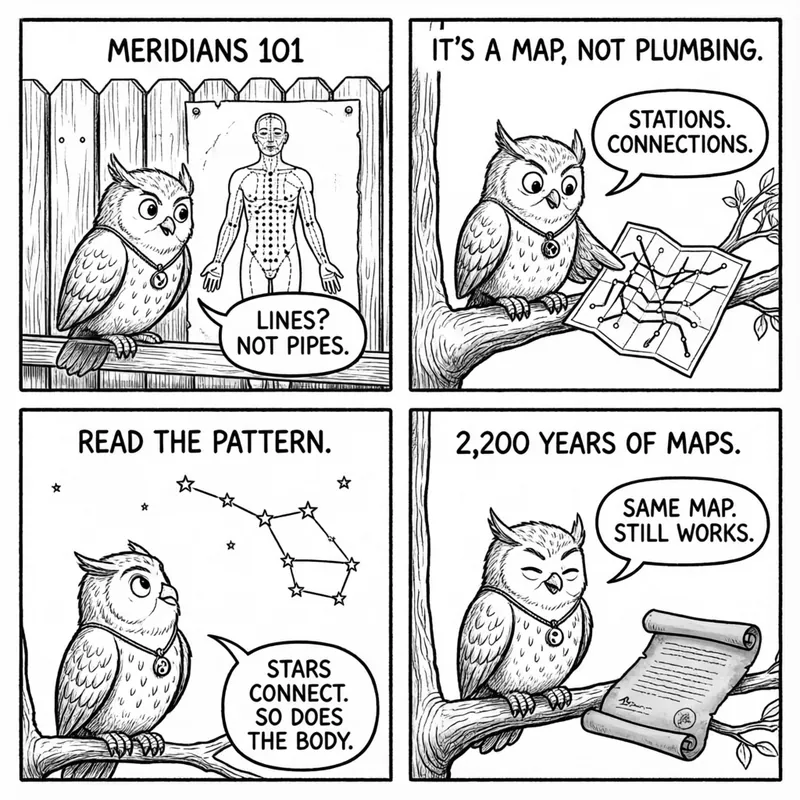
Ollie's take: Hoo-hoo! People keep asking where the energy pipes are. They're looking for plumbing in a subway map. Read the lines, find the station, and the whole system starts to make sense.
What's in a Name? From Warp Threads to Meridians
Words have power. They shape how we think. The original Chinese term for the channel system is jingluo (经络).
Let's break that down. Jing (经) means the “warp” threads on a loom: the strong, vertical threads that provide the main structure for a piece of fabric. In the body, these are the primary trunk lines, the major pathways.
Luo (络) means “net” or “web.” These are the smaller, connecting threads that crisscross the main jing pathways, weaving everything together into a coherent whole. Think of a fishing net or a spider's web.
So, jingluo describes a woven network. A system of primary trunks and connecting branches that form a complete, interconnected web throughout the body. The twelve primary jing are the main highways, but the map also includes eight extraordinary vessels and countless smaller luo branches, a complete, multi-layered network. It’s about relationships and communication, not plumbing.
So where did “meridian” come from? In the 17th century, when European missionaries and scholars first encountered acupuncture charts, they needed a word for these lines. The lines reminded them of the meridians of longitude on a globe. It was a handy visual metaphor. It stuck.
But the metaphor came with a hidden cost. A line of longitude is a fixed, geographic thing. Calling the channels "meridians" accidentally turned a functional concept, a network, into a claim about literal, physical structures. It made people expect to find tiny, invisible tubes when they looked under a microscope. And when they couldn't, many dismissed the entire system.
Unearthing the Original Blueprint
The jingluo map wasn't dreamed up in a philosophical brainstorming session. It was built, piece by piece, from centuries of direct, hands-on clinical observation. It’s an empirical document.
The oldest physical evidence we have comes from a spectacular archaeological find. In 1973, excavators opened a tomb at Mawangdui, sealed since 168 B.C. Inside, among perfectly preserved silks and lacquerware, were medical texts written on bamboo slips and silk scrolls, manuscripts that reflect knowledge compiled even earlier.
These Mawangdui texts contain the earliest known descriptions of the body's channels. They don't match the later, standardized system perfectly, but the core concepts are there. They describe pathways of sensation and influence, recording where pressure, heat, or stone needles (bian shi) could affect symptoms in other parts of the body. They traced these paths by observing where pain, numbness, or referred sensation traveled when a point was stimulated. The channels are maps of the body's own signal patterns.
A century or two later, these early observations were compiled and systematized in the classic text known as the Huangdi Neijing (The Yellow Emperor's Inner Canon). One section, the Lingshu (灵枢, “Spiritual Pivot”), gives the first complete, systematic account of the twelve primary channels, their pathways, their connections to the organs, and the locations of the acupoints along them. Ling names the body's responsive, watchful function—the part that answers back when you pay attention, not anything mystical.
This wasn't theory. This was a record of what worked. Generations of practitioners noticed that pressing a certain spot on the leg reliably eased indigestion. They saw that a particular kind of headache was often accompanied by tension along a specific path on the shoulder and arm. They mapped these consistent, observable patterns of connection. The jingluo system is the result of that massive, multi-generational project.
It’s a Subway Map, Not a Photograph
Here’s the best way I know to think about it. I’m an owl, and I know a thing or two about maps. On a clear night, I tip my head back and trace the Big Dipper with my gaze. It isn't a literal ladle in the sky, and the stars in Orion aren't physically connected. But the pattern they form is a reliable map that helps me navigate the night. It's a functional tool.
The meridian map is like a city’s subway map. Look at a map of the New York City subway. You see clean, color-coded lines and neat little dots for the stations. The map shows you that the L train connects 14th Street in Manhattan to Bedford Avenue in Brooklyn. It’s simple and clear.
But that map is not a literal picture of what’s happening underground. It doesn't show the actual tunnels, the concrete, the rats, the complex wiring, or the layers of rock the trains pass through. If you went digging for a big "blue line" under the ground because you saw it on the map, you’d be missing the point entirely.
The map is a diagram of function and connection. Its purpose is to help you use the system.
The jingluo system works the same way. The lines show the functional relationships. The acupoints are the stations, key locations where the function of the entire line can be influenced. The map explains why a practitioner might place a needle in your hand at a point called Hegu (LI-4, Joining Valleys) to address a toothache, or on your leg at Zusanli (ST-36, Leg Three Miles) to support digestion.
The points are functionally connected, like stations on a subway line. You don't have to see the tunnel to know that getting on at one station will let you off at another.
I tilt my head, ear tufts pricked forward, and think about the mice I track across the meadow. I never see their tunnels underground. But I know their routes from where they emerge. The meridian map works the same way: you don't need to see the infrastructure to trust the pattern.
Why This Map Still Matters
Understanding the jingluo as a map, not anatomy, is the key to understanding the entire logic of Chinese medicine. It answers the biggest questions people have.
Why does an acupuncturist ask about your sleep, your mood, and your digestion when you came in for knee pain? Because they’re looking at the whole map, not just the one station where the alarm is going off. They are trying to see which lines are affected. Is the problem just at the "Knee Pain" station, or is it a system-wide traffic jam on the Liver channel line that just happens to be most obvious at the knee?
This is why TCM is always concerned with patterns, not just isolated symptoms. The map provides the framework for identifying those patterns. A headache, ringing in the ears, and irritability might seem like three separate problems to a Western doctor. On the meridian map, a practitioner might see them as three different stations along the Gall Bladder channel, pointing to a single, underlying pattern of disharmony.
The map lets you see how scattered symptoms fit together as one coherent pattern.
So when someone says, “But scientists can’t find meridians on an X-ray!” you can smile. Of course they can’t. You can’t find the plot of a novel by analyzing the chemical composition of the ink and paper. The map describes function, not physical form. It’s a different category of information. Its value is not in being dissectible, but in being useful.
Ollie Speaks
From my branch, I adjust my little pendant and watch the forest breathe, ear tufts pricked forward. The wind rustles a patch of ferns over here, and a moment later, a loose piece of bark falls from a pine tree over there. To the untrained eye, it’s all random. But I can read the pattern. I know the wind’s direction, its strength. I see the connection.
The body has its own language of patterns. A subtle change in your complexion, the quality of your sleep, the tension in your shoulders. These are not random events. They are messages. A good practitioner learns to read these signs the way I read the forest. The jingluo map is their field guide. It shows them how one rustle over here connects to a falling leaf over there. That's not mysticism—that's just paying attention to what's already happening.

Modern Science Follows the Map
Here is where the story gets really interesting. For decades, the Western scientific view was that meridians were a quaint, pre-scientific folk belief. But recently, researchers have started exploring physiological systems that, curiously, seem to run along pathways very similar to the ancient jingluo map.
Let's be clear: this research does not "prove meridians are real." Instead, it’s beginning to uncover the potential physical structures and mechanisms, the "tunnels" for our subway map, that could explain the functional connections observed by TCM practitioners two millennia ago.
One major area of focus is the body's connective tissue, or fascia. It is a web-like sheet that surrounds and interconnects every muscle, bone, nerve, and organ in your body, a body-wide communication network. Dr. Helene Langevin at the University of Vermont found that when an acupuncture needle is inserted and rotated, the fascia winds around it, creating a mechanical signal that can be transmitted long distances through the fascial planes.
Researchers have noted that roughly 80% of acupuncture points sit in the spaces between or on the edges of muscles, right where these fascial planes are thickest.
Other researchers are looking at different mechanisms. A 2010 study in Nature Neuroscience found that inserting a needle at an acupuncture point triggers the release of adenosine, a natural chemical that acts as a powerful local painkiller. This suggests a direct biochemical basis for acupuncture's analgesic effects.
Meanwhile, neuroscientists like Dr. Vitaly Napadow use functional MRI (fMRI) to watch the brain in real-time during an acupuncture session. They’ve found that needling specific points creates distinct and predictable activation patterns in the brain, different from placebo. In some studies, needling a foot point that classical texts link to the eyes produces measurable activity in the brain's visual areas.
Some scientists are even exploring whether the interstitial spaces, the fluid-filled gaps between our cells, could act as a primitive, high-speed communication highway that follows paths similar to the classical channels. This is still a new and developing field, but it’s exciting.

These researchers are not trying to validate ancient Chinese philosophy. They are using modern tools to investigate a clinical phenomenon: acupuncture works. And in their search for how it works, they are finding that the body’s own anatomy and physiology seem to be organized along lines that look a lot like that 2,200-year-old map.
The map has been useful for a very long time. Science is finally drawing its own map—and it looks surprisingly similar.
That chart of the human body covered in lines? It's not a mystical diagram of "energy." It's one of the oldest and most durable clinical tools in human history—a functional map of the body's vast, interconnected web, still helping people navigate their way back to balance.
FAQ
If meridians aren't physical tubes, why do some people feel a sensation along a channel?
That sensation, often called deqi, is a real and important part of an acupuncture session. The feeling doesn't mean a physical pipe has been activated, but rather a functional pathway. Modern science suggests this could be caused by several factors working together. The needle may stimulate a nerve, causing a sensation to be referred along its path. It could also be the transmission of a signal through the web of connective tissue, or fascia, which wraps around all our muscles and organs. This creates a tangible pulling or radiating feeling that often follows the classical channel pathway with surprising accuracy.
Do modern scientists accept that meridians exist?
The answer is nuanced. Most scientists do not accept the existence of meridians as literal, discrete structures as they were once imagined. However, many are deeply interested in the phenomena the meridian map describes. They are actively researching the underlying physiological systems that could account for the map's clinical effectiveness. Research into fascial planes, the nervous system, and interstitial fluid pathways is providing modern explanations for the connections ancient practitioners observed. So, while the term "meridian" is seen as a pre-scientific model, the functional reality it points to is an area of serious and growing scientific inquiry.
Can I find my own meridians at home?
You can feel hints of the map, but reading it takes real training. The sensations practitioners look for are subtle: a spreading heaviness, a dull ache, a traveling tingle. Most people new to this feel nothing at first, or press too hard and just get sore. If you're curious, book a session with a licensed practitioner and ask them to walk you through what you're feeling when they work with a point. That's the best way to understand what the map feels like in your own body.
Sources
- Lu, Gwei-Djen, and Joseph Needham. Celestial Lancets: A History and Rationale of Acupuncture and Moxa. Routledge, 2002.
- Huangdi Neijing: Lingshu (Spiritual Pivot), compiled c. 1st century BCE.
- Langevin, H. M., et al. "Mechanical Signaling through Connective Tissue: A Mechanism for the Therapeutic Effect of Acupuncture." FASEB Journal, vol. 15, no. 12, 2001, pp. 2275-82.
- Goldman, N., et al. "Adenosine A1 Receptors Mediate Local Antinociceptive Effects of Acupuncture." Nature Neuroscience, vol. 13, no. 7, 2010, pp. 883-88.
- Napadow, V., et al. "Effects of Electroacupuncture versus Manual Acupuncture on the Human Brain as Measured by fMRI." Human Brain Mapping, 2005.