The Yellow Emperor's Inner Classic Isn't One Book. It's a Library.
 Ollie's Take
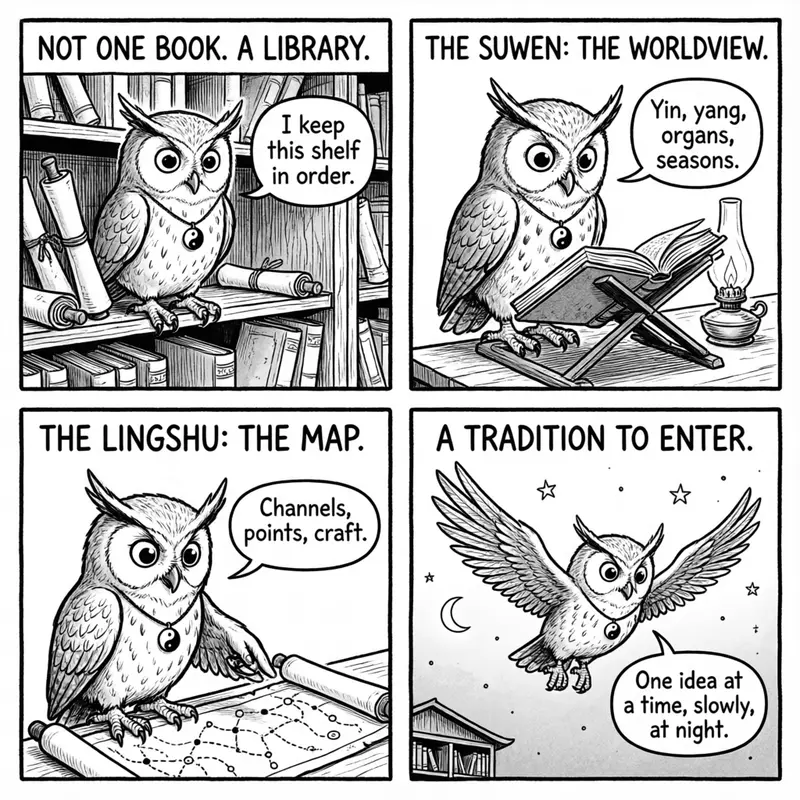
Ollie's take: Hoo-hoo! One famous title, 162 chapters, zero single authors. Forget reading it cover to cover. Wander the shelves. I'll show you around.
The Huangdi Neijing is Chinese medicine's foundation text, and it wasn't written by one person, in one century, or even as one book. It's more like a canyon wall covered in centuries of handprints, layer upon layer of voices all teaching under the same name. If you're picturing one author at one desk, erase that image now.
The "Yellow Emperor" in the title is not the literal author. He's a legendary cultural ancestor, a teaching figure. The texts are framed as dialogues between the Yellow Emperor and his advisors, especially a physician named Qi Bo (岐伯). The Emperor asks, the teacher answers, and the wisdom comes alive in their back-and-forth. You're not reading a lecture. You're eavesdropping on a teaching session.
Think of it this way: you're not opening a textbook. You're stepping into a room where a conversation has been running for two thousand years. The speakers keep switching: scholar, physician, village healer, but they're all circling the same three questions: What keeps a body balanced? What throws it off? How do we read the signs before trouble sets in?
The dating is debated. Most textbook accounts place the core layers somewhere between the Warring States period and the Han dynasty, with heavy editing and additions long afterward, but nobody can pin the whole text to a single century, let alone a single moment. No single author, no single year. It's a working library for an entire tradition, organized under one title.
I'm Ollie, the screech owl who keeps this library's shelves in order. I read most of it the way owls read: slowly, at night, one idea at a time, shifting my weight from talon to talon. My ear tufts droop. The page sits open on the branch. This is my kind of catalog.
What survives today as "the Inner Classic" is really two major parts: the Suwen and the Lingshu. Each has 81 chapters — a number that's no accident, since 9×9 carries auspicious weight in the old way of counting. Together they give you the theory and the practice, the worldview and the map.
The Two Parts You Need to Know
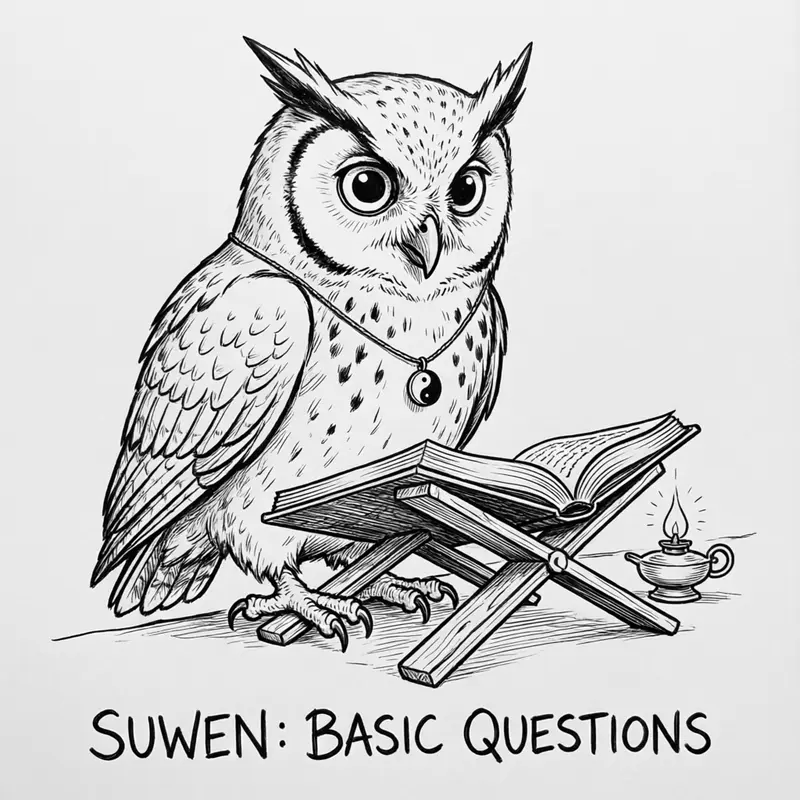
The Suwen (素问, Basic Questions) is the theory book. It lays out the system: yin and yang, the five elements, the organ systems (zang and fu, 脏腑), Qi, essence (jing), spirit (shen), pulse diagnosis, and how to live according to the seasons. If you want to understand how Chinese medicine thinks about the body, the cosmos, and health, you start here.
The split isn't clean, though. The Suwen also carries clinical and diagnostic material, and the Lingshu opens with theory of its own. But as a rough map it holds: the Suwen builds the worldview, the Lingshu hands you the craft.
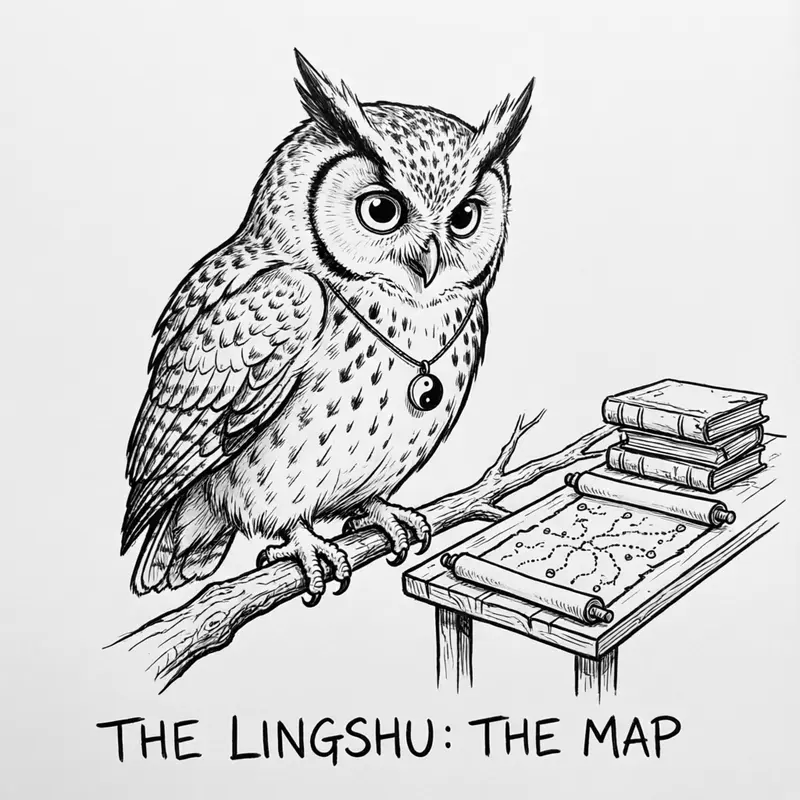
The Lingshu (灵枢, Spiritual Pivot) is the hands-on manual. It maps the channels and collaterals — jingluo (经络), the pathways Qi travels — locates the acupoints, and teaches needling technique. If the Suwen gives you the philosophy, the Lingshu gives you the craft. Acupuncture is not some separate "alternative" thing; it's the practical half of the same system.
Ollie's aside: I once traced the Lung channel's path along my wing with a molted primary feather, holding it in my beak and dragging the quill tip along the line. It made more sense than any chart had.
Later catalogs list the Inner Classic in eighteen fascicles, but the path from those entries to today's Suwen and Lingshu is still debated; scholars describe the received texts as the surviving core of a much larger collection.
The Yellow Emperor as Teaching Frame
The Yellow Emperor, Huangdi (黄帝), is a mythic cultural ancestor, a legendary ruler credited with inventing medicine and writing. He probably never existed as one person, but as a teaching figure he's perfect.
In the dialogues, the Emperor asks the questions a student would ask. Qi Bo and the other advisors answer with the tradition's accumulated knowledge. The dialogue form gives the teachings authority and rhythm. You're not slogging through a textbook; you're listening in on a conversation between a curious ruler and a patient teacher.
This matters because the Inner Classic isn't a lookup manual; it teaches you how to think.
The Suwen Gives You the Worldview
The Suwen's 81 chapters cover a huge range: yin and yang as the root of all change; the five elements as a map of transformation; the organs as functional systems tied to seasons, emotions, and Qi flow. In the old reading, constrained Liver Qi can overact on the Spleen — the wood-over-earth pattern — showing up as irritability, a heavy meal sitting badly, a tendency to worry. The mechanism: when the Liver's free-flowing function (疏泄, shu xie) is blocked, its stagnant Qi presses on the Spleen's transforming and transporting work, disturbing digestion. The five-element lens gives you the relationship; the organ-function lens gives you the mechanism. The traditional response: soothe the Liver while steadying the Spleen.
It explains jing (essence, the deep reserve you're born with and slowly draw on), Qi (the active force that moves and warms), and shen (spirit, the light of consciousness and vitality). It lays the groundwork for pulse diagnosis and later diagnostic habits like reading the tongue, and it dedicates chapters to living in harmony with the seasons.
You've already met pieces of the Suwen here: the yin-yang overview (#16), five elements (#17), organs as systems (#18), jing-Qi-shen (#19), and the seasonal articles (spring #40, autumn #42). The old seasonal guidance — cultivate yang in spring and summer, store yin in autumn and winter — comes from these chapters.
I spent three nights once tracing every mention of essence through the Suwen, ear tufts flattening lower with each chapter. By dawn I'd filled half a margin with talon scratches. That's the thing about theory: pull one thread and the whole cloth starts moving.
The Lingshu Gives You the Map and the Craft
The Lingshu is where the theory becomes craft. It maps the twelve primary channels and their collaterals — jingluo (经络) — that carry Qi through the body. It names and locates the acupoints. It teaches needling depth, angle, technique, and what to expect.
The channels are not blood vessels or nerves in the Western sense; they're functional pathways. When Qi flows smoothly, the body is balanced in the old view. When it stagnates, the old reading might trace irritability and rib-side tightness to Liver Qi stuck in place. When Qi depletes, movement and drive falter: a weak voice, exhaustion, a sense of being drained. When Yang runs short (Yang Xu, 阳虚, in TCM terms), the picture is internal cold: cold limbs, low energy, a need for warmth. This differs from exterior wind-cold invasion, which brings sudden onset, aversion to wind, and a floating pulse. Yang Xu is an internal deficiency, a lack of warming fire from within; wind-cold is an excess arriving from outside. In the old clinical logic, this meant warming the interior for Yang Xu (building the fire) versus releasing the exterior for wind-cold (clearing the invader): different strategies for different root causes. In the same pattern language, a stiff shoulder might be read as a Large Intestine channel story, not a diagnosis, just a way of organizing what you're seeing. The Lingshu teaches how to read those disruptions by location and quality.
The Lingshu also draws the body as a connected whole: a point on the foot linked to the head, a needle in the hand to digestion. Not mysticism, just the map.
Ollie Speaks: I tried reading this library straight through once. By the twelfth chapter my eyes were crossing, my talons were cramping, and my pendant was swinging from all the head-shaking. Night vision doesn't help when you're trying to read a library like a novel. Doesn't work that way. The Inner Classic rewards a different kind of attention: you read a chapter, you live with it, you come back when the season turns. You need to see how the Suwen's theory lights up the Lingshu's channels, how the five elements thread through the organs, how the seasons quietly steer the advice. That's why I'm here, ear tufts pricked, pendant clinking softly when I shift on the branch. I'm your librarian owl. I read by moonlight, I know where every thread connects, my ear tufts swivel toward the next question, and I'll show you which shelf to visit next. Nobody gets through this library without a guide. I've been roosting here long enough to know it by heart.
The Map You Need, Not the Book You Finish
You do not need to read all 162 chapters of the Huangdi Neijing. Most people never do. What you need is a good map, a sense of how the pieces fit together, and a path through the ideas that matter to you.
The Huangdi Neijing is not a book you finish; it's a tradition you enter. You return to it when you're ready for the next layer, and a passage that seemed abstract suddenly clicks when you see it applied.
There are three honest ways to read it, none starting on page one: skim it like a field guide, chase one idea at a time like index cards, or sit with it like a patient text, a few lines a day. All three are ways the tradition itself has always read it. The only wrong way is pretending you have to finish. If you want an English translation, Paul Unschuld's annotated Suwen is the standard scholarly door in, dense but worth it.
Teachers don't hand students the whole text and say "read this"; they introduce one idea, let it settle, then the next. The dialogues model that rhythm.
The Living Tradition Behind the Text
The Huangdi Neijing is old, really old, but it isn't dead. It's still the foundation of Chinese medicine education: students memorize passages, practitioners quote them, researchers mine them for insight.
From my perch, why does a text compiled two thousand years ago still matter? Because it isn't just historical; it's generative. Yin and yang are a working model for reading patterns. The five elements are a way of thinking about relationship and change. The channels are treated as a functional map, not old anatomy.
A principle from the Suwen has followed practitioners for two thousand years, usually paraphrased as "the best physician works before illness takes hold"; a version appears in its opening chapters. In the old text this isn't a slogan; it's a habit of mind: watch for the small signs, the early tilt, the pattern before the problem.
The Inner Classic matters because it teaches a way of seeing. Once you learn to read the body as a system of flows and balances rather than a collection of parts, you can't unsee it. That shift is what the text offers: not trivia or recipes, but a new lens.
And you don't need to treat it as gospel; the tradition never did. Chinese medicine has always argued with itself, tested new ideas against old ones. The Inner Classic is the starting point, not the ending point.
So where do you start?
Your Next Steps
If you're new, start with Qi (#03); then yin and yang (#16), then the five elements (#17). For the body's architecture, read organs (#18) and jing-Qi-shen (#19). For the practical side, the channels and acupuncture logic, go to #48. For seasonal living, read spring (#40) and autumn (#42).
The Inner Classic is not one book. It's a library. You don't read a library; you explore it. And every article on this site is a room in that library, a door you can open when you're ready.
Welcome in. I'll keep the light on from my branch outside, one eye open, ear tufts swiveling toward whatever question comes next — your librarian owl, perched and ready.
FAQ
If the Inner Classic was compiled over centuries, why is it still taught as "the" foundation text?
Because it's the frame everything else hangs on. The Suwen gives the theory, the Lingshu the craft; later schools argued with both, but they argued in the same vocabulary. It's still the starting point in Chinese medicine education today, not as a museum piece but as the working language practitioners use.
Do I need to read the whole Huangdi Neijing to understand Chinese medicine?
No. The Huangdi Neijing is 162 chapters of dense classical Chinese, and most practitioners never read it cover to cover. What matters is the core ideas: yin and yang, the five elements, the organs as systems, Qi, the channels, and seasonal living. Those ideas are introduced throughout this site in plain English; think of the Inner Classic as the root and the TCM Way articles as the branches.
What is the difference between the Suwen and the Lingshu?
The Suwen (Basic Questions) is the theory half: yin and yang, five elements, organs, Qi, essence, spirit, diagnosis, and seasonal living. The Lingshu (Spiritual Pivot) is the practice half: channels, acupoints, needling technique. Acupuncture without the Suwen's theory is needles without a map; theory without the Lingshu's maps is just abstraction. You need both halves, but you can start with whichever interests you first.
Sources
- Huangdi Neijing: Suwen (Basic Questions) — traditionally associated with materials accumulated over the Warring States and Han periods, with later editing and transmission.
- Huangdi Neijing: Lingshu (Spiritual Pivot) — traditionally associated with materials accumulated over the Warring States and Han periods, with later editing and transmission.
- Unschuld, Paul U. Huang Di Nei Jing Su Wen: Nature, Knowledge, Imagery in an Ancient Chinese Medical Text. University of California Press, 2003.
- Sivin, Nathan. Traditional Medicine in Contemporary China. Ann Arbor: Center for Chinese Studies, University of Michigan, 1987.