
The Physics of Acupuncture (No, It's Not Magic)
 Ollie's Take
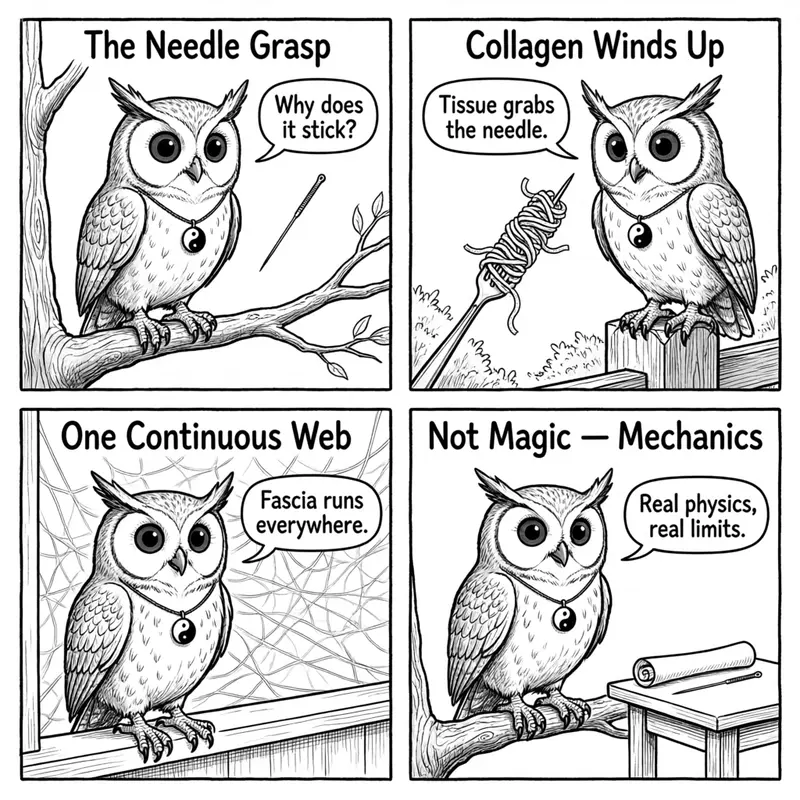
Ollie's take: Hoo-hoo! The needle sticks because the tissue grabs it. Real physics — and real limits. I'll show you both.
For decades, practitioners have talked about "needle grasp": the way tissue seems to grip an acupuncture needle as you turn it. In 2001, researcher Helene Langevin decided to measure it. Her team rotated needles in tissue and tracked exactly how hard they were to pull back out. What they found, published in the Journal of Applied Physiology, looked almost mundane at first glance: the pullout force climbed as connective tissue wound around the needle, the way spaghetti winds around a fork. Pull, and you'd feel resistance. A sensation practitioners had described for centuries now had a mechanical explanation sitting beside the traditional one, one piece of the picture rather than the whole of it.
This post walks through what researchers have really measured: winding tissue, the body's own chemistry, a mouse study about pain-blocking, brain scans that shift under a needle. Then it takes an honest look at what those findings do and don't prove. Real physics. Real limits. Both matter.
[Ollie the screech owl leans in from his perch on the edge of a stack of textbooks, one ear tuft flicking upward. He nudges the small jade yin-yang pendant hanging from his neck with the side of his beak.] "Grab a seat," he says. "There's real science in this one. It won't bite; less than the needles, anyway."
The Tug: What a Needle Does to Tissue
Connective tissue (fascia, to use the technical word) doesn't stop at the edge of one muscle and start fresh at the next. It runs through the body in continuous sheets, threading around organs, muscles, and bones like packing material that never quite lets go. Langevin's team wondered what happens to that material when a needle enters and turns.
The answer: it grabs. Collagen fibers coil around the needle shaft, and the tighter they wind, the more force it takes to withdraw. Measurable in a lab. Repeatable. Not mysterious once you see it under a microscope.
What's less settled is how far that pull travels. Because fascia is continuous, a tug in one spot could transmit some mechanical signal nearby, though researchers are still working out how far, how reliably, and what it does once it gets there. It is not a demonstrated body-wide signaling network, and it is not another word for meridians. The channel system is a separate, older framework with its own logic. Blurring the two does neither any favors.
Your Body's Own Pharmacy
Now the part that brings most people in: pain relief. Needling appears to trigger the release of the body's own opioid-like chemicals (endorphins, enkephalins, dynorphins). The same family your body produces during exercise or stress: the runner's high, the dull relief after intense effort.
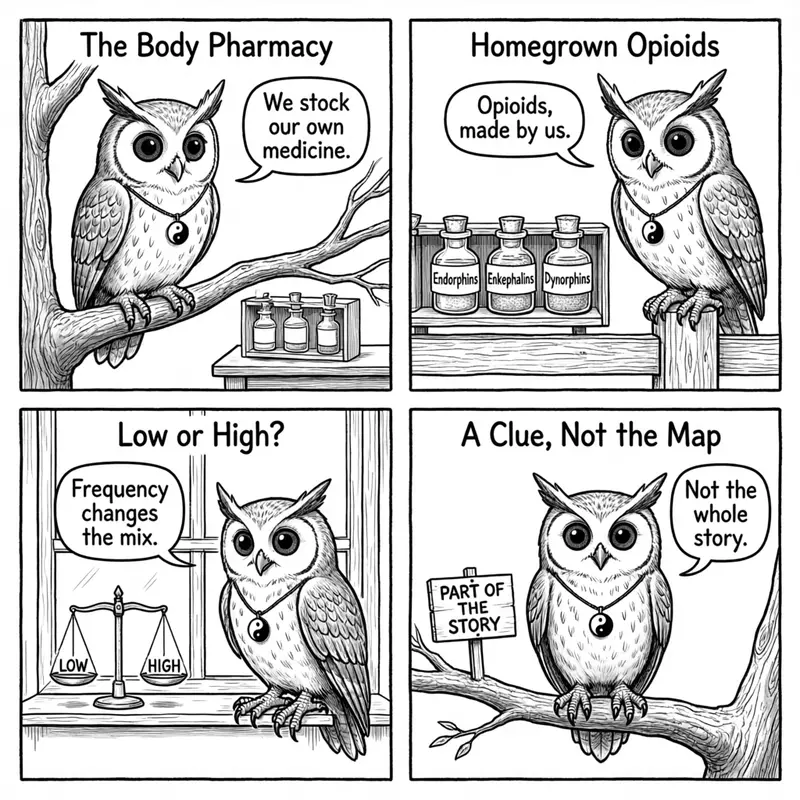
Han Ji-Sheng's 2004 work in Neuroscience Letters found something specific: in electroacupuncture experiments, different stimulation frequencies favor different opioids. Low frequency leaned toward enkephalins. High frequency leaned toward dynorphins. That work leans on animals and electrical stimulation: a clue, not a map of ordinary hand needling in humans.
Supporting evidence comes from an unlikely source: naloxone, the drug used to reverse opioid overdoses by blocking opioid receptors. In some experimental studies, naloxone reduced acupuncture's pain-relieving effect. Not in every case, not in every study. That partial blocking is a clue that endogenous opioids do some of the work. Not all of it.
The Pain-Off Switch
A 2010 Nature Neuroscience study led by Nanna Goldman and colleagues pointed to another player: adenosine. It's a molecule your body already uses for plenty of things, pain signaling among them. In mice, needling triggered a local release of adenosine near the needle site, which activated receptors that dial down pain signals.
Give the mice a compound that boosts adenosine, and the pain-relieving response grows stronger. Breed mice without the relevant receptor, and the effect disappears. A clean result, for mice.
Say it plainly: a mouse study. Mouse and human biology overlap substantially at this level of cell signaling, but overlap isn't identity. Whether adenosine stars the same way in humans is an open question. A promising lead, not a finished story.
Inside the Scanner
Put someone in an fMRI machine, insert a needle at a point, and watch what lights up. Vitaly Napadow and colleagues have done exactly this work, and their scans show something real: needling shifts activity in brain networks involved in processing pain.
The scans aren't telling one story. A 1998 study by Cho and colleagues, later hotly debated, reported that needling a point on the little toe that traditional practice associates with the eyes (Bladder 67) lit up visual processing areas in the brain. In another, needling a traditional pain point activated the limbic system, the brain's emotional center, not just sensory pain regions. Dozens of stories at once. That's why "heterogeneous" is the honest word here.
[Ollie rotates his head nearly sideways, both ear tufts standing at attention like twin antennae.] "I've got a fairly small head myself," he mutters, adjusting his pendant with one talon. "Even a small brain lights up differently depending on what's happening to the body. So does yours."
Here's the honesty this section owes you: these findings are heterogeneous. Different studies, different points, different populations, different results. Sham needling (a fake needle, or a real one placed where traditional theory says it shouldn't matter) also moves these networks, sometimes by a lot. Expectation alone changes brain activity. That's true of many interventions people believe are helping them.
Brain changes are interesting. They are not, by themselves, proof of clinical benefit. A shift on a scan and a real reduction in someone's pain are two different claims, and conflating them is the exact shortcut this post avoids.
What Two Thousand Years Called It
None of the above is how acupuncture was described for most of its history. The older framework deserves time on its own terms, not as a folk footnote to modern science but as the thing that came first and still shapes how many practitioners think.
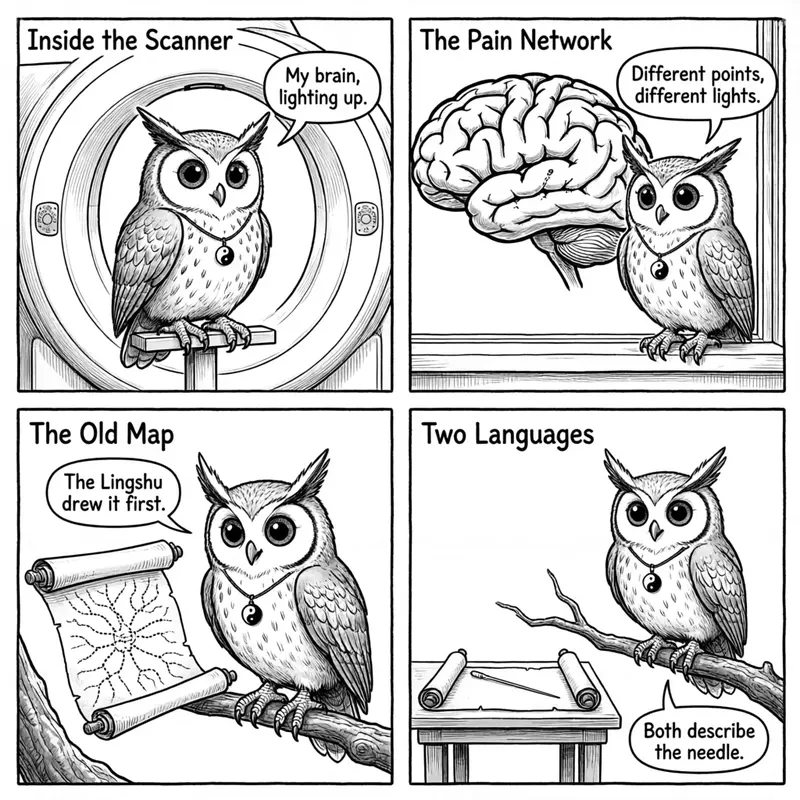
The Lingshu, traditionally seen as the acupuncture-focused half of the Yellow Emperor's Inner Classic, lays out a system built around Qi moving through channels, and describes nine classical needle types, each suited to different depths and purposes. The text describes regulating Qi (supporting where it runs thin, easing where it's congested), and the approach depends on the person: which channel, which pattern, which technique fits the moment. Never a one-size "insert needle, unblock everything."
Central to the practice is de qi, literally "arrival of Qi." Traditionally, this is a sensation the person feels: heaviness, distension, a dull spreading ache, sometimes numbness. The practitioner feels something too, a kind of grip or resistance under the needle, not unlike the needle grasp Langevin measured decades later. Some studies link de qi to activity in certain nerve fibers: faster A-delta fibers that carry sharp, well-localized signals, and slower C fibers that carry dull, aching ones. De qi is hard to define, varies person to person, and not every tradition insists on it. The correlation is worth noting, and worth being careful with: a nerve fiber response is one measurable thing a machine can register. Qi, in the traditional framework, is assessed through a much wider pattern: tongue, pulse, symptoms, constitution. The two are related observations, not interchangeable definitions of the same thing. In traditional practice, de qi is also the sign that the needle has engaged the channel and that Qi is now moving: drawn to the point to supplement a deficiency, or dispersed away from it to clear an excess. Without it, the tradition holds, the work hasn't taken hold.
The tradition also carries its stories. Sima Qian's Shiji, the Records of the Grand Historian, tells of the physician Bian Que reviving the crown prince of Guo from shi jue ("corpse reversal," a collapse so profound it mimicked death) using acupuncture, which later retellings compress into a single needle. Those retellings also connect it to the point known today as Baihui, GV20, at the crown of the head; the Shiji itself doesn't specify the point. Baihui, where all the Yang channels meet at the crown, is classically used to raise sunken Qi and restore consciousness, which is why later generations saw it as the fitting point for such a reversal even if Sima Qian never named it. Still: transmitted lore, a story that shaped how the tradition sees itself, not clinical evidence. Worth knowing. Worth holding loosely.
The Practical Side: What to Expect
A first session usually starts with questions, not just about the pain or issue at hand but sleep, digestion, stress, tongue, pulse. In the TCM framework, this pattern differentiation matters: a practitioner distinguishes between deficiency and excess patterns, and the technique shifts accordingly. A deficiency pattern might call for gentler needling, shorter retention, and a tonifying touch, while an excess pattern (something stuck or accumulated) might warrant stronger stimulation to move it. The real map is finer than that two-way split: Qi stagnation, Blood stasis, Phlegm, and heat each change the approach. Pain from Qi stagnation tends to move around, worsens with stress, and eases with pressure; pain from Blood stasis stays fixed, feels stabbing, and worsens at night. Distinctions like that shape whether a practitioner needles gently to move Qi or more firmly to break up stasis. The same point needled two different ways produces different sensations and, in the tradition's view, different effects.
Trained practitioners use sterile, single-use needles. Most people feel a brief pinch on insertion, then pressure or a dull ache once the needle settles, if they feel de qi at all.
Risks are real, even if uncommon. Minor bruising or soreness at the needle site is the most likely thing you'll notice. Lightheadedness happens occasionally, especially first time or on an empty stomach. Infection and bleeding are possible if hygiene standards slip. Rarer still: a needle left in by mistake, or, with needling near the chest or upper back, a punctured lung known as pneumothorax. That's why training matters, and why guesswork has no place here. People on blood thinners or living with a bleeding disorder are generally advised to discuss acupuncture safety with a physician first.
None of this replaces regular medical care. Acupuncture sits alongside it, in the TCM framework, as a complementary approach, not a substitute for a diagnosis, a prescription, or a hospital visit. Lab responses don't mean every treatment produces the same clinical result for every person. And the channel system, however coherent as a traditional model, hasn't been validated as a map of the body's anatomy the way the circulatory system has.
Ollie Speaks: "Here's how I hold both of these," he says, one ear tuft drooping slightly as if the whole question is making him drowsy. "The tradition asks: what's this person's body showing right now, and what helps? The lab asks: what molecule just moved? Different tools, different centuries. I can't prove they're describing the same thing. Can't prove they're not, either. Maybe the needle grabbing collagen is Qi arriving. Maybe they're two separate things happening at once. Either way, people feel something real." He fluffs his chest feathers briefly, then smooths them back down. "That's good enough for me." He blinks slowly. "Also, I'm an owl. Take that for what it's worth."
Sources and Limits
The key studies behind this post: Langevin et al., "Relationship of acupuncture points and meridians to connective tissue planes," Journal of Applied Physiology, 2001. Han Ji-Sheng, on frequency-dependent opioid release, Neuroscience Letters, 2004. Goldman et al., on adenosine signaling in mice, Nature Neuroscience, 2010. Napadow et al., on fMRI responses to acupuncture, Human Brain Mapping, 2005. Hui et al., a review of acupuncture's central nervous system effects, BMC Complementary and Alternative Medicine, 2007. Melzack and Wall's gate control theory of pain, Science, 1965. For the historical material: Sima Qian's Shiji.
What these sources do not establish: that acupuncture "works" as a single, blanket fact across all conditions and all people. That the channel system has been mapped onto known anatomy. That brain or chemical changes guarantee a clinical outcome anyone would notice. That Qi has been reduced to fascia, or nerve firing, or endorphins. These are separate, partial pieces of a picture still being assembled: some from a two-thousand-year-old observational tradition, some from an fMRI machine. Treat both with respect. Treat neither as finished.
[Ollie stretches one wing, then the other, and gives his pendant one last nudge before folding up for the night.] "If you try it," he adds, "trained and licensed practitioners are the norm here, and telling them what you feel — the heaviness, the ache — is part of the tradition. Keeping your regular doctor in the loop is standard advice. That's not hedging. It's the careful way in."
FAQ
Why would a practitioner ask about my digestion when I came in for shoulder pain?
Because in the TCM framework, pain is rarely a local-only event. A shoulder problem might be read as a blockage along a channel that also runs through the gut, or as a pattern where digestion and circulation influence each other. The practitioner is assembling a picture (sleep, digestion, stress, tongue, pulse) to decide whether the pattern is one of deficiency or excess, stagnation or cold, and then to choose points and technique accordingly. Questions that look unrelated are usually the ones doing the real diagnostic work. That's pattern thinking: the body is one connected system, not a list of separate parts.
Does acupuncture hurt, and what are the risks?
Most people describe a brief pinch, then pressure or a dull ache rather than sharp pain; needles are hair-thin, nothing like injection needles. Risks exist but are uncommon with a trained practitioner, which is exactly why anatomical training matters. Sterile, single-use needles are standard practice. People who take blood thinners or live with a bleeding disorder are generally advised to check with a physician first. This isn't a place for shortcuts or untrained hands.
Does it work, or is it just placebo?
Neither answer is honest by itself. Real physiological responses happen: connective tissue reacts, endogenous opioids release, brain networks shift on a scan. Those are measurable, not imagined. But sham needling moves some of the same networks, expectation plays a real role, and clinical results vary by condition and by person. Research findings vary by condition: chronic pain (osteoarthritis, low back pain, migraine) is among the most-studied areas, with mixed but notable results, while evidence elsewhere is weaker or more inconsistent. It's not a magic cure, and nobody honest claims it is. It's an old intervention studied for decades, with outcomes that differ by condition, study design, and person. Worth approaching with curiosity, not blind faith or dismissal.