The 800-Year-Old Chinese "Stretching" That's Beating Blood Pressure Meds?
 Ollie's Take
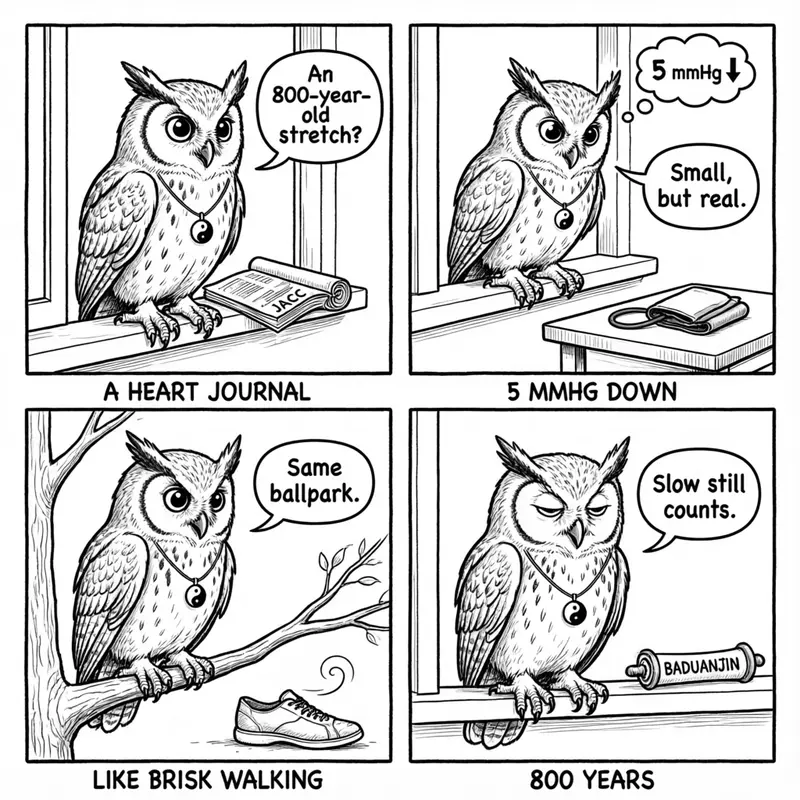
Ollie's take: Hoo-hoo! An 800-year-old stretch landed in a heart journal. Slow is having a moment.
A top American cardiology journal recently published a major study on a set of eight simple movements that have been practiced in China for about 800 years. The Journal of the American College of Cardiology (JACC), a publication read by heart doctors everywhere, published the trial in March 2026. The American College of Cardiology's own journal scan covered it for cardiologists under the nickname BLESS.
This wasn't a small, obscure finding. It was a large, multicenter, randomized controlled trial—the gold standard of medical research—looking at an ancient wellness practice called Baduanjin (pronounced "bah-dwahn-jin"). The name means "Eight Pieces of Brocade," a nod to the precious, silk-like value of these movements for health. And for people with blood pressure creeping into the high-normal range, the findings are pretty remarkable.
[Ollie the screech owl leans in from his perch on the edge of the desk, his jade yin-yang pendant glinting in the morning light. One ear tuft twitches.]
"Hoo knew? My ancestors have been doing one of these moves for millennia. We just call it 'checking for mice.'"
[He does a slow head swivel, then settles back, eyes half-closed.]
The Study That Stopped Cardiologists in Their Tracks
Start with the science, because this is where the story gets good. The trial, nicknamed BLESS, was led by Dr. Li Jing and colleagues at Fuwai Hospital in Beijing, part of the Chinese Academy of Medical Sciences. They wanted to see if Baduanjin could really make a difference for people whose blood pressure isn't high enough for medication yet, but is definitely heading in the wrong direction. This "high-normal" range, or pre-hypertension, is a huge global health issue.
The researchers recruited 216 adults with blood pressure between 130-139 systolic and 85-89 diastolic. They were randomly assigned to either practice Baduanjin five days a week for three months or to a control group that received only standard health education.
The results were clear and consistent. The Baduanjin group saw their office systolic blood pressure drop by about 5 mmHg more than the control group. Even better, that reduction was still there when they were checked again a full year later. Using 24-hour ambulatory monitoring—a cuff that measures your pressure around the clock—the Baduanjin group's systolic pressure ran about 3 mmHg lower than the control group's, both at the three-month and one-year marks.
This matters. Earlier trials hinted at this effect, but a 2020 meta-analysis pointed out that many were small and had methodological weaknesses. The BLESS trial is the first large, multicenter randomized trial of Baduanjin on blood pressure. It's a big deal.
What Baduanjin Is
Baduanjin is a form of Qigong, or "energy work." It's a set of eight distinct, gentle movements that are coordinated with your breath and a focused mind. Tradition traces it back to the Song Dynasty (around the 12th century), though the exact origins are debated. Some attribute it to the general Yue Fei; others say Daoist adepts refined it over centuries. Either way, it has been passed down and practiced for generations, and it is one of the most popular and accessible forms of Qigong practiced today.
Think of it as a moving meditation that takes about 12 to 15 minutes. No gym membership, no special clothes, no equipment. Just enough floor space to stretch your arms out. It's low-impact on the joints, which makes it a good option for older adults or anyone with cranky knees.
I practice it myself, most mornings, in a patch of floor no bigger than a yoga mat. I was never a gym person, and the idea of a pre-dawn spin class still makes me want to crawl back under the covers. But twelve quiet minutes at home, moving through these slow forms while the house is still silent, works for me. The first movement starts with both palms turning upward, and somewhere in that slow reach, the stiffness from sleep lets go. It has stuck. It is not a workout. It is a way of waking up my body and clearing my head before the day gets loud.
From "Shooting Eagles" to "Dousing Heart Fire"
Part of the charm of Baduanjin lies in the names of the eight movements. They're not technical or anatomical. They're poetic, evocative images that help you embody the feeling of the movement. You're not just doing a side bend; you're "Separating Heaven and Earth."
Here are some of the movements in the set:
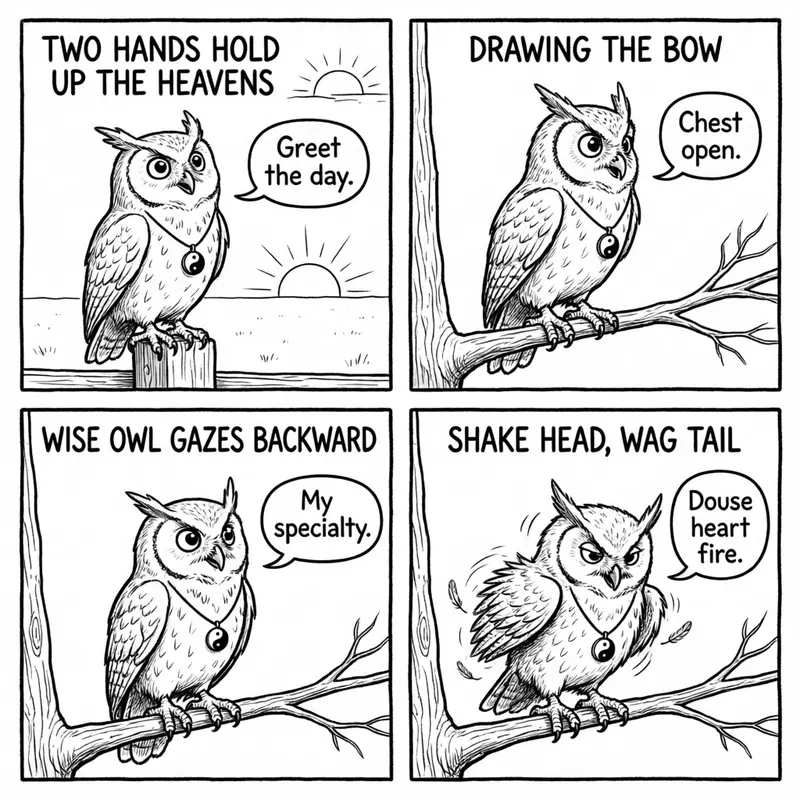
- Two Hands Hold Up the Heavens to Regulate the Triple Burner: The very first movement, a full-body stretch that feels like you're greeting the day.
- Drawing the Bow to Shoot the Eagle: A deep horse stance while mimicking an archer, opening the chest and strengthening the legs.
- Separate Heaven and Earth: A single-arm stretch traditionally linked to the spleen and stomach.
- Wise Owl Gazes Backward to Prevent the Five Strains and Seven Stresses: A slow, deliberate neck turn to release tension. [From his perch in the corner, Ollie's ear tufts perk up.] "Finally," he mutters, "a movement named after someone sensible." He does a slow 270-degree head swivel for emphasis.
- Shake the Head and Wag the Tail to Douse the Heart Fire: A deep squat and sway meant to calm irritability and what TCM calls "Heart Fire."
- Bouncing on the Toes Seven Times to Dispel Disease: A simple, gentle shaking of the whole body to invigorate you at the end of the set.
The full set runs eight movements; the remaining two, "Two Hands Hold the Feet to Strengthen the Kidneys and Waist" and "Clench the Fists and Glare Fiercely to Increase Strength," round it out. The names aren't just for show. They guide your intention, turning a simple physical exercise into a more mindful, deliberate practice.
How Tradition Says It Works: Moving Qi and Calming the Spirit
From a Western medical perspective, the benefits of Baduanjin might be explained by gentle stretching, improved circulation, stress reduction via the parasympathetic nervous system, and the rhythmic nature of deep breathing. Researchers have proposed that each of these factors may contribute to lower blood pressure.
But in the language of Traditional Chinese Medicine (TCM), something else is happening. The practice is designed to move Qi.
Qi (pronounced "chee") is the vital energy or life force that flows through pathways in the body called meridians. When you're stressed, sedentary, or sick, this Qi can become stuck or "stagnant," leading to pain, dysfunction, and emotional imbalance. The slow, flowing, coordinated movements of Baduanjin are believed to unblock stagnation, smooth the flow of Qi, and restore balance to the internal organs. In TCM, high blood pressure is not one condition; practitioners describe several patterns, including Liver Yang rising (often tied to stress), Kidney Yin deficiency, phlegm-dampness, and blood stasis. Baduanjin's calm, Qi-moving character fits most naturally with stress-driven patterns, where stagnation and agitation dominate. Each of the eight movements is also said to target specific meridians and organ systems: "Separating Heaven and Earth" stretches the Spleen and Stomach meridians along the sides of the torso, while "Drawing the Bow" opens the chest and the Lung meridian. The sequence is designed to address the whole body in balance.
The practice also "calms the Shen." The Shen is often translated as "Spirit" or "Mind," and in TCM, it is said to reside in the Heart. A disturbed Shen manifests as anxiety, insomnia, and mental restlessness. In this framework, emotional stress and mental agitation are seen as internal "winds" that agitate the Heart and stir Yang upward. Calming the Shen settles that agitation, allowing Qi and blood to flow smoothly rather than surging upward. By focusing your attention inward and synchronizing breath with movement, Baduanjin helps quiet the mental chatter and soothe the Shen. It's a beautifully simple way to address the mind-body connection that we in the West are just beginning to fully appreciate.
The Honest Truth: Baduanjin vs. Brisk Walking
Baduanjin is not a magic bullet, and it is not a replacement for medicine. The BLESS trial's authors noted that the effect size they saw—that 3-5 mmHg drop in systolic pressure—is in the same ballpark as what you'd get from other lifestyle changes, like brisk walking.
But here's the thing: that is its greatest strength.
According to the World Health Organization, nearly half of the 1.28 billion adults with hypertension worldwide don't even know they have it. For the millions who do, and for the many more in that "high-normal" zone, "get more exercise" is standard advice. But plenty of people hate walking. Maybe it is snowing outside. Maybe your joints ache, the gym costs too much, or you are simply too tired after work.
That's where Baduanjin shines: real trial evidence, zero barriers to entry, and a practice that feels more like self-care than exercise. It's free. It takes 12 minutes. You can do it in your pajamas in your bedroom. It's gentle. It feels good. It's not just another thing on your to-do list; for many, it becomes a cherished ritual. It's not about being better than brisk walking. It's about having another excellent tool in the toolbox.
How to Start (and When to Stop)
Getting started is easy. You can find countless free videos on YouTube. I recommend searching for a standardized version, like the one from the Chinese Health Qigong Association, to ensure you're learning a well-established form. Follow along, don't worry about getting it perfect, and just focus on how it feels.
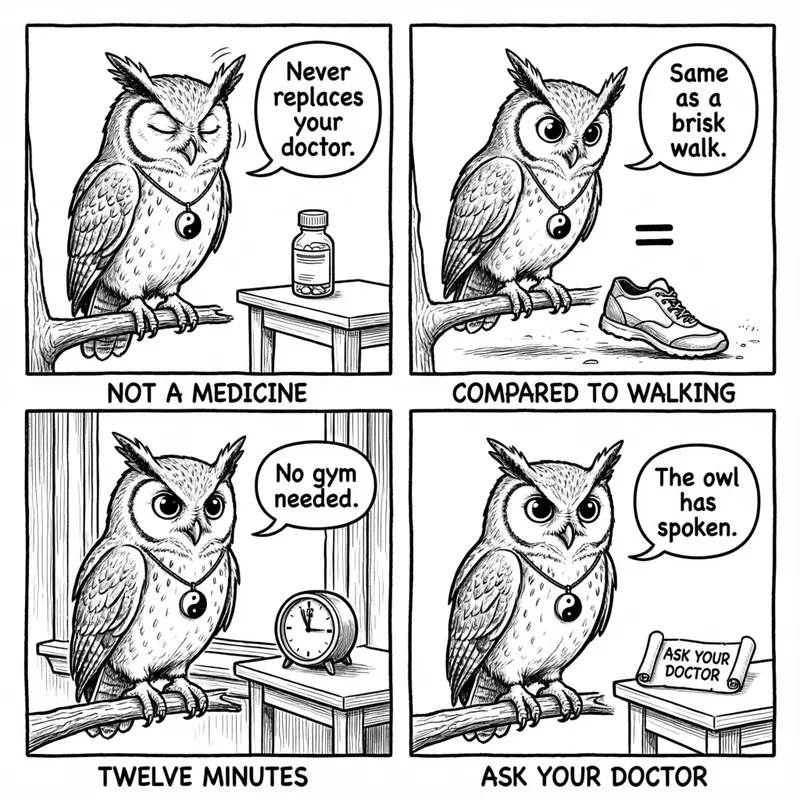
Now for the important part: a safety note. While Baduanjin is very gentle, it's still a physical activity. If you have a heart condition, uncontrolled high blood pressure, joint problems, balance issues, or any other health concern, talk to your doctor first. That goes for any new exercise program, not just this one. And one rule applies to every movement practice: if something hurts, stop.
Baduanjin is not a miracle cure. It's a practice. It's an invitation to spend twelve minutes a day connecting with your body and breath. For an 800-year-old tradition, it feels surprisingly perfect for our modern lives.
Ollie Speaks: Hoo, humans. You finally did a proper study on something we owls have known forever. [Ollie adjusts his pendant with one talon, settling deeper onto his favorite branch.] A good stretch and a calm mind are better than a frantic chase. You call it "Wise Owl Gazes Backward." I call it Tuesday.
You get all tangled up in your own heads, letting your "Heart Fire" burn too hot. [He ruffles his feathers, then smooths them back down with a few quick beak strokes.] Of course your pressure goes up. A bit of quiet focus, a little slow movement... it's just common sense. You don't see owls needing medication for getting too worked up over an email.
This Baduanjin isn't a magic trick to get out of seeing your doctor. Don't be a silly mouse about it. Medication decisions belong to a qualified clinician, not a blog post or an owl. Baduanjin is a tool, like a good, sharp talon. You keep it ready, you use it when you need it, and you don't expect it to do the work of a doctor's prescription. It teaches you to pay attention. And an attentive creature is a healthy creature. Now, if you'll excuse me, I see something moving in the grass. [He adjusts his pendant one more time, eyes locked on the movement below.] Focus is everything.
FAQ
Is Baduanjin just stretching?
No. Stretching is something you do before a run, and that is where most people stop. Baduanjin is a mind-body practice that pairs gentle movement with deliberate breathing and steady attention. The eight forms are flowing rather than static, and in the traditional Chinese framework the aim is not just to lengthen muscle but to keep Qi (vital energy) moving and settle the Shen (the spirit or mind). In practice it feels less like touching your toes and more like a moving meditation that slows the whole nervous system down. That combination is what makes it stick.
How is it different from tai chi?
That's a great question, as they look similar at first glance. The simplest difference is in structure and complexity. Baduanjin is a fixed set of eight distinct, relatively simple exercises that are repeated a certain number of times. It's much shorter—typically 12-15 minutes—and significantly easier to learn, making it a perfect entry point into Qigong. Tai chi (Taijiquan), on the other hand, is a much longer, continuous martial arts form with dozens of complex, interconnected movements. Learning a full tai chi form can take months or even years. Baduanjin gives you many of the same mind-body benefits in a more compact package.
Can Baduanjin replace my blood pressure medication?
Absolutely not. This is the most important question, and the answer is an unambiguous no. The BLESS clinical trial specifically studied people with high-normal blood pressure, not individuals diagnosed with hypertension. If you have been diagnosed with high blood pressure and take medication, decisions about your medication belong with a qualified clinician, not this article. Baduanjin can be an excellent complementary lifestyle practice to support your overall wellness, but it is not a substitute for medical treatment. Whether and how it fits alongside prescribed care is a question for your clinician.
Sources
- Li J, et al. Effect of Baduanjin on Blood Pressure Among Individuals With High-Normal Blood Pressure: A Multicenter, Open-Label, Blinded-Outcome Randomized Controlled Trial. Journal of the American College of Cardiology. 2026;87(12):1436-1449. doi:10.1016/j.jacc.2026.01.014
- American College of Cardiology. BLESS: Ancient Mind-Body Practice Proven to Lower BP. Journal Scan, February 17, 2026. acc.org/latest-in-cardiology/journal-scans/2026/02/17/14/32/bless
- Guan YY, et al. Effects of Baduanjin exercise on essential hypertension: A meta-analysis of randomized controlled trials. Medicine (Baltimore). 2020;99(32):e21577. doi:10.1097/MD.0000000000021577
- World Health Organization. Hypertension. Fact sheet. who.int/news-room/fact-sheets/detail/hypertension