
White Dew: The Morning the Grass Turns Silver
 Ollie's Take
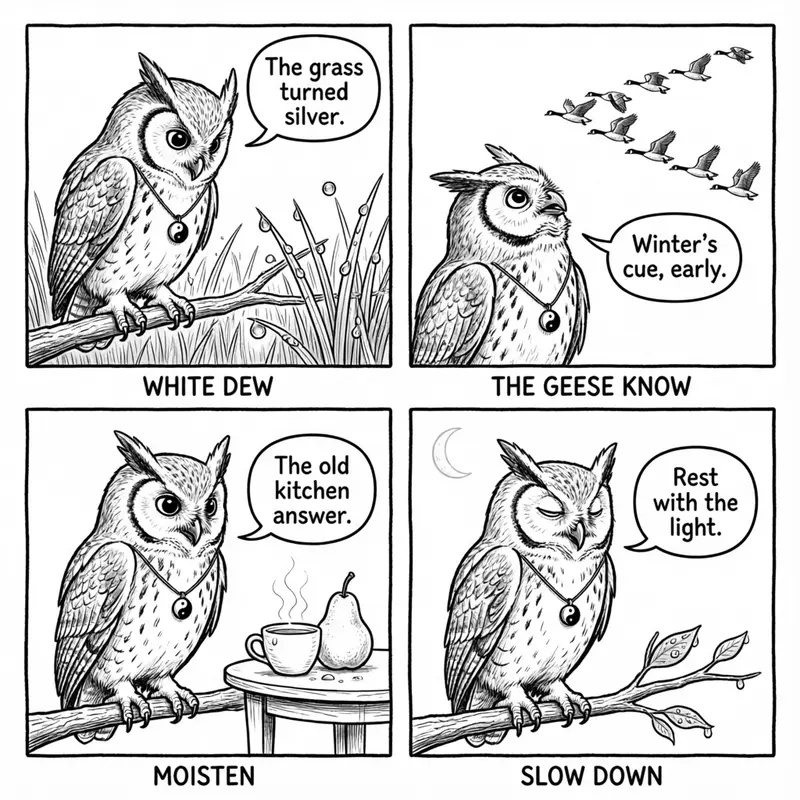
Ollie's take: Hoo-hoo! The grass went silver overnight, and now the geese are flying south. Autumn stopped whispering and started clearing its throat.
Step outside before sunrise in early September and you'll find the grass coated in silver. Not frost—it's too early for that—but dense beads of dew left when cold night air settles over warm soil. By mid-morning, the sun erases every drop. But the world has already changed.
In the traditional Chinese calendar, this morning turning point is called Bai Lu, translated as White Dew. Arriving every year around September 7 or September 8, it is the fifteenth of the twenty-four solar terms (jie qi) and marks the third seasonal chapter of autumn.
Ollie rustles his feathers on a low maple branch, his small jade yin-yang pendant tapping softly against the bark.
"Look closely at the grass before you step out," he says, tilting his round feathered head. "Summer left without saying goodbye, and now the earth is leaving little silver notes."
The Silver Grass and the Three Signs of the Almanac
The name Bai Lu comes from a direct visual observation of nature. As late-summer warmth recedes, overnight temperatures drop fast enough to cause water vapor near the ground to condense on leaves, grass, and rooftop tiles. In the early morning light, before the direct rays of sunrise break through, these scattered water drops catch the gray dawn sky and look milky white or silver.
The ancient Chinese agricultural almanac does not rely on instruments alone to measure the passing year. Instead, it breaks each fifteen-day solar term into three five-day micro-seasons called hou, or pentads. Each pentad records a specific shift in animal behavior or plant growth, creating a practical calendar for farmers and townspeople alike.
During White Dew, the three pentads follow the birds:
First comes hong yan lai, which translates as "wild geese arrive." These large migratory birds leave their northern breeding grounds, traveling southward in disciplined V-formations across the autumn sky.
Second is xuan niao gui, meaning "swallows return south." The swallows that nested under the eaves of family homes all summer long pack up and fly toward warmer southern river valleys.
Third is qun niao yang xiu, or "flocks of birds gather and store food." Smaller forest birds, from finches to woodpeckers, turn their attention to survival, filling their nests and tree hollows with grains, nuts, and dried berries to prepare for the coming cold.
Ollie perches high in an oak tree, one wing tucked against his side as he watches a tidy line of geese pass against the pale clouds. He keeps a protective eye on his own stash of dried seeds tucked into a knot of bark, occasionally swiveling his head to check on it.
To the traditional mindset, these bird movements were not decorative trivia. They were clear, rhythmic instructions from the natural world: the open, scattering energy of summer was over, and the time for gathering, storing, and settling inward had begun. In villages, children used to race outside at dawn to count the geese overhead, while grandmothers tied red thread to windowsills to wish the swallows safe passage south.

From Warm Dryness to Cool Dryness
Autumn does not arrive all at once. In the classical Chinese view of the seasons, the early weeks of the third quarter carry a distinct quality known as wen zao, or warm dryness. During the earlier terms of Beginning of Autumn (Li Qiu) and Limit of Heat (Chu Shu), the air begins to dry out, but the afternoon sun remains fierce. The earth feels parched, yet people still reach for fans and cool drinks because the summer heat has not fully drained away.
White Dew is the moment when that balance shifts. Here, wen zao gives way to liang zao, or cool dryness.
Here's what changes: you peel off a sweater at noon and pull a jacket back on by eight in the evening. At midday the sun can still push past twenty degrees Celsius; before dawn it drops toward ten. The swing in twelve hours is what your skin notices first.
This rapid cooling pulls moisture out of the air and out of everything living in it. Unlike the heavy, damp heat of July that makes shirts stick to backs, cool dryness creates crisp, clear days with deep blue skies and thin air. The wind starts coming from the north and northwest, carrying a brisk bite that whisks away moisture from plant leaves, topsoil, and human breath. For people living in temperate climates, this is often the week when you first smell autumn in the air: a blend of drying leaves, dry earth, and cold morning dew.
The Delicate Organ and the Autumn Air
In classical Chinese medicine philosophy, each season corresponds to a specific organ system and natural element. Autumn belongs to the metal element, which governs the lungs and the large intestine.
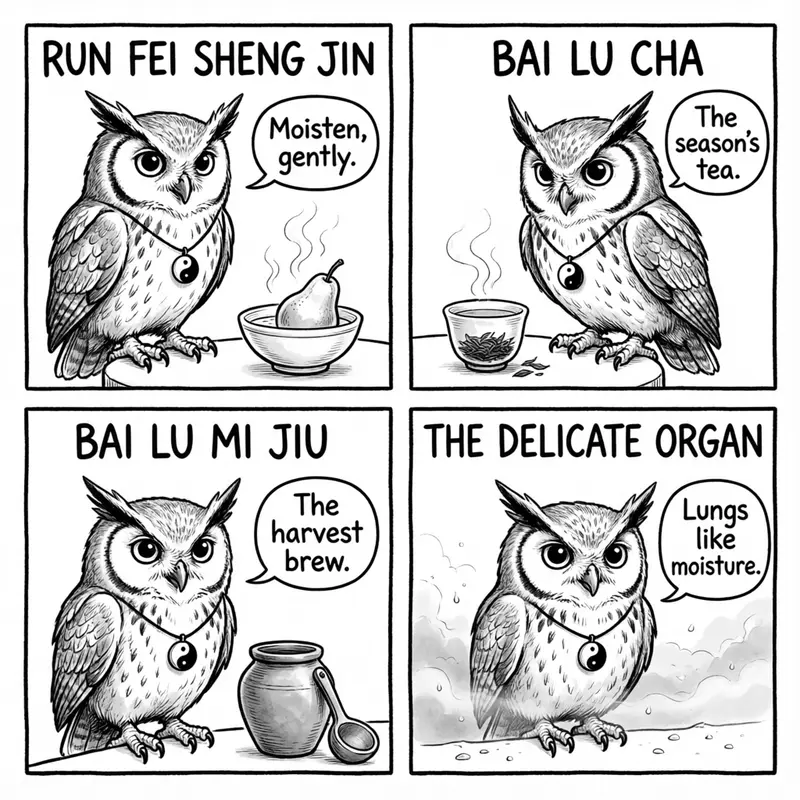
Among all the internal organs, the classics give the lungs a special title: jiao zang, the "delicate organ." The reasoning is simple and anatomical in its traditional logic. Organs like the liver, spleen, and kidneys are housed deep inside the body cavity, insulated from external factors (wai xie). The lungs, by contrast, open directly to the outside environment through the nose and throat — they are the first line of contact with wind, cold, and dryness. Every breath draws the seasonal climate straight into the chest.
The classics observe that the lungs have two primary characteristics: they "love moisture and dislike dryness," and "the lungs govern the skin and body hair" (fei zhu pi mao). The skin is seen as the body's outermost boundary, sharing the job of breathing, sweating, and defending the interior against cold drafts. Both act as the body's outermost barrier, exchanging Qi with the environment and guarding against wind and cold (feng xie).
Because White Dew brings the first sustained wave of cool dryness, the old texts suggest that the lungs are the first to register the change. Traditional culture interprets common early-autumn discomforts through this framework. When the air turns sharp and dry, people frequently notice a scratchy sensation in the back of the throat upon waking. Lips chap, the nasal passages feel tight or tender, and a dry cough with little to no phlegm may show up. The skin on the forearms and shins might look dull, rough, or slightly flaky.
Within this philosophical framework, these are not seen as random complaints, but as natural reflections of the season's drying climate. The external atmosphere is contracting and pulling moisture away, so the delicate upper respiratory system and the skin feel the deficit first.
The Kitchen Logic of Moistening
To balance the drying effect of White Dew, traditional households across China turn to a simple culinary guideline: run fei sheng jin, which means "moisten the lungs and generate bodily fluids (jin ye)."
Rather than relying on excessive cold water, which classical thought views as taxing on the digestive fire of the stomach and spleen, the tradition favors foods that are naturally moist, nourishing, and easily absorbed.
Following five-phase theory, white-colored ingredients are traditionally linked with the metal element and the lungs. The autumn grocery basket fills with foods known for their gentle, fluid-generating qualities. Asian pears take center stage, alongside fresh or dried lily bulbs (bai he), snow fungus (yin er, a translucent ruffled mushroom also called tremella), lotus root, water chestnuts, white sesame seeds, and raw honey.
The classic autumn bowl is a steamed Asian pear: the top cut off, the core scooped out, the hollow filled with soaked snow fungus, a couple of dried lily bulbs, and a spoonful of rock sugar, then steamed until the flesh turns translucent. It is not spoken of as medicine — just a gentle kitchen ritual that appears with the first crisp mornings.
Alongside adding moistening foods, the old kitchen logic suggests reducing ingredients that are strongly pungent or spicy. Fiery chili peppers, raw onions, garlic, and heavy black pepper are classified as dispersing in nature. Because their heat drives sweat to the surface and scatters bodily fluids outward, the tradition advises eating them sparingly during White Dew, saving the body's moisture for the colder months ahead. Ollie tilts his head from a nearby windowsill, one ear tuft raised. "If you ask me, a bowl of steamed pear is a lot more appealing than another plate of spicy noodles when your throat already feels like sandpaper."
White Dew Tea, Sweet Wine, and Morning Drops
The arrival of White Dew has long inspired small cultural rituals focused on flavor, harvest, and the changing light.
One of the most famous traditions is the picking and brewing of White Dew tea (Bai Lu cha). Tea enthusiasts in China divide the harvest year into distinct seasons. Spring tea is prized for its pale, grassy tenderness, while summer tea is often sharp, bitter, and astringent due to rapid growth under scorching sun and heavy rain. But tea bushes harvested around White Dew have lived through the heat and are now slowed down by cool nights. The leaves grow thicker and hold more sweet compounds. Brewed with hot water, White Dew tea produces a deep golden infusion with a smooth, sweet, and mellow taste that coats the throat without the biting edge of younger harvests.
In the fertile river country of Jiangsu and Zhejiang provinces, rural households celebrate this time by making White Dew rice wine (Bai Lu mi jiu). Families take newly harvested glutinous rice, clean well water, and traditional fermentation starter to brew a cloudy, sweet, low-alcohol wine. The drink has a rich, slightly tart rice flavor and is often served warm during evening gatherings. Historically, the first fresh batch was poured as an offering to Yu the Great, the legendary hero-king of ancient China who regulated the country's great rivers and protected the plains from catastrophic floods. By sharing the wine, communities honored the water that had nourished their summer crops.
Older folklore also speaks of gathering morning dew (cai lu). Classical texts from the Ming dynasty describe scholars and household elders walking out into gardens at sunrise with small porcelain spoons, collecting dew drops from lotus pads, chrysanthemum petals, and sweet osmanthus blossoms. Modern readers might see this as pure folklore, the tradition held that dew collected on this exact morning carried the pure, settled Qi of autumn, making it the finest water for brewing rare tea or washing tired eyes.
Daily Rhythms as the Light Shortens
Beyond food and drink, White Dew calls for small, thoughtful adjustments to daily habits.
The classic text Huangdi Neijing (The Yellow Emperor's Inner Canon) outlines the general seasonal rule for autumn in four words: zao wo zao qi, meaning "go to bed early and wake up early."
Retiring to bed earlier honors the shrinking daylight and allows the body to conserve warmth and energy as nighttime temperatures sink. Rising with the dawn sun allows you to fill the lungs with fresh morning air before the wind stirs up dust, keeping the mind clear and attentive.
Traditional proverbs also offer very practical clothing advice: "Do not expose your skin at White Dew, or cold will settle into your joints." While people often cling to summer shorts and short sleeves during sunny afternoons, the sudden temperature drop at dusk can catch the body unprepared. The tradition places special emphasis on covering the back of the neck, the upper chest, and the ankles, areas where cool drafts are thought to penetrate most easily. A light cardigan or a thin scarf tucked into a bag makes the transition between warm sunlight and chilly shade manageable.
Physical activity also shifts in style. In traditional seasonal theory, White Dew is not the time for exhausting, sweat-drenching exertion. The old preference leans toward calm, steady movement: a brisk walk along tree-lined paths, slow tai chi postures, or gentle stretching to keep the muscles supple without straining the breath.
Ollie perches upright on his branch, his jade pendant catching a gleam of morning sun as he preens a feather on his wing.
Ollie Speaks: "Honestly, migrating thousands of kilometers like those geese sounds exhausting. I'm with the finches on this one—stay put and stash snacks.
"I spent last night watching the dew form on these leaves, one tiny bead at a time. Took hours. And you humans? You're still figuring out it's autumn three days after the grass turns silver, wondering why your throat's scratchy and your nose feels tight.
"Here's the thing: nobody fights the seasons and wins. When the air gets sharp, people layer up. When a throat turns dry, the old answer is a pot of simmered pears. When the daylight shrinks, people go to bed earlier. Not complicated. Just notice what's happening and adjust. My pendant's been clinking against bark all week because the night wind's picked up. That's your cue."
Traditionally, White Dew was a time to slow down, add a layer against the brisk dawn, and turn the kitchen toward warm, moistening foods. This article is shared for cultural education and seasonal appreciation, not medical guidance; whether any specific dietary shift fits your personal health situation is always a question for a qualified professional.
FAQ
What is White Dew, and when does it happen?
White Dew, or Bai Lu, is the fifteenth of the twenty-four traditional Chinese solar terms. It falls each year between September 7 and September 9, in the middle of autumn. The name refers to the tiny droplets of water that condense on leaves and grass blades during the chilly nights and glisten white in the early morning sun. Culturally, this period marks the moment summer heat finally gives way to crisp autumn air, prompting people to adjust their sleep, dress, and daily diet to match the cooling natural world around them.
What does "cool dryness" mean compared to the dryness of early autumn?
In classical Chinese seasonal theory, autumn dryness is split into two distinct phases. Early autumn brings warm dryness, where parching air combines with leftover summer heat. Around White Dew, this climate shifts into cool dryness as nighttime temperatures plummet and northern winds pick up strength. Cool dry air draws moisture out of the throat, nose, and skin much faster than warm air does. The tradition observes this environmental change closely, encouraging people to bundle up against morning drafts and choose hydrating, slow-cooked foods that help maintain bodily comfort through the crisper months.
What do people traditionally eat at this time of year, and why?
Traditional diets during White Dew favor moist, mild foods, especially white ingredients: Asian pears, lily bulb, snow fungus, lotus root, sesame seeds, and honey. A classic home dish is a warm soup of steamed pear and tremella fungus, made by hollowing out a pear, filling it with fungus and rock sugar, and steaming until translucent. Households also ease off spicy seasonings like garlic and chili, since the tradition reads pungent flavors as dispersing and pulling away moisture the body is said to store for winter.