
The Cracks, the Coating, the Color: Reading the Tongue Like a Practitioner
 Ollie's Take
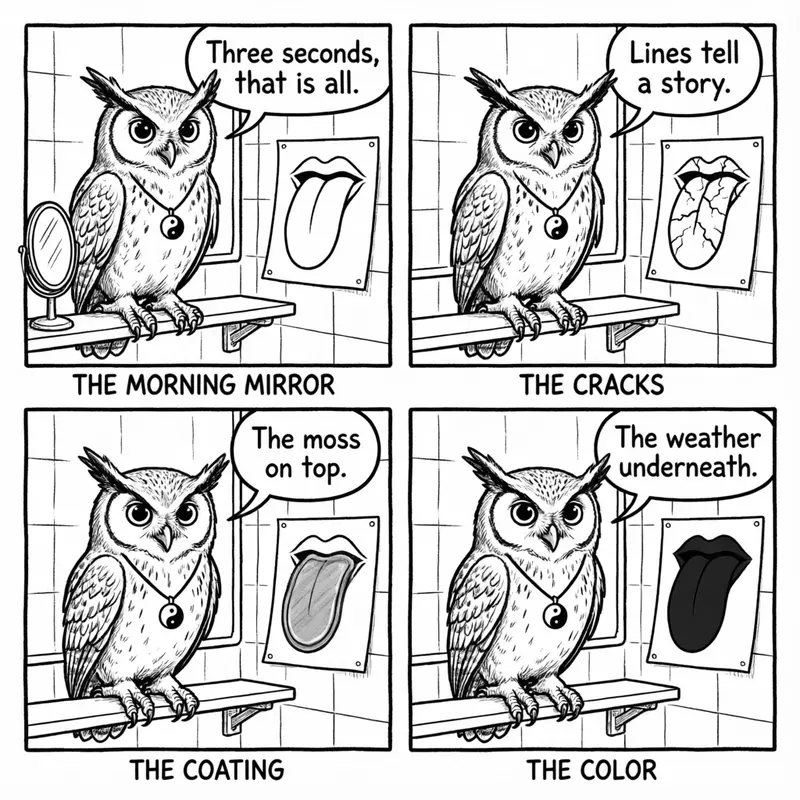
Ollie's take: Hoo-hoo! Stick your tongue out, look, and don't panic. The mirror is a weather report, not a verdict.
You walk into the bathroom, flick on the light, and stick your tongue out in the mirror. In Chinese medicine, that tongue is read like an open weather report of the internal organs.
Ollie, our resident screech owl, usually sits on the edge of the towel rack during morning routines. He gave a quiet clack of his beak this morning, shifted his weight on one talon, and blinked at the mirror. To a bird, watching a human stick out a large pink muscle at their own reflection looks pretty ridiculous.
If you read our earlier introduction to tongue signs, you already know the basics: an acupuncturist or herbalist looks at shape, color, coating, and moisture. This time, we are skipping the general survey and going straight into the three details that tell the most together: the cracks in the surface, the coating on top, and the color of the body underneath. In classical thought, these three elements show how fluids move, where warmth or chill gathers, and what your constitutional baseline looks like over time.
The Cracks
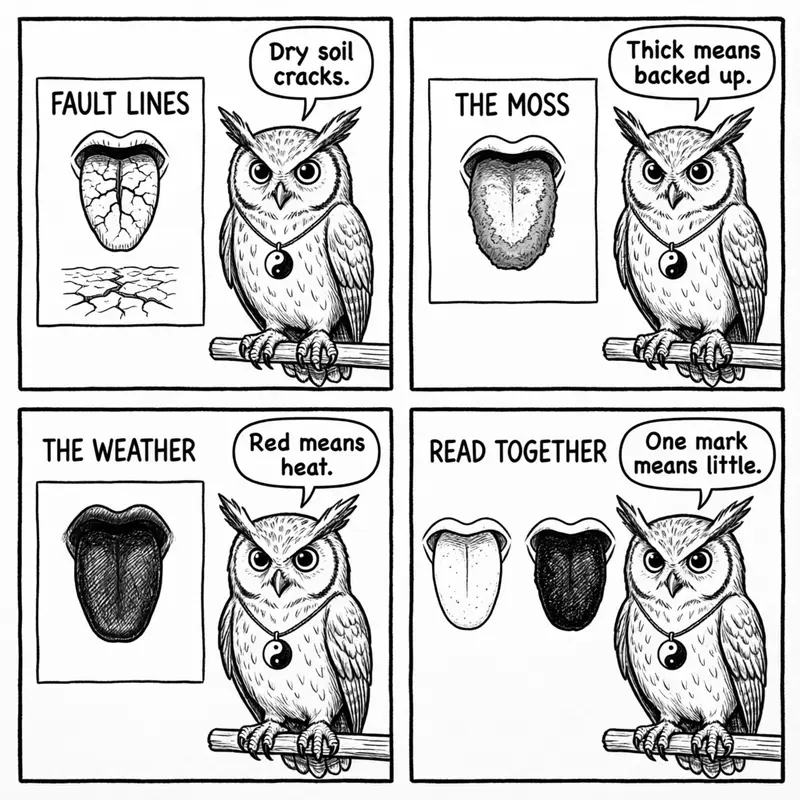
When you look closely at the tongue surface, you might see smooth tissue, or you might see lines that look like dry riverbeds. In the Chinese medical tradition, cracks are viewed as maps of moisture, heat, and constitutional strength.
Practitioners first separate cracks into two broad groups: congenital and acquired. Congenital cracks are lines you were born with. They tend to stay stable year after year, and the tradition interprets them as part of your natural constitution rather than a sign of developing trouble. If you have had deep grooves across your tongue since childhood and feel energetic and healthy, those lines simply reflect the unique blueprint you started with.
Acquired cracks are different. These develop slowly over months or years, or deepen during periods of intense stress, lack of sleep, or long illnesses. In classical theory, the tongue body depends on a constant supply of fluids and Yin to stay soft, supple, and smooth. When chronic internal heat scorches those fluids, or when the body simply runs low on moisture, the tissue loses its plumpness and begins to crack, much like fertile soil drying out during a summer drought.
The location of these cracks gives traditional practitioners clues about where fluids are running low:
A horizontal crack running across the middle third of the tongue corresponds to the digestive zone, linked to the Spleen and Stomach. In the classical view, this suggests the digestive system is having trouble producing or holding onto fluids, often showing up in people who skip meals, eat on the run, or deal with chronic bloating.
A deep central groove running down the midline points toward the Stomach and Heart regions. When this line extends all the way toward the tip, classical texts often associate it with emotional strain, persistent worry, or chronic mental overwork that has started to drain the body's deeper reserves.
Fine, scattered cracks spread out across the entire surface look like a network of tiny spiderwebs. The tradition reads this as a widespread depletion of Yin and fluids throughout the whole system, common in older adults or people recovering from long, dehydrating illnesses.
Remember: these lines are topographical markers in a symbolic map, not physical damage to organs.
The Coating
Sitting on top of the tongue is the coating, known in Chinese as tai. If the tongue body represents the foundation of the house, the coating represents the daily activity happening inside the kitchen.
In classical theory, a healthy coating is thin, white, and slightly moist. It is described as having roots, meaning it grows naturally out of the tongue tissue like grass from healthy soil, rather than sitting on top like spilled paint. This thin white film shows that the Stomach is breaking down food properly and sending clean moisture upward.
When internal balance shifts, the coating changes thickness, texture, and color.
A thick coating signals accumulation. When the digestive system becomes sluggish, or when rich, greasy foods overwhelm the stomach, moisture gets stuck and turns into what the tradition calls dampness, phlegm, or food stagnation. The thicker the moss gets, the more clogged the system is considered to be.
The opposite problem is a peeled or absent coating, sometimes called a mirror tongue. When the coating disappears completely, leaving behind a smooth, shiny red or pink surface, classical practitioners read it as the exhaustion of Stomach Yin. The digestive fire has burned away its own protective fluids, leaving no moisture behind to generate a normal coating.
Color changes in the coating reflect internal temperature:
A white coating is the baseline, associated with neutral conditions or internal cold.
A yellow coating points to internal heat. A pale, light yellow coating suggests mild heat beginning to gather, while a thick, deep mustard-yellow coating indicates strong, established heat, often linked to sluggish digestion or heavy, rich meals.
Texture tells another layer of the story:
A greasy or slippery coating feels slick and oily, pointing to heavy dampness or phlegm that is slow to clear.
A dry, rough coating feels like sandpaper, suggesting that internal heat has scorched away the surface moisture.
You might also notice patches where the coating peels away in irregular sections, looking like continents on a globe. Modern medicine calls this geographic tongue, a harmless and very common condition that comes and goes on its own. In the Eastern tradition, this patchy look is read as digestive Yin thinning out in specific zones, often shifting when you are fatigued, stressed, or eating irregularly.
The Color
Underneath the coating lies the tongue body itself. While the coating can change quickly over a few days based on what you eat or how you sleep, the color of the tongue body changes much more slowly. It reflects the deep, long-term state of your Qi, blood, and internal temperature.
A pale tongue body looks washed out, ranging from light pink to nearly white. The tradition divides pale tongues into two distinct patterns:
Blood deficiency shows up as a tongue that is pale, thin, and slightly dry, with a scanty coating. The body simply lacks the rich nourishment needed to fill the tissue with color.
Yang deficiency and internal cold show up as a pale tongue that is wet, puffy, and swollen. Because there is not enough metabolic warmth to move fluids, water collects in the tongue, causing it to press against the teeth and leave distinct scalloped teeth marks along the edges.
A red tongue body signals the presence of internal heat. The specific location of the redness gives classical practitioners a window into where that heat is concentrated:
A bright red tip points toward the Heart, often showing up in people dealing with insomnia, busy minds, or emotional restlessness. Ollie tapped his little jade yin-yang pendant against the shelf when we talked about red tips, reminding us that emotional stress often shows up right at the front edge of the tongue.
Bright red edges or sides point toward the Liver and Gallbladder zones, classically linked to built-up frustration, long work hours, or suppressed stress.
A deep crimson color, darker than ordinary red, shows that heat has moved into the deeper layers of the body. During the Qing dynasty, the Warm Disease school developed a four-level framework to track acute fevers as they traveled from the defensive exterior (wei), into the interior Qi level, and down into the nutritive (ying) and blood (xue) layers. A dark crimson tongue indicates heat reaching those deepest levels.
The tradition also makes a clear distinction between deficiency heat and excess heat. Deficiency heat appears on a thin, dry, crimson tongue with little or no coating, like a small campfire burning out of control because the water bucket is empty. Excess heat appears on a full, swollen, bright red tongue covered in a thick yellow coating, like an overfed bonfire blazing with too much wood.
A purple or blue-purple tongue points to blood stasis, meaning circulation has slowed down. A reddish-purple tongue suggests that heat has thickened body fluids and made the blood sluggish, while a bluish-purple or dusky pale tongue indicates that internal cold has constricted the blood vessels and slowed circulation down to a crawl.
Reading Them Together
A single feature never tells the whole story — a mechanic does not judge an engine by one squeak. The art of classical observation comes from reading cracks, coating, and color together as a unified pattern.
Here is how the tradition reads three classic combinations:
In a cold-deficiency pattern, you see a pale, puffy tongue body with a thin, wet white coating and scalloped edges. The pale color and excess moisture show that internal warmth is too low to transform fluids, while the lack of redness confirms an absence of heat.
In a damp-heat pattern, you see a red tongue body covered by a thick, greasy yellow coating. The red body signals active internal heat, while the heavy yellow moss reveals that moisture and metabolic waste have built up together into a hot, sticky accumulation.
In a fluid-depleted heat pattern, you see a deep crimson tongue body with deep central cracks and no coating at all. The crimson color and cracked surface show intense internal heat drying out the tissue, while the missing coating confirms that the body's protective Yin fluids are running dangerously low.
When you look at all three elements at once, the tongue stops being a random collection of marks. It becomes a coherent picture of how warmth, moisture, and vitality are flowing through your system.
How to Look (and What Not to Do)
A few guidelines keep your self-observation from going wrong.
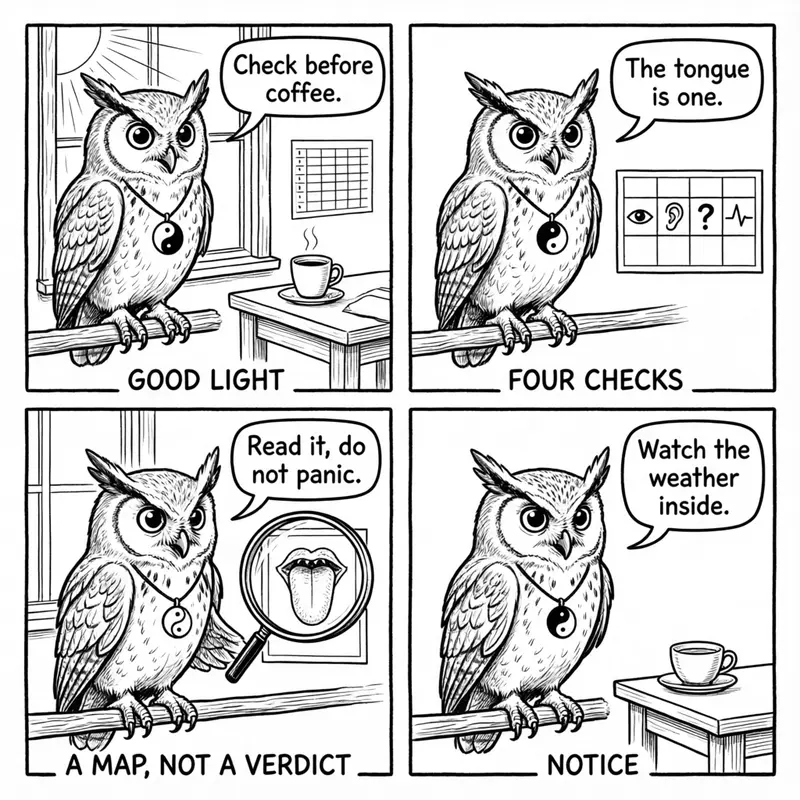
First, always check your tongue in natural indirect daylight, ideally near a window. Yellow bathroom lightbulbs and harsh fluorescent tubes completely alter the color of both the tongue body and the coating, making a normal tongue look falsely pale, yellow, or grey.
Second, check your tongue first thing in the morning, before you eat breakfast, drink coffee, brush your teeth, or scrape your tongue. Coffee, tea, candy, berries, and spicy curries can stain the coating for hours. Brushing or scraping scrapes away the very evidence you are trying to observe.
Third, relax your mouth. Stick your tongue out gently for three to five seconds at a time. If you strain, flex the muscle, or hold it out for too long, blood will pool in the tip and edges, turning a normal pink tongue an artificial red or purple.
Finally, keep everyday chemical factors in mind. Antibiotics can cause the coating to peel or turn dark, iron supplements and bismuth stomach medications can turn the coating black, and alcohol or antihistamines can dry out the surface within hours.
The Honest Limits of the Mirror
Tongue observation is a wonderful tool for building self-awareness, but it is not a standalone crystal ball. In traditional Chinese medicine, looking at the tongue is only one quarter of the Four Examinations: Looking (Wang), Listening and Smelling (Wen), Inquiring (Wen), and Feeling the Pulse (Qie). A skilled practitioner never creates a wellness strategy based purely on what the tongue looks like without listening to your history and checking your pulse.
Modern conventional medicine also examines the tongue, looking for specific clinical signs such as vitamin B12 deficiencies, oral thrush, bacterial infections, or structural lesions.
Sores that do not heal, painful lumps, thick white patches that cannot be wiped away, or persistent bleeding are not subtle energetic patterns to ponder over tea. Those signs belong with a qualified professional, not a mirror. Classical tongue reading is meant to help you understand your lifestyle rhythms, hydration, and digestion, not to replace qualified clinical care.
Taking a mindful look at your tongue in the morning mirror is simply an invitation to listen to your body, notice how your rest and diet are serving you, and make gentle adjustments to stay balanced.
Ollie Speaks: Look, I am a screech owl. My tongue is a tiny grey triangle, and I mostly use it to swallow mice whole. But watching you humans contort your faces in front of the glass every morning has become my favorite hobby. You wake up, pull your lips back, stick out this giant pink sponge, and squint like you are reading tea leaves. Sometimes you see a little yellow fuzz and panic, and other times you get overly excited about a shiny patch. From where I sit—perched on one foot on the shower curtain rod, tapping my jade yin-yang pendant against the metal—it seems pretty simple. Your body leaves notes on your tongue the way the forest leaves tracks in the dirt. You do not need to freak out over every footprint. Just notice the weather inside, put the kettle on, and drink some water.
FAQ
Do cracks in my tongue mean something is wrong?
Not necessarily. In Chinese medicine, cracks are viewed as signs of fluid balance and constitutional strength rather than physical damage or illness. Many people are born with natural fissures that stay the same throughout their entire lives, which the tradition simply views as an inherited trait. Acquired cracks that develop over time often reflect long-term dryness, heat, or depleted Yin fluids, particularly within the digestive system. In modern medicine, fissured tongues are common and harmless. Cracks that come with persistent pain or burning are a conversation for a qualified professional.
What does a yellow coating mean in the tradition?
In classical thought, a yellow tongue coating points toward internal heat. The tongue naturally carries a thin, white, translucent layer formed by healthy digestive activity. When heat builds in the stomach, liver, or lungs, that coating shifts in color from pale yellow to a deep mustard hue. A light, thin yellow film suggests mild, early heat, while a thick, greasy yellow moss indicates damp-heat, often linked to sluggish digestion and rich, heavy foods. Before jumping to conclusions, always remember that morning coffee, dark tea, mustard, and curry can easily tint a normal white coating yellow for several hours!
Can tongue reading diagnose anything on its own?
No. Tongue observation in traditional Chinese medicine is never a standalone diagnostic tool. Classical practitioners view the tongue as just one piece of the Four Examinations, which also include listening to your voice, asking detailed questions about your daily habits, and feeling your pulse. While observing your tongue in the morning is a wonderful way to track your hydration, digestive rhythms, and stress levels, it cannot replace professional clinical evaluations. If you notice persistent sores, bleeding, painful lumps, or sudden unexplained changes, you should always consult a licensed healthcare provider or dentist.
Sources
- Maciocia, Giovanni. Tongue Diagnosis in Chinese Medicine. Eastland Press, 1995.
- Kirschbaum, Barbara. Atlas of Chinese Tongue Diagnosis. Eastland Press, 2000.
- Kaptchuk, Ted J. The Web That Has No Weaver: Understanding Chinese Medicine. McGraw-Hill, 2000.
- Deng, Tietao. Practical Diagnosis in Traditional Chinese Medicine. Churchill Livingstone, 2003.