
Overthinking Is a Spleen Problem
 Ollie's Take
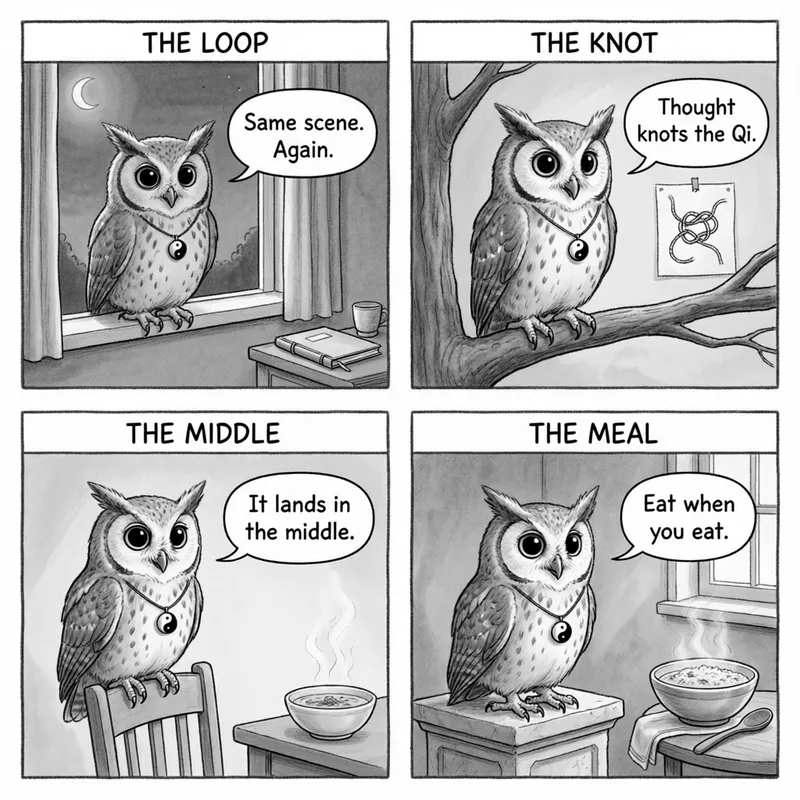
Ollie's take: The loop loves midnight; the middle prefers dinner.
The Meeting That Never Ends
It is two in the morning on a Tuesday, and a conversation from ten hours ago is running for the ninth time behind your eyelids. You are rewriting a sentence from two in the afternoon, imagining the three ways your manager might have heard it. Under the blanket, your belly sits tight and hard, like a clenched fist. Dinner was finished hours ago, but your middle feels full, motionless, and heavy.
In the Chinese medical tradition, this midnight state is neither bad luck nor personal weakness. It is a recognizable pattern with a location in the body, where mental looping and digestive stalling meet.
In this framework, unfinished thinking does not stay in the head; it settles in the middle of the body.
Your Spleen Is Not Your Spleen
Reading Chinese medical texts requires bypassing a major naming trap. When modern medicine says "spleen," it refers to a distinct fist-sized organ resting in the upper left abdomen behind the stomach. Its tasks are vascular and immunological: it filters aged red blood cells, recycles iron, and houses white blood cells that fight infection.
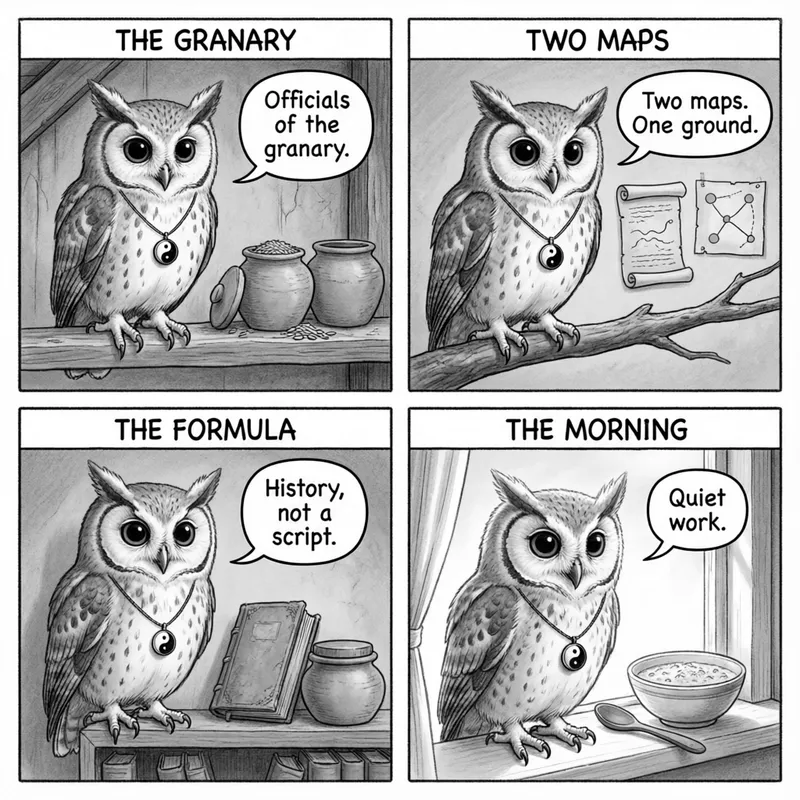
The traditional Chinese medicine (TCM) Spleen is different. In the classical framework, organ names describe networks of physiological function. In TCM terms, the Spleen handles transformation and transportation: receiving food and drink, producing Qi and blood, distributing nourishment to the limbs, and keeping fluids moving upward. In chapter 8 of the Suwen, the text describes the Stomach and Spleen as the official granaries from which the five flavors emerge. This mismatch creates two misunderstandings: skeptical readers picture a blood filter and dismiss the system, while others hear that worry affects the Spleen and panic about organ failure. One map describes cellular histology; the other describes functional patterns in a living body.
Si Ze Qi Jie: Thought Knots the Qi
The core classical description of overthinking appears in chapter 39 of the Suwen, in the nine Qi discourse (Ju Tong Lun). The chapter explains how internal states disrupt natural movement, including si ze qi jie, meaning "thought knots the Qi."
The text gives a concise explanation: when thought fixes on a single object, the spirit settles onto it, and the proper Qi stays put instead of circulating. In this system, Qi names function in motion. When the body's ordinary movements proceed without obstruction, the tradition says Qi flows freely.
The image of a knot is a useful one: nothing is necessarily damaged, but normal movement becomes restricted. When string knots, the material is intact; its geometry stops moving smoothly along its length.
The tradition describes this pattern in functional terms: a long season of study or worry can bring a tight abdomen, a stalled appetite, and cold hands. When attention remains glued to an unresolved problem, the natural downward momentum of the body slows to a crawl.
Si Shang Pi: Why Worry Lands in the Middle
The connection between mental fixation and physical digestion goes deeper in chapter 5 of the Suwen (Yin Yang Ying Xiang Da Lun). The text pairs five emotional habits with internal systems: anger matches the Liver, joy matches the Heart, grief matches the Lungs, fear matches the Kidneys, and pensiveness matches the Spleen. The text summarizes the middle pairing as si shang pi, meaning pensiveness injures the Spleen.
The tradition draws a sharp line between clear thinking and circular dwelling. The problem is never the act of thinking; it is the loop that refuses to close. When a problem cannot be resolved immediately, the habit is to chew on it continuously.
In chapter 8 of the Lingshu (Ben Shen), the text defines the yi as what the heart remembers, and associates the Spleen with the ying that houses it. In the classical model, focused thought, memory, and brooding all belong to the Spleen's sphere, alongside digestion.
Digestion is quiet work requiring blood flow and calm. Rumination is demanding. When you turn over a difficult conversation for hours, the middle of the body loses its rhythm because the mental loop has taken over the kitchen.
Ollie gives a quiet hoot from the mantelpiece, his ear tufts flicking forward as we scatter notes across the table. Staring at a blank wall never caught a field mouse; it only tires the neck. He shifts his weight on the high shelf, the jade pendant swaying against his bare chest.
The Shape of an Overworked Middle
When mental looping continues for weeks, the classical tradition watches for a predictable physical cluster. Appetite fades around midday or disappears near a deadline. Lunch eaten while answering messages brings upper-abdominal bloating twenty minutes later. Bowel movements become unpredictable on the morning of a major presentation.
People caught in this pattern describe a heavy tiredness that extra sleep does not fix. A practitioner might also note a soft, thin pulse and a tongue with teeth marks along its edges.
A practitioner reading this cluster weighs several possibilities: Spleen Qi deficiency; a combined Heart-Spleen pattern, where prolonged worry wears down both digestive vitality and sleep until dreams turn vivid and memory frays; or Liver Qi stagnation pressing on the Spleen. The shapes overlap, and telling them apart is a practitioner's job.
Pattern language describes the shape symptoms make across bodily systems, giving a vocabulary for when the mind has overdrawn the body's digestive account.
What the Gut-Brain Conversation Sees
Modern gastroenterology and neurobiology describe this exact intersection using different instruments. The gastrointestinal tract contains its own complex neural network embedded within its walls: the enteric nervous system. As documented by neurogastroenterologist J. B. Furness, this system contains between 200 million and 600 million neurons.
When stress signals dominate, gut motility, acid secretion, and blood flow change within seconds. In a comprehensive review published in Nature Reviews Gastroenterology & Hepatology, L. Van Oudenhove and Q. Aziz established that psychosocial factors and psychiatric disorders, particularly anxiety and depressive states, play an intrinsic role in functional dyspepsia. Anxiety can impair gastric accommodation, the stomach wall's ability to relax and receive a meal.
A 2022 systematic review by Z. Wei and colleagues, analyzing 14 randomized controlled trials with 1,434 participants, concluded that psychological interventions may reduce dyspeptic symptoms and improve psychological scores, with the clearest effects in structured psychotherapy.
The perseverative cognition hypothesis, outlined by J. F. Brosschot, W. Gerin, and J. F. Thayer, shows that worry, rumination, and anticipatory dread prolong the body's stress responses long after the trigger has ended.
It is tempting to equate the TCM Spleen with the enteric nervous system, but the equation fails on a week of reading. One is an observational map grouping functional patterns; the other is a mechanistic map built on cellular anatomy and chemical signaling. Both maps, drawn for different purposes, keep pointing at the same patch of ground: circular thinking and stalled digestion travel together.
The Lunch That Reports to a Spreadsheet
Consider the modern working lunch. You open a container with one hand while scrolling a project board with the other. You chew fast, type mid-bite, and skim emails about quarterly targets. Twelve minutes later, the food is gone, your jaw is tight, and you have no clear sensory memory of what you ate.
Researchers have measured part of what the habit costs. A meta-analysis led by E. Robinson in the American Journal of Clinical Nutrition found that distraction during eating moderately increased immediate intake and raised later snacking, because the brain missed the sensory satiety signals of the meal.
The old advice is four words long: eat when you eat. One common way people keep it: a single meal a day gets full attention, phone in another room, no documents competing for the table. Slowing the start of a meal is the part most people can feel.
The Worry Window and Three Other Small Knots
You cannot turn off an overactive mind through willpower alone. Ollie ruffles his wing feathers and swivels his head half-around. Some thoughts need examining from another angle. Glaring at a dark branch will not bring a field mouse to your perch; a busy mind needs somewhere to put its worries, not another lecture about calming down.
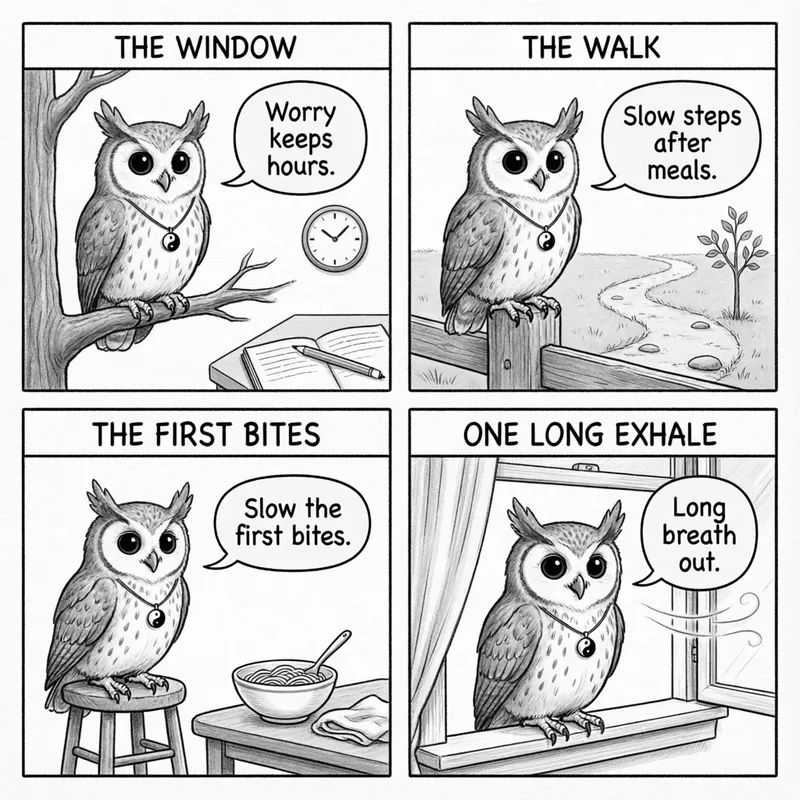
- The Worry Window: a fifteen-minute appointment with a notebook, where looping concerns get written down in plain words. When a worry pops up earlier, it has a confirmed seat at four o'clock.
- The After-Meal Walk: a slow ten-minute stroll, no pace tracking, no calorie math. The tradition reads gentle upright movement as helping Qi descend after a meal.
- The First Few Bites: the start of a meal kept quiet, each bite chewed before the next. An unhurried start tends to set the pace for everything after it.
- One Longer Exhale: five slow breaths before a meal or bed, four counts in and six counts out. A long, quiet exhale is one of the body's simplest downshifts.
You will not out-think a habit of overthinking; a daily structure tells the body the shift has ended.
The Formula Named "Return the Spleen"
Among the classical formulas, the one most tied to this complaint is Gui Pi Tang, meaning "Return the Spleen Decoction."
First recorded in 1253 by Yan Yonghe in the Ji Sheng Fang, the formula was recorded for overthinking that taxes the heart and spleen, with forgetfulness and heart palpitations. During the Ming dynasty, physician Xue Ji added danggui (Chinese angelica root) and yuanzhi (polygala root) to nourish blood and calm the spirit.
This is history, not a prescription. Herbal formulas can interact with medications and are not appropriate in pregnancy without professional guidance. In contemporary practice, formulas are individualized according to pattern differentiation rather than taken as generic remedies off a shelf. Gui Pi Tang is proof of one thing: physicians have worried about the overworked middle for centuries.
When It Is Something Else
Some digestive symptoms sit beyond the scope of a lifestyle article and raise questions that call for qualified medical advice:
- Unexplained, unintentional weight loss
- Blood in your stool or vomit, bright red or black and tarry
- Difficulty swallowing food or liquids, or persistent pain during swallowing
- Continuous vomiting that prevents normal fluid retention
- Severe abdominal pain that wakes you at night
Mental health draws the same line. When anxiety or depressive episodes impair daily life, that territory belongs with licensed therapists and clinicians, and traditional practitioners have always been quick to refer people onward.
Dinner, Unattended
The kitchen is quiet at seven in the evening. A pot of millet congee simmers over low heat, steam rising toward the vent as you hold a wooden spoon.
The difficult meeting scheduled for tomorrow still waits on your calendar, but the office doors are closed for the evening. The conversation does not belong over the stove, and your belly no longer takes notes.
You carry a bowl to the table and sit without a screen. Taking the first slow bite, you let your middle do its quiet work.
I learned young that replaying a missed mouse at midnight will not fill your crop. You just end up groggy at dawn when the voles are moving.
The jade pendant warms against my bare chest. Mountain air cuts cold past midnight, so I fluff my ruff feathers, tuck my wings, and let the breeze slide past.
Quiet hunting is how an owl notices the faint rustle beneath the brush. Give your dinner that same stillness, and your mind will stop chasing shadows it cannot catch.
FAQ
Does stress or overthinking damage the spleen?
In modern medicine, stress does not cause physical tissue lesions in the anatomical spleen, which filters blood and supports immune defenses. In Chinese medicine, the Spleen represents a functional network governing digestion, nutrient distribution, and Qi production. Research suggests that chronic worry and mental looping may influence autonomic signaling, which can affect stomach relaxation and gut movement. While emotional strain leaves the physical lymphatic organ unharmed, it directly disrupts the digestive functions that traditional texts assign to the Spleen network, creating bloating, fatigue, and poor appetite after demanding days.
What is the single easiest habit to start with?
The single easiest habit to build is eating the first five bites of every meal in complete silence and without distraction. Chewing those initial bites slowly while focusing on the taste can set a slower pace for the rest of the meal. The pause is also a chance to notice the food before the meal runs on autopilot. The practice requires no extra time, demands no special equipment, and interrupts the habit of consuming food while answering messages during a busy afternoon at your desk.
Do I need herbs or acupuncture, or can habits alone help?
Small daily habits may take some pressure off the everyday digestive tension that comes with mild stress and busy schedules. A worry window, brief walks after lunch, and screens-off dinners are traditional ways of keeping a steadier rhythm over time. If symptoms persist, a medical evaluation comes first. For herbal medicine or acupuncture, work with a licensed acupuncturist or a qualified practitioner who can review your medications, pregnancy status, and health history. A proper assessment matches any support to your whole picture rather than a single symptom.
Sources
- Huangdi Neijing, Suwen — chapter 5 (Yin Yang Ying Xiang Da Lun), chapter 8 (Ling Lan Mi Dian Lun), chapter 39 (Ju Tong Lun).
- Huangdi Neijing, Lingshu — chapter 8 (Ben Shen).
- Ji Sheng Fang (1253), Yan Yonghe — the original Gui Pi Tang entry; later revision attributed to Xue Ji (Ming dynasty).
- Van Oudenhove, L., & Aziz, Q. "The role of psychosocial factors and psychiatric disorders in functional dyspepsia." Nature Reviews Gastroenterology & Hepatology, 2013; 10(3): 158-167.
- Wei, Z., et al. "The Effects of Psychological Interventions on Symptoms and Psychology of Functional Dyspepsia: A Systematic Review and Meta-Analysis." Frontiers in Psychology, 2022; 13: 878342.
- Furness, J. B. "The enteric nervous system and neurogastroenterology." Nature Reviews Gastroenterology & Hepatology, 2012; 9(5): 286-294.
- Brosschot, J. F., Gerin, W., & Thayer, J. F. "The perseverative cognition hypothesis: A review of worry, prolonged stress-related physiological activation, and health." Journal of Psychosomatic Research, 2006; 60(2): 113-124.
- Robinson, E., et al. "Eating attentively: a systematic review and meta-analysis of the effect of food intake memory and awareness on eating." American Journal of Clinical Nutrition, 2013; 97(4): 728-742.
- Note on evidence: the trials summarized here are indexed in PubMed; this essay summarizes the general tenor of that literature rather than restating each study.