Shen, Hun, Po — TCM's Map of the Mind
 Ollie's Take
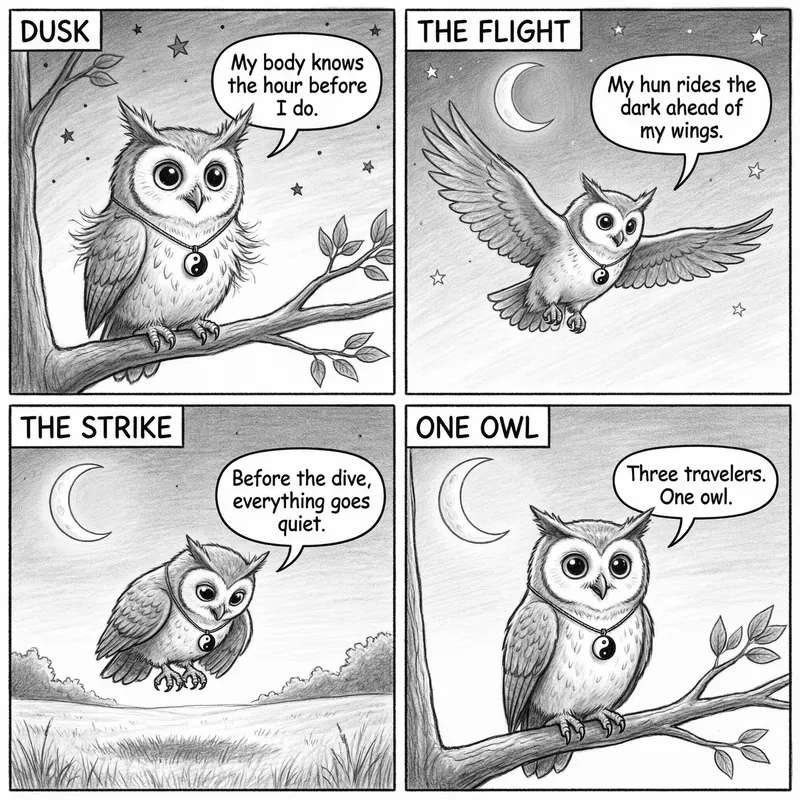
Ollie's take: a dreamer, an anchor, a decider — one owl.
Everyday speech quietly divides you into parts. You say your heart wasn't in it, or that your mind drifted down the street. You confess you almost jumped out of your skin, or that your gut made the call before your head caught up. We talk this way because consciousness never feels like one block of stone. We live as an inner council.
Western thought spent centuries trying to cram that council entirely into the skull. Yet the body constantly betrays the blueprint: stomachs knot during tense calls, and feet pace while the mind replays old arguments.
Traditional Chinese Medicine mapped these seams over two thousand years ago. Instead of locking mental life inside the brain, it divided the mind into distinct spirits housed across the physical frame: shen, hun, and po. Heart, blood, breath — three seats in the living body, each holding a different piece of who you are.
The One-Line Source in the Classics
The core architecture comes from the foundational medical text, the Huangdi Neijing. In Suwen chapter 23, the text outlines the five stores. The heart stores the shen. The lungs store the po. The liver stores the hun. Alongside these, the spleen stores intention (yi), and the kidneys store will (zhi). The body functions not as a vehicle run by a distant driver, but as an estate of specialized offices.
The eighth chapter of the Lingshu, titled Ben Shen or "Rooting the Spirit," sharpens the definition. It explains that life arrives first through jing, the essence inherited from our parents. When the two essences unite, what arises is called shen. What follows shen back and forth, drifting out into abstract thought, is called hun. And what adheres directly to physical essence, moving with the tides of flesh, is called po.
Shen leads, hun ranges outward, po anchors the base. These are not supernatural ghosts. They are physiological movements of consciousness, tied directly to the tissues that shelter them.
Shen: The Spirit That Decides
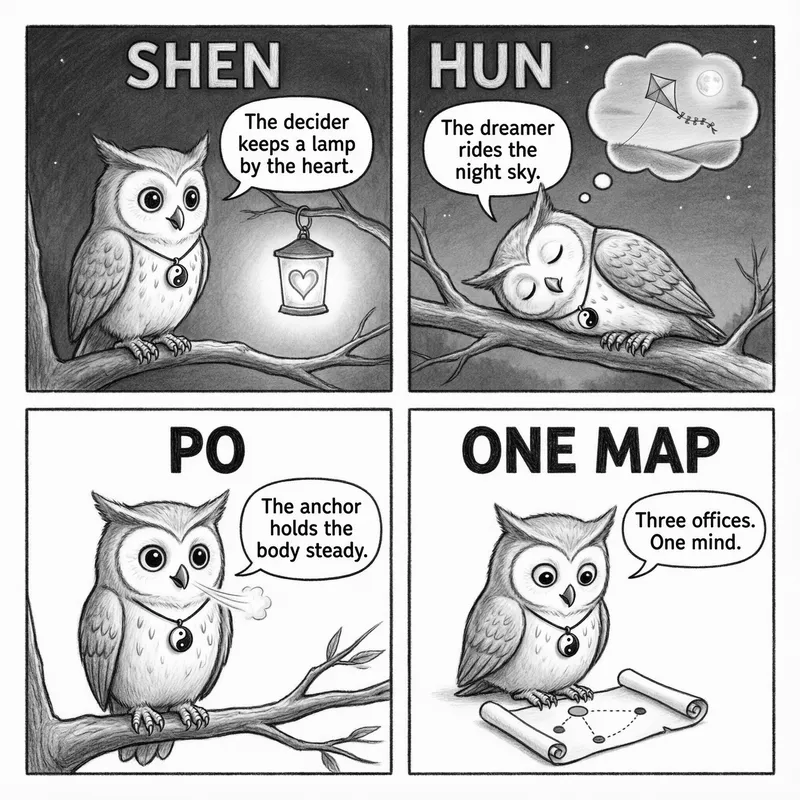
Shen is the captain. Housed in the heart, it represents clear awareness, presence, and your capacity to inhabit the room you stand in. Shen recognizes a friend's face, weighs options, chooses the path forward.
In classical diagnostics, a practitioner reads shen in the eyes. An eye with shen has light behind it, tracking movement with steady focus to show the resident is home. An eye without shen looks dull or vacant, like an unlit room behind dusty glass.
When shen is unsettled, evenings dissolve into static. You sit on the couch while attention scatters. You read the same sentence four times without absorbing a word. The pulse feels rapid, and you feel strangely absent, waiting for yourself to arrive.
Hun: The One Who Leaves at Night
If shen is the waking ruler, hun is the nocturnal voyager. The tradition assigns hun to the liver, where it anchors directly in blood. The classical dictum states plainly: the liver stores blood, and blood houses the hun. Hun is imagination, long-range vision, and the part of the mind that wanders across dreamscapes while the body rests quietly.
Sleep is the hun's scheduled itinerary. When activity slows at dusk, blood returns inward to the liver. As blood settles in this reservoir, the hun eases in like a traveler entering a warm inn. When it finds adequate lodging, sleep is deep, dreams are coherent, and you wake restored.
In the TCM night clock, the liver peaks between 1:00 a.m. and 3:00 a.m. When liver blood runs thin or heat disturbs that shelter, the hun cannot rest. The tradition ties the 2:00 a.m. waking to the hun adrift — mind drafting emails and fretting over distant plans. The hun wanders because its bed was cold.
Po: The One Who Stays Home
Po wants nothing to do with abstract dreams or tomorrow's calendar. Po is raw animal life. Housed in the lungs and carried on the rhythm of Qi, it belongs to flesh, reflex, and instantaneous physical response. When a horn blares and your spine snaps straight before intellect identifies the sound, po keeps you safe.
You feel po whenever you jump out of your skin. It runs the body's machinery: swallowing, dilating pupils in the dark, and goosebumps in an icy draft. It works below conscious thought.
Modern Mandarin's word for boldness, po li, glosses as "po-strength" — an echo of the old po, though an echo is not a lineage. In this framework, nerve comes not from pep talks but from the vitality of your physical animal. A strong po gives a person heavy bones, even breath, and an instinctive refusal to back down.
Older Than the Medicine: The Cultural Bedrock
These concepts were woven into Chinese culture long before the Neijing. The Zuo Zhuan was compiled later, but the words it preserves are older: the sixth-century BCE statesman Zichan described human life as a convergence: at the beginning of life, the earthly po takes shape first; then the luminous, Yang component arrives and becomes the hun.
The Liji, or Book of Rites, laid down traditional funeral liturgy with the same structural division. When a person died, their hun Qi ascended into the sky, while bodily po sank into the earth: one part belonging to clouds, the other to clay.
Daily speech still keeps this ancient map alive:
The phrase shi hun luo po translates to "losing your hun and dropping your po," describing someone shattered by shock. The idiom hun bu shou she means "the hun refuses to stay in its lodging," naming the daydreamer whose attention roams distant mountains. And jing xin dong po means "startling the heart, shaking the po," reserved for terrifying spectacles that knock the breath clean out of your ribs.
The culture never abandoned these categories. They are still the instinctive language people use to describe how they feel.
The Kite and the String
The three work like a kite against an autumn sky.
The hun is the kite: light paper and bamboo, eager to catch drafts and pull toward the upper atmosphere. The po is the spool near the grass and the twine anchoring the frame. The shen is the pilot holding the spool, tracking motion, reading line tension, and deciding when to haul the kite home.
On a restful night, shen yields command. The po maintains quiet breathing, keeping the body grounded on the mattress. Meanwhile, the hun unspools into dreams to process emotion. Because po holds the string, you dream of falling off a cliff without kicking yourself onto the floor.
Trouble arrives when the cord snaps. Weak po leaves a kite tearing loose into manic drift. Trapped hun turns a person mechanical, blind to possibilities. The three spirits are meant to push and pull against each other; their dynamic tension makes us whole.
Two Maps at the Same Kitchen Table
Laying neuroscience over this ancient framework flattens both traditions. A Western researcher measures microvolts and blood flow, while an ancient physician observed patterns across a wooden bench. These two maps are distinct, yet they sit comfortably at the same kitchen table.
Consider mind-wandering. In a 2016 review in Nature Reviews Neuroscience, Kalina Christoff and colleagues outlined how the default mode network generates spontaneous, associative thoughts unconstrained by tasks. This drift reads like the classic actions of the hun, which steps away from immediate input to forage through memory and possibility.
When you snap out of a daydream to focus, executive networks re-center attention in real time. This focused arbitration is the operational territory of the shen.
The po finds a modern echo in interoception. In a 2009 review in Nature Reviews Neuroscience, A. D. Craig mapped how the anterior insular cortex integrates visceral sensations (temperature, pain, muscle tone, and breath) to form our primary sense of physical selfhood. A startle or bodily shudder echoes the visceral po.
A 2018 review in Frontiers in Human Neuroscience by Andrea Zaccaro and colleagues showed that slow breathing with prolonged exhalations stimulates the vagus nerve and shifts autonomic tone toward parasympathetic dominance. In Neijing phrasing, lung Qi calms the physical beast.
Finally, consider dreams. In a 2010 review in Trends in Cognitive Sciences, Yuval Nir and Giulio Tononi detailed how rapid eye movement sleep decouples vivid imagery from motor output, blocking motor neurons so muscles remain still. Ancient clinicians mapped this exact balance: the hun flies through the dark, while the po pins flesh to the bed.
Three Questions at 3 a.m.
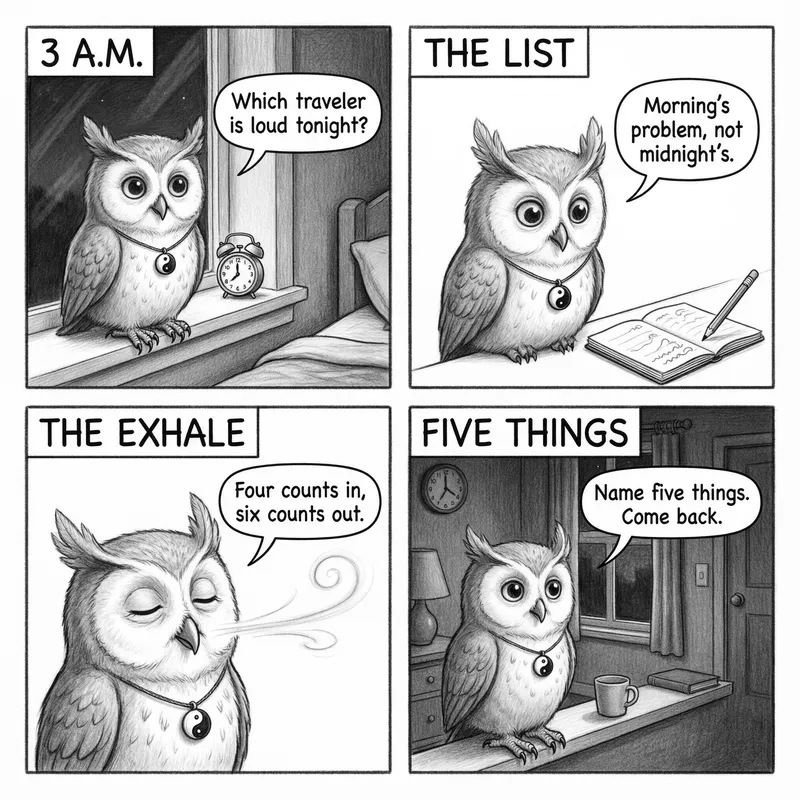
The framework meets a real bedroom at 3:15 a.m.: pitch black, and you are awake. Instead of tossing, the old map has its own quiet triage: which traveler is talking loudest?
Is it the hun? If so, your thoughts are racing down future pathways—reorganizing the garage, drafting messages, or planning next year's budget. Traditional practice gave the wanderer a boundary: a notebook and pencil by the bed, the lamp soft, the thought on a single page, and a quiet line — "We deal with this at eight o'clock." A shelf for the wanderer, and it lies down. The contrast helps: a wandering hun asks, "What about next week?" An unsettled shen scans this room for "What was that sound?"
Is it the po? If the po is restless, your mind may be blank while your body trembles with raw static. Your chest feels tight, your skin hyper-aware of the sheets, and your breathing shallow. The animal is startled. Traditional practice reached for air: a slowed breath, the exhale drawn out longer than the inhale, a way of telling the po that no wolves are nearby.
Is it the shen? If shen is unsettled, you feel a prickly dread, scanning shadows for threats and feeling detached from your resting body. The captain is spinning. Folk practice answered through the senses: the weight of the heels on the mattress, the cool headboard, familiar objects named in the dark, until shen was reminded that this moment is safe.
Remember: this bedside triage is an educational exercise from traditional concepts, not a clinical treatment for insomnia. Sleep trouble that continues week after week is a separate question, one that may warrant discussing the pattern with a physician or qualified practitioner.
Let me tell you how this works out on the night branch.
I settle my jade pendant against my chest feathers; it has caught just enough moonlight to remind me I am solid.
Right at dusk, as the orange light drains behind the pines, my po wakes up first. My ear tufts perk up, my neck feathers tighten against the breeze, and my talons test their grip on the bark—pure, sharp animal reflex. Then, as I launch into the pitch black, my hun takes over. It flies out ahead of my wings, tracing every invisible thermal draft and listening for the faintest rustle of dry leaves thirty meters down on the forest floor. That's imagination, reach, and hunting instinct reading what cannot be seen.
Then comes the split second before the dive. My wings cup the air, my head locks dead center, and my whole self goes completely motionless. That is shen. Total presence. The three just work. No arguments, no meetings. Just flight, focus, and dinner.
What the Map Is For
Understanding shen, hun, and po is not about memorizing antique terms. Treating the mind as a single engine is flawed. When you believe you are one simple thing, every bout of restlessness, brain fog, or midnight worry feels like a personal failure.
Chinese medicine hands you a map of internal diversity. You are a council of three. When attention wanders, your hun may have outrun its blood supply. When nerves jump, your po is guarding the flesh. And when you sit quietly, breathing morning air with steady eyes, shen sits centered in its palace.
Evening is where this map earns its keep: screens dark early, one long exhale before the lamp goes out: shen invited inward, po holding the fort, hun wandering out into the stars.
FAQ
Are hun and po the same as a religious soul?
No, they operate as functional aspects of living physiology rather than immortal, theological souls. In classical Chinese thought, hun represents the ethereal, psychic movements of imagination, dreaming, and consciousness, while po governs physical instincts, somatic reflexes, and bodily coordination. They are bound directly to organs, blood, and Qi during your earthly lifetime. While ancient texts describe hun returning to the sky and po to the earth after death, clinical medicine treats them simply as natural components of human psychological and somatic health.
Why does TCM tie the mind to organs at all?
Traditional Chinese Medicine views mental processes and physical tissues as inseparable movements of the same underlying Qi. Rather than isolating consciousness within the brain, the traditional framework maps specific emotional tendencies directly to organ networks: grief corresponds to the lungs, worry to the middle burner, and fear to the kidneys. Housing faculties like shen, hun, and po inside tangible organ systems gives practitioners a direct vocabulary to address psychological distress through the body, supporting balance by nourishing blood and regulating Qi flow.
Does vivid dreaming mean something is wrong?
Vivid dreaming is a normal, natural part of the hun's nightly journey across human experience and memory. Dreams that turn persistently terrifying or chaotic, or that leave a sleeper waking exhausted, are read in the traditional frame as an unanchored hun — a pattern tied to depleted blood or unsettled heat. This reading is an educational concept, not a diagnosis or an illness label. Persistent sleep disruption may warrant discussing the pattern with a healthcare professional, since ongoing nightmares can have many sources.
Sources
- Huangdi Neijing, Suwen — chapter 8 (Ling Lan Mi Dian Lun) and chapter 23 (Xuan Ming Wu Qi Pian).
- Huangdi Neijing, Lingshu — chapter 8 (Ben Shen).
- Zuo Zhuan (The Zuo Commentary) — Zichan's passage set in Duke Zhao's 7th year (535 BCE); text compiled in the Warring States period.
- Liji (The Book of Rites), Jiao Te Sheng chapter.
- Zhang Jiebin, Lei Jing (Classic of Categories), 1624.
- Kaptchuk, T. The Web That Has No Weaver. 2nd ed., 2000.
- Christoff, K., et al. "Mind-wandering as spontaneous thought: a dynamic framework." Nature Reviews Neuroscience, 2016; 17(11): 718-731.
- Zaccaro, A., et al. "How Breath-Control Can Change Your Life: A Systematic Review on Psycho-Physiological Correlates of Slow Breathing." Frontiers in Human Neuroscience, 2018; 12: 353.
- Nir, Y., & Tononi, G. "Dreaming and the brain: from phenomenology to neurophysiology." Trends in Cognitive Sciences, 2010; 14(2): 88-100.
- Craig, A. D. "How do you feel — now? The anterior insula and human awareness." Nature Reviews Neuroscience, 2009; 10(1): 59-70.
- Note on evidence: the modern studies summarized here are indexed in PubMed; this essay restates their general tenor rather than each result.