Your Insomnia Has a Type — A TCM Field Guide
 Ollie's Take
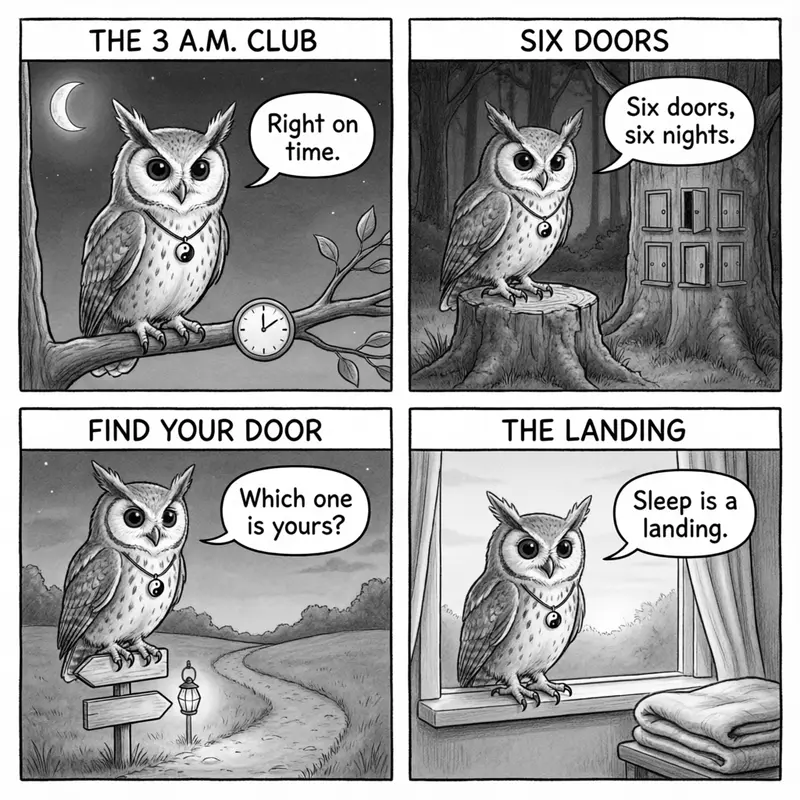
Ollie's take: find your door, then let the night land.
Three people can't sleep tonight. The first stares at the ceiling for two hours while her brain reviews every email sent since Tuesday. The second drops off immediately, then bolts wide awake at 2:15 a.m., heart hammering, with a sudden memory of a high-school dispute. The third sleeps eight uninterrupted hours, hears the alarm, and feels as though someone dumped three bags of wet cement across his chest.
We use one word for three different nights — insomnia — the way "pain" covers both a stubbed toe and a cracked rib. Traditional Chinese Medicine reads the night as a status report: the hour you wake and the way you wake tell you which part of the system is running hot, running dry, or running on nothing but reserve.
Chinese medicine has no single canonical list of sleep patterns: teaching lineages count four to six, and no two lists agree. Below are six portraits clinics actually meet — including two standard lists skip: the overdue sleep of Type Five and the wide-awake stomach of Type Six. A seventh needs a practitioner's hand, so it waits at the end.
Chinese medicine sorts nights by pattern, not disease name. A zheng is the whole cluster — how you look, when you wake, what you ate — gathered into one reading. Your body files a report between dusk and dawn; read it closely, and the guessing stops.
Ollie, the screech owl who shares our reading room, ruffles his ear tufts and adjusts his jade pendant. "Curious what my hours are actually for?" he mutters. "Then we should start there."
Type One: The Mind That Won't Switch Off (Heart and Liver — With Two Close Relatives)
The classic midnight vigil: exhausted on the sofa, yet the moment your head hits the pillow, your brain opens forty-two tabs at once.
This vigil belongs to the Heart and the shen, the seat of conscious awareness — and, more often than not, to the Liver, which stores the Blood. The classical texts say Blood houses the hun, the Liver's ethereal soul, the way a mattress holds a sleeper. When Liver Blood and yin run thin, the hun has nothing to lie down on, and the shen turns relentless and petty: recalculating your mortgage at 1:00 a.m.
One close relative deserves its own line: Heart and Spleen deficiency. Spleen Qi turns food into Blood, and the Heart stores it for the shen — so when overthinking and skipped meals wear down your digestion, the shen loses its floor — poor appetite, loose stools, forgetfulness, palpitations on waking, pale tongue, thin pulse — and traditional teaching shifts the emphasis to regular meals and earlier nights, not more stimulation.
Suan Zao Ren Tang, from Zhang Zhongjing's Jin Gui Yao Lue (c. 200 CE), addresses that Liver-Blood picture: sour jujube seed (suan zao ren) does the anchoring, while zhi mu (Anemarrhena) cools the low-grade heat that so often comes with it. The formula sits on the seam between Heart and Liver, nourishing the Blood while cooling the restlessness. It is not a sedative; it rebuilds what the broken nights drew down, feeding the bed so the guest can lie down. Suan Zao Ren Tang isn't a bedtime tea; it's dosed to your pattern, and a bottle labeled "sleep" is a different animal entirely.
The other close relative — night sweats, dry mouth, a red tongue with scant coating, a thin rapid pulse: not Blood deficiency but yin deficiency with empty heat — the cooling half has run out, and the yang has nothing to nest in. Traditionally, Heart and Kidney failing to communicate — nourish yin and settle the spirit, don't move Qi. A pattern for a practitioner.
Type Two: The 1 to 3 a.m. Alarm (Liver Qi Stagnation)
Type Two falls asleep without drama, then snaps awake between 1:00 and 3:00 a.m. — alert, warm, annoyed, jaw clenched, shoulders raised. Your brain drafts confrontational emails or stews over a slight from weeks ago.
This is the territory of the Liver, which governs the smooth movement of Qi. When emotional tension bottlenecks that flow, Qi backs up and generates internal heat. The hours between 1:00 and 3:00 a.m. belong to the Liver channel in the two-hour organ clock — a teaching convention derived from the Zi Wu Liu Zhu Zhen Jing's time-based needling. The Neijing ties sleep to the Liver differently: "when a person lies down, the Blood returns to the Liver" (Suwen 10). If the day's frustration is still parked in that channel, you wake ready to settle scores in an empty room.
Before you assume stagnation, look at the tongue. Little coating and a thin, rapid pulse say the opposite: empty heat, which moving and warming Liver Qi will only irritate. Stagnation turned to heat shows a red tongue with a yellow coat and a wiry, rapid pulse; plain stagnation, a thin white coat and a wiry pulse.
Ollie swivels his head nearly backward, tufts swinging with it. "Coated tongue, wiry pulse," he mutters. "A Liver still on duty — push it and it argues louder."
Type Three: The 3 to 5 a.m. Club (Lung and the Po)
Type Three wakes in the pre-dawn corridor, between 3:00 and 5:00. Unlike the hot wakefulness of the Liver hours, this waking is cool and strange: breath feels shallow, the chest constricted, as if expanding the ribs takes conscious effort; the house feels too cold and too quiet.
This interval belongs to the Lungs and the corporeal soul, the po, which governs physical instinct and stays bound to the body from conception — the hun, in most teaching lineages, arrives with the first breath and leaves at death. Unresolved grief disrupts the Lungs' descending, so Qi cannot settle into rest. People in this category wake with a heavy heart on calm days, feeling fragile before dawn.
Ollie shifts his grip on the perch. "This is my shift," he says, and blinks slowly.
Type Four: The Watchman Who Startles (Heart and Gallbladder Qi Deficiency)
Type Four does not stay awake for hours, but never truly sleeps either. A creaking floorboard, a screen rattling in the wind, and their heart leaps against their ribs.
This is vigilance disguised as rest: dreams run all night at high volume — missed flights, sudden hazards — and you wake as if you'd spent eight hours walking perimeter security around an abandoned warehouse.
This is the signature of Heart and Gallbladder Qi deficiency. Unlike Type One's endless mental tabs, Type Four's wakefulness is reactive: sounds trigger the startle, not internal rumination. The Gallbladder governs decisiveness and courage; the Heart hosts the spirit — and when both lack reserves, confidence falters. Cheng Guopeng's Qing text Yi Xue Xin Wu recorded An Shen Ding Zhi Wan: dragon's tooth (long chi), polygala (yuan zhi) and acorus (shi chang pu) to settle a startled spirit, with ginseng, poria, and fu shen (poria grown around the pine root) to build the reserves — and ginseng is the wrong tonic for anyone already running hot. An Shen Ding Zhi Wan is a prescription, not a supplement — the wrong build deepens the very nights it's meant to settle. A body that feels unsafe in its own skin cannot fully surrender, so a guard stays at the gate.
Type Five: Slept Eight Hours, Woke Wrecked (Spleen and Dampness)
Type Five has no trouble staying asleep. Lights out at 10:30 p.m., barely a shift, eyes open at 7:00 a.m. — and wrecked anyway: the textbooks wouldn't call this insomnia at all. You slept; the sleep just didn't do anything.
Your head feels stuffed with wet cotton; your limbs feel leaden; the tongue says it: pale, swollen, greasy coat. If this is your morning, look at last night's plate: a heavy, late, or dairy-rich dinner is often behind it.
The Spleen and internal dampness are behind this one: a digestive core too sluggish to transform what you ate. If the overnight energy moves like cold porridge, the eight hours never touch you. This is the pattern traditionally addressed by moving dinner earlier.
Ollie, perched with one foot tucked into his breast feathers, cracks an eye. "That's not sleep," he says. "That's a nap in a wet coat."
Type Six: The Kitchen Still Running at Bedtime (Stomach Discord)
Type Six usually has a timestamp — yours. Noodles at the counter at 9:15 p.m., right before bed; then a warm pillow, one leg always out from under the covers.
The Huangdi Neijing captured the logic in the Suwen's seven characters: wei bu he ze wo bu an — the Stomach's wei (胃), not the Wei Qi (卫) of the surface — "When the stomach is not at peace, sleep will not be either." Digestion needs Stomach Qi to descend; sleep needs defensive yang to withdraw inward. A stomach still churning a late meal blocks that retreat. You cannot ask your body to lock the doors while the kitchen is still running. The difference is what the meal does: dampness (Type Five) leaves you heavy but asleep, while stomach discord (Type Six) keeps you awake and restless.
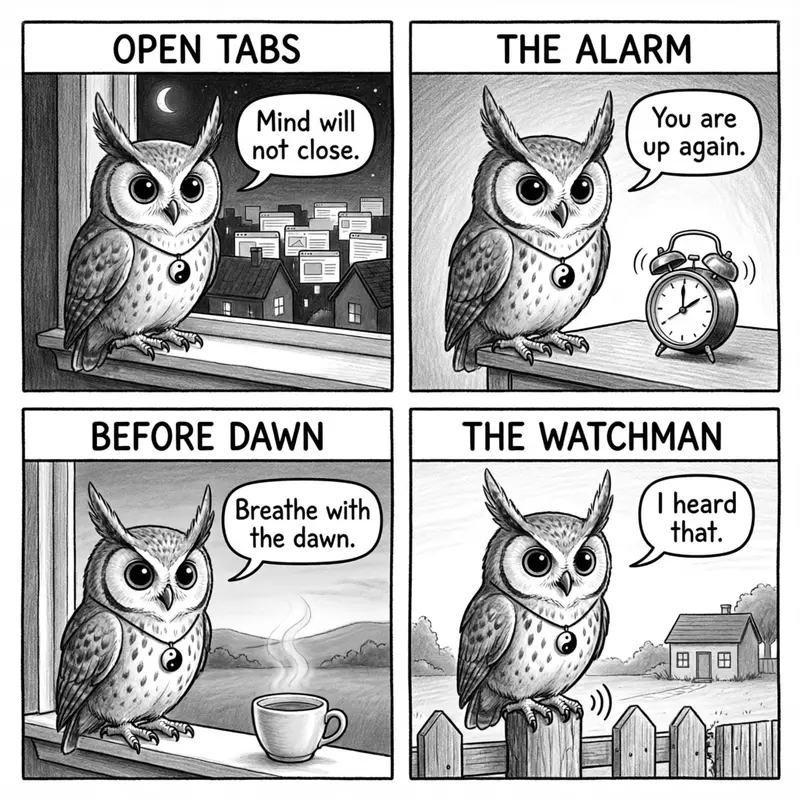
The Seventh Pattern the Six Doors Hide
One pattern sits outside the six: phlegm-heat disturbing the Heart, one of the most commonly taught insomnia patterns. These aren't nights of lying awake so much as nights that give nothing back: dreams crowd in, the chest feels oppressed, the mouth tastes bitter or greasy, the tongue red with a yellow greasy coat, the pulse slippery and rapid. Wen Dan Tang — recorded in Chen Yan's San Yin Ji Yi Bing Zheng Fang Lun (1174) — is the classical answer: it clears heat and transforms phlegm, but like the others it is a practitioner-adjusted formula, not a shelf product. Traditional teaching is blunt: get it backwards and the nights get worse — which is why it belongs here.
Where the Map Ends
Every type above is the same handover failing — the defensive yang must withdraw inward, and the Ying Qi (nutritive qi) must receive it (Lingshu 18; Lingshu 80). Zhang Jingyue (Zhang Jiebin)'s Bu Mei chapter split these nights in two — something lodged, or nothing left — and the seven patterns sketched above fall on both sides; a field guide gives vocabulary, not treatment. Severe or months-long sleep disruption deserves a doctor: modern sleep-medicine guidelines make CBT-I, not a pill, first-line care — and apnea, restless legs, thyroid disease, and depression all impersonate these patterns.
Ollie Speaks
A 1 a.m. club, a 3 a.m. club, an eight-hours-and-still-wrecked club: every broken night checks in at the same front desk. I've been perched at that desk a long time. I tilt my head, ear tufts twitching, jade pendant cool against my chest, while my ears pick out a mouse at fifteen meters. Even I yawn when the mice are slow.
You humans weren't built with night-vision lenses or soundless feathers — you borrowed owl hours with the light bulb. You look lost out there, hunting mice on a glowing screen; not your fault, you just lack the gear.
If your eyes pop open before the birds start, don't take it personally. My ears clock on at dusk; yours clock off. Nothing's broken — you're just standing in my shift. Let the daylight creature you are go back to being one.
Try This Tonight
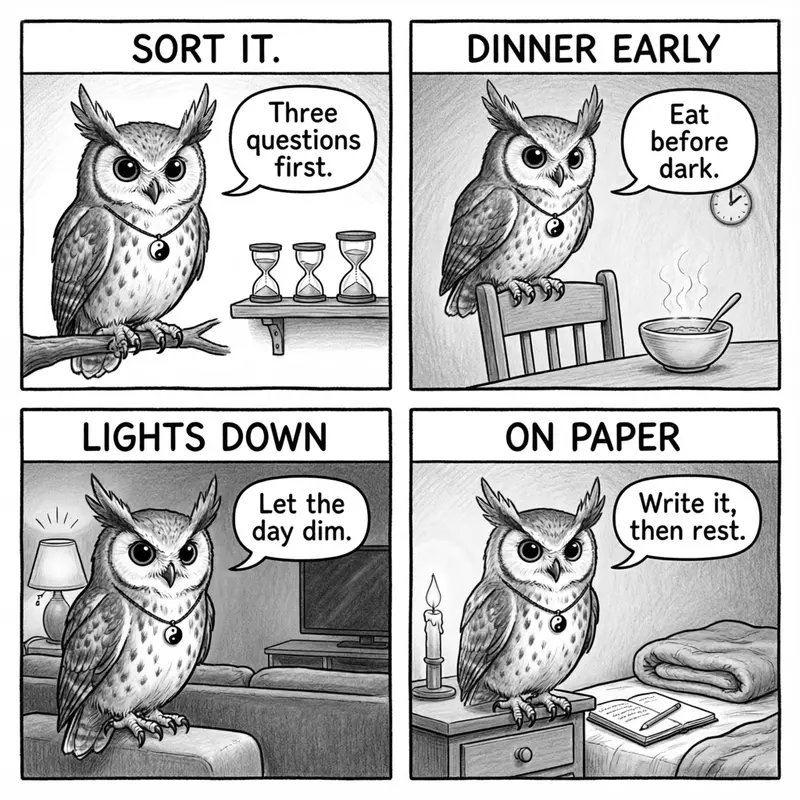
No need to overhaul your lifestyle: one adjustment, matched to your type. In the traditional home-care reading, three gentle moves: dinner two hours earlier, lights dimmed by 9 p.m., and tomorrow's list written on paper before bed — the idea being that paper holds the loop so the mind can let go.
FAQ
How do I tell which type I am?
When does it peak? Trouble falling asleep points to Type One or Type Six; waking between 1:00 and 3:00 a.m. to Type Two (Liver); 3:00 to 5:00 to Type Three (Lung); all-night waking to Type Four.
What pulls you out? Frustration and jaw-clenched heat point to Liver stagnation; a mind that loops and plans — especially if you were tired before bed — points to Type One's Blood-deficient vigil; sounds startling you awake, to Type Four; fullness or acid, to stomach discord.
How does your morning start? A foggy, forgetful, heart-racing morning suggests Blood deficiency; a buzzing, wired morning suggests empty heat; clenched tension, Liver stagnation; heavy limbs, Spleen dampness; quiet hollowness, grief in the Lung. Match the last three nights, not the last three years.
What if I match two types, or none?
Most people do. A week of four-line notes — when you fell asleep, when you woke, what woke you, how morning felt — usually makes the repeating line obvious; one bad night tells you nothing.
Can I just buy these formulas?
No — the formulas named here are practitioner-adjusted prescriptions, not shelf products; each is dosed to the pattern, and tradition warns that the wrong one makes nights worse.
Sources
- Huangdi Neijing, Suwen — chapter 34 (Ni Tiao Lun) and chapter 10 (Wu Zang Sheng Cheng).
- Huangdi Neijing, Lingshu — chapter 18 (Ying Wei Sheng Hui), chapter 80 (Da Huo Lun), and chapter 8 (Ben Shen: "the Liver stores Blood; Blood houses the hun"; "the Lung stores Qi; Qi houses the po").
- Jin Gui Yao Lue (Zhang Zhongjing, c. 200 CE) — the Suan Zao Ren Tang entry.
- San Yin Ji Yi Bing Zheng Fang Lun (Chen Yan, 1174) — the Wen Dan Tang entry.
- Yi Xue Xin Wu (Cheng Guopeng, 1732) — the An Shen Ding Zhi Wan entry.
- Jing Yue Quan Shu (Zhang Jiebin, 1624) — the Bu Mei (sleeplessness) discussion.
- Zi Wu Liu Zhu Zhen Jing (He Ruoyu; compiled by Yan Mingguang, Jin (Jurchen) dynasty, 12th c.) — the two-hour organ clock (zi wu liu zhu).
- Kaptchuk, T. The Web That Has No Weaver. 2nd ed., 2000.
- Benjamins, J. S., et al. "Insomnia heterogeneity: Characteristics to consider for data-driven multivariate subtyping." Sleep Medicine Reviews, 2017; 36: 71-81.
- Riemann, D., et al. "The neurobiology, investigation, and treatment of chronic insomnia." The Lancet Neurology, 2015; 14(5): 547-558.
- van Straten, A., et al. "Cognitive and behavioral therapies in the treatment of insomnia: A meta-analysis." Sleep Medicine Reviews, 2018; 38: 3-16.
- Morin, C. M., et al. "Cognitive behavioral therapy, singly and combined with medication, for persistent insomnia: a randomized controlled trial." JAMA, 2009; 301(19): 2005-2015.
- Note on evidence: the modern studies cited here are indexed in PubMed; this essay restates their general tenor.