
What Classical Chinese Medicine Means by “Escorting Out” an Illness
 Ollie's Take
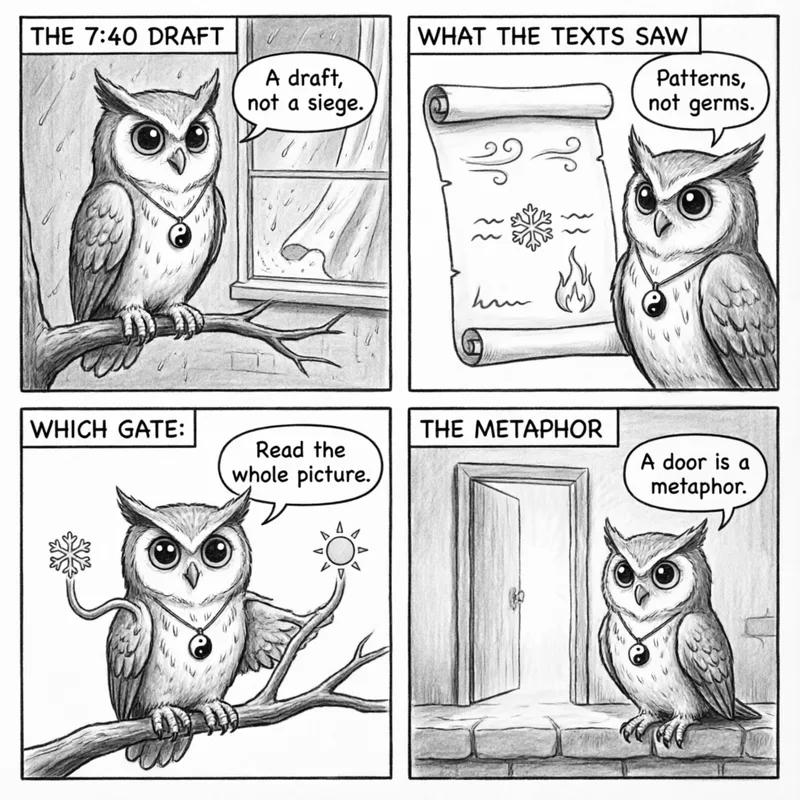
Ollie's take: follow the direction of the pattern, not the certainty of a slogan.
The Cold That Doesn't Need a War
The 7:40 train is late. You stand on a damp October platform, cold air under your collar. By the time you reach your desk, your throat feels scratchy, your shoulders are up around your ears, and the office vents blow through your shirt.
The modern reflex is military: zinc, decongestants, anti-inflammatories, three teas in the same mug. Classical Chinese medicine asks something stranger: not what to attack, but where the trouble is sitting and which way the tradition thought it should leave.
Ollie swivels his head toward the window, his ear tufts angling into the draft, then turns back. "I used to think every cold called for the same plan," he says. "Then I learned to ask what had changed. Apparently, being an owl doesn't make you observant automatically."
What the Old Texts Could Not See
Classical physicians never saw a virus. When old literature mentions wind (feng), cold, dampness, or heat, these are not influenza code words. Wind described behavior: sudden onset, rapid change, stiffness, or tremors. Drafty windows, cold snaps, and wet clothing were the exposures early physicians tracked.
Modern medicine names the organism. Chinese medicine described patterns of chills, heat, moisture, thirst, appetite, pulse, and tongue. They are different tools.
Huangdi Neijing (Yellow Emperor's Inner Classic), Suwen chapter 33, contains a line usually rendered: where harmful influences gather, upright Qi (zheng qi) is necessarily deficient. Chapter 72, one of the two "lost chapters" supplied in later transmission and generally regarded as a Song addition, adds that when upright Qi holds the interior, Xie Qi cannot intrude.
That is how the tradition reasoned, and reasoning is all it is. These categories were never evidence of a virus, and nothing here is treatment advice.
The Six Channels Are Patterns, Not a Timetable
Zhang Zhongjing, writing around 200 CE, is credited with the Shang Han Za Bing Lun. The received Shang Han Lun (Discussion of Cold Damage) and Jin Gui Yao Lue came through later transmission and editing. The six channels are overlapping pattern categories, not stages every infection must pass through, and they do not climb a simple ladder from skin to organs.
For this essay, the useful distinction is location. Taiyang points toward the exterior: chill, neck stiffness, and a floating pulse. Yangming points inward, with heat and heavy thirst or a bowel pattern of fullness and constipation. Shaoyang sits between them, where alternating chills and fever, a bitter taste, or rib-side fullness make a single direction hard to choose. Taiyin often shows digestive weakness with cold signs. Shaoyin can transform toward cold or heat; marked coldness, lethargy, and a faint pulse need urgent medical assessment. Jueyin may mix heat and cold. These categories overlap and change.
Ollie shuffles sideways along the branch, one ear tuft dipping. "Six names and centuries of arguing about where one stops," he says. "I lose track at four mice."
The 7:40 commuter's scratchy throat cannot be assigned to a channel from that description alone. Infection, allergy, dryness, and irritation all remain possible. A practitioner would weigh the whole picture. Don't diagnose yourself off this map.
Your Body Already Has Doors
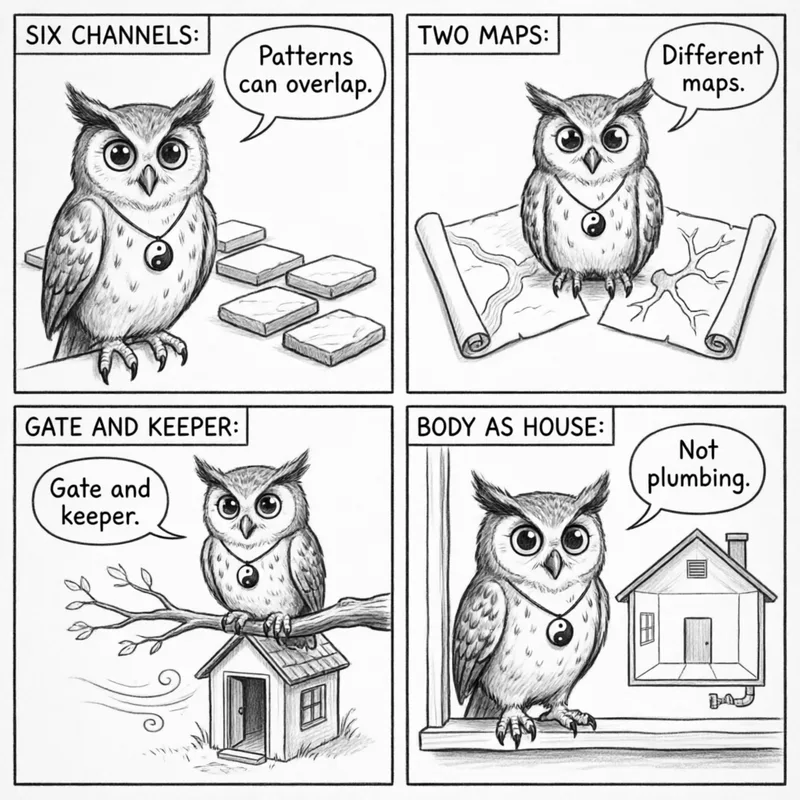
In classical theory, the body is an open building with vents, windows, and drains. Organ names describe traditional functions, not surgical anatomy. That framework associates Wei Qi with pores and warmth; the Lungs diffuse Qi outward and direct Qi and fluids downward. The Stomach receives food and begins its breakdown, while the Spleen transforms and transports nourishment and fluids.
Lingshu chapter 18 places Wei Qi outside the vessels and Ying Qi inside them. In this model, Ying Qi circulates within the vessels and nourishes the body while Wei Qi moves outside them. In Taiyang wind-strike with spontaneous sweating and aversion to wind, the tradition says the two have lost coordination. Sweat escapes while fever persists, and forcing more sweat can further spend fluids the surface needs. Classical strategy therefore tried to restore coordination between Ying and Wei.
An exterior cold pattern may involve chills outweighing fever, clear thin discharge, a scratchy throat, and a thin white coating. The classic no-sweat exterior-excess picture also has a floating, tight pulse; spontaneous sweating with aversion to wind points to the separate Ying-Wei pattern. Wind-heat often reverses the balance: fever outweighs chill, the throat is sore and swollen, thirst arrives, discharge thickens and yellows, tongue edges redden, and the pulse floats fast. Mucus color alone settles neither pattern and says nothing reliable about bacteria.
Exterior Cold is described with a relatively sudden aversion to cold and a floating pulse. Yang deficiency is different: cold limbs, fatigue, a pale tongue, and a deep, weak pulse may persist. Cold hands alone do not establish either pattern, and the two can overlap.
Warm-disease literature distinguishes warm dryness from cool dryness, a seasonal framework often associated with autumn. Warm dryness may involve a burning throat and dry cough; cool dryness may include chills and nasal dryness or congestion.
Ollie grips the windowsill with his talons and tilts one ear tuft toward the draft, his pendant brushing his chest feathers. "I can hear something moving," he says. "That doesn't mean I know what it is."
The Eight Methods and the Polite Exit
Cheng Guopeng's Yi Xue Xin Wu (Awakening of the Mind in Medical Studies), usually dated to 1732, systematizes eight treatment methods: promoting sweat, inducing vomiting, purging, harmonizing, warming, clearing, reducing, and tonifying. These are practitioner categories, not a home protocol. Do not induce vomiting or use purgatives to treat a respiratory illness.
Notice that the first three are directions, not products. Sweating was described as moving a disturbance through the surface; vomiting upward; purging downward. "Escorting out" is this article's shorthand, not a single named classical doctrine. It describes how some traditional methods matched an exit to the presentation. Sweating a deep accumulation, or purging a surface pattern, counted as a mismatch. Sweating spends fluid at the surface, doing little for a deep accumulation. Classical texts also warn that inappropriate purging can produce complications.
The Shang Han and Wenbing systems are related but not identical. Cold-damage literature developed earlier around the six channels; warm-disease literature developed later for epidemic heat illness and used different level systems. They are distinct historical models, not two labels for one diagnosis.
Jie biao means releasing the exterior, and its method depends on the presentation. Taiyang wind-strike with spontaneous sweat calls for harmonizing Ying and Wei — regulating the exterior, not simply stopping sweat or forcing more. Taiyang cold-damage, with no sweat and a floating, tight pulse, presents the opposite problem: the surface is shut. For an appropriate presentation, the classical strategy releases the exterior through sweating; method and administration depend on the full picture and are not home instructions. Harmonizing is one way to treat an exterior pattern, not an alternative to exterior release.
Traditional warm-disease theory uses another map: Wei, Qi, Ying, and Xue. Historical descriptions of the Wei level call for a gentle, cool-acrid release rather than a warming one. At Qi, attention shifts to clearing heat. At Ying, tou re zhuan qi means venting heat outward toward the Qi level. At Xue, bleeding, confusion, or severe agitation require urgent medical assessment, not home classification.
Why "Fighting" Can Backfire
Fever, nasal discharge, and cough can accompany the body's response, but they do not all work as exits. Treating fever or cough for comfort does not mean an infection has been trapped inside. Appropriate relief depends on the symptom, age, medication, and medical history.
A traditional caution against premature astringing is often summarized as bi men liu kou, shutting the door and keeping the thief inside. It concerns securing too early within traditional pattern reasoning, not ordinary symptom relief.
The opposite error appears when every cold gets the same warming approach. A burning throat, thirst, and irritability can occur in heat presentations, but they do not establish wind-heat or warm dryness. A dry cough with pronounced dryness supports a dryness pattern; traditional warm-dryness strategy gently disperses and moistens rather than piling on heat.
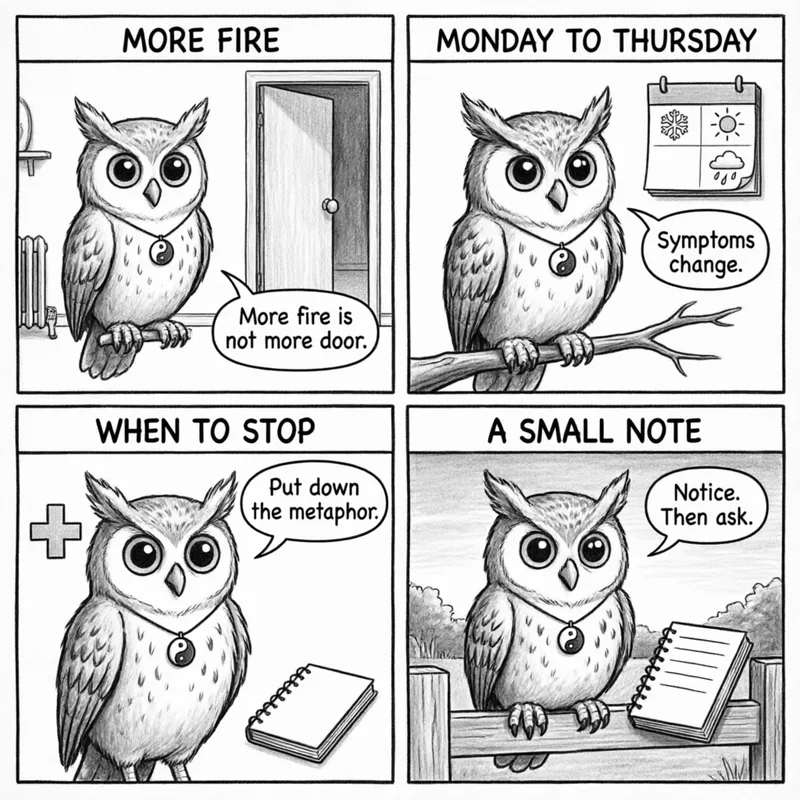
Ollie shifts on the banister, one eye closing. "I once sat on a radiator all afternoon," he says. "Still sore. More fire is not more door."
Three Days, Read as a Pattern
Monday, your partner hunts for the blanket, nose running clear, and refuses cold water. By Wednesday the blanket is on the floor, the throat feels hot rather than scratchy, nasal mucus has thickened, and she keeps reaching for water. The symptoms have changed, so Monday's assessment may no longer fit.
Ollie tilts his head at the calendar, one foot tucked into his chest feathers. "I wrote 'chilly' on Monday and kept believing it on Thursday," he says. "Excellent memory. Terrible updating."
A practitioner would reassess the whole presentation rather than assume the first pattern persists.
After an infection, a dry cough may reflect temporary airway irritation; it does not by itself establish depleted Lung Yin. A persistent or worsening cough also needs assessment for asthma, postnasal drainage, reflux, or complications.
A symptom log can help you describe change; it never needs to delay care.
By evening, rain touches the window and a cup cools on the sill. The blanket is not a cure; it is what you reach for while you watch the pattern change.
Ollie Speaks
I keep one eye half shut most of the day. There's a draft under the door, and both feathery ear tufts keep turning toward it without checking with me first. I once chased a cold as small as a dropped feather with everything in the cupboard.
My small Yin and Yang pendant taps my chest when I shift—Yin on one face, Yang on the other, and I have spent years failing to be as balanced as a piece of jewelry. One clawed foot stays hooked over the banister. More heat, I learned, is not the same as more help.
You don't have to sweat it out. You don't have to tough out a cough you could have soothed. Nothing gets trapped in you because you took something that helped. The door is just a picture I keep behind my eyes so the rest of it holds together. There's no actual door in your chest, and I'd have noticed. If breathing gets hard, or something feels badly wrong, stop reading and get real medical care. I'll keep you company on the banister.
A Simple Symptom Log
Pattern tracking helps only if it leads to sensible action. Write these six lines the same way each day:
- Chills or heat — which is winning today?
- Mouth — dry, or moist?
- Discharge — thin and clear, or thick?
- Sweat — none, light, or soaking?
- Appetite and sleep — normal, or off?
- Trajectory — better, worse, or better then worse?
Date each entry and bring it to an appointment. Do not keep logging through a warning sign.
What the log can help you ask
- Did chills and heat change rank over the last twenty-four hours?
- Did thirst, sweat, appetite, sleep, or breathing change too?
- Which new symptom would make the earlier pattern no longer fit?
- If risk is higher, when should testing or antiviral assessment happen?
Symptom relief is not evidence that an illness has been trapped inside. This article does not recommend herbs or formulas, and purgatives or induced vomiting do not belong in home care for a respiratory illness.
When to Get Medical Care
Maps are useful until you reach the edge of the paper. Use this to understand symptoms, never as an emergency plan.
Seek emergency help for trouble breathing, especially if speaking in full sentences is difficult, or for chest pain, confusion, seizure, a stiff neck with fever, a rash that does not fade under pressure, or severe dehydration with fainting or inability to keep fluids down. Unexplained bleeding needs prompt assessment.
If influenza or COVID-19 is possible, especially during pregnancy, older age, immune compromise, or chronic illness, contact a clinician promptly. Some antivirals work best when started early.
Antibiotics do not act on viruses. Antivirals exist for some viruses and are prescribed by clinicians.
FAQ
If TCM doesn't kill viruses, what does it do instead?
It decides direction. Wind-cold and wind-heat point toward different traditional strategies: one warms and opens the surface, the other cools and vents it, and the assessment can change if the pattern changes. The work is sorting chills from heat, thin discharge from thick, dry from damp, then matching the response to what is present. It does not identify an organism. No universal TCM strategy has been shown to remove a respiratory virus or replace testing, vaccination, antivirals, or other indicated care.
Does "releasing the exterior" mean I should sweat it out?
Releasing the exterior is one TCM treatment principle for certain early patterns, not a general instruction to force a sweat. Classical descriptions of some presentations mention a light sweat, but the method depends on the whole pattern. Exterior excess and exterior deficiency receive different approaches, and wind-heat differs from wind-cold. A metaphor about an exit does not make sweating a home-treatment target. Heavy sweating can deplete fluids. Any herb or formula belongs with a qualified practitioner, not a web article.
When should I stop reading and see a doctor?
The course of an illness matters, but one red-flag symptom can require immediate care. Seek emergency help for severe breathing difficulty, chest pain, confusion, or seizure regardless of timing. Contact a clinician if symptoms worsen, fever returns after improvement, or new shortness of breath develops. A baby under three months with a temperature of 38°C or higher needs immediate assessment. Do not wait for a particular day of illness; if influenza or COVID-19 is possible and risk is higher, ask about early antiviral treatment.
Sources
- Huangdi Neijing, Suwen 33 and 72 (chapter 72 is a received “lost chapter”).
- Huangdi Neijing, Lingshu 18 (Ying Wei Sheng Hui).
- Shang Han Lun (Zhang Zhongjing, c. 200 CE) — six-channel chapters.
- Yi Xue Xin Wu (Cheng Guopeng, 1732) — eight methods.
- Wen Re Lun (Ye Tianshi, 1667–1746; recorded by Gu Jingwen) — four-level theory.
- Evans, Repasky & Fisher. “Fever and the thermal regulation of immunity.” Nature Reviews Immunology, 2015.
- Walter et al. “The pathophysiological basis and consequences of fever.” Critical Care, 2016.
- Knowles & Boucher. “Mucus clearance as a primary innate defense mechanism for mammalian airways.” JCI, 2002.
These modern reviews do not establish that TCM principles clear respiratory viruses.