
Frost's Descent: The Last 15 Days of Autumn
 Ollie's Take
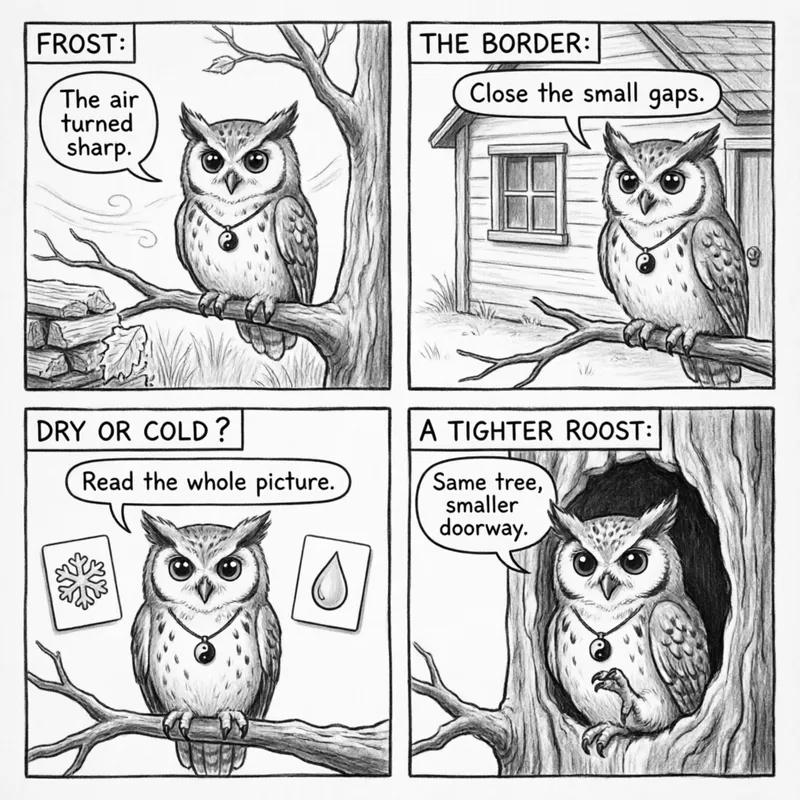
Ollie's take: notice the edge first; the season is already there.
You notice it first on the windshield. A thin crust of ice gives way under the scraper with a dry rasp. Crabgrass turns silver. Inside, the pipes clank. Your feet hit the cold floor, and you're already thinking about soup.
Frost's Descent, or Shuangjiang, is the eighteenth solar term. It begins when the Sun reaches 210 degrees of ecliptic longitude, usually October 23 or 24, and runs to Lidong about fifteen days later. The system came from the Yellow River basin, where frost tends to arrive on cue; elsewhere, the jet stream decides.
Ollie knows this turning point before the rest of us do. Perched high in a hollow oak near the woodpile, he fluffs his down feathers against the dawn chill. "My feathers know before my calendar does," he says. "When the morning air turns sharp, I stop fussing and find a tighter roost."
The TCM Lens: Metal, Dryness, and the Body's Border
Autumn belongs to Metal, paired with the Lung and Large Intestine. Its climate is dryness, or Zao, and external dryness reaches the Lung first, consuming fluids. The Lung also governs skin and body hair, which is why the Suwen's line that prevailing dryness produces desiccation reads like a description of your knuckles in October.
Most of this comes from the Huangdi Neijing, the Yellow Emperor's Inner Classic, which arrives in two halves: Suwen (Basic Questions) and Lingshu (Spiritual Pivot). The terms were built around northern China's weather. Suwen chapter 5 says autumn injures through dampness, then later, cataloguing the climates, that when dryness prevails, there is desiccation. Later physicians spent centuries arguing over that first line. Yu Jiayan insisted in Yi Men Fa Lü that autumn's real threat is dryness. Later writers split the pattern by whether dryness rode in on summer heat or the first cold; Fei Boxiong's Yi Chun Sheng Yi describes both.
Think of Wei Qi as household work: warmth and openings. In July the windows stay open. When frost arrives, you latch the sashes and check the weather stripping. You're minding where the house meets the weather.
Wei Qi, or defensive Qi, circulates outside the vessels, warming flesh and governing the pores. The Lingshu, chapter 18, traces Ying, the nutritive Qi, and Wei to food and drink: clear becomes Ying inside the vessels, turbid becomes Wei outside. The Suwen, chapter 43, calls Wei the fierce Qi of water and grain — the bold, fast-moving share of what you eat, the part that patrols instead of nourishing.
Later physicians called the Lung the delicate organ, Jiao Zang. It opens at the nose and governs the pores, so it meets outside air at two surfaces and needs moisture at both. The Lung pushes Qi and fluids outward (Xuan Fa) and downward (Su Jiang). In TCM, the Lung and Large Intestine form an interior–exterior pair. Lung Qi's descending movement is understood to support the Large Intestine's downward movement, while fluids help keep stools moist. A dry throat and hard stools often pair up, but heat, Qi deficiency, or dehydration can all explain it.
Classical writing splits body fluids in two. Jin is thin and quick: it keeps lips from splitting and the nose comfortable. Ye is thicker and slower, cushioning joints and deeper tissues. The Lingshu, chapter 30, draws the line. External dryness taxes the more mobile fluids; when the Lung cannot distribute enough to the surface, nose, throat, and skin dry together, often with a cough.
"I re-line my hollow about now," Ollie says, tucking one foot up into his breast feathers and leaving it there. "Same hole, smaller doorway. The oak isn't going to grow me a new tree, so I work on the edges."
Three Signs: Jackals, Falling Leaves, and Burrowing Life
Classical observers split each solar term into three five-day periods, or hou. In the Yuan dynasty, Wu Cheng collected these much older cues in Yueling Qishier Hou Jijie. For Frost's Descent, jackals lay out their kills, grass and trees yellow and shed, and burrowing creatures go still. Nobody needs to believe jackals hold ceremonies. The point stands either way: even the hunters are putting food by.
"Someone wrote this down long ago, and I like that they bothered," Ollie murmurs, settling his wings. "I mostly watch the puddle by the woodpile. When it grows a lid of ice, I slow-blink and reconsider my plans."
Telling It Apart: Cool Dryness, Cold, and Their Neighbors
Cold air doesn't create a respiratory infection; viruses, and sometimes bacteria, do. Closed windows and closer indoor contact help them spread. What the seasonal lens describes is how a given body responds.
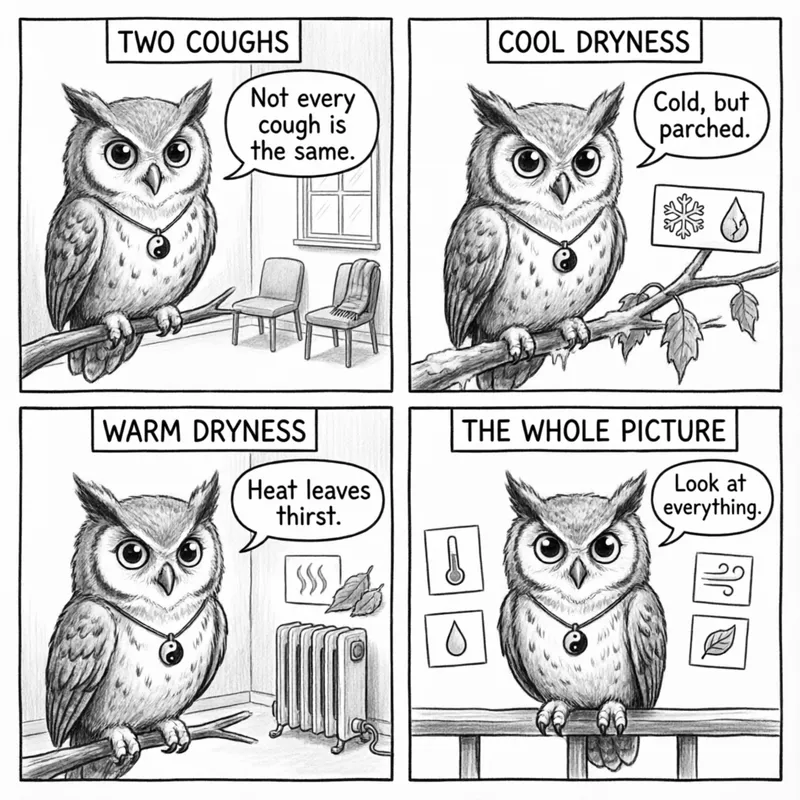
Two people cough in one late-October waiting room. One is hot, thirsty, and wants a window open. The other is chilled, barely thirsty, and pulls up a collar. What follows is how the tradition sorted them; persistent or severe symptoms need a clinician.
Cool dryness injures twice. Cold constrains Wei Qi at the surface, causing chills and body aches. Dryness consumes Jin, chapping the lips and making the cough unproductive. Warming can disperse the cold but drive off more fluid, leaving the throat rawer. Moistening restores fluid but can deepen the chill. Wu Tang's Wen Bing Tiao Bian turned the argument into formulas. Xing Su San is his answer for cool dryness. Its counterpart, Sang Xing Tang, treats warm dryness, cooling as it moistens. Neither is a self-care item; the wrong direction deepens the problem.
Cool dryness or wind-cold?
Cool dryness and wind-cold overlap: mild chill, little thirst, a dry or stuffy nose, and a thin white coating. Cool dryness reads drier across the board: chapped lips, a nose that won't clear, a cough that gives you nothing back. The pulse floats and feels wiry rather than tight—a distinction that matters here. Zhang Zhongjing's Discussion of Cold Damage opens Tai Yang with a floating pulse, a stiff aching head and neck, and aversion to cold. Cold damage adds body aches and no sweating; wind-strike adds a moderate pulse and sweating.
Cool dryness or warm dryness?
Warm dryness arrives on summer heat's tail: fever outweighs chill, thirst is real, the cough stays dry with little sticky matter, and the pulse floats and races. The tongue is red with a thin, dry coating—usually white, sometimes yellow as heat deepens. Wind-heat tends to come on fast: fever, aversion to wind, and a throat that hurts before anything else does. Yellow phlegm shows up sometimes. You can have wind-heat without it. Prominent dryness of the nose, lips, and throat with scant sputum supports warm dryness.
Cool dryness or Yin deficiency?
Neither the calendar nor the length of your symptoms settles this one. Yin deficiency runs deeper than a dry season: night sweats, heat in the palms and soles, a red tongue with little coating, and a thin, rapid pulse. Dry indoor air can make seasonal symptoms persist; short-term relief proves neither pattern.
Seasonal cold or Yang deficiency?
Cold feet usually follow the room and weather and are common without Yang deficiency. A clinician looks past the feet: fatigue, a standing preference for warmth, a pale tongue, and a deep, weak, often slow pulse.
Cold hands with a normal-colored tongue, tension, and a wiry pulse elsewhere may point to constrained Yang, or Yang Yu: warmth is present, but stagnation keeps it from the limbs. It isn't Yang collapse, and the two require different care; the whole pattern matters.
Persistent cold feet also have possible medical causes, especially with pain, numbness, or color changes. Those signs need medical assessment.
Back to the waiting room. The first—hot, thirsty, red-tongued—looks like warm dryness. The second—chilled, chapped, with a thin dry white coating—looks like cool dryness. Same room, same week, different problems.
"Two coughs can sound alike from a branch," Ollie says, swiveling his head a slow half-turn toward the woodpile, then back. "I hear a dozen things move in the dark. It took time to learn which was a mouse and which was a leaf."
The Late Autumn Kitchen: Persimmons, Roots, and Moderate Nourishment
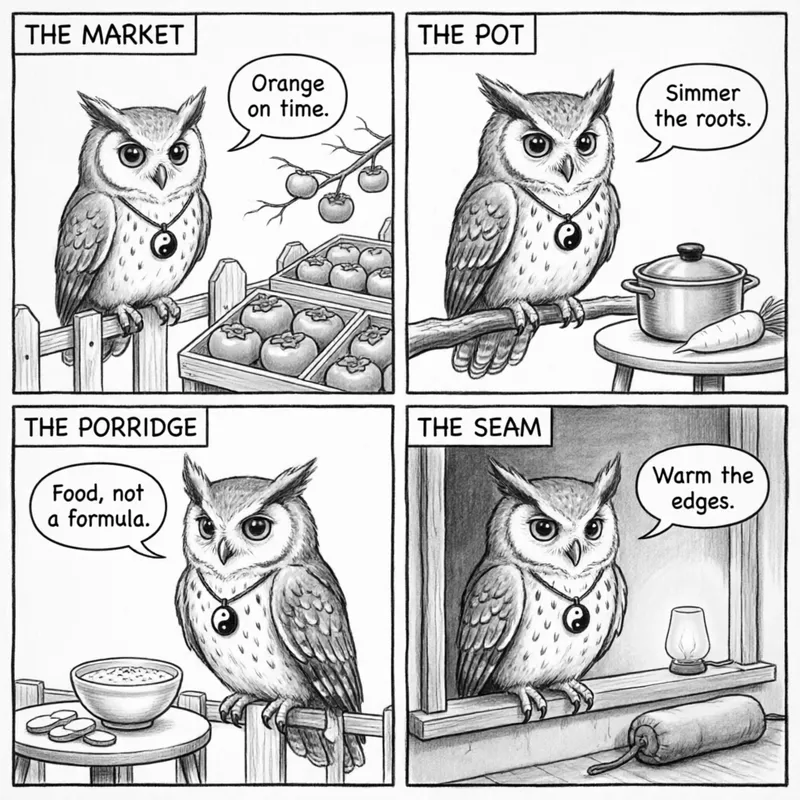
Walk through a northern Chinese market in late October and the persimmons find you first: crate after crate of fruit orange enough to look lit from inside. Folk wisdom promises persimmons prevent a runny nose.
Ollie has opinions about the persimmon tree behind the market. "I watched a man bite a hard one last October," he says, one ear tuft flicking up as he tilts his head. "His whole face folded like a paper bag. I thought about it for days."
Firm astringent persimmons carry soluble tannins, and traditional dietary writing warns against eating a pile on an empty stomach. Case reports describe rare phytobezoars, masses formed when tannins bind stomach contents. Wait until an astringent fruit slumps in your hand; Fuyu-type persimmons are fine crisp. If pregnant, taking regular medication, or managing a digestive condition, ask someone who knows your history.
Beyond persimmons, the pantry turns toward roots and dense foods. White radish, or Luo Bo, goes into the pot for a long simmer. Traditional dietary sources call it pungent, sweet, and cooling, and say it directs Qi downward and loosens phlegm. Some traditional sources warn against taking radish with ginseng. That caution belongs to prescribing, not dinner: a few slices in soup aren't a dose. If ginseng is in your formula, ask your prescriber what to eat around it.
Chestnut vendors turn iron drums over flame; shells split like knuckles. Pears steam with rock sugar and ginger. Chestnuts warm, pears moisten.
Northern grandmothers have a line: better to nourish at Frost's Descent than at the start of winter. You fortify the house before the storm, not during it. At the table that means soups, roots, and porridge, not concentrated tonics; those depend on the person and health history.
Living at the Seam: Sleep, Warm Feet, and Steady Rhythm
Suwen chapter 2 gives autumn its own instructions: early to bed, rising with the rooster, and a settled mind. Frost's Descent already borrows from its winter counsel: seek warmth, don't drain the skin with sweat.
In Five Element terms, Metal generates Water: the Lung's descending movement hands the season to the Kidney, which stores. That is why late-autumn advice turns conservative. You are protecting what gets put away, not building.
You can date late October by the small surrenders. The chapstick moves from the drawer to your coat pocket. Your feet learn the two warm floorboards between bed and bathroom. The salad bowl goes back in the cupboard and the soup pot never quite leaves the stove.
A household saying holds that "cold starts at the feet." A warm foot soak may soothe cold evenings; if you have reduced sensation, poor circulation, or open sores, ask a clinician first.
No new wardrobe is needed. There's an old warning against the heavy coat too soon: chun wu qiu dong, bundle in spring, stay cool in autumn. By Frost's Descent, many households add a scarf or a longer layer over the lower back—spots tradition watched and where the wind finds you first.
Ollie Speaks: A Word on Drafts and Perches
I shifted along this branch four times before finding where the wind stopped. My talons know every groove in the bark.
I should have been asleep an hour ago. The wind had other plans.
You have a box on the wall that tells you the temperature. I have feathers, and they are usually right. Then my feet tell me something else, and the feet win. My yin-yang pendant turns cool when the air shifts; I have learned to notice. Your ankles could be sitting in a draft the box will never meet. My branch is the same: windy at one end, still at the other.
So I stopped arguing with the box on the wall. I just find where the cold gets in. Floor level, usually. Then I move. I settle my wings over my feet and that's the end of it. You don't have wings, so you'll have to improvise—socks by the bed, a scarf at the neck.
Five Things to Do This Week
- Leave socks beside the bed instead of in a drawer.
- Swap one cold breakfast this week for porridge or soup.
- Add sliced white radish to a hearty soup or stew.
- Buy persimmons now, but let the astringent ones soften fully on the counter.
- Short on sleep? Go to bed fifteen minutes earlier and leave your alarm where it is.
FAQ
Does Frost's Descent mean anything where frost never appears?
Yes, though not as a weather forecast. In Miami or Brisbane, frost may never show, but the date still marks the Sun reaching 210 degrees of ecliptic longitude. What does not travel is the weather advice. If late October is humid and 24°C where you live, dryness guidance may belong to another climate. Your seasonal turn might be air conditioning running all night. In the Southern Hemisphere, the same date points toward lengthening days and summer. Treat Frost's Descent as a cultural date for checking your own sky, not a forecast.
Can I eat a persimmon while it's still firm?
It depends entirely on the variety. Non-astringent persimmons, such as Fuyu, can be eaten while crisp. Astringent varieties, such as Hachiya, contain soluble tannins when firm and should ripen until fully soft. If you have a history of bezoars, stomach surgery, or delayed stomach emptying, ask a clinician whether persimmons are suitable for you. Anyone taking regular medication or managing a digestive condition should also raise dietary questions with a qualified professional rather than using a seasonal saying as guidance.
My throat has been dry for three weeks. Is that just the season?
A dry throat that is unexplained, worsening, or not improving with simple measures deserves medical advice; humidification may help but doesn't establish the cause. Seek prompt assessment for coughing up blood, persistent fever, unexplained weight loss, or new breathlessness, and emergency care for severe breathing difficulty. Clinicians often use eight weeks to define a chronic cough. Don't wait that long if something feels wrong. Night sweats, heat in the palms and soles, or a red tongue with little coating also merit a qualified practitioner's assessment.
Sources
- Huangdi Neijing Suwen, chapters 2, 5, and 43.
- Lingshu, chapters 18 and 30.
- Wu Cheng, Yueling Qishier Hou Jijie.
- Zhang Zhongjing, Discussion of Cold Damage.
- Yu Jiayan, Yi Men Fa Lü, discussion of autumn dryness; Fei Boxiong, Yi Chun Sheng Yi, on warm and cool dryness.
- Wu Tang, Wen Bing Tiao Bian (1798), on the formulas for warm and cool dryness.
- Hong Kong Observatory, 24 Solar Terms (accessed October 22, 2026).
- MedlinePlus, U.S. National Library of Medicine, overview of bezoars (accessed October 22, 2026).