
Appetite Is Your Body's Health Barometer
 Ollie's Take
Black coffee at seven can quiet an empty stomach for an hour. You answer emails, sit through a meeting, and ignore the hollow beneath your ribs. At three, the quiet breaks. Your hands tremble over the keyboard, and you stand in the office kitchen hunting for crackers or chocolate.
That sudden scramble is not a failure of character. It is an overdue bill.
Outside, Ollie perches on a low oak limb. He ignores every breeze and turns at the rustle that matters. His ear tufts flatten. The pendant turns once as he shifts his grip, and he settles with one foot tucked into his feathers. He catches the quiet signals first. By the time one gets loud, something has already slipped past him.
Ollie's Take
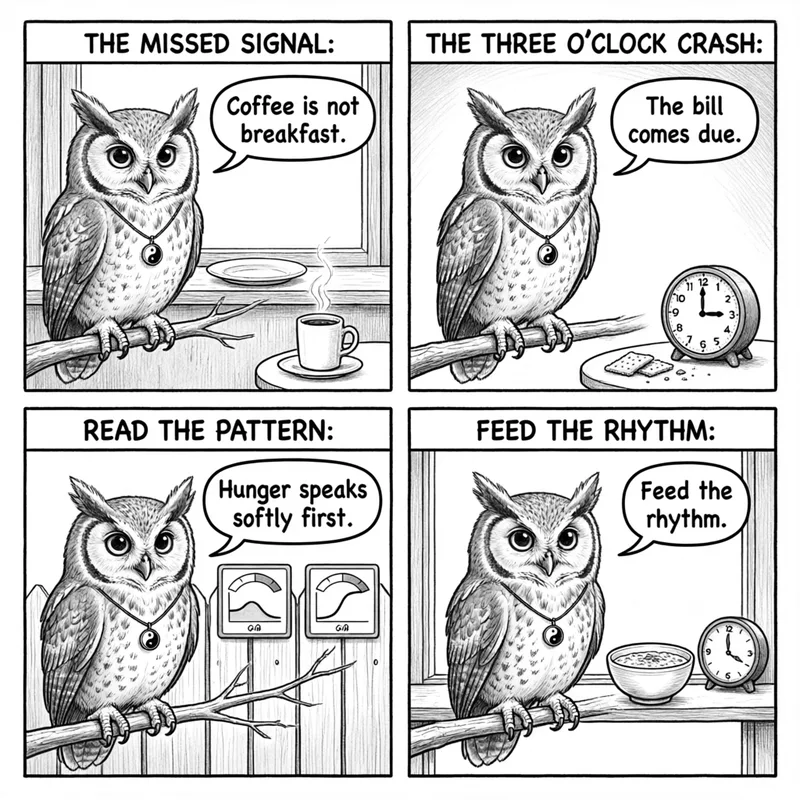
Ollie's take: the quiet signal is the useful one.
What Appetite Means in Chinese Medicine
In Chinese medicine, appetite is not a preference. It is a readout: how well the Stomach takes food in, and how well the Spleen transforms food into usable Qi and Blood.
In TCM, capitalized Stomach and Spleen describe broader functional systems, not just the anatomical organs. The Stomach receives and ripens food, sending Qi downward. The Spleen transforms food and lifts nourishment upward. A steady rhythm means hunger near mealtimes, a meal that satisfies, and energy that holds.
Where Digestive Power Comes From
The traditional Spleen (Pi) governs transformation and transport, produces Qi and Blood (Xue) from food, and keeps Blood in the vessels. Xue nourishes and moistens; it is not the same substance a lab measures in a tube.
Chapter 8 of Huangdi Neijing Suwen names the Spleen and Stomach the granary officials, source of the five flavors. Chapter 21, the Jing Mai Bie Lun (Separate Discourse on the Channels and Vessels), traces two routes. Food Qi enters the Stomach, scatters essence to the Liver, and from there Qi overflows to the sinews. Drink enters the Stomach, rises to the Spleen, and is scattered to the Lung. The Nei Jing describes the route; later physicians extended it: when transport falters, fluid pools, and the tradition calls that Dampness.
The tradition reads digestive warmth as Spleen Yang, which is not self-sustaining. It draws on Ming Men fire, the ministerial fire between the Kidneys that supports baseline heat. When cold settles in the low back and feet, with loose stools before dawn, the root may be Kidney Yang rather than Spleen alone — a practitioner's call.
Li Dongyuan (Li Gao, 1180–1251), founder of the Jin-Yuan Spleen-Stomach school, wrote the Pi Wei Lun amid war and displacement. He argued that irregular meals, emotional strain, and overwork damaged this central system. Later tradition condensed his argument into a line now widely quoted: when the Spleen and Stomach are damaged from within, the hundred diseases arise.
In Ye Tianshi's clinical cases, later compiled by Hua Xiuyun in Lin Zheng Zhi Nan Yi An, the Spleen's preference for dryness is contrasted with the Stomach's preference for moisture. Ye also described warm, drying formulas injuring Stomach Yin.
Ollie rouses, shakes out every feather, and settles his wings flat. Dry wood lights, he says. Wet wood smolders.
The Appetites and What They Signal
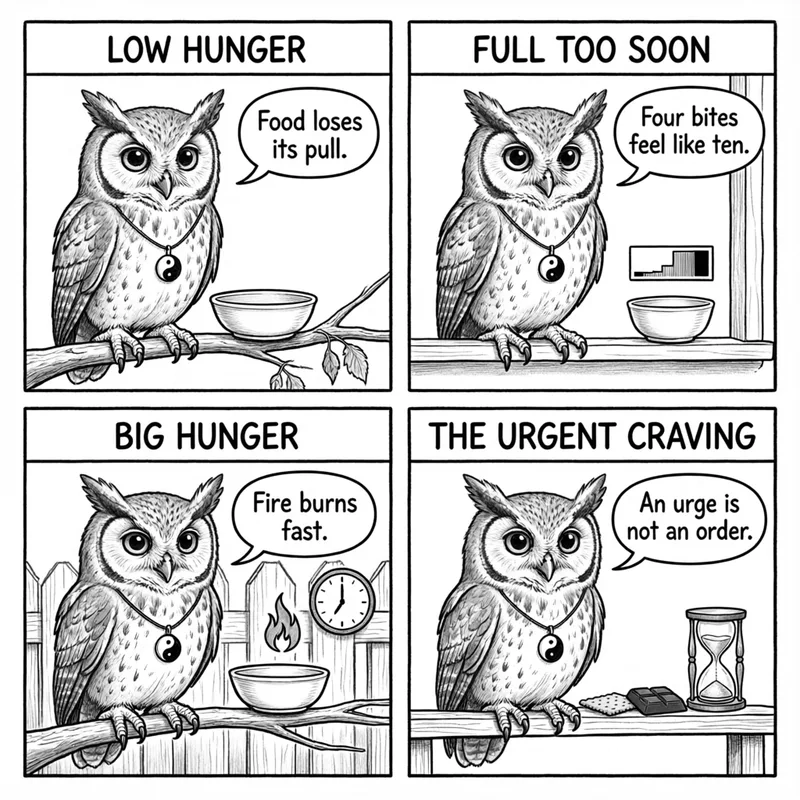
Appetite goes wrong in four recognizable ways: too little, too easily full, too much, or too urgent. Low appetite itself has two common versions.
These overlap in real bodies; read them as signals to notice, not labels.
Low Appetite With Fatigue: Spleen Qi Deficiency
If food holds little appeal, lunch is easy to skip, and the tongue is pale with a soft, weak pulse, the traditional reading is Spleen Qi deficiency. Transformation and transport are underpowered, so appetite and post-meal energy fall instead of food becoming usable Qi. Stomach Yin deficiency can also read as low appetite, but its tongue tends toward red with scant coating, night dryness is common, and warm, drying tonification can intensify the emptiness.
Cold limbs, loose stools, and a preference for warmth may suggest Spleen Yang deficiency. Recurrent predawn diarrhea with low-back weakness or urinary changes can also accompany a Kidney Yang picture.
Low Appetite With Dampness: Dampness Encumbering the Spleen
If the limbs feel sandbagged, the head feels wrapped in wet wool, and a thick white coating sits on the tongue with a soggy pulse (soft and fine, close to the surface), Dampness may accompany deficiency or obstruct digestion on its own. Dampness usually needs to move before rich tonics; cloying tonics add to what the Spleen must transform. Both can say, "I get tired after I eat"; the coating is one clue, not a deciding test.
Early Fullness: When Liver-Stomach Disharmony Is Considered
Fullness after four bites is called early satiation. Impaired gastric accommodation is one possible mechanism. Van Oudenhove and Aziz describe how psychosocial stress changes both gastric movement and how strongly a person feels it. The Stomach's work runs downward. In a Liver-Stomach disharmony picture, constrained Liver Qi presses sideways into that descent, and Stomach Qi counterflows instead — belching, pressure under the ribs, four bites and done. That is the mechanism the pattern name points toward; fullness alone does not establish it. A wiry pulse and red or dusky tongue edges may accompany the traditional reading.
If fullness follows a heavy late meal, with sour belching and a thick greasy coating, think Food Stagnation; easing that load comes before tonifying.
Early fullness can also follow medication effects, ulcers, or delayed stomach emptying. Vomiting, weight loss, or fullness that does not pass are findings clinicians assess.
Hunger That Outruns What the Body Can Use: Stomach Fire vs. Stomach Yin Deficiency
Stomach Fire is excess heat: a full meal disappears, hunger returns fast and loud, the breath turns foul, the gums may feel swollen or hot, the tongue is red with a thick yellow coating, and the pulse is rapid and forceful. Stomach Yin deficiency means the Stomach lacks moistening and nourishment; deficiency Heat can develop alongside it. In TCM, Fire is approached by clearing and Yin deficiency by moistening. The two orientations move in opposite directions. Classical dietetics pairs dried ginger (Gan Jiang) with cold and Dampness in the middle burner; fresh ginger (Sheng Jiang) has a milder role in nausea and chills. Neither fits a Fire or Yin-deficiency picture with marked heat or dryness. Thirst, frequent urination, unintended weight loss, or heat intolerance point to medical questions such as diabetes or hyperthyroidism, which can resemble Fire from the outside.
Ollie tilts his head nearly upside down, pendant swinging loose. Two mice can look alike from his branch, he says, though one gnaws because the granary is endless and the other because nothing is left.
Cravings That Arrive Out of Nowhere: Not a Pattern on Their Own
Sweet or salty cravings are not diagnostic by themselves. A persistent urge to chew ice is a recognized clinical clue because it can accompany iron deficiency; it is not a reliable TCM pattern on its own. Traditional theory maps sweet to the Spleen and salt to the Kidneys. Sleep loss, stress, restriction, and habit can strengthen cravings. A craving has no reliable tongue or pulse signature alone; duration and accompanying symptoms matter more.
The Hunger That Disappears in a Hard Week
When bad news hits, hunger can vanish. The mouth dries, warm food turns mildly nauseating, and coffee replaces lunch.
In acute alarm, the sympathetic nervous system diverts blood toward muscles and heart, away from digestion. Su Wen 39 puts it compactly: fright throws Qi into disorder, and sustained pensiveness — the mind circling one thing — knots it. Su Wen 5 locates the knot: pensiveness injures the Spleen.
Distraction changes meals too. Eric Robinson's systematic review in the American Journal of Clinical Nutrition found that distraction increased immediate and later intake, while stronger meal memory reduced later intake; awareness alone did not clearly reduce immediate intake.
Ollie flattens when a dog barks near the woodpile — ear tufts down, body drawn thin as a broken branch. He holds still, swivels his head once toward the sound, then lets his feathers loosen and shifts his weight back onto both feet. Digestion works best when the body is not bracing for pursuit.
What Returned Appetite Can and Cannot Tell You
After three days in bed with a seasonal virus, the fourth morning can bring an unexpected appetite. Toast or warm broth suddenly smells good.
Returning appetite suggests Stomach Qi is coming back and the body is shifting toward rebuilding. That is hopeful, not proof the illness has resolved; small portions often sit better. Persistent low appetite after a fever, especially when other symptoms are not improving, moves from ordinary convalescence into clinical assessment.
Meals That Ask Less of You
An 800 g meal can feel like a dare. Ease matters more than volume; labels count calories, not steadiness. Traditional dietetics pays close attention to temperature, texture, and post-meal comfort. A bowl of millet congee has little drama.
Regular timing matters more than any single ingredient, and cold food that reliably worsens symptoms is one observation rather than a diagnosis. The congee leaves no trace. That is the whole point of it.
When to See a Doctor
Persistent appetite loss, unintended weight loss, difficulty swallowing, vomiting, or new fullness that does not settle point beyond ordinary appetite variation to clinical assessment.
The NHS notes that unexplained weight loss can have serious causes. Vomiting blood, black tarry stools, severe abdominal pain, high fever with digestive shutdown, severe dehydration, or confusion are emergency warning signs.
Shaking, sweating, or confusion can raise a low-blood-glucose safety concern for people taking glucose-lowering medication.
Ollie Speaks
From this branch, hunger looks different than it does from a computer chair. My pendant has gone cold against my chest — that is how long I have been sitting here, watching the woodpile and thinking about your three o'clock. Out here, nobody flies to a field with nothing in it. Still, I have skipped a hunt to keep watching. Even I can make "one more look" sound important.
I miss the early whisper too. I tell myself I will eat after one more look at the woodpile, and then my feet are unsteady on the branch and I cannot remember why. Waiting for the body to shout is a hard way to hunt.
I sit a while before I eat. Not out of discipline — I am slow to wake, and I need a quiet minute to notice whether I am hungry or merely watching a very interesting woodpile. A few unhurried bites with nothing lit up in front of you will show what the food tastes like. I shake my feathers out, tuck one foot up, and wait.
A Seven-Day Appetite Audit
If your health is stable but meals feel disjointed, try a small audit without an app.
A caution: for anyone with a history of restrictive eating, binge eating, or compulsive tracking, a seven-day record can strengthen pressure that is already there. This informal audit is not designed for that situation.
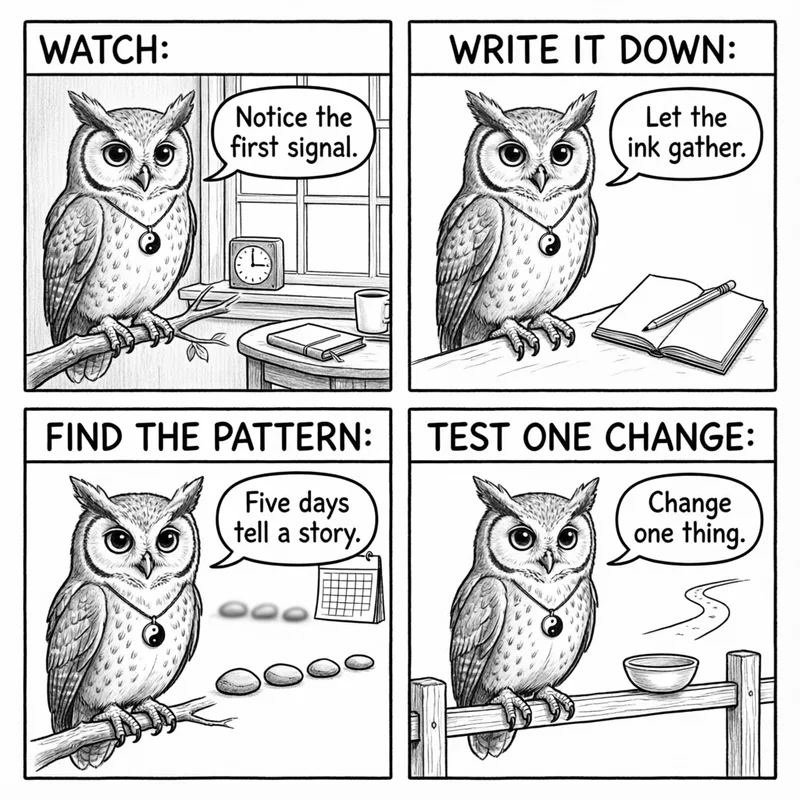
For seven days, record four observations:
- Arrival: Did hunger arrive before the meal as a steady, comfortable signal, as an anxious tremor, or not at all?
- Receptivity: Did the first few bites taste satisfying, or did a sense of heavy fullness appear immediately?
- Post-Meal Sensation: Thirty minutes after eating, do you feel light and clear-headed, or bloated, sleepy, and burdened?
- Mid-Afternoon Stamina: At three or four in the afternoon, does your mental energy hold steady, or do you experience sudden irritability and sweet cravings?
Let the ink accumulate. By day five, patterns usually appear: missed lunch and a four o'clock sugar hunt, or stress-packed email eating followed by uncomfortable fullness.
At dusk Ollie waits on the woodpile, ear tufts half-raised and pendant catching the last light. The first minutes are for finding out what is there.
Then test three ordinary practices that make digestive signals easier to notice. Protect one regular meal anchor, even if the other meals move. Take five unhurried bites before opening a laptop or phone; seeing and smelling the food gives the body's pre-digestion warm-up a chance to start. If you feel up to it, walk a flat 500 m after the largest meal — about ten easy minutes.
The audit is not a diagnosis; it can show why the afternoon crash repeats. Appetite stays useful either way: not an enemy, not a nuisance, just a signal that keeps a schedule.
FAQ
Is poor appetite always a sign of an underlying medical problem?
Not necessarily. A temporary dip can come with warm weather, a quieter week, mild emotional fatigue, or a passing viral illness. In Chinese medicine, a brief shift may suggest that the digestive system needs rest rather than a heavier meal. If poor appetite lasts more than two weeks, comes with unexplained weight loss, or arrives with pain, nausea, or severe exhaustion, that is no longer a lifestyle quirk. Notice how quickly it changed and whether other symptoms came with it. Persistent or alarming patterns point beyond a lifestyle explanation.
Why does stress cause some people to stop eating while others overeat?
Stress can suppress appetite, increase it, or do both at different times. A sharp alarm may shut digestion down within minutes, while longer strain can leave sleep poorer and quick fuel more appealing. Duration matters, but so do individual stress responses, medications, and eating history; cortisol alone does not explain the difference. Neither response is a failure of willpower. Both are physical adaptations shaped by sleep, history, and circumstance, and the same person may shift from one to the other.
How long before the appetite audit tells me anything?
There is no validated deadline, but repeated entries often show something by day five: a skipped lunch turning into a four o'clock sugar hunt, or email-and-eat followed by heaviness. If a full week looks random, that is useful too; meal rhythm may not be the problem. The log is informal and does not replace clinical care. Use the four observations, including how you feel about thirty minutes after eating, rather than grading each day. Persistent or alarming symptoms remain a separate clinical question.
Sources
- Huangdi Neijing, Suwen, chapters 5, 8, 21, and 39.
- Li Dongyuan (Li Gao), Pi Wei Lun, 1249.
- Ye Tianshi, case records in Lin Zheng Zhi Nan Yi An (Case Records as a Guide to Clinical Practice), compiled by Hua Xiuyun, 1766.
- Robinson, E., et al. "Eating attentively: a systematic review and meta-analysis of the effect of food intake memory and awareness on eating." American Journal of Clinical Nutrition, 2013; 97(4): 728-742.
- Van Oudenhove, L., and Aziz, Q. "The role of psychosocial factors and psychiatric disorders in functional dyspepsia." Nature Reviews Gastroenterology & Hepatology, 2013; 10: 158-167.
- NHS, "Unexplained weight loss," accessed October 27, 2026.