
Is Your Body Breaking Down — or Crying for Help?
 Ollie's Take
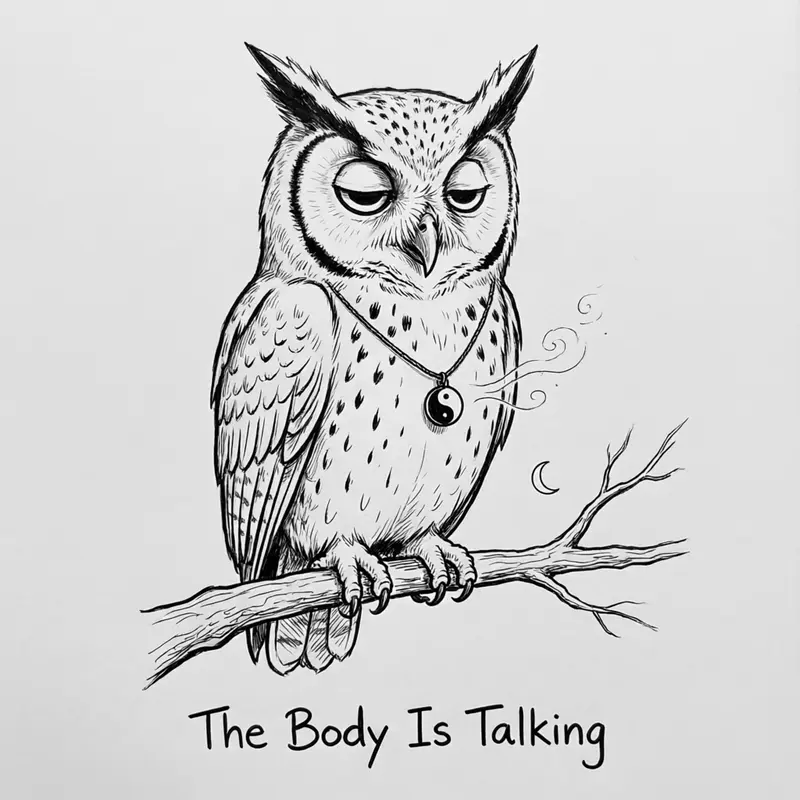
My feathers were doing that thing where every single one stands up at once, and my heart was going like I'd hit a window. Nothing had happened. I was on my usual branch, chest tight, talons trembling, thinking: something is wrong with me. I got checked out. Everything came back normal. That was almost worse.
If you've had a night where your heart pounds for no reason, your chest feels boxed in, your hands shake, your throat feels like something's stuck in it, and then a doctor tells you your labs look fine, you know that particular kind of lonely. Your body is clearly saying something. Nobody can find the sentence.
A quick note first: if chest pain or pressure is severe, new, or getting worse, or comes with shortness of breath, fainting, or pain spreading into your arm or jaw, get urgent medical care right now. This piece can wait. You can't.
In the TCM tradition, the body was never separate from the feelings running through it. The old medical text Suwen, in the chapter often called "On Pain," puts it plainly: hundreds of conditions are born from the movement of qi. Not from weak character. From movement, or the lack of it.
That same text gives a list, sometimes called the "nine qi." The full list also includes cold, heat, and exertion, but the lines people remember are the feelings: anger sends qi rising. Joy slows it down. Grief dissolves it. Fear makes it sink. Shock throws it into chaos. Overthinking ties it in knots. Each feeling has its own way of moving qi through you, and when a feeling gets stuck, held in, never let out, the qi it was supposed to move gets stuck too. Stuck qi doesn't just disappear. It finds a place in the body to sit.
There are old names for this territory. Yu zheng, constraint patterns: the sense of being blocked, unable to release. Zang zao, visceral restlessness: an inner agitation that won't settle. Bai he bing, the lily pattern. And mei he qi, the "plum-pit" feeling: that lump in the throat swallowing never fixes.
The liver — the TCM one, a functional system, not the organ on a scan — sits at the center of a lot of this. It governs free-flowing movement and dispersal, and it stores the blood. The old texts say the hun, often translated as the wandering spirit, rests in that blood at night. In this pattern-based framework, when its free movement gets blocked, the heart can race and the mind can't land anywhere quiet. And when persistent worry is read as draining the blood, practitioners may describe the shaking, the numbness, the tingling that makes no sense on a scan.
None of this means you're broken. It doesn't mean you're weak, and it isn't "just think positive" in disguise. In this way of reading the body, a body that shakes when words won't come out isn't failing you; it's carrying the load somewhere the mind can't yet hold. That's self-rescue, not self-destruction.
In this framework, care tends to move in a few directions: smoothing the liver and helping qi flow again, nourishing the heart and settling the spirit, supporting the spleen so the whole system has something steady to stand on. In daily life that can look almost boring: sleep at consistent hours, slow breathing, a walk, warm food eaten on a rhythm, writing down what's loud in your head, telling one person the truth of how you're doing. Herbs and acupuncture belong to this tradition too, but that's a conversation for a qualified practitioner, and anyone on medication should mention herbs before adding them. This is a traditional interpretive framework, not medical advice and not a diagnosis.
I still perch on that same branch most evenings. Some nights my feathers still do the thing. I've stopped being startled by it, mostly.
The body isn't breaking down. It's talking. The first step is just not being afraid of what it's saying.
FAQ
Is this saying anxiety or bipolar disorder isn't real, just "stuck qi"?
No. Anxiety disorders and bipolar disorder are recognized medical conditions with their own diagnostic criteria and treatments. TCM is a traditional framework for describing certain experiences; it isn't a diagnosis and doesn't replace assessment by a qualified professional.
What does "liver qi" mean here — is it about the physical liver organ?
In TCM, "liver" refers to a broader functional system tied to emotional flow and blood storage, not only the physical organ studied in Western anatomy. It's a different mapping of the body, built on its own logic.