
Shang Huo: The Fire That Isn't Really Fire
 Ollie's Take
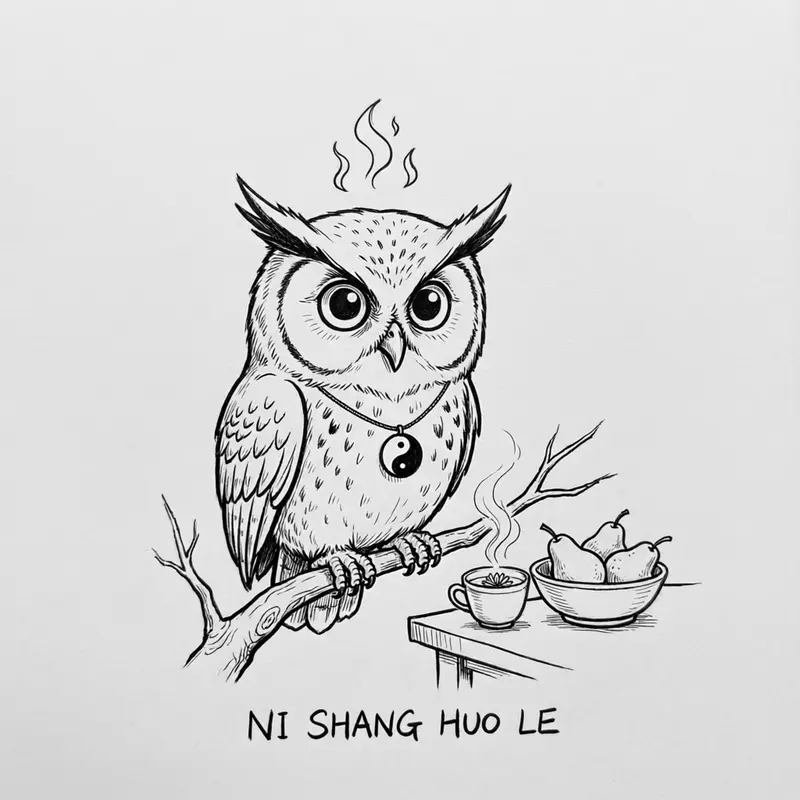
Ollie's take: Hoo-hoo! No thermometer, no flame, but somehow you're "on fire." My family says it to me all the time.
You're sitting across from your Chinese roommate at breakfast. Your throat feels scratchy, there's a small pimple on your chin, and before you can even complain, she glances at you and says, "Ni shang huo le." You've gone up in fire.
No thermometer, no flame, no fever. But somehow you are definitely on fire.
Welcome to shang huo (上火), one of the most common phrases in Chinese household health talk, and baffling to outsiders. It literally means "rising fire": the body's internal balance tips toward heat. In the traditional view, that heat rises to the upper body, which is why the symptoms show up there: sore throat, mouth ulcers, bleeding gums, pimples, bloodshot eyes.
It's not a medical diagnosis. It's a folk-health shorthand with centuries of logic behind it, and once you know it, you'll hear it everywhere.
Scene One: The Morning After Hotpot
You stayed out late, the hotpot was spicy, and you ate twice as much lamb as you should have. The next morning your throat feels like sandpaper and there's a fresh pimple on your forehead.
Your friend takes one look and delivers the verdict: "Hotpot. You went up in fire."
No mention of bacteria, allergens, or late nights. In her framework, the spicy food tipped your system toward heat and your body is showing it. It makes perfect sense to her. You're still figuring out how noodles set you on fire.
Scene Two: Summer Fruit Season
It's July and the market is full of lychees, longan, mangoes, durian. You eat a dozen.
Your grandmother notices. "Don't eat too many," she warns. "Those are heaty fruits. You'll get fire."
You haven't even developed symptoms and she's already predicting them. Certain foods, especially tropical fruits, fried snacks, and anything spicy, are "heaty." Eat too much and the heat accumulates. It's a preemptive scolding, delivered with love and a side-eye.
Scene Three: Stress Week, Mouth Ulcer
You've been working late, sleeping little, and by Friday there's a painful ulcer on the inside of your cheek.
"That's fire from not resting," your mom says over the phone. "Sleep more, drink chrysanthemum tea."
Shang huo isn't just about food. Stress, lack of sleep, and emotional strain tip the balance toward heat. The body, they say, doesn't compartmentalize.
What Families Do
When someone has shang huo, the response is immediate and food-based. Grandma tells you to drink more warm water (yes, even for "heat"; we covered that paradox in an earlier note). Mung bean soup appears, bitter melon shows up at dinner, chrysanthemum tea lands in your cup.
Everyone agrees: cut back on spicy food and late nights, go to bed earlier, let the system cool down.
It's all framed as common sense, not prescription: "cooling" foods are household responses, not instructions. If symptoms are severe or persistent, that's a conversation for a healthcare professional. For an everyday scratchy throat or pimple, the family playbook has been in use for generations.
The Western Confusion
Shang huo is not a fever, not inflammation in the biomedical sense, not literal fire. It's a traditional pattern-description, which is why your Chinese friend blames the spicy noodles while your Western friend blames the weather. Different frameworks, different explanations.
My family tells me I have fire all the time. I stay up all night, eyes bloodshot, screeching a lot. I keep explaining that owls are crepuscular and this is just how we look, but no one listens. Also, a screech owl "on fire" sounds like a forest-safety disaster, so I'd like to clear my name.
The Last Word
Next time someone says you're on fire, you'll know what they mean, and whether to blame the hotpot or the late night is up to you.
FAQ
Is shang huo the same as a fever or inflammation?
No. Shang huo is a folk-health phrase rooted in traditional pattern language, not a biomedical diagnosis. It describes a perceived imbalance toward heat with symptoms that show up in the upper body: sore throat, mouth ulcers, red eyes. A fever is a measured body temperature; shang huo is a cultural shorthand.
Do Chinese people really believe food causes "fire"?
Yes, in the sense that traditional food classification divides ingredients into "heaty," "cooling," and neutral categories based on their perceived effects on the body's internal balance. It's not about calories or vitamins; it's about energetic properties. Belief varies by generation, but the language is still used in everyday family life.