Cupping Isn't Bruising. Those Purple Circles Are Something Else.
 Ollie's Take
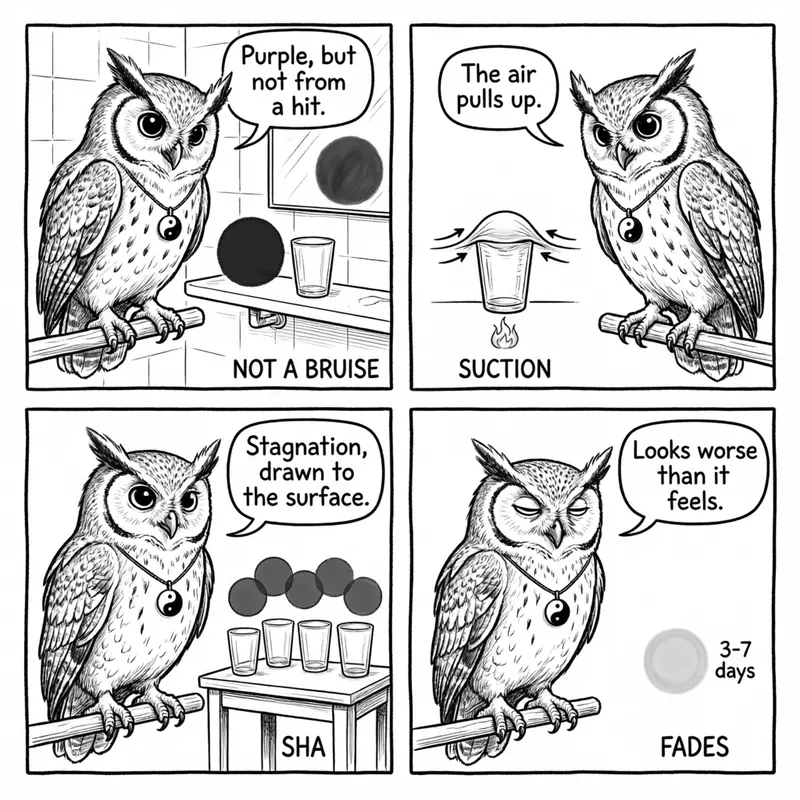
Ollie's take: Hoo-hoo! Suction, not a bruise. The purple circle is doing the talking.
Back at the 2016 Rio Olympics, Michael Phelps stepped onto the starting block, a back covered in dark purple circles. Western social media erupted. People asked if he'd fallen onto giant checkers, collided with blunt objects, or collected giant hickeys.
Viewers across China and East Asia saw the same broadcast and shrugged. To them, it was completely ordinary. It was just ba guan—cupping.
Ollie the screech owl ruffled his feathers from a nearby shelf, adjusting the jade yin-yang pendant at his chest. "Humans see dark purple and scream bruise," he muttered. "They forget the power of simple air pressure."
The Physics of a Purple Circle
A bruise comes from impact. You bang your knee against a coffee table, and the blunt force crushes deep blood vessels beneath the skin. Blood pools into the muscle and connective tissue, causing deep-seated tenderness and swelling.
Cupping works in the exact opposite direction. Instead of blunt force pushing downward, it creates suction that pulls upward.
A practitioner places glass, silicone, or plastic cups on the skin and creates a vacuum. In traditional fire cupping, a lit cotton ball warms the air inside a glass cup before it's placed on the back. As the air cools, it contracts, pulling skin and superficial tissue up into the dome. Modern versions use a handheld pump.
That negative pressure stretches the surface tissue and breaks tiny, superficial capillaries right beneath the skin. Blood gathers in the very top layers, leaving round petechiae. It looks dramatic, but there is no crushed muscle underneath.
What the Tradition Says
In the Chinese wellness framework, those colored rings are called sha.
Traditional theory views cupping as a way to bring trapped heat, stagnation, and sluggish Qi to the surface so the body can disperse it. When Qi and blood flow freely, comfort returns.
Folk readings often interpret the color of the circle: a light pink might suggest mild muscular fatigue, while a deep, eggplant purple is read as heavy stagnation. That color scale is a cultural tradition rather than a medical diagnosis, but it remains a comforting neighborhood ritual across Asia.
Not Just a Chinese Thing
While ba guan became deeply tied to Chinese home wellness and traditional medicine, pulling skin with cups is not uniquely Asian.
Ancient Egyptian papyri describe cupping methods dating back thousands of years. Greek physicians like Hippocrates recommended it for body aches. It exists in traditional Arabic healing as hijama, and appears in European folk remedies dating back centuries.
Wherever people had hollow animal horns, bamboo segments, or glass jars, they realized that creating suction over tight muscles felt surprisingly good.
So Do They Work?
Athletes and everyday gym-goers often use cupping to soothe stiff backs and relax tight shoulders between heavy training sessions.
The scientific verdict is mixed. Some trials suggest cupping may ease localized muscle tension or act as a relaxing sensory reset, while others find little difference versus a massage or placebo. It's a wellness habit, not a cure.
The marks themselves are harmless and usually fade within three to seven days. It's not for everyone, though: whether cupping fits your situation is a question for a qualified professional. And open-flame fire cupping is never something to try without training.
Those purple rings are not battle wounds or broken tissue. They are simply the colorful, temporary mark of negative pressure—and a reminder that wellness traditions often look much more intense than they feel.
FAQ
Do cupping marks hurt?
Despite their fierce purple color, cupping marks do not hurt the way an impact bruise does. During a session, you feel a firm pulling or pinching sensation as the skin draws upward into the cup. Afterwards, the area might feel warm, slightly tender, or tight for an hour or two, similar to a mild sunburn. Because there is no underlying muscle damage, pressing on the circles the next day rarely causes a bruise's sharp ache. The marks fade on their own over several days.
Is cupping safe, and does it work?
When done by a trained practitioner with clean tools, cupping is generally safe for healthy adults. The evidence is mixed: many people report short-term relief from stiff muscles and everyday tension, while studies show modest physical changes. It's a supportive wellness practice, not a cure, and not for everyone. Whether it fits your situation is a question for a clinician. And skip DIY fire cupping, since open flames carry a real burn risk.