
Your Spice Rack Is Secretly a Chinese Medicine Cabinet
 Ollie's Take
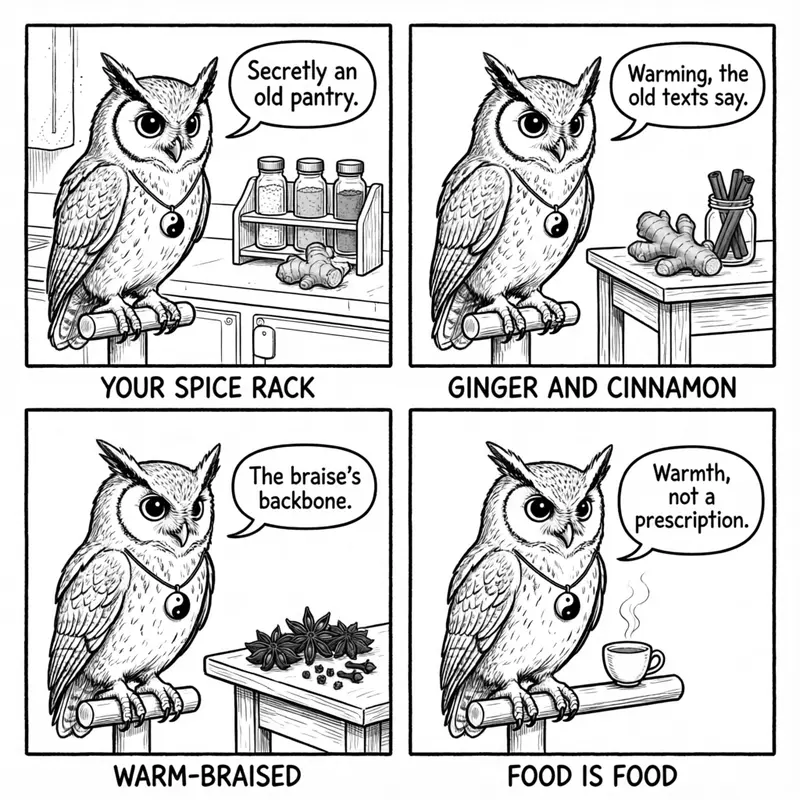
Ollie's take: Hoo-hoo! Your spice rack is the old pantry in disguise.
A wooden cutting board sits on the counter beside a half-grated knob of ginger, a jar of cinnamon, and a handful of star anise.
Ollie the screech owl perches quietly on top of the paper towel holder, his jade Yin-Yang pendant catching the afternoon light. He blinks one round eye toward the cutting board. To most home cooks, this is just prep work for dinner. In Chinese culture, it is the threshold of an ancient pantry.
The tradition holds a simple phrase: yao shi tong yuan, or "medicine and food share the same origin." Long before these plants were packaged into neat glass jars at the local grocery store, they were cataloged by their thermal nature, flavor, and direction. Your spice rack is simply where the cooking pot and the traditional herbal shelf meet.
The Ginger That Was Never Just a Spice
Fresh ginger (sheng jiang) is a kitchen staple across the globe, prized for its fiery bite. In the Chinese culinary tradition, ginger is classified as warming, sharp, and capable of "dispersing cold."
The classic household gesture is familiar: someone gets caught in a chilly downpour, comes home shivering, and simmers thick slices of ginger in water with a spoon of brown sugar. It is not a clinical treatment—it is a traditional home habit meant to wake up the senses and coax Qi outward toward the skin.
Two Cinnamons, Two Jobs
Western baking treats cinnamon as a single, cozy dusting on toast or oatmeal. Traditional herbal theory, however, looks at the tree and sees two completely different ingredients.
The young, slender cassia twigs are called gui zhi. The thicker, mature inner bark is rou gui. The old texts view the twigs as lighter and active along the limbs, while the heavy bark is deep, fiery, and focused on the interior of the body. Same plant, two completely different culinary and herbal personalities.
The Warm-Braised Spices
Open a jar of star anise (ba jiao) or whole cloves (ding xiang) and the aroma fills the room immediately. In Chinese kitchens, these two spices form the warming backbone of slow winter braises.
They often share a pot with Sichuan pepper (hua jiao). That famous citrusy, tongue-numbing sensation from hua jiao is understood in the tradition as dispersing and moving. When simmered with meats and root vegetables, these aromatics were traditionally relied upon to make heavy foods feel lighter on cold days.
The One That Nourishes
Tucked right next to the pungent spices, you might keep a bag of bright red goji berries (gou qi).
Unlike the sharp kick of cloves or the heat of ginger, goji berries are sweet, mild, and soft. The tradition considers them nourishing rather than dispersing—leaning closer to a tonic than a spice. Home cooks toss a few into morning porridge or steep them with hot water on a dry afternoon to support Yin.
Not Just a Chinese Instinct
This way of using plants is far from unique to China. Northern Europe has simmered mulled wine with cloves and cinnamon for centuries. Indian households brew spiced pots of masala chai on rainy mornings. Gingerbread cookies appear whenever the leaves fall. Humans everywhere noticed that certain aromatic plants make cold weather feel a little more bearable.
Ollie ruffles his feathers and gives his take: a pinch of cinnamon in your morning oats makes a great breakfast, not an apothecary prescription. Food is food. If you ever want to explore herbs for a specific personal condition, that is a conversation for a qualified professional. Until then, enjoy the warmth in your soup pot.
FAQ
Does eating ginger or cinnamon do anything, or is it just flavor?
In culinary quantities, spices are primarily seasonings that bring aroma, depth, and pleasure to a meal. In traditional Chinese thought, flavor and function are linked; the aromatic, sharp qualities that make ginger and cinnamon taste invigorating are the very things that give them their warming classification. That said, sprinkling cinnamon on your coffee is an everyday food choice, not a medical intervention.
Does a "warming" spice raise your body temperature?
In Chinese food philosophy, "warming" describes how an ingredient feels and behaves in the body, not a measurable rise on a fever thermometer. A steaming cup of ginger tea creates a sensation of heat, movement, and mild perspiration when you feel chilled. It is a traditional sensory classification based on centuries of kitchen observation rather than clinical thermal data.