Stop Feeding What You're
Trying to Fight
You're standing in the supplement aisle. Vitamin D drops. Omega-3 capsules. A probiotic that promises to "restore gut harmony." A multivitamin with 27 minerals you can't pronounce but assume you need. The checkout total: $47.36. You do this every month. You've been doing it for years.
And yet — you still wake up tired. You still catch two colds every winter. Your digestion is hit-or-miss. You can't remember the last time you felt genuinely, deeply well, not just "not sick."
Here's a question Chinese medicine has been asking for two thousand years — one that no supplement label will ever pose: Who else are you feeding?
Because in the classical TCM view, nutrition doesn't discriminate. The same vitamin C that boosts your immune cells? It also feeds any abnormal growth that's quietly taking root inside you. The same protein powder that builds your muscle? It also fuels the inflammation you don't know you have. You're not just nourishing yourself. You're running an open buffet — and you don't get to choose which guests show up.
"Imagine you have a garden. Some of your plants are healthy, and some have a patch of weeds spreading in the corner. If you pour fertilizer evenly across the entire garden, what grows faster — the vegetables, or the weeds? Chinese medicine doesn't ask 'is this nutrient good?' It asks 'is your soil ready to receive it, or are you just feeding the weeds?'"
— Ollie
What the Ancients Saw That Took Western Science Two Millennia to Confirm
The Chinese medical tradition has a concept that cuts straight to the heart of this issue. It comes from a clinical observation made over centuries of treating chronic disease:
⚕️ The Principle of Selective Nourishment
Disease processes consume resources. Tumors metabolize glucose at rates far higher than normal tissue. Chronic inflammation demands constant cellular repair — which requires proteins, lipids, and micronutrients. In the TCM framework, anything that nourishes the body also nourishes whatever is imbalanced within it — unless the body's processing systems are working perfectly first.
The great physician Ni Haixia (Ni Haixia (1954–2012, modern TCM master), 1954–2012), one of the most influential classical TCM teachers of the modern era, taught this with characteristic directness. When treating patients with chronic conditions — especially cancer — he gave a counterintuitive instruction: stop taking vitamins. Stop protein supplements. Stop nutritional drinks. Eat simple, warm, cooked food.
His rationale was stark: tumors need two things to grow — cold water and nutrition. Vitamins and supplements, being highly concentrated nutrients that bypass normal digestion, effectively deliver both directly to whatever is growing inside you. His clinical rule was simple: "If the feet are cold, do not supplement." Cold extremities signal that the body's internal fire — what TCM calls Yang Qi (Yang Qi) — is too weak to distribute warmth to the limbs. In that state, anything you consume that requires processing energy will either stagnate as waste (what TCM calls dampness) or feed pathogenic processes directly.
 Ollie's Take
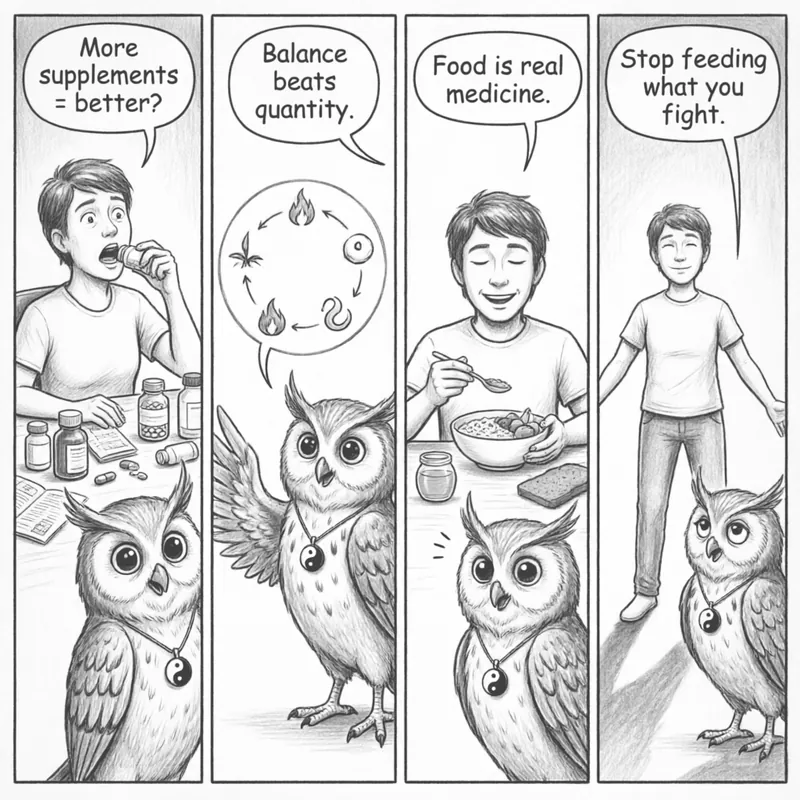
Stop fighting your body. Start feeding it what heals.
Wait — Aren't Vitamins Essential for Health?
They are. But not in the way you think.
Classical Chinese medicine has always understood that nutrients must be processed to become useful. This is the job of the Spleen and Stomach system (Spleen-Stomach, pí wèi) — the duo at the center of the body's metabolic engine. In TCM physiology, the Stomach receives food and begins breaking it down. The Spleen then extracts the pure essence (Gu Qi, Grain Qi) and transports it upward to nourish the Lungs, Heart, and eventually the entire body.
When this system works well, you can extract everything you need from a bowl of congee with some ginger and a soft-cooked egg. When it's weak — which is the case for most people living modern sedentary lives with air conditioning, cold drinks, and constant snacking — even the most expensive organic superfood supplement becomes stagnant gunk that clogs your system rather than nourishing it.
This is why TCM practitioners rarely prescribe "nutritional therapy" in the modern sense. Instead, they prescribe herbs and foods that strengthen the digestive engine itself. Because once the engine works, it extracts what it needs. Once it's broken, no amount of premium fuel helps — it just floods the engine and stalls the car.
The Two Ways Supplements Backfire
In the TCM clinical view, supplements cause problems through two primary mechanisms:
Path 1: Dampness Creation (dampness generation)
Your Spleen is too weak to process concentrated nutrients → they sit in your system as stagnant fluids → you get bloating, brain fog, phlegm, fatigue, and that heavy-limbed feeling that won't lift.
Path 2: Disease Nourishment (pathogen nourishment)
The nutrients are absorbed — but into pathological tissue rather than healthy cells → the "weeds in the garden" grow faster → underlying conditions worsen silently while you think you're being healthy.
Neither path shows up on a standard blood test. Your vitamin levels might look great. You might have "no deficiencies." But underneath the numbers, your body is accumulating waste it can't clear, or fueling processes it can't control. This is the blind spot that classical Chinese diagnostics were designed to illuminate — not by measuring isolated markers, but by observing how the whole system behaves: your energy, your sleep, your digestion, your warmth.
What Ni Haixia Taught: Fix the Engine First
Ni Haixia's clinical approach to nutrition was radically simple. His framework can be summarized in three rules that challenge everything the supplement industry wants you to believe:
Rule #1: Warm foods only when Yang is weak
If your hands and feet are cold, your digestive fire is low. Cold foods and raw vegetables douse it further. You need warming, cooked foods — ginger, cinnamon, lamb, bone broths — not another capsule of freeze-dried spinach extract. The principle: cold extinguishes fire; warmth kindles it.
Rule #2: Simple meals, not complicated ones
A bowl of warm congee with a slice of ginger is more nourishing than a smoothie with fifteen ingredients — if your Spleen is weak. Complexity demands more processing power. When the engine is sputtering, give it fuel it can handle, not a chemical formula it has to decipher. This is why classical TCM formulas often contain only 3–7 herbs — simplicity is a feature, not a shortcoming.
Rule #3: Stop feeding the competition
This is the rule most people resist. If you have any chronic condition — even something "mild" like frequent colds, digestive issues, or fatigue — stop all non-essential supplements for two weeks. Watch what happens. Many patients feel better. Their body was spending energy processing supplements that should have gone toward healing. Ni Haixia was blunt: "The tumor eats before you do. Why are you setting the table for it?"
"The first principle of classical medicine is: do not nourish the disease. Before you add anything to the body, ask — is my digestion ready? Are my hands warm? Is there anything inside me that might eat before I do? If you can't answer yes to all three, put the supplement down."
Your Practical Toolkit: The "Stop Supplements" Test
Try This: A Two-Week Supplement Fast
- Week 1: Stop ALL non-prescribed supplements. No multivitamin. No protein powder. No fish oil. No probiotics. Just food — warm, cooked, simple. Three meals a day. Drink only warm water, ginger tea, or weak green tea.
- Week 2: Continue. Pay attention to three things: (1) Your energy levels — did you crash, or did you actually feel clearer? (2) Your digestion — bloating better or worse? (3) Your sleep — any change?
- End of Week 2: Evaluate. Many people discover their "essential" supplements were doing nothing — or actively making things worse. If you felt worse, your Spleen was too weak to survive without them, and you need to rebuild it with warm foods before reintroducing anything.
- If you felt the same or better: You just saved yourself $50/month. Spend it on fresh ginger, organic vegetables, and good quality meat instead. Your body knows what to do with those.
🥣 Ollie's Spleen-Rebuilding Breakfast
Here's what I eat when my digestion feels sluggish and my hands are cold (which, for a creature with feathers, is most mornings):
- ☕ Ginger tea first — three thin slices of fresh ginger in boiling water. Drink before eating anything. Warms the digestive furnace.
- 🍚 Warm congee — rice cooked until it's almost a porridge, with a pinch of salt and a sprinkle of cinnamon. Easy to digest, deeply warming.
- 🥚 One soft-cooked egg — gently nourishing, not heavy. Scrambled in a tiny bit of butter or sesame oil.
- 🚫 Nothing cold. No smoothies. No iced anything. No raw food before noon. Your digestive fire is a candle, not a bonfire — protect it.
But What About Vitamin Deficiencies?
Legitimate question. Here's the TCM answer, which is more nuanced than a simple yes or no:
True vitamin deficiencies exist — scurvy, beriberi, rickets — and they are medical conditions that require treatment. But the vast majority of people taking daily supplements do not have clinical deficiencies. They have a digestive system that can't extract what's already in their food. If your blood work shows low iron despite eating red meat and spinach, the problem isn't that you need more iron. The problem is that your Spleen isn't absorbing it properly. Flushing in more iron won't fix the Spleen. It'll just strain it further.
This is the fundamental difference between Western nutritional science and Chinese medical thinking. The West asks: "What's missing? Add it." TCM asks: "Why can't you extract what's already there? Fix that." The first approach gives you a lifelong customer. The second gives you your health back.
🔍 The 5-Question Supplement Test
Before you swallow any supplement, ask yourself:
- Are my hands and feet warm right now? (If no → your Yang is weak. Don't supplement until you warm up.)
- Did I eat a warm meal today? (If no → fix food first. Pills can't replace meals.)
- Can my digestion handle this? (If you get bloated easily → your Spleen is struggling. Adding supplements makes it worse.)
- Do I have a diagnosed deficiency from a blood test? (If no → what are you treating?)
- Could I eat a real food version of this instead? (Need vitamin C? Eat an orange. Need minerals? Drink bone broth. The body recognizes food. It doesn't always recognize capsules.)
The Bigger Picture: Your Body Is Not a Chemistry Set
The supplement industry sells a seductive story: your body is a machine with interchangeable parts, and if you top off the right fluids and swap the right components, it'll run smoothly forever. It's a nice story. It's also wrong in ways that matter.
Your body is not a chemistry set. It's not a car engine. It's a living ecosystem — more like a garden than a machine. You don't "fix" a garden by dumping in nitrogen and potassium and hoping the plants sort it out. You fix it by improving the soil, adjusting the water, pulling the weeds, and giving the healthy plants room to grow. Chinese medicine has been doing systems-level health for two millennia — not by isolating problems into elements, but by strengthening the whole organism's ability to regulate itself.
Supplements, for all their promised precision, are a blunt instrument. They bypass the body's own elaborate filtering and distribution systems. They assume the problem is a missing ingredient rather than a broken kitchen. And in many cases — especially when cold hands, chronic fatigue, or digestive weakness is present — they actively make things worse by nourishing the very imbalances they're supposed to correct.
This is the teaching Ni Haixia spent his career defending: Your body knows what it needs. Give it a working engine, and it'll handle the rest. Give it a broken engine and premium fuel, and you've just invested in bigger problems.
— Ollie
FAQ
Should I stop taking all supplements?
Not all supplements — but you should evaluate them with a pattern-based lens. If you're taking 15 things without a clear diagnosis, you're likely feeding both your body and your underlying pathology. The key question: does this supplement address a confirmed deficiency or pattern?
What's the difference between nourishing and feeding a pathogen?
Nourishing means providing what a healthy system genuinely lacks — like giving iron to someone with confirmed iron-deficiency anemia. Feeding a pathogen means dumping nutrients into a system that can't process them, where they stagnate and fuel inflammation, dampness, or Yin Excess.
How do I know if I have Yin Excess?
Signs include: feeling heavy or sluggish despite adequate sleep, cold sensations that don't improve with warming, persistent digestive issues, and symptoms that worsen with rich foods or supplements. A TCM practitioner diagnoses this through pulse, tongue, and symptom pattern analysis.
Sources & Further Reading
- Shanghan Lun (Classic on Cold Damage) by Zhang Zhongjing (150–219 CE) — The foundational text on how pathogens exploit Spleen-Stomach weakness to establish Yin Excess patterns.
- Ni Haixia (1954–2012) — Ren Ji lectures on the Shanghan Lun. Extensive clinical commentary on Yin Excess, supplement misuse, and the "stop feeding what you fight" principle.
- Huangdi Neijing (The Yellow Emperor's Inner Classic) — Suwen chapters on Spleen-Stomach transformation and transport as the root of post-natal Qi.
Enjoying TCM Way?
New letters every week. No spam, no hype — just classical Chinese medicine, told warmly.
Subscribe →