
The Castle Inside You
Your Body's 6-Layer Defense System
You went to bed with a scratchy throat. Two days later, you're shivering under blankets, nose running. Your doctor says "just a virus — rest and fluids." You take some cold medicine. The symptoms fade. A week passes. The fever is gone, but something's off. You're exhausted in a way that feels different. Your appetite never came back. You drag yourself through the days. Three months later, you're at the gastroenterologist with "unexplained" digestive issues, and nobody connects it to that cold.
That wasn't just a cold. That was a battle — and your body lost territory it may never fully reclaim.
Here's something your doctor probably never told you: your body doesn't just "get sick" and "get better." It fights illness through a map — six layers of defense, each with its own territory and its own warning signs. Ancient Chinese physicians mapped this system two thousand years ago. Once you learn to read the map, you'll never look at a simple fever the same way again.
"Think of your body as a fortified castle. Invaders don't just walk into the throne room. They have to breach six walls first. Each wall has guards, alarms, and counter-attack protocols. If a wall falls and you don't take it back, the enemy moves deeper. That's exactly how illness works — and exactly how healing should work, in reverse."
— Ollie
The Map: Six Layers, One Body
This framework is called Six Conformation Differentiation (Six-Meridian Pattern Differentiation (liu jing bian zheng), liù jīng biàn zhèng). The great physician Zhang Zhongjing (Zhang Zhongjing (150–219 CE, author of Shanghan Lun)) codified it in the Shang Han Lun (Shanghan Lun (Classic on Cold Damage)) around 200 AD — a clinical classic that remains the backbone of herbal medicine to this day. It is widely regarded as the most complete map of how disease moves through the body.
The six layers are divided into two territories:
🍃 The Yang Territory (Outer 3 Layers)
Your body's first line of defense. The fight is in the open, and you can win — if you fight smart.
⚠️ The Yin Territory (Inner 3 Layers)
This is where chronic disease lives. Recovery is possible, but it takes time and strategy.
 Ollie's Take
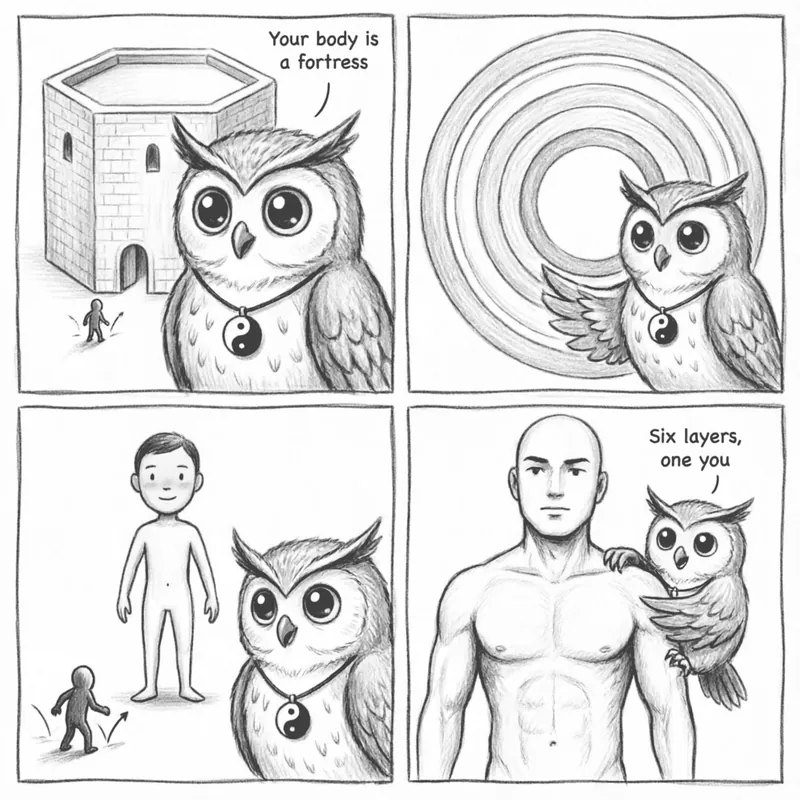
Your body has six layers of defense. Most medicine only looks at the first one.
The Six Walls, From Outside In
WALL 1 Taiyang — The Skin Shield
Territory: Skin, pores, back of the neck — your boundary with the world.
Signs: Stiff neck, chills, slight fever, headache at the back of the head. You feel like you might be getting sick.
Your move: The easiest layer to resolve. Ginger tea, a hot bath, or the classical formula Gui Zhi Tang (Guizhi Tang) to open the pores and sweat the pathogen out. Do NOT take cold-natured medicine here. That's like opening the gate to let the enemy in.
WALL 2 Shaoyang — The Hinge
Territory: The space between surface and interior — chest, rib area, lymphatic system.
Signs: Alternating chills and fever, bitter taste in mouth, dry throat, dizziness, irritability. You're "half-sick, half-well."
Your move: The classical formula Xiao Chai Hu Tang (Xiao Chaihu Tang) "harmonizes" — it restores your body's ability to push the pathogen back out rather than attacking it head-on. Win here and you bounce back. Lose here and things get serious.
WALL 3 Yangming — The Last Stand in Yang Territory
Territory: Stomach and large intestine — your body's furnace.
Signs: HIGH fever, profuse sweating, extreme thirst, constipation. The body has gone ALL-IN.
The good news: This layer is a dead end. Once the pathogen reaches Yangming, it CANNOT go deeper — Yangming is pure Yang, and Yin territory requires Yang depletion to enter. Fight here and you either win or the disease burns out. The catch: modern medicine often suppresses this fever with antipyretics. Remember — the fever IS the fight.
⚠️ You've Crossed Into Yin Territory
If the pathogen bypassed Shaoyang — say, because cold-natured medicine drove it straight down — it enters the Yin layers. This is where "I just never felt the same after that illness" happens.
WALL 4 Taiyin — Spleen & Lungs Under Siege
Territory: Spleen, pancreas, lungs — your digestive and energy headquarters.
Signs: Bloating, no appetite, loose stools, frequent phlegm, chronic fatigue. The fire has gone out.
If you've ever had a stomach bug that left you weak for weeks, or a respiratory infection that turned into months of coughing — you've tasted Taiyin. Your body is no longer overheating; it's running cold.
WALL 5 Shaoyin — Heart & Kidney: The Core
Territory: Heart and kidneys — your body's power plant.
Signs: Constant sleepiness ("wanting to sleep," dan yu mei wanting to sleep), cold hands and feet that never warm up, lower back pain, nighttime urination, brain fog. The kidneys — your body's battery — are running on empty.
Clinical rule: When a patient says "I just want to sleep all the time," experienced TCM physicians immediately become alert. This is NOT normal tiredness or "just being busy." It signals the disease has reached Shaoyin, where the body's core energy (kidney Yang) is being drained. The danger here isn't dramatic symptoms — it's the quiet, creeping loss of vitality that's easy to dismiss until it's advanced.
WALL 6 Jueyin — The Last Fortress
Territory: Liver and pericardium — the deepest layer, where Yin and Yang lock in a final struggle.
Signs: Upper body burning hot while lower body is ice cold, thirst with no desire to drink, hunger with no desire to eat, severe exhaustion. The thermostat is shattered.
A classic teaching: chronic liver conditions often trace back to a pathogen that traveled to the Jueyin layer and lodged there. When treated properly, patients go through phases of fever and skin rashes — the disease being driven back out through the layers.
The Most Important Rule: Healing Goes in Reverse
Disease moves forward: Wall 1 → Wall 2 → Wall 3 (dead end) or bypass to Wall 4 → Wall 5 → Wall 6.
Healing moves backward: Wall 6 → Wall 5 → Wall 4 → Wall 2 → Wall 1 → out of the body.
"This is why people treating chronic conditions with TCM sometimes get 'worse' before they get better. A skin rash appears, or a fever spikes, or old symptoms return. Your doctor might panic. But a classical TCM physician celebrates — the enemy is evacuating. The castle walls are being reclaimed, one by one."
Classical TCM calls this phenomenon retreating disease. Patients with deep-seated chronic conditions, after months of treatment to warm the body and drive out cold, will suddenly develop rashes or fever — signs that whatever was stuck inside is being pushed outward toward the surface. This is not a setback or a side effect. It's the disease leaving. An experienced practitioner celebrates these moments. It means the castle walls are being reclaimed.
Your Practical Toolkit: Where Are You on This Map?
🔍 Quick Self-Check: Which Layer Are You At?
- Wall 1 (Taiyang) — New cold, stiff neck, slight fever. → Ginger tea + hot bath + rest.
- Wall 2 (Shaoyang) — Hot and cold in waves, bitter taste, no appetite. → See a TCM practitioner. Do NOT ignore.
- Wall 3 (Yangming) — High fever, extreme thirst, sweating. → The fever IS the fight. Rehydrate with warm fluids.
- Wall 4 (Taiyin) — Chronic bloating, loose stools, fatigue, phlegm. → Warm foods only. Ginger tea daily. Cook with cinnamon.
- Wall 5 (Shaoyin) — Always tired, cold hands, nighttime urination, brain fog. → Requires TCM treatment. Start warming foods and moxibustion now.
- Wall 6 (Jueyin) — Severe mixed symptoms, hot/cold chaos, chronic organ issues. → Professional TCM care essential. Do not self-treat.
Ollie's 3-Day Challenge
For three days, every time you feel slightly off — a tickle in the throat, a chill, a headache — ask yourself: "What layer is this?" Is it Taiyang (surface)? Shaoyang (in-between)? Don't just think "I'm getting sick." Think "an invader is at Gate 1 — what opens the gate to let it out?"
Most people reach for cold medicine at Gate 1 and drive the pathogen straight to Gate 4. They feel better for a few days, then develop a lingering cough, digestive issues, or that vague "never quite recovered" feeling. Don't be most people. Learn to read the map.
Why This Framework Matters
Modern medicine is extraordinary at acute emergencies — surgeries, trauma, infections with clear pathogens. But chronic illness is where the gap lives. Autoimmune conditions, chronic fatigue, fibromyalgia, IBS, "mystery" symptoms that test after test can't explain — these are often diseases that slipped into the Yin layers years ago and were never driven back out.
Here's the bitter truth: most people with chronic conditions can trace them back to a single illness they "got over" — a bad flu in their twenties, a pneumonia that took months to shake, a stomach infection they treated with antibiotics and forgot about. The pathogen never left. It just went deeper.
The Six-Layer map isn't a replacement for modern diagnostics. It's a complement — a way to understand the terrain of your own body. Once you know the map, every symptom becomes a signal: "The enemy is here. Which wall needs reinforcement?"
📝 One Thing to Remember
Never suppress a Taiyang illness. When a cold starts — stiff neck, chills, that scratchy feeling at the back of your throat — your body is fighting at the surface, where it has the advantage. Help it sweat. Help it warm up. Drink ginger tea. Take a hot bath. Don't drive the fight deeper with cold medicine, antibiotics (for a virus — they do nothing but damage your gut), or by simply ignoring it and pushing through. Your future self — the one who doesn't have a chronic illness in five years — will thank you. This is not folk wisdom. It's two thousand years of clinical observation, compressed into one rule.
Ollie Speaks
Think of your immune system as a castle with six walls, not one. Most people only know about the moat (wash your hands!) and maybe the outer gate (vitamin C!). Chinese medicine mapped all six layers two thousand years ago — and the genius of the system is that it tells you exactly which wall the invader is at, and exactly how to push it back out. Without ever letting it reach the throne room.
— Ollie (brewing his third ginger tea of the morning — 1:12 ginger-to-water, he'll have you know)
FAQ
What's the difference between this and the Western immune system model?
The Western model focuses on cellular and molecular mechanisms — T-cells, antibodies, cytokines. The Chinese model focuses on functional layers and patterns of progression. They're complementary: the Western model explains what's happening at the cellular level; the Chinese model explains why the pathogen moved from one tissue layer to another and what to do about it clinically.
Does the Six-Layer Defense system apply to non-infectious diseases?
Yes, though the application is more metaphorical. Chronic inflammatory conditions, autoimmune patterns, and even emotional trauma can be understood through the lens of depth and progression — surface irritations versus deep-seated patterns. The framework helps clinicians decide treatment priority: clear the surface before addressing the interior.
Sources & Further Reading
- Shang Han Lun (Shanghan Lun (Classic on Cold Damage)) by Zhang Zhongjing (Zhang Zhongjing (150–219 CE, author of Shanghan Lun)), ~200 AD. The original text mapping the Six Conformations — still the clinical backbone of classical herbal medicine.
- Ni Haixia (Ni Haixia (1954–2012, modern TCM master)). Ren Ji Series (Ren Ji (Human Benchmark) lecture series): Shang Han Lun (Shanghan Lun). A modern revival of the Six-Layer framework, taught through clinical cases and practical application.
- Huangdi Neijing (Huangdi Neijing (The Yellow Emperor's Inner Classic), Yellow Emperor's Inner Canon). The foundational text on the Six Conformations and their relationship to organ systems.
- Ni Haixia (Ni Haixia (1954–2012, modern TCM master)). Clinical teachings on Six-Layer pathogenesis — including the concept of "retreating disease" and the layered approach to chronic conditions.
— Ollie
Enjoying TCM Way?
New letters every week. No spam, no hype — just classical Chinese medicine, told warmly.
Subscribe →