
That Heavy Feeling in Your Limbs? It's Not Laziness.
You know that feeling? Arms like lead. Climbing stairs feels like summiting Everest. Getting out of bed requires a negotiation process that would exhaust a UN diplomat.
You've been told it's a discipline problem. That you're lazy. That you just need to push harder.
I'm here to tell you: there's a very good chance none of that is true.
Your body isn't slacking off.
It's sending you an SOS that nobody taught you how to read.
The "Lazy" Label Is a Trap
Here's the thing about "lazy": it frames a physical experience as a moral failure. If your car won't start, you don't call it morally deficient. You check the battery. You ask what changed.
But when you won't start — when your body refuses to cooperate — the default explanation is character flaw. Not enough grit. Not enough willpower.
TCM asks a different question: "What if the engine that turns food into energy is running on fumes?"
That engine is called the Spleen. (Not the organ that filters blood — TCM and Western anatomy use the same word for completely different things. Annoying, I know.)
 Ollie's Take
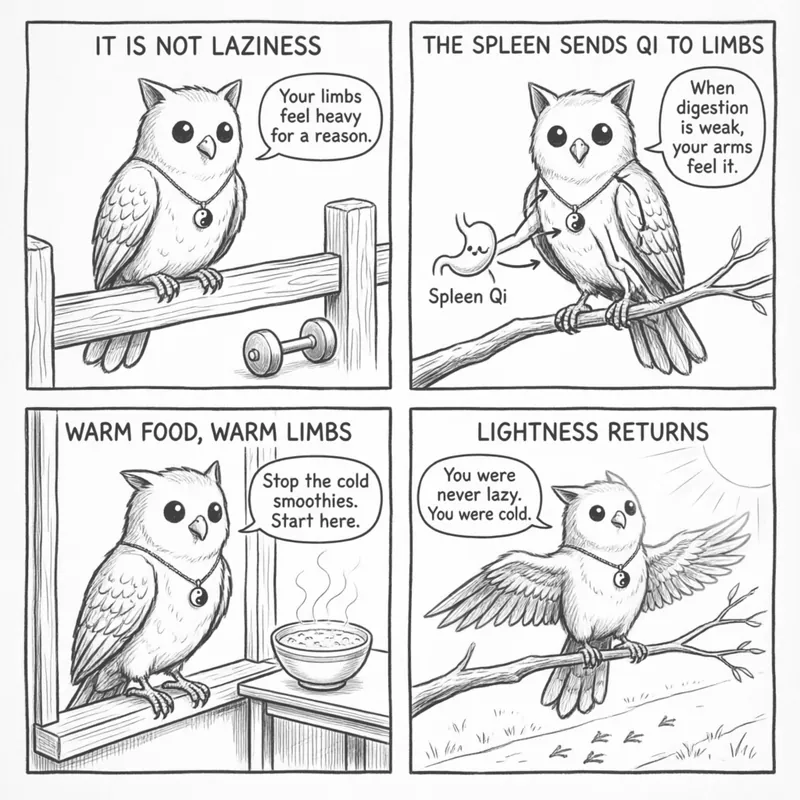
Dampness isn't laziness. It's a sponge where your energy should be.
Meet Your Spleen — The Energy Plant
In TCM, the Spleen is a functional system with three jobs: digest food into raw materials, convert those materials into usable Qi (energy), and transport that energy to your muscles, limbs, and brain.
When it works well: you feel light, clear, strong. When it doesn't — well.
Does any of this sound familiar?
- Limb heaviness — especially after meals
- Fatigue that doesn't improve much after 8+ hours of sleep
- Bloating or fullness after modest meals
- Brain fog, particularly mid-morning
- Weak muscles that tire quickly
- A pale tongue with teeth marks on the edges (go ahead, check)
- Craving sweets when tired
Check more than three? TCM would say: your Spleen Qi is waving a white flag. Not because you're weak-willed — but because the system that produces your energy is running at half capacity.
The Central Axis — Why Everything Goes Wrong
Peng Ziyi (1871–1949) described the body as a wheel. The Spleen/Stomach is the central axle — when it turns smoothly, everything else rotates. When it jams, the whole wheel grinds to a halt.
Think of your Spleen as a power plant. When it goes offline, it doesn't matter how many lightbulbs you have. The factory goes dark. Every other organ — muscles, brain, immune system — gets underpowered.
This is why Spleen issues show up everywhere. It's not localized fatigue. It's systemic underpowering. And it explains why fixing one thing (more sleep, more coffee, iron supplements) never fully solves it — you're treating symptoms while the power plant is still running at half capacity.
What Wears Down the Spleen?
The Spleen has preferences. Modern life is a catalog of things it hates:
1. Cold, raw foods. Digestion is a cooking process — your body needs metabolic "fire" to break down food. Ice water, smoothies, cold salads? That's dumping cold water on a stove mid-cook. (No, it doesn't mean never eat salad again. Just not while your Spleen is struggling.)
2. Overthinking. In TCM, the Spleen houses thought. Excessive worry, rumination, replaying conversations — these directly tax Spleen Qi. Notice how stress kills your appetite? That's your brain hijacking resources from your gut.
3. Eating while stressed / multitasking. Digestion needs rest-and-digest mode. Answering emails while eating? That's asking your Spleen to do its hardest work while someone's screaming at it.
4. Irregular eating + sugar crashes. The Spleen likes rhythm. Skipping breakfast then late-night snacking confuses it. And sugar? Gives you a 45-minute spike, then a crash that makes you want more. It's a cycle that further depletes an already-tired Spleen.
What To Actually Do (The Practical Stuff)
- Start your day warm. Warm water with lemon. Oatmeal. Congee if you're feeling ambitious. Something that doesn't require your stomach to heat it from fridge temperature. This single change has the biggest impact of anything on this list.
- Cooked > raw. Steamed, baked, stewed. Raw salads can come back when your energy returns. Right now? Cooked vegetables taste better anyway when seasoned properly.
- Sit down to eat. Without your phone. Ten minutes. Taste your food. Chew it. Let your body know: mealtime means mealtime.
- Protect your rhythm. Roughly the same windows each day. Your Spleen is a creature of habit — give it one.
- Move gently. Not HIIT. Not marathon training. Walking. Gentle yoga. The Spleen governs muscles — moderate movement strengthens it. Excessive intense exercise without recovery depletes it.
One more thing: Spleen weakness often comes with Dampness — fluid accumulation that feels like wearing wet clothes on a humid day. It's why limb heaviness is so characteristic. The good news: the same adjustments above also clear Dampness. Fix the engine, and the flooding clears itself.
The goal isn't to transform overnight. It's to stop attacking the system that's already struggling — and give it conditions under which it can recover.
— Ollie
Ollie Speaks
"Dampness" sounds like a basement problem, not a health problem. But here's the thing: your Spleen is a dehumidifier. When it gets overwhelmed — by greasy food, by overthinking, by eating while distracted — the humidity builds up. You feel heavy because you are heavy. The water that should have been processed is sitting in your tissues. The fix isn't a pill. It's giving your dehumidifier a break.
— Ollie (who may or may not have nodded off halfway through that metaphor — he's an owl, it happens)
FAQ
What exactly is "dampness" in Chinese medicine?
Dampness describes a pathological accumulation of fluids that the body hasn't properly processed. It feels heavy, sticky, and sluggish. Common causes: poor diet (especially greasy or sweet foods), weak Spleen function, and living in humid environments. It's a real clinical pattern, not a metaphor.
How do I know if I have dampness?
Key signs: feeling heavy (especially in the limbs), foggy thinking, sticky tongue coating, bloating after meals, and a sensation of "fullness" without eating much. If you feel worse in humid weather, that's another strong clue.
Sources & Further Reading
- Peng Ziyi (Peng Ziyi (1871–1949, author of Circular Motion in Ancient Chinese Medicine)). The Circular Motion of Ancient Chinese Medicine (《Circular Motion in Ancient Chinese Medicine》). Introduces the "central axis" model of Spleen/Stomach as the pivot of all bodily Qi movement.
- Zhang Zhongjing. Treatise on Cold Damage (Shanghan Lun, Taiyin chapter). The 1,800-year-old classic that first systematically described Spleen deficiency patterns.
- Kaptchuk, Ted. The Web That Has No Weaver: Understanding Chinese Medicine. Contemporary Books, 2000. Chapter 4 ("The Spleen") — the clearest English-language explanation for general readers.
Enjoying TCM Way?
New letters every week. No spam, no hype — just classical Chinese medicine, told warmly.
Subscribe →