
The Five Elements Are Not
a Personality Test
Somewhere between the Huangdi Neijing and the wellness internet, the Five Elements turned into a personality test.
Type “which element am I” into any search engine and you will find something that looks more like an issue of Cosmopolitan than a medical text. “Wood types are leaders.” “Fire types are passionate.” “Earth types are nurturing.” Last week I saw one with 47,000 likes. Forty-seven thousand. That is more people than live in the town where the Huangdi Neijing was written.
The problem is not that people enjoy personality frameworks. People have enjoyed personality frameworks since Hippocrates drew circles for the four humors. The problem is that the Five Elements were never a personality framework to begin with. Applying them as one is like reading a circuit diagram and asking which resistor you identify with.
If you read the chapters of the Huangdi Neijing that deal with the Five Elements — Suwen chapters 4 through 7 — you will notice something striking. There is not a single BuzzFeed quiz. Not a single “which element are you.” Not a single moment where the text pauses to assign Wood, Fire, Earth, Metal, or Water to a person as an identity. What you find instead is a functional map. The Elements describe how organ systems relate to each other, how seasons affect health, how emotions move through the body, and what happens when one part of the system falls out of rhythm with the rest.
In other words: the Five Elements are not about who you are. They are about how your body works. And the distinction matters more than most people realize.
Your Body Is a Garden, Not a Label
Before we get to the mechanics, let’s fix the metaphor.
If you think of the Five Elements as personality types, the metaphor is a filing cabinet. You open a drawer marked WOOD, find the description, and file yourself there. Done. Next to you are four other drawers with four other types, and everyone is neatly sorted and labeled.
This is satisfying. It is also wrong.
The correct metaphor — the one consistent with classical usage — is a garden. In a garden, every plant depends on every other plant. The rose is not a “rose type” independent of the soil it grows in. The tomato is not a “tomato personality” separate from the water that reaches its roots. The soil feeds the stem. The stem holds the leaves. The leaves catch the sun. The fallen leaves rot back into the soil. Everything is connected. Nothing stands alone. And if you pull one plant out and ask “what is this plant, in essence, in isolation” — you have already missed the point.
This interconnectedness is not decorative. It is the central organizing principle of the Five Element framework. And classical physicians gave it two interlocking names: the Sheng cycle and the Ke cycle.
 Ollie's Take
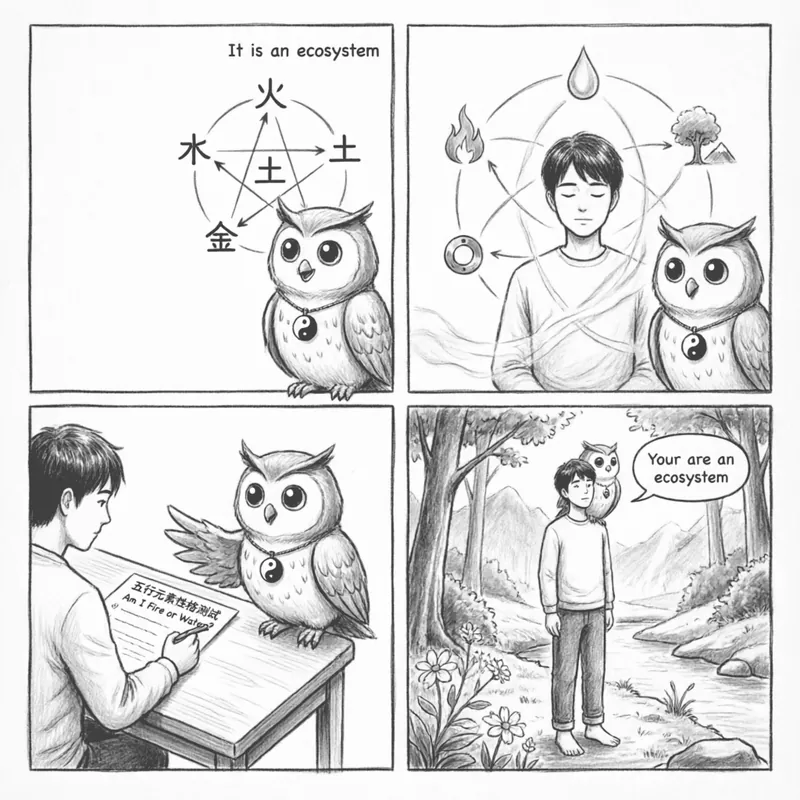
▸ Panel 1: The BuzzFeed quiz trap — "Which element are you?" is the wrong question.
▸ Panel 2: Your body is a garden, not a personality label — all five elements interconnected.
▸ Panel 3: The Sheng cycle (nourishing) and Ke cycle (regulating) as garden relationships.
▸ Panel 4: The Five Elements in your body today — which relationship is out of tune?
The Sheng Cycle: How Your Systems Feed Each Other
Sheng means “generating” or “giving birth to.” The Sheng cycle describes how each Element nourishes the next, in a continuous circuit:
The Sheng (Nourishing) Cycle
This is not poetry. It maps directly to physiology. The Liver (Wood) stores and distributes blood — without this, the Heart (Fire) has nothing to pump. The Heart circulates blood to the Spleen (Earth), which extracts nutrients. The Spleen sends refined essence to the Lungs (Metal), which distribute Qi downward. The Lungs — through their relationship with the Kidneys (Water) — regulate fluid metabolism and anchor the breath.
Every hour of your life, this cycle is running. You do not need to “activate” it. You do not need an app to remind you. The Sheng cycle is what a healthy body does when you do not interfere. It is the default state.
The Ke Cycle: Why Your Body Has a Built-in Regulator
Ke means “controlling” or “restraining.” If the Sheng cycle is the accelerator, the Ke cycle is the brake pedal — and a body without brakes is not a healthy body.
The Ke (Regulating) Cycle
Every system in your body has a counterpart that keeps it from running away. The Liver (Wood) regulates the Spleen (Earth), preventing digestive stagnation. The Spleen manages fluid, preventing the Kidneys (Water) from being overloaded. The Kidneys cool the Heart (Fire), preventing pathological heat. The Heart warms the Lungs (Metal), preventing cold phlegm accumulation. The Lungs regulate the Liver, preventing Qi from rising uncontrollably.
Notice the language here: regulates, prevents, manages, cools, warms. The Ke cycle is not destructive. It is corrective. It is the difference between a lively dinner party and a dinner party where one guest stands on the table and starts shouting. The Ke cycle is the guest who says “maybe sit down and have some water.”
The Map Your Body Uses
So what actually belongs to each Element? The classical correspondences are dense, but here are the core organ-emotion-tissue relationships that show up in clinical practice every day:
| Element | Zang (Yin Organ) | Fu (Yang Organ) | Season | Emotion | Tissue | Direction |
|---|---|---|---|---|---|---|
| Wood | Liver | Gallbladder | Spring | Anger | Tendons | East |
| Fire | Heart | Small Intestine | Summer | Joy | Blood vessels | South |
| Earth | Spleen | Stomach | Late Summer | Worry | Muscles | Center |
| Lungs | Large Intestine | Autumn | Grief | Skin | West | |
| Water | Kidneys | Bladder | Winter | Fear | Bones | North |
Look at this table. Now ask yourself: which row are you? If the answer is a single row, you are misunderstanding a table that describes everyone. You contain all five Element dynamics, all the time. The question is never which one you are. The question is: which relationship is currently out of tune?
When the Garden Overgrows: Stress and Your Digestion
Here is where the rubber meets the road. This is the clinical pattern that pays the rent of traditional Chinese medicine clinics worldwide, and it comes directly from the Ke cycle.
Look again at the Ke cycle row that reads: Wood → Earth. Wood restrains Earth. In the body: the Liver (Wood) regulates the Spleen (Earth). When this regulation is balanced, digestion is smooth. When Wood over-restrains Earth — a pattern classical physicians call Cheng (over-controlling) — the digestive system takes the hit.
What makes Wood over-restrain Earth? Stress. Anger. Frustration. The Liver is the organ most sensitive to emotional constraint, and when it becomes stagnant from unexpressed frustration, its energy can “attack” Earth horizontally — generating bloating, acid reflux, irritable bowel patterns, and that specific type of stomach pain that gets worse when you are upset.
This is not a metaphor. The pattern is so predictable that experienced practitioners will ask a person with chronic digestive issues: “What is the stress in your life right now?” Not because they are being a therapist. Because they are reading the Ke cycle.
And here is the twist: your stomach’s problem might not be in your stomach. You might have normal stomach acid levels, a healthy gut lining, and a perfectly functional microbiome — and still have indigestion every day — because the problem is upstream in the Liver, and the stomach is just the collateral damage. Treating the stomach directly would be like repainting a wall that keeps getting kicked.
"You know how in a garden, the rose doesn't get to vote on the soil pH? Same thing with your stomach. It doesn't get to vote on how stressed you are. Your Liver decides, and your stomach just has to live with the decision. That's the Ke cycle. Not a personality type. Just the plumbing diagram of your emotional life."
Systems Thinking, Two Thousand Years Early
What the Huangdi Neijing describes in the Five Element framework is, by any reasonable definition, a systems theory of the human body. It identifies functional subsystems, maps their relationships, specifies regulatory feedback loops, and predicts what happens when those loops break down. It does all of this without microscopes, without biochemistry, without RCTs — and yet it produces clinical predictions that practitioners validate daily.
Compare this to a personality quiz. A personality quiz tells you a story about yourself that flatters your self-image and ends with a purchase link. A systems theory gives you a map that is indifferent to your feelings about it — but that, used carefully, can help you understand why your body does what it does.
The Five Elements were never about self-discovery. They were about pattern recognition. The patterns are still there. The quiz is still a quiz.
— Ollie
FAQ
Am I one element or a mix?
Everyone has all five elements operating — they're functional systems, not personality types. You might have a tendency, but "I'm a Fire type" misses the point. The Five Elements describe relationships.
How do I know which element is out of balance?
Through the Four Examinations. Wood imbalance → irritability. Fire → insomnia. Earth → bloating. Metal → grief. Water → low back pain. But real patterns are usually mixed — pure single-element imbalances are rare.
Sources
- Huangdi Neijing (Yellow Emperor’s Inner Canon), Suwen Chapters 4–7: “Jin Kui Zhen Yan Lun” (Chapter 4), “Yin Yang Ying Xiang Da Lun” (Chapter 5), “Yin Yang Li He Lun” (Chapter 6), “Yin Yang Bie Lun” (Chapter 7) — Compiled circa 200 BCE – 200 CE. These chapters collectively establish the Five Element correspondences, the Sheng and Ke cycles, and their clinical application to organ system relationships.
- Kaptchuk, Ted J. The Web That Has No Weaver: Understanding Chinese Medicine. 2nd ed., Contemporary Books, 2000. — A landmark English-language introduction that explicitly frames the Five Elements as a relational system, not a typology. Chapter 5 in particular unpacks the difference between the Element framework and Western personality classification.
- Classical concepts referenced: Sheng cycle (generating/nourishing cycle), Ke cycle (controlling/restraining cycle), Cheng (over-controlling pathology) — as developed by generations of classical physicians from the Huangdi Neijing through the Ming and Qing dynasties.
Enjoyed this?
Subscribe via RSS — new articles delivered to your feed reader.
Have a question? Reply by email — good questions become future articles.