Your Body Is a Kingdom
If you open a Western anatomy textbook, your body looks like a warehouse. The liver is Aisle 4, the heart is Aisle 7, and they only interact when a truck (your blood) delivers a shipment from one to the other. Each organ has a job description that fits on a sticky note: filter toxins, pump blood, exchange oxygen.
It's a useful model. It's also incomplete — and it's why you can have perfect lab results and still feel like your body is staging a mutiny.
I learned this the hard way. For years I thought of my organs as separate machines — like appliances in a kitchen, each with its own manual. The Huangdi Neijing showed me a different picture, and once I saw it, I couldn't unsee it.
The Huangdi Neijing, written two millennia ago, uses a different model. Your body isn't a warehouse. It's a kingdom. And the five zang organs aren't isolated departments. They're ministers in a court where every decision ripples through every other department.
When your sleep falls apart, the Neijing doesn't just ask what's wrong with your brain. It asks: which minister is out of step? Because in a kingdom, a dispute in the Ministry of Water (Kidney) eventually shows up as insomnia in the Ministry of Fire (Heart). The kingdom model doesn't just track parts. It tracks relationships.
The Five Ministers (And What They Actually Do)
In classical Chinese medicine, the five zang organs — Liver, Heart, Spleen, Lung, Kidney — are called the wu zang, often translated as "five solid organs." But the character zang (Zang (solid organs)) means "to store, to conceal, to be the treasure house of." Each one stores a specific kind of essence and oversees a specific domain of your life.
Here's the ministries, translated for modern readers:
The Five Zang — A Kingdom Organizational Chart
| Minister | Domain | Stores | Opens Into |
|---|---|---|---|
| Liver | Flow & Planning | Blood | Eyes / Nails |
| Heart | Spirit & Presence | Spirit (Shen) | Tongue / Complexion |
| Spleen | Transformation | Food Essence | Mouth / Lips |
| Lung | Boundaries & Breath | Qi | Nose / Skin |
| Kidney | Reserves & Roots | Essence (Jing) | Ears / Bones |
This isn't metaphor. Each of these pairings has observable correlates. The Liver stores blood — and your eyes (which the Liver "opens into") are the first place you see blood deficiency (blurry vision, floaters). The Kidney stores essence — and your hearing (which the Kidney "opens into") declines when Kidney essence is depleted. The model makes predictions. And those predictions are testable.
 Ollie's Take
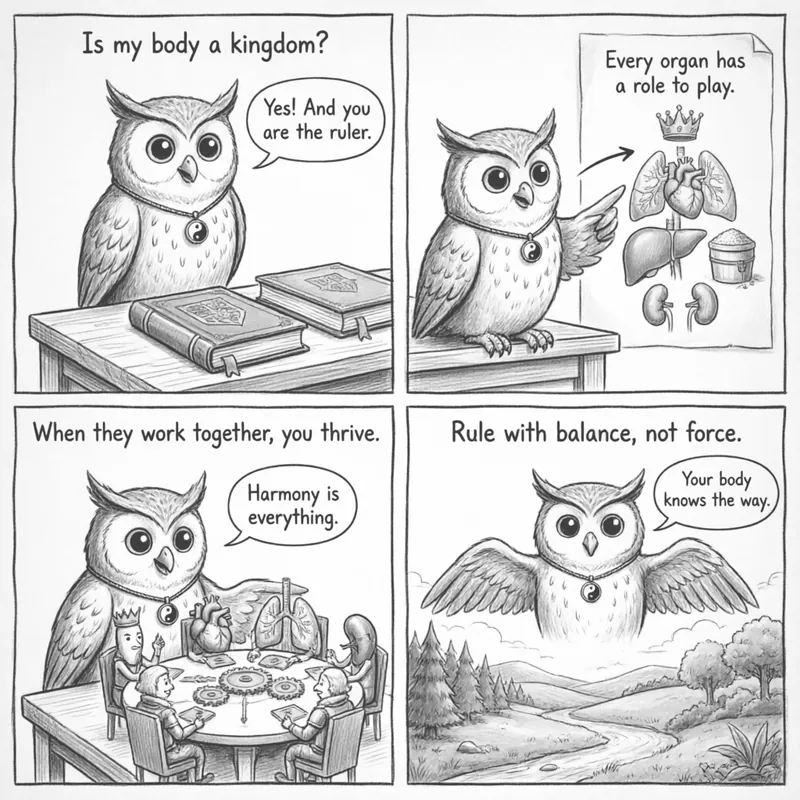
Your organs aren't parts. They're departments in a kingdom that's been running for 2,000 years.
The Liver: The Minister of Flow (And Why Your Shoulders Know It)
The Liver's job description in the Neijing is shuchu (dredging and draining (shu xie, Liver's function)) — "smooth flow and drainage." The Liver ensures that Qi, blood, and emotions move through your body instead of pooling in corners.
When the Liver is functioning well, you're flexible — physically and emotionally. Your periods come on time. Your digestion doesn't seize up when you're stressed. You can take a deep breath when things go wrong.
When the Liver isn't flowing, the Neijing describes it as ganqi yujie — Liver Qi constraint. And it shows up in places that seem to have nothing to do with the liver: shoulder tension, rib-side fullness, irregular periods, digestive spasms, a specific kind of irritability where you're angry but you don't know why.
Western medicine is beginning to map this. The liver-axis theory in gastroenterology now recognizes that liver dysfunction affects gut motility, and that stress (which the Neijing assigns to Liver domain) directly alters liver enzyme patterns. The kingdom model predicted the connectivity. The warehouse model missed it.
The Heart: The Emperor (And Why Your Sleep Depends on It)
The Heart in the Neijing isn't just a pump. It is the jun huo — the sovereign fire, the emperor. And its most important job isn't pumping blood. It's housing the Shen — often translated as "spirit," but more accurately: your capacity for presence, awareness, and emotional clarity.
When the Heart/Shen is stable, you can sit still. You can fall asleep and stay asleep. You wake up feeling like yourself. Your eyes have a calm brightness.
When the Heart/Shen is disturbed — by stress, by grief, by too much coffee, by staying up past midnight — sleep becomes fragmented. You fall asleep but wake at 3 AM with your mind already racing. Or you sleep eight hours and wake up exhausted because your Shen never really came home.
The Neijing's prescription for insomnia isn't always "take something to help you sleep." It's: find out which minister is disturbing the Emperor. Sometimes it's the Kidney (not enough Yin to anchor the Fire). Sometimes it's the Liver (constrained Qi rising and harassing the Heart). Sometimes it's the Spleen (not enough blood to nourish the Heart). The kingdom model asks: who is disturbing whom?
The five zang organs all depend on the Heart to unify them. The Heart is the lord of the five zang and the six fu. When the lord is bright, the ministers are at peace.
— Huangdi Neijing, Suwen, Chapter 8 (paraphrased)
The Spleen: The Minister of Transformation (And Why You're Tired After Eating)
The Spleen in Western medicine is a forgotten organ — a vestigial immune tissue that you can live without. In the Neijing, the Spleen (pi) is one of the most important ministers. Its job: yunhua — transport and transformation. It takes the food you eat and turns it into usable essence (grain Qi), then distributes that essence to the four limbs and the hundred vessels.
When the Spleen is strong, you feel energized after eating. Your muscles are firm. Your lips are a healthy pink.
When the Spleen is weak — often from overthinking, irregular eating, or too many cold/raw foods — you feel heavy and foggy after meals. Your limbs feel like lead. Your lips lose color. And eventually, the Spleen's weakness affects the Lung (its child in the generative cycle) and then the Kidney (its root in the water cycle).
This is the kingdom logic: a weak Ministry of Transformation doesn't just mean poor digestion. It means the entire kingdom starts running low on provisions. Every other minister starts making do with less. And that's when symptoms multiply.
The Lung: The Prime Minister (And Why You Cry When You Grief)
The Lung is the xiangfu — the prime minister, the organ that regulates boundaries. It governs the breath (obviously), but also the skin (your boundary with the outside world) and the circulation of Wei Qi (defensive Qi — your outer immune defense).
The Lung also has the most direct emotional correlate: grief. In the Neijing, grief injures the Lung. And when the Lung is weak, you become prone to unresolved grief — things you can't quite let go of, a heaviness in the chest that won't lift.
This isn't metaphor either. The Lung/immunity/grief connection is now well-documented: bereavement suppresses T-cell function, lowers natural killer cell activity, and increases susceptibility to respiratory infection. The Neijing mapped the Lung-grief boundary 2,000 years before psychoneuroimmunology gave it a mechanism.
The Kidney: The Treasurer (And Why You Crash at 40)
The Kidney stores Jing — essence, the deep reserve that you're born with and that you spend throughout your life. It's your genetic inheritance, your deep energy bank, your ability to age well.
The Neijing describes the Kidney as the xian tian zhi ben — the foundation of before-heaven. Everything you're born with lives here. And everything you do — how you eat, how you sleep, how you love, how you rest — either spends this reserve or conserves it.
This is why the Neijing places such emphasis on midlife. Around age 40, your Kidney Jing naturally begins to decline. If you've spent it recklessly (chronic stress, sleep deprivation, excessive stimulation), the decline is noticeable. If you've conserved it (regular rest, warm cooked food, governed emotions), the decline is gentle.
The kidney also "opens into" the ears — and sure enough, presbycusis (age-related hearing loss) correlates strongly with markers of Kidney essence decline in TCM observational studies.
"The kingdom model asks a different question than the warehouse model. The warehouse model asks: which part is broken? The kingdom model asks: which minister is out of step with the others? And once you learn to hear the kingdom's language — shoulder tension = Liver, 3 AM waking = Lung/Heart, heavy limbs after eating = Spleen — your body stops being a mystery and starts being a conversation."
The Communication System: Qi and Meridians
A kingdom needs messengers. In the Neijing model, that's Qi — and the meridian system is the road network that Qi travels on.
Every organ has a meridian that connects it to the surface of the body. That's why acupuncturists can treat heartburn (Heart domain) by needling a point on the foot (Kidney meridian). The roads connect. The messengers travel. The kingdom communicates.
When communication breaks down — when Qi stagnates in one ministry and can't reach another — symptoms appear in the gaps. Shoulder pain that moves around. Digestive issues that flare with stress. Sleep that's fine until you have an argument, and then it's gone for three days.
The kingdom model predicts these patterns. The warehouse model calls them "functional" and tells you the labs are normal.
What This Means When You Walk Into a TCM Clinic
When a classical physician asks you about your sleep, your appetite, your bowel movements, your thirst, your temperature preference, your emotions, and your menstruation — they're not being nosy. They're doing a kingdom audit.
Each question illuminates a different ministry. Sleep = Heart/Shen. Appetite = Spleen. Bowel = Spleen/Lung/Kidney. Thirst = Lung/Stomach. Temperature = Kidney/Yang. Emotions = Liver/Lung/Heart. Menstruation = Liver/Kidney.
By the time they put the three fingers on your radial pulse (the bian mai — pulse diagnosis), they already have a map. The pulse just confirms which ministers are crying for help and which ones are silently collapsing.
You don't need to become a TCM expert to use the kingdom model. You just need to notice which "ministries" flare up together. Shoulder tension + irritable + irregular cycle? That's the Liver ministry sending up a flag. Waking at 3-5 AM + grief that won't lift + easy colds? That's the Lung ministry. The kingdom is telling you where to look.
The Point of the Kingdom
The kingdom model isn't just poetic. It's a diagnostic framework that tracks relationships instead of parts. And in a world where chronic, multi-system symptoms are becoming the norm — fatigue plus brain fog plus sleep disruption plus digestive sensitivity — the warehouse model runs out of answers precisely where the kingdom model starts to be useful.
Your body isn't a machine. Machines don't cry. Machines don't stay up at 3 AM grieving. Machines don't get shoulder tension from unexpressed anger. Your body is a kingdom — and the fact that it sometimes feels like it's falling apart is just evidence that the ministries need better coordination, not that the parts are broken.
— Ollie
FAQ
Does TCM really think the heart "governs" the mind?
Yes — but "Heart" in TCM is broader than the anatomical pump. TCM's Heart includes functions we'd now call neurological and emotional: consciousness, memory, sleep quality, and emotional equilibrium. When TCM says "Heart houses the Shen (Spirit)," it's describing the organ system that hosts your conscious experience — closer to the brain-heart axis in modern science than either organ alone.
If the Spleen is so important, why does Western medicine barely talk about it?
Western medicine sees the spleen primarily as an immune and blood-filtering organ. TCM's Spleen includes those functions but extends to the entire digestive transformation process — extracting nourishment from food and distributing it as Qi and Blood. You can live without your anatomical spleen; you can't thrive without TCM's functional Spleen.
Is this "kingdom" model just a metaphor?
It's a functional model that proved clinically useful for 2,000 years. The relationships it describes — Liver supporting Heart, Spleen controlling Kidney water, Lung restraining Liver — map onto real physiological feedback loops. The poetry is a memory device; the physiology underneath is the real thing.
Sources
- Huangdi Neijing (Yellow Emperor's Internal Canon), Suwen Chapters 8, 9 — On the five zang organs as a governing system and the Heart as sovereign fire.
- Huangdi Neijing, Suwen Chapter 5 — "Yin Yang Ying Xiang Da Lun" — The mutual rooting and mutual use of Yin and Yang, extended to the five-phase relationships between organs.
- Maciocia, Giovanni. The Practice of Chinese Medicine. Churchill Livingstone, 1994. — Authoritative English-language reference on five zang organ theory and clinical application.
- Kaptchuk, Ted. The Web That Has No Weaver. Congdon & Weed, 1983. — The classic Western introduction to Chinese medicine, with an excellent chapter on Zang-Fu organ relationships.
- Classical concept: zang-fu (Zang-Fu (organ systems)) — the five zang (solid, storage) and six fu (hollow, transport) organs as a coordinated administrative system, as developed across two millennia of classical Chinese medical literature.
Enjoying TCM Way?
New letters every week. No spam, no hype — just classical Chinese medicine, told warmly.
Subscribe →Enjoyed this?
Subscribe via RSS — new articles delivered to your feed reader.
Have a question? Reply by email — good questions become future articles.