Yin & Yang ≠ Good vs Evil
A friend once said to me, “I need more Yang energy right now.”
I paused before answering. Not because she was wrong. Because the sentence itself was built on a misunderstanding so common that it has become invisible.
We talk about Yin and Yang the way we talk about good and bad habits. Yang is what you want more of. Yin is what you need less of. Yin is the couch. Yang is the gym. Yin is the lazy Sunday. Yang is the productive Monday. Yin is the thing you apologize for. Yang is the thing you put on your Instagram bio.
And therein lies perhaps the most consequential mistranslation in the history of East-West cultural exchange: the idea that Yin and Yang are opponents on a scoreboard.
They are not. They never were. And the oldest medical text in continuous use on this planet — the Huangdi Neijing, compiled roughly two millennia ago — is extraordinarily clear about this, if you know where to look.
The Seesaw That Only Works When Both Sides Move
Imagine a seesaw in a children’s playground.
One end goes up. The other goes down. Then the momentum reverses. The end that was up comes down, the end that was down rises. This is not a failure of the seesaw. It is not a sign that one side is “winning.” It is the seesaw doing exactly what a seesaw is supposed to do.
Now someone walks up to this seesaw and says, “You know what? The up side is better. Let’s nail it there.”
They hammer a spike through the fulcrum. The seesaw stops moving.
Congratulations. You now have a broken seesaw — and, in the logic of classical Chinese medicine, a broken body.
This is not my metaphor. Well, the seesaw part is. But the mechanism it describes has a name in the Huangdi Neijing: dongtai pingheng — dynamic equilibrium. And it is the difference between understanding Chinese medicine and just collecting its vocabulary.
 Ollie's Take
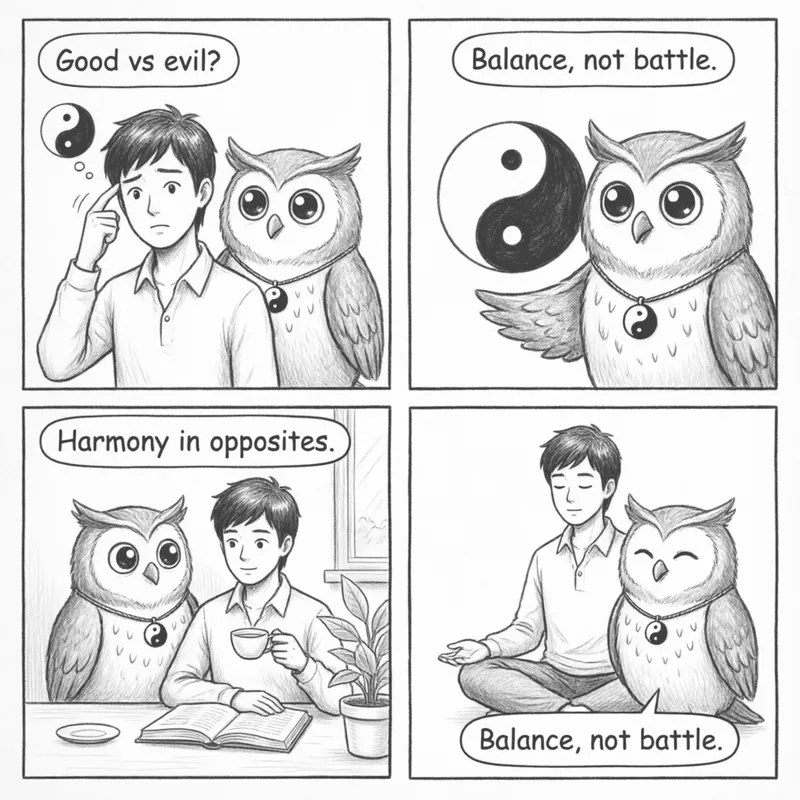
Yin and Yang aren't opponents on a scoreboard. They're a seesaw — and the point is to keep it moving.
The Textbook Definition vs. The Lived Reality
Any introductory TCM textbook will give you the list: Yin is cold, dark, rest, internal, descending, substance. Yang is hot, bright, activity, external, ascending, function.
This is accurate. It is also dangerous — because lists invite ranking. Once you have two columns, the human mind cannot help but ask: which one is better?
The Huangdi Neijing answers this question before you even finish asking it. Suwen, Chapter 5, opens with a line that deserves to be as well-known as “first, do no harm”:
Yin and Yang are the Dao of Heaven and Earth, the fundamental principle governing all things, the parents of change, the root and beginning of birth and destruction.
— Huangdi Neijing, Suwen, Chapter 5
Read that again. Yin and Yang are the Dao of Heaven and Earth. Not a ranking. Not a hierarchy. They are the grammar of how things change — and that grammar has three rules that wellness culture consistently gets wrong.
Rule One: You Cannot Have One Without the Other
The classical term is hugen huyong — mutual rooting and mutual use. Yin is the root of Yang. Yang is the function of Yin. They don’t just coexist; each one generates the other.
Think of a candle. The wax is Yin — substance, stillness, material. The flame is Yang — heat, light, activity. You cannot have a flame without wax. But equally, wax without flame is just a lump sitting in a drawer. The wax exists for the flame. The flame depends on the wax.
In your body: your blood is Yin. Your Qi is Yang. Blood nourishes Qi; Qi moves blood. When a classical physician sees fatigue, they do not automatically say “you need more Yang.” They ask: is the Yang weak, or is the Yin too depleted to support it?
This is the question that “I need more Yang energy” skips entirely.
Rule Two: More of One Always Means Less of the Other
The term is xiaozhang pingheng — waxing-and-waning balance. When Yin increases, Yang naturally decreases. When Yang increases, Yin naturally contracts. This is not pathology. This is physics.
Day gives way to night. Summer yields to winter. Your heartbeat contracts, then relaxes. Your lungs inhale, then exhale. Every single physiological process in your body is a Yin-Yang oscillation.
Where we get into trouble is when we decide we like one direction better than the other. We try to stay in Yang-mode permanently: always on, always producing, always lit. We treat rest as a bug rather than a feature. We forget that the exhale is not a failure of the inhale — it is its completion.
The Huangdi Neijing is blunt about where this leads. When Yang is excessive and Yin is damaged, the text describes it as “the strong suppress the weak” — and it identifies this as the root of illness, not a state of peak performance.
Rule Three: They Transform Into Each Other
This is the one that surprises people most: yin-yang zhuanhua — mutual transformation. At its extreme, Yin transforms into Yang, and Yang transforms into Yin.
Midnight is the peak of Yin. That is also precisely the moment when Yang begins to rise. Noon is the peak of Yang. That is precisely the moment when Yin begins its return. The seed of one is always inside the other. That is not philosophy. That is what the taijitu — the Yin-Yang symbol — actually shows you, with the small dot of the opposite inside each half.
In practice: an intense workout (Yang activity) eventually forces you into deep sleep (Yin rest). High fever (extreme Yang) can suddenly flip into chills and collapse (extreme Yin). The body does not stay in one mode forever. It cycles. Health is not about maximizing one pole. It is about maintaining the rhythm.
"Here’s the thing nobody told you at that wellness retreat: the Yin-Yang symbol isn’t a battle emblem. It’s a weather map. It shows you which way the wind is blowing right now, so you can dress accordingly. If you look at a weather report and see rain, you don’t declare war on water. You bring an umbrella. Same logic. Different hemisphere."
What This Means When You Wake Up Tomorrow
You do not need to “maximize Yang.” You need to notice which way your internal seesaw is tilted — and then do the most counterintuitive thing possible: let it swing back.
Feeling wired, scattered, unable to sleep? Your Yang is excessive relative to your Yin. The answer is not more stimulation to “burn it off.” The answer is something quiet, grounding, nourishing. A walk without a podcast. Food that is warm and cooked, not raw and cold. Going to bed before you’re exhausted.
Feeling heavy, sluggish, unmotivated? Your Yin is dominating your Yang. The answer is not more coffee. It is gentle movement that invites Yang to rise naturally: a morning stretch, sunlight on your face, a brisk ten-minute walk where you actually swing your arms.
Notice what both prescriptions have in common: they are not about fighting the dominant force. They are about inviting the opposite force to participate. You are not at war with your Yin. You are not at war with your Yang. You are conducting the orchestra.
The Cowardly Lion and the Scarecrow
There is a reason we gravitate toward treating Yin and Yang as good and evil. It makes the world simpler. It turns an infinitely subtle dynamic into a binary. You can sell supplements to a binary. You can build a personal brand on a binary. You cannot build a practice of genuine self-understanding on one.
Classical Chinese medicine is not interested in whether you are a Yin person or a Yang person. The very question misunderstands the framework. You are a shifting person, whose Yin and Yang fluctuate with the seasons, the time of day, what you ate, how you slept, who you talked to, and whether you have been holding your breath without realizing it for the last three hours.
The task is not to pick a side. The task is to learn how the seesaw works — and to stop driving nails through it.
— Ollie
FAQ
Is Yang better than Yin?
No. Yin is cooling and nourishing; Yang is warming and activating. A healthy body needs both in dynamic balance. Excess Yang without Yin is like a fire without fuel.
How is this different from the Western idea of "balance"?
The Western concept often implies a static 50/50 equilibrium. Chinese Yin-Yang balance is dynamic — a constantly shifting relationship. Health is the body's ability to return to balance after being pushed.
Sources
- Huangdi Neijing (Yellow Emperor’s Inner Canon), Suwen Chapter 5: “Yin Yang Ying Xiang Da Lun” (The Great Treatise on the Manifestations of Yin and Yang) — Compiled circa 200 BCE – 200 CE, foundational text of classical Chinese medicine.
- Huangdi Neijing, Suwen Chapter 2: “Si Qi Tiao Shen Da Lun” (The Great Treatise on Harmonizing the Spirit with the Four Seasons) — On the cyclical relationship between Yin-Yang dynamics and seasonal health.
- Classical concepts referenced: hugen huyong (mutual rooting), xiaozhang pingheng (waxing-waning equilibrium), yin-yang zhuanhua (mutual transformation) — as developed by generations of classical physicians.
Enjoyed this?
Subscribe via RSS — new articles delivered to your feed reader.
Have a question? Reply by email — good questions become future articles.
Share on Twitter · Reddit · Email
🎧 Listen to this article: East & Inner with Ollie — Ep. 1: Yin & Yang ≠ Good vs Evil
▶️ Watch the Short: They Nailed the Seesaw Down — 30 seconds of TCM