
Wind-Cold Is Not A Weather Report
 You wake up feeling... off. A little scratchy in the throat, a stiffness in your neck you can't quite shake. You know the feeling. Your first thought might be, "Ugh, I'm getting a cold." You reach for the vitamin C, maybe an over-the-counter remedy, and hope for the best.
But in Chinese medicine, that initial moment is the most critical battlefield. What happens in these first few hours determines whether you'll have a minor sniffle that's gone by morning or a lingering illness that drags you down for weeks.
As we discussed last time, thinking "it's just a cold" is the most dangerous sentence in Chinese medicine. Today, we're going to get specific. We're diving deep into the very first stage of a cold invasion described in the Shang Han Lun (Treatise on Cold Damage): the Taiyang stage. And we're going to learn why one simple question — "Are you sweating?" — changes everything.
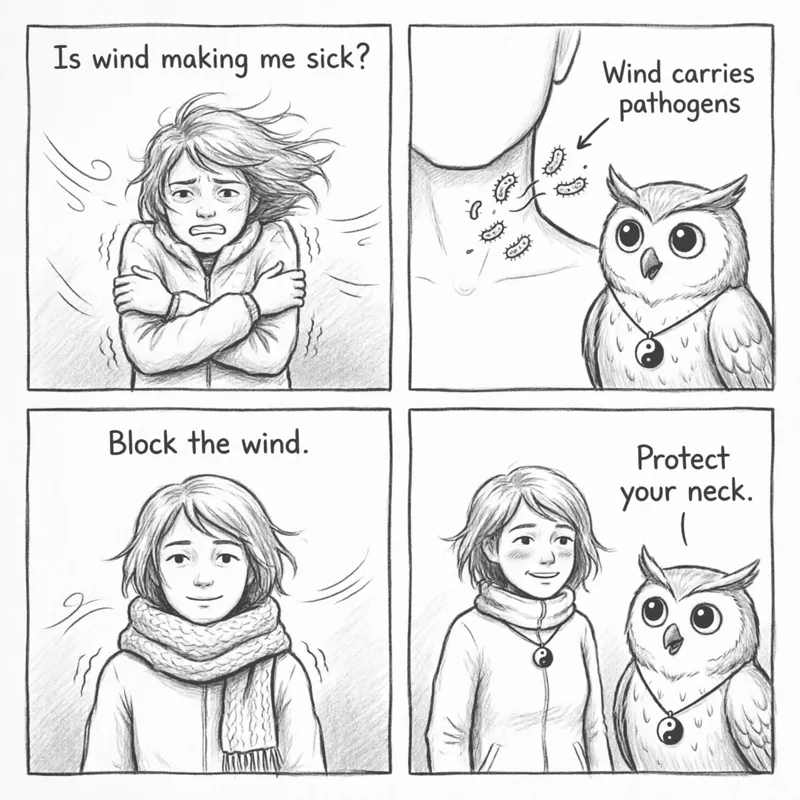
From his perch in the corner, our mascot Ollie the screech owl is ruffling his feathers. He knows this stuff is the bedrock of our entire clinical practice.
 Ollie's Take
The First Lines of the Shang Han Lun
The brilliant physician Zhang Zhongjing, writing around 200 AD, didn't waste any time. He opened his masterpiece, the Shang Han Lun, with the most common and critical pattern he saw. The very first line of the book reads:
"The floating pulse, stiff neck, and aversion to cold — these are the signs of Taiyang disease."
Taiyang (太阳) is the most external of the six layers of the body's defense system. It's your first line of defense, governed by the Bladder and Small Intestine channels, which run along the entire back of your body. Hence the classic stiff neck and upper back.
The three cardinal signs of a Taiyang invasion are:
- Aversion to cold (恶寒): You feel chilled to the bone, no matter how many blankets you pile on.
- Fever (发热): Your skin feels hot to the touch, but you still feel cold inside.
- Floating pulse (脉浮): When a practitioner feels your pulse, it feels like a cork bobbing on the surface of the water. It's right there under the fingers with a light touch — a clear sign that the body's Qi is rushing to the surface to fight an invader.
The Shang Han Lun devotes its largest chapter to this stage for a reason. What happens here — at the surface — determines the entire course of the illness. As the even older Huangdi Neijing states, "When evil wind attacks, it first enters the skin and hair." Get the treatment right at this stage, and you can expel the pathogen completely. Get it wrong, and you risk pushing it deeper into the body.
Wind-Cold Is Not a Metaphor
When we say you've been attacked by Wind-Cold (风寒), we're not just talking about the weather. It's a clinical diagnosis describing a specific physiological event.
Here's what's happening: An external pathogen — what we might call a virus or bacteria — has breached your first line of defense. Your body's protective Qi, the wei qi (卫气), sounds the alarm and rushes to the surface to fight it off.
In a Wind-Cold invasion, the "Cold" aspect causes the pores of your skin to slam shut. Think of it as your body battening down the hatches. The wei qi is trapped at the surface, locked in a fierce battle with the invader. This battle generates heat, which is why you have a fever.
But because your pores are locked tight and the Cold pathogen is obstructing the flow of warming yang Qi to the surface, you feel an intense aversion to cold. This isn't just "feeling a little chilly." This is the kind of deep, unshakable cold where you're shivering under three blankets while the thermostat is cranked to 80. This is the hallmark sign that the battle is happening at the Taiyang level.
The Sweat Question: Gui Zhi Tang vs. Ma Huang Tang
Okay, so you have a fever, chills, and a stiff neck. You're in the Taiyang stage. Now what? This is where the genius of Zhang Zhongjing's observation comes into play. The next step is to ask one, single, all-important question:
"Are you sweating?"
The answer to this question is the fork in the road. It tells your practitioner which of two foundational formulas to use. Ollie hooted from his bookshelf when I said this, because he knows this is the money question.
The Gui Zhi Tang (Cinnamon Twig Decoction) Pattern
- The Answer: "Yes, I'm sweating a little, but I don't feel any better."
- What's Happening: The patient has spontaneous sweating (自汗). This tells us the exterior is "deficient" or weak. The pores are somewhat open, but the wei qi is not strong enough to coordinate with the nutritive Qi (ying qi 营气) and successfully push the pathogen out. The sweating is ineffective.
- The Pulse: Floating and moderate or slow (浮缓). It lacks force.
- The Strategy: We don't need to blast open the exterior; it's already leaking. We need to harmonize the wei and ying Qi, gently release the pathogen, and support the body's righteous Qi.
- The Formula: Gui Zhi Tang uses Gui Zhi (Cinnamon Twig) to release the muscle layer, paired with Bai Shao (White Peony Root) to nourish the Ying and astringe sweat. Sheng Jiang (Fresh Ginger) and Da Zao (Jujube) harmonize the interior, all guided by Zhi Gan Cao (Honey-fried Licorice). Famously, the patient is instructed to drink a warm bowl of rice porridge after taking the formula to help generate a light, healing sweat.
The Ma Huang Tang (Ephedra Decoction) Pattern
- The Answer: "No, not a drop. I feel completely dry, locked up, and my body aches all over."
- What's Happening: The patient has no sweating (无汗). This is an "excess" condition. The Wind-Cold pathogen is so strong it has completely sealed the exterior. The wei qi is trapped, leading to severe body aches (身疼), chills, and often a feeling of pressure in the chest or wheezing.
- The Pulse: Floating and tight (浮紧). It feels like a tense rope under your fingers.
- The Strategy: We need a powerful intervention. The goal is to use a strong, pungent herb to forcefully open the pores, induce a powerful sweat, and expel the pathogen in one fell swoop.
- The Formula: Ma Huang Tang is the formula for the job. Ma Huang (Ephedra) is one of the strongest herbs in our pharmacopeia for inducing sweat. It's paired with Gui Zhi to amplify the effect. Xing Ren (Apricot Seed) helps descend Lung Qi to stop wheezing, and Zhi Gan Cao harmonizes the formula.
What Happens When You Get It Wrong
This differentiation is not just an academic exercise. The clinical consequences of getting it wrong are serious, and the Shang Han Lun is full of warnings.
If you give the gentle Gui Zhi Tang to a person with a locked-tight Ma Huang Tang pattern, it's like trying to put out a forest fire with a garden hose. The formula is too weak. The pathogen isn't expelled and has a chance to penetrate deeper into the body, moving from the Taiyang layer to one of the deeper, more complex layers.
Even more dangerous is giving the powerful Ma Huang Tang to a patient who is already sweating. Their exterior is already weak and open. Forcefully inducing more sweat will scatter their defensive Qi, damage their fluids and Yin, and can lead to a state of collapse. You've taken a weak defense and completely shattered it.
This is precisely why the phrase "it's just a cold" is so problematic. Choosing the wrong strategy at the very first stage can turn a simple, easily resolved illness into a complicated, chronic one.
Modern Relevance
You might be thinking, "This is fascinating, but it's from an 1800-year-old text. Does it still apply?" Absolutely. Every single day.
During the recent pandemic, practitioners of Chinese medicine saw these exact patterns play out again and again. Early-stage viral infections frequently present as classic Taiyang Wind-Cold or Wind-Heat. The name of the virus doesn't matter as much as the pattern it creates in the individual's body.
For anyone interested in taking charge of their health, this is the foundational lesson. The next time you feel a cold coming on, start to observe like a TCM practitioner. Are you shivering even under a duvet? Are you sweating, or are you bone dry? Are your body aches mild, or do you feel like you've been hit by a truck?
Of course, there's another possibility — a Wind-Heat invasion, which typically presents with a more severe sore throat, a higher fever with less chills, and a floating, rapid pulse. But understanding the Wind-Cold differentiation is the first step to decoding your body's signals.
Hoot hoot! Let's make this super simple. You feel sick. Are you sweating?
YES, and I still feel awful? Your pores are leaky but your defenses are weak. That's Gui Zhi Tang territory. The goal is to harmonize.
NO, I'm dry as a bone and my body feels like it's in a vice? The bad guy has locked you down tight. That's a Ma Huang Tang emergency. The goal is to blast the doors open.
Never, EVER guess. These are powerful medicines. Hoot this over with your licensed TCM practitioner!
FAQ
Can I take Gui Zhi Tang or Ma Huang Tang on my own if I have a cold?
No. Absolutely not. These are powerful, prescription-only herbal formulas. Ma Huang (Ephedra), in particular, is a heavily regulated substance in the United States and many other countries due to its potency. Only a licensed TCM practitioner can accurately diagnose your specific pattern by feeling your pulse and examining your other signs. The wrong choice can make your condition significantly worse.
What if I have both sweating AND body aches?
This is a great question that highlights the need for a practitioner. Both patterns can have body aches. However, in a Gui Zhi Tang pattern, the aches are typically milder, more of a general soreness. In a Ma Huang Tang pattern, the body pain (身疼) is a cardinal sign and is often severe — the patient feels crushed, and their muscles and joints ache intensely. If any sweating is present, the diagnosis leans away from Ma Huang Tang. Your practitioner's pulse diagnosis is the ultimate tie-breaker.
How is Taiyang different from just 'having a cold' in Western medicine?
Western medicine identifies a cold by the pathogen (e.g., a rhinovirus) and generally offers one-size-fits-all supportive care for a common group of symptoms. Chinese medicine, through the Taiyang framework, asks a different question: "How is this specific person's body reacting to this invasion?" It differentiates between Wind-Cold and Wind-Heat, an excess or deficient state (Ma Huang vs. Gui Zhi), and the strength of the pathogen versus the strength of the person. The treatment is tailored to that unique pattern, not just the name of the disease.
Sources
- Zhang Zhongjing. Shang Han Lun (Treatise on Cold Damage). c. 200 AD, Taiyang Chapter, Lines 1–3.
- Huangdi Neijing (Yellow Emperor's Inner Classic), Su Wen.
- Bensky, D. et al. Chinese Herbal Medicine: Formulas & Strategies (2nd ed.). Eastland Press.
- Scheid, V. et al. Chinese Medicine: The Ideas and Clinical Practice of an Ancient Art.
Enjoyed this?
Subscribe via RSS — new articles delivered to your feed reader.
Have a question? Reply by email — good questions become future articles.