
Your Body Doesn't Need a Warrior — Stop Fighting, Start Warming
 You feel it coming on. That tell-tale tickle in your throat, the slight ache in your shoulders, the wave of exhaustion that makes you want to cancel all your plans and crawl under the covers. What's your first move?
If you're like most of us, you probably think, "I have to fight this thing." You picture tiny invaders marching through your bloodstream, and you prepare for battle. You grab the strongest cold medicine you can find, down some vitamin C, and maybe even call your doctor for an antibiotic, just in case. Your body has become a battlefield, and you are its commanding general, ready to annihilate the enemy.
But that may be the wrong way to think about it. Your body isn't under attack. It's just... cold.
In Chinese medicine, we see things a little differently. We don't see illness as an external enemy to be obliterated. Instead, we often see it as a loss of warmth, a retreat of your body's natural, vibrant energy. You don't fight the cold — you gently warm it away. You shift from fighting to nurturing, from warring to warming.
The War Metaphor Is Wrecking Your Health
In the West, we're raised on germ theory. The idea is that tiny microorganisms — bacteria, viruses — are the bad guys. They invade, we get sick, and the only solution is to kill them off. This sets up a "war" mentality. We use words like "attack," "defend," and "fight." We take medicines designed to be search-and-destroy missiles.
But this approach can be exhausting. Fighting takes energy! And sometimes, the "weapons" we use cause collateral damage, wiping out the good guys (like our gut flora) along with the bad.
Chinese medicine looks at the situation from another angle. It's less about the "invader" and more about the "terrain" — your body's internal environment. Imagine your body is a house. If the house is warm, well-lit, and sturdy, a little draft from an open window isn't a big deal. But if the house is already cold, damp, and dark, that same draft can make the whole place feel uninhabitable.
When you start to feel sick from a chill — the kind where you've been caught in cold wind and now you're shivering and achy — here's what's happening in TCM terms: a wind-cold pathogen has entered your body's exterior layer (the skin and muscles). Your Wei Qi (卫气, defensive Qi — a yang function that circulates at the surface) is being blocked by this cold, which constricts the pores and traps the pathogen. Your body responds by sending more Yang Qi to the surface to break through the blockage, which is why you feel chills internally but might also run warm. If your overall Yang Qi is already running low, that external cold can push deeper and create a more stubborn pattern.
As the classic text Huangdi Neijing, Suwen (黄帝内经, 素问) says, "正气存内,邪不可干" — when righteous Qi abides within, evil cannot invade. Keep your house warm and strong from the inside out. Fighting depletes your resources; warming restores them.
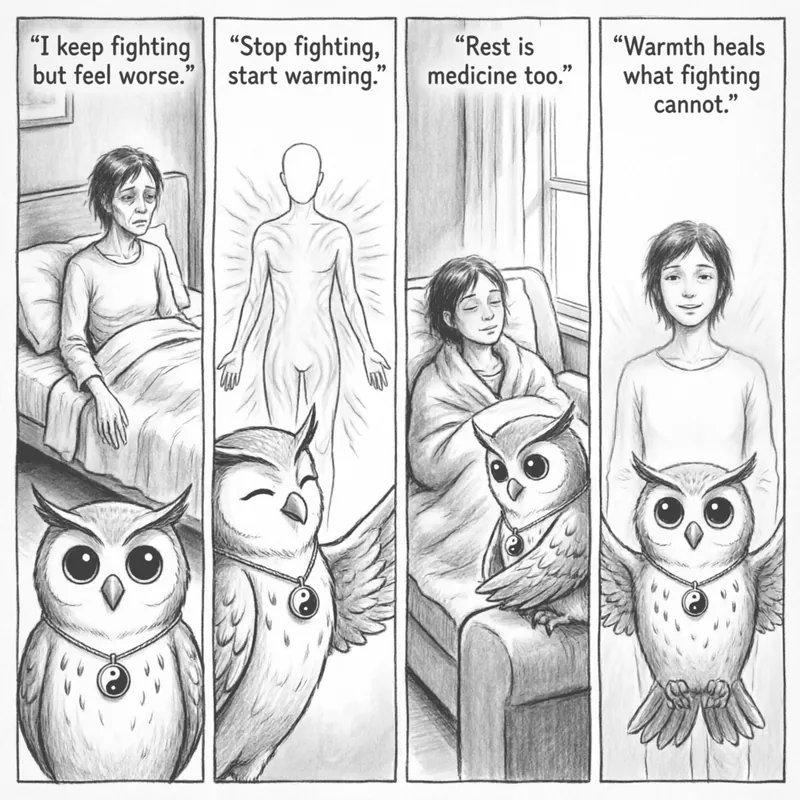
Ollie says: "Hoo's that? Just me! Remember, your body knows what it's doing. Let's listen."
🌿 3 Herbs for the First Sign of a Cold
Ginger, cinnamon bark, scallion white — which one, when, and how. Get the free quick-start guide →
 Ollie's Take
Meet Your Three Warming Herbs
So, how do we turn up the heat? Chinese herbal medicine has a whole category of herbs dedicated to this job. They're called the herbs that warm the yang (温阳). Think of them as different kinds of heaters for your house, each with a specific job. Let's meet three of the most important ones.
1. Gui Zhi (桂枝, Cinnamon Twig) — The Surface Warmer
Think of a room that's gotten a bit chilly overnight. The first thing you might do is open the curtains and let the morning sun stream in. That's Gui Zhi. It's the light, aromatic twig from the cinnamon tree, and its job is to warm the surface of the body.
Gui Zhi is fantastic for the very beginning of a cold — the kind where you feel chills, a stiff neck, and maybe a slight sweat that doesn't seem to help. It gently warms the channels and muscles, encouraging a little circulation right at the surface, like that first ray of sunshine warming your skin. It doesn't blast you with heat; it just coaxes the warmth back to the exterior where it belongs.
2. Gan Jiang (干姜, Dried Ginger) — The Middle Warmer
Okay, the sun is nice, but the core of the house is still cold. Time to bring in a space heater. That's Gan Jiang (干姜, Dried Ginger). This isn't the fresh ginger you use for cooking (that's Sheng Jiang). Dried ginger is much hotter and more powerful. Its target is the "middle" of your body — your digestive system, specifically the Spleen and Stomach.
In TCM, your digestive system is the furnace that turns food into Qi and Blood. If that furnace is cold, your digestion gets sluggish. You might have bloating, loose stools, or a feeling of cold in your belly. Gan Jiang is like putting a space heater right in the kitchen, reigniting your digestive fire so you can properly process food and generate energy to warm the rest of the house.
3. Fu Zi (附子, Prepared Aconite) — The Deepest Warmer
Sometimes, the situation is more serious. It's the dead of winter, the power is out, and the pilot light on the main furnace in the basement has gone out. The whole house is frigid, and you're starting to lose hope. This is when you need Fu Zi (附子, Prepared Aconite).
Fu Zi is one of the most powerful warming herbs in the entire materia medica. It's a true powerhouse, used for situations of profound cold where the body's core fire — the Kidney Yang — is on the verge of extinguishing. This is the pilot light for your entire system. When it's weak, you feel a deep, penetrating cold that no sweater can fix. Your hands and feet might be icy, you feel utterly exhausted, and your whole system is slowing to a crawl. Fu Zi dives deep into the "basement" to relight that fundamental fire.
Ollie says: "Hoo-boy, that's the deep stuff. The basement furnace needs a pro. Your body knows what it's doing. Let's listen."
A quick TCM clarity note before we move on: these three herbs work on different depths of cold, and it's worth understanding the distinction. Gui Zhi primarily addresses external cold invasion — a chill that just got in from outside. Gan Jiang and Fu Zi address internal cold from Yang deficiency — a deeper, chronic pattern where the body isn't generating enough heat on its own. They're related (a body with weak Yang is more vulnerable to external invasion), but they're not the same thing.
Gui Zhi Tang — The First Formula in the Book
It's no accident that one of the most famous and foundational books in Chinese medicine, the Shang Han Lun (傷寒論, Treatise on Cold Damage), opens with a formula built around our surface-warmer, Gui Zhi. The formula, Gui Zhi Tang (桂枝汤), is presented in Line 12 as the primary treatment for what's called a "Taiyang wind-cold strike" — an external wind-cold pathogen that has just entered the body's surface layer.
But check out the strategy. It's not an attack on the pathogen. The formula is a beautiful, balanced team:
- Gui Zhi warms the surface and releases the chill.
- Bai Shao (Peony Root) nourishes the Yin and Blood, making sure the warming doesn't dry you out.
- Sheng Jiang (Fresh Ginger) helps Gui Zhi do its job.
- Da Zao (Jujube Date) nourishes the body and harmonizes.
- Zhi Gan Cao (Honey-Fried Licorice) brings everyone together and supports the digestive Qi.
See? It's not a weapon; it's a warm bowl of soup for your Qi. The goal of Gui Zhi Tang isn't to kill a pathogen. It's to gently warm the body, harmonize its defensive and nutritive energies (Yin and Yang), and give your system the support it needs to gently nudge the cold out the door on its own. It's like tucking you into a warm bed and giving you a cup of tea, trusting that your body will take it from there.
Ollie says: "See? No fighting needed. Your body knows what it's doing. Let's listen."
Si Ni Tang — When the Fire Is Almost Out
Now let's jump to a more dramatic scenario from the Shang Han Lun. The formula is Si Ni Tang (四逆湯), which translates to "Frigid Extremities Decoction." Unlike Gui Zhi Tang, which pushes out an external invader at the surface, Si Ni Tang addresses a crisis at the deepest level: internal Yang collapse. This is for when the body's core fire is failing, not because something got in, but because the pilot light itself is sputtering. The person is deathly pale, lying listlessly, with icy cold hands and feet, and may have profuse diarrhea with undigested food. The furnace isn't just sputtering; it's almost out.
This is an emergency. And the formula is simple, direct, and incredibly powerful:
- Fu Zi (Prepared Aconite): The hero herb, diving deep to reignite the Kidney Yang fire.
- Gan Jiang (Dried Ginger): The trusty sidekick, warming the middle and supporting the digestive fire.
- Zhi Gan Cao (Honey-Fried Licorice): The harmonizer, protecting the stomach from the intense heat of the other two herbs and supporting the body's core Qi.
Three herbs, one mission: save the Yang. This isn't for a minor chill. This is a defibrillator for the body's energy system. While you might not experience a full-blown Yang collapse, many people in our modern world suffer from patterns that echo this, like severe chronic fatigue, fibromyalgia, or post-viral syndromes where they feel bone-cold and depleted all the time. Si Ni Tang shows us that for the deepest cold, we need the deepest warmth.
Ollie says: "From the surface to the basement, your body always knows what it's doing. Let's listen — especially when it's asking for more warmth."
How to Work With Your Body Instead of Against It
So, how can you start applying this warming wisdom to your own life? First, learn to recognize the signs that your body might be asking for more warmth.
Do you have chronically cold hands and feet? Do you feel more tired and sluggish in the winter? Are your stools often loose? Is your urine mostly clear? Is your tongue pale and maybe a little wet-looking? These are all classic signs that your Yang Qi could use a little boost. But here's the thing: these signs are clues, not a diagnosis. If you're dealing with persistent symptoms, please see a licensed TCM practitioner who can do a proper tongue and pulse assessment. Self-diagnosis can be misleading, and using the wrong herbs (especially powerful ones like Fu Zi) can make things worse.
You don't have to jump straight to Fu Zi! You can start with simple things in your kitchen.
- Switch to warm foods: Especially in the colder months, try to favor soups, stews, and roasted vegetables over raw salads, smoothies, and iced drinks. You wouldn't pour cold water on a weak fire, so don't do it to your digestion!
- Welcome warming spices: Add a little cinnamon (Gui Zhi's cousin!) to your morning oatmeal. Grate fresh ginger (Sheng Jiang) into your tea or stir-fries. These little additions act as gentle, daily support for your digestive fire.
- Mindset Shift: The next time you feel "off," pause before you think "fight." Ask yourself a different question: "What part of me feels cold?" or "What in my life needs more warmth right now?"
The deepest shift is learning to see your body as an intelligent, self-regulating system that's constantly communicating with you. It's not a broken machine or a besieged fortress. It's a living ecosystem.
(Hoo-hoo!) It's me, Ollie. I've been listening from my branch, and all this talk of warming makes perfect sense to an owl. When the nights get cold, I don't go out and try to fight the frost. That would be silly! I find a nice, sheltered spot, and I fluff up my feathers. That fluffing traps air, creating a warm, insulating layer around my little owl body.
Your body is like my cozy tree hollow. When it gets cold outside — or inside — the answer isn't to declare war on the winter. The answer is to tend to your own feathers. Light the fire in your hearth. Make a nice, warm soup. Put on your fuzziest socks. Fluffing your feathers is just another way of tending to your inner fire, your Yang Qi. So stop fighting the cold, my friends. Just fluff up and get warm.
FAQ
Can I just drink hot water? Is that "warming yang"?
Drinking hot water is definitely a good idea! It's comforting and much gentler on your digestive system than ice water. However, it's not quite the same as "warming yang." The heat from hot water is temporary and mostly affects the surface. Herbs like Gan Jiang or Fu Zi work on a much deeper level — they don't just add external heat; they help your body generate its own internal heat by stoking the metabolic furnace. Think of hot water as a warm blanket and warming herbs as fixing the furnace.
Are these herbs safe? Isn't Fu Zi toxic?
This is a fantastic and important question. Yes, in its raw form, aconite is toxic. That's why in Chinese medicine, we ONLY use Fu Zi (附子), which is prepared aconite. It goes through an extensive detoxification process (often involving hours of boiling) that makes it safe for clinical use when prescribed correctly. This is absolutely not a DIY herb. Fu Zi is a powerful tool that should only ever be used by a qualified, trained herbalist who has correctly diagnosed a severe Yang deficiency pattern.
How do I know if I need warming vs cooling?
A great way to get a general idea is to observe your own "temperature signs." These are simplified indicators, not a diagnosis — think of them as clues, not a conclusion.
- Signs of Cold: Feeling cold, cold limbs, a pale face, no thirst, a preference for warm drinks, loose stools, clear and copious urine, a pale and wet-looking tongue.
- Signs of Heat: Feeling hot, a red face, thirst for cold drinks, constipation, dark or scanty urine, a red tongue with a yellow coating.
In real clinical practice, patterns are often mixed and more nuanced than any checklist. If you're unsure, that's when it's time to see a practitioner.
Sources
- Zhang Zhongjing. Shang Han Lun (傷寒論, Treatise on Cold Damage). c. 200–210 AD. — Specifically Gui Zhi Tang (Line 12) and Si Ni Tang. English translation: Luo Xiwen, New World Press.
- 佚名. Huangdi Neijing: Su Wen (黄帝内经, 素问). c. 200 BC–200 AD. English translation: Paul U. Unschuld & Hermann Tessenow, University of California Press, 2011. — The theoretical root: "正气存内,邪不可干" (When righteous Qi abides within, evil cannot invade).
- Mitchell, C., Ye, F., & Wiseman, N. (1999). Shang Han Lun: On Cold Damage — Translation & Commentaries. Paradigm Publications.
- Scheid, V., Bensky, D., Ellis, A., & Barolet, R. (2009). Chinese Herbal Medicine: Formulas & Strategies (2nd ed.). Eastland Press.
Enjoyed this?
Subscribe via RSS — new articles delivered to your feed reader.
Have a question? Reply by email — good questions become future articles.