Move Like Water: Why Your Workout Might Be Working Against You
Let me tell you about my friend, Jenna.
For six solid months, Jenna was the picture of discipline. Her alarm blared at 5 a.m., and she’d be in a high-intensity spin class before the sun was even thinking about its day. Her weekends were a blur of long, punishing runs, training for a half-marathon she felt she *should* want to run. She was chugging green smoothies, posting sweaty selfies, and doing everything the chiseled fitness gurus on her phone told her to do.
There was just one problem. She felt absolutely, bone-crushingly awful.
Instead of that promised post-workout glow, she felt a deep, unshakable exhaustion. Her muscles ached in a way that felt more like coming down with the flu than getting stronger. Her hands and feet were perpetually like blocks of ice, her digestion was a mess, and she felt puffy and bloated no matter how “clean” she ate.
She came over one evening, slumped on my couch, and confessed, "I think I'm just broken. I'm pushing harder than ever, and I feel worse than when I was doing nothing. Maybe I'm just not built for this."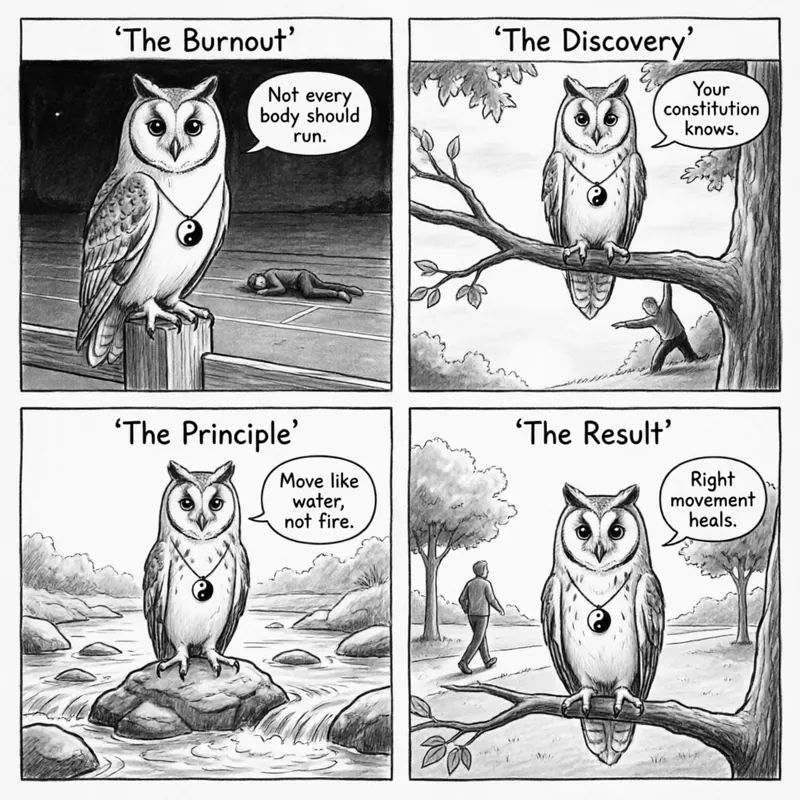
I've heard this story a hundred times. We're sold a one-size-fits-all vision of fitness: crush it, burn it, push through the pain, no days off. But from the perspective of Traditional Chinese Medicine, that's like telling every single plant in a garden it needs the exact same amount of sun and water. A cactus will thrive; a fern will wither and die.
The problem wasn’t Jenna’s effort — it was the *type* of effort. What if your body has a unique instruction manual, and your workout is accidentally written in the wrong language?
In TCM, this instruction manual is called your constitution. It’s your body’s unique energetic blueprint, your default setting. It’s not about being an “apple” or a “pear” shape; it’s about your internal climate. Are you naturally warm or cool? Do you tend to be dry or damp? Does your energy flow freely or get stuck?
Once you understand your own internal weather system, exercise stops being a battle against your body and becomes a conversation with it. You stop forcing yourself into workouts that drain you and start choosing movements that actually fill you up.
The Human Furnace vs. The Overheating Engine
Think of your body’s energy as a beautiful, complex river system. For some, the river runs slow and is at risk of freezing over. For others, the river is evaporating too quickly, leaving the riverbed dry and cracked. And for some, the river has become a stagnant, swampy bog. The goal of movement isn't to blast the river with dynamite; it's to restore its natural, healthy flow.
Let’s explore the three most common patterns I see and find out which river sounds most like yours.
Are You Running on Empty? The Yang-Deficient Pattern
What it feels like: You know that deep, cellular cold that has nothing to do with the room temperature? That’s the hallmark. You’re the one wearing a sweater in July. Your hands and feet are your personal ice packs. You feel a deep fatigue that no amount of sleep can seem to fix, often with a dull, achy lower back. Your energy isn’t just low; it feels like the pilot light on your internal furnace has gone out. You might also notice you feel puffier than usual or have looser digestion.
The TCM Lowdown: In your body, Yang (pronounced *yahng*) is the sun. It’s the fire, the warmth, the metabolic spark that drives every single process. It’s what gets you out of bed, digests your food, and keeps you warm. When your Yang is low, or “deficient,” your whole system runs cold and slow.
For someone with a Yang-deficient constitution, the goal of exercise is to gently stoke this internal fire. You’re trying to build a small, sustainable bonfire, not create a fireworks display that burns through all your fuel in five minutes.
This was Jenna. Her body was a flickering bonfire, and her high-intensity workouts were like dumping a bucket of ice water on it every single morning. She was depleting the very energy she was so desperately trying to build.
Our resident screech owl, Ollie, who likes to perch on the clinic windowsill, once saw a man with this pattern push himself through an outdoor bootcamp on a chilly morning. Ollie said the poor guy looked like he was turning blue before he finally had to sit down, completely spent. He was trying to be a hawk, when his body was clearly an owl.
Movement that Supports (Stoking the Fire):
- Tai Chi (tie-chee) and Qi Gong (chee-gong):: These are the gold standard. They are slow, flowing, meditative movements designed specifically to cultivate and circulate your body’s vital energy, which we call Qi: (chee). Think of it as gently fanning the embers of your furnace until they glow.
- Walking in the Sun:: Simple, yes, but deeply effective. A brisk walk, especially in the morning or midday sun, generates gentle internal warmth while the sunlight itself provides a direct infusion of Yang energy.
- Intentional Strength Training:: Forget frantic circuits. Focus on foundational, grounding poses. Slow, controlled squats and lunges, or holding a yoga pose like Warrior II, builds muscle and generates heat in a contained, sustainable way. You’ll feel warm and strong, not wiped out.
Movement that Drains (Putting the Fire Out):
- Marathon or HIIT Training:: The extreme endurance and explosive intensity of these workouts are deeply depleting for a Yang-deficient system. It’s like using up your entire winter’s supply of firewood in one night, leaving you colder and more exhausted than before.
- Cold-Water Swimming:: Plunging into cold water is a direct assault on your already-low Yang. Your body has to expend a massive amount of precious energy just to keep your core temperature stable.
- Anything with Profuse Sweating:: In TCM, your sweat and your Qi are seen as having a common source. When you sweat excessively, you are leaking vital energy. A light sheen is fine, but if you’re dripping sweat, you’re losing more than just water; you’re draining your battery.
Feeling “Wired and Tired”? The Yin-Deficient Pattern
What it feels like: You’re the opposite of the Yang-deficient person. You run hot. You might get waves of heat in the afternoon or evening, kick off the covers with night sweats, or always feel thirsty with a dry mouth and skin. Your palms and the soles of your feet might feel hot to the touch. Mentally, you feel “wired but tired”—anxious, restless, with a mind that races a million miles an hour, especially when you’re trying to sleep.
The TCM Lowdown: If Yang is the sun, Yin (pronounced *yin*) is the moon, the water, the quiet, cooling, and nourishing substance in your body. It’s the juice that keeps your joints lubricated, your skin supple, and your mind calm. It’s the coolant in your body’s engine.
When Yin is deficient, it’s not that the fire (Yang) is too strong; it’s that the water (Yin) is too low to balance it out. The engine starts to overheat. This creates a phenomenon called “empty heat,” which is responsible for that feeling of anxious, restless heat.
For someone with a Yin-deficient constitution, the goal of exercise is to clear this empty heat, replenish fluids, and calm the revved-up nervous system—not to boil away what little coolant you have left.
Movement that Supports (Replenishing the Coolant):
- Swimming:: This is, hands down, the best exercise for a Yin-deficient type. Moving through cool or neutral-temperature water is inherently calming and clears heat without the jarring impact or heat generation of land-based cardio. It’s like giving your entire system a cool drink.
- Yin or Restorative Yoga:: The name says it all! Unlike a fast-paced Vinyasa class, these styles involve long, deep stretches and mindful breathing that soothe the nervous system and help the body access its deep reserves of calm. (Just please, *please* do not do it in a heated room).
- Evening Walks:: A gentle stroll as the sun goes down, especially near a lake, a river, or the ocean, is incredibly nourishing. The cooler air and the presence of water have a Yin quality that helps to settle the day’s accumulated heat and quiet the mind before bed.
Movement that Drains (Boiling the Pot Dry):
- Hot Yoga:: This is the number one offender. Why would you add extreme external heat to a body that’s already overheating internally? The profuse sweating it causes is a direct and rapid depletion of the precious Yin fluids you need to conserve. It’s like pouring gasoline on a fire.
- High-Intensity Interval Training (HIIT):: The explosive, aggressive nature of HIIT is very Yang. It can be jarring to an already over-stimulated nervous system, fueling more anxiety and leading to burnout.
- Running in the Midday Sun:: This is a double-whammy of internal exertion and external heat. It’s a surefire recipe to dry up your fluids, fray your nerves, and leave you feeling frazzled and depleted for days.
Feeling Stuck in the Mud? The Damp-Phlegm Pattern
What it feels like: Do you often feel heavy, sluggish, and mentally foggy, as if you’re trying to think through a thick mist? This is the classic feeling. You might struggle with your weight, feel puffy or bloated, and notice a lot of mucus or sinus congestion. Your limbs can feel heavy, and your motivation is often stuck in first gear. It’s less about pain and more about a feeling of being clogged up.
The TCM Lowdown: In your internal weather report, this is a period of high humidity and fog. Dampness is a concept in TCM for a pathogenic influence that is heavy, sticky, and obstructive. It gums up the works, slowing down the flow of Qi and blood, leading to that classic feeling of being “stuck.” Think of it like trying to walk through a swamp—everything takes more effort.
For this constitution, the advice is the complete opposite of the other two. Here, a sedentary lifestyle is the enemy. You need to *move* to break through the stagnation.
Movement that Supports (Drying Out the Swamp):
- Sweaty Cardio:: This is your time to shine! High-Intensity Interval Training (HIIT), vigorous running, spin classes, and energetic dance cardio are fantastic. The goal is to get your heart rate up, stimulate circulation, and generate a good sweat. Sweat is one of the body’s primary pathways for expelling excess Dampness.
- Consistent Strength Training:: Building muscle is key. In TCM, the organ system responsible for managing fluids is closely related to the muscles. Strong muscles support a strong metabolism that can properly transform and transport fluids, preventing them from accumulating as Dampness in the first place.
- Anything that Breaks a Sweat:: The key is to move with enough vigor to get things circulating and open the pores. You want to feel lighter, clearer, and less foggy after your workout. For you, sweat isn’t depleting; it’s cleansing.
Movement that Drains (Letting the Swamp Grow):
- A Sedentary Lifestyle:: For a Damp-Phlegm type, the worst thing you can do is sit still. Inactivity allows the Dampness to settle, congeal, and become even harder to move, making you feel heavier and foggier over time. For you, the old adage is true: move it or lose it.
Move Like Water, Not Like Fire
The ultimate goal of exercise shouldn’t be to punish your body into submission. It should be a practice of restoration. It should leave you feeling more vibrant, more balanced, and more at home in your own skin.
Jenna, my friend from the beginning, took this all to heart. She traded her 5 a.m. spin classes for midday walks in the sun. She swapped her marathon training for a gentle Qi Gong routine she found online and some slow, heavy weightlifting twice a week.
Within a month, the change was stunning. Her hands were warm. The deep fatigue lifted. Her digestion calmed down. She wasn’t working “harder,” but she was working *smarter*. She was finally speaking her body’s language.
Your body isn't a machine to be conquered. It's a garden to be tended. The first step is to know your soil. Stop fighting your nature and start flowing with it. Move like water, which adapts its path to the terrain it crosses. Don’t move like fire, which consumes everything in its path, including itself.
You know, my great-grandmother’s wisdom-feathers always ruffled when she saw humans running on those ‘go-nowhere’ machines. *Ollie polishes his little yin-yang pendant with a wing.* She’d say, ‘They’re trying to outrun a feeling that isn’t chasing them.’ I see it all the time from my perch. One person finishes their run and looks bright and clear, like a freshly washed sky. The next person finishes and looks like a raincloud about to burst. Same movement, different weather inside. What works for the high-flying hawk will exhaust the burrowing owl. The trick isn’t to fly higher; it’s to know your own wings.
— Ollie
FAQ
This is fascinating, but I feel like I’m a mix of two types! What should I do?
That’s incredibly common! Constitutional patterns are rarely black and white; they often overlap. For example, you could be both cold (Yang Deficient) and feel foggy (Damp). The best approach is to start with the middle path. Gentle-to-moderate exercises like brisk walking, swimming in a neutral-temperature pool, or Tai Chi are beneficial for almost everyone. Pay close attention to which of your symptoms is bothering you the most. If it’s the cold, prioritize warming movements. If it’s the “wired” feeling, prioritize calming movements. And for a truly personalized plan, nothing beats a consultation with a licensed acupuncturist or TCM practitioner who can read your body’s unique signals.
You mentioned sweat can be depleting. I thought sweating was always a good thing?
It’s all about context and amount! In TCM, there’s a beautiful and important axiom: “Sweat is the fluid of the Heart.” Appropriate sweating is healthy—it regulates body temperature and helps expel pathogens (like when you “sweat out” a cold). However, *excessive* or spontaneous sweating can be a sign of imbalance. For someone who is already low on fluids (a Yin-deficient type), sweating profusely is like draining the oil from an already-hot engine. It can weaken not just your Yin, but also your Heart Qi, leading to things like palpitations, anxiety, and insomnia. The goal is a gentle glow, not a drenching downpour (unless you’re a Damp-Phlegm type who needs that release!).
Does my diet matter as much as my exercise for my constitution?
Oh, absolutely. You can’t out-run, out-yoga, or out-walk a diet that’s working against your body’s nature. They are two wings of the same bird. If you have a Damp-Phlegm constitution and do sweaty HIIT workouts but continue to eat a lot of greasy, fried foods, sugar, and dairy, you’ll be stuck in a cycle of creating and clearing Dampness. A Yang-deficient person needs to support their warming exercises with warming foods like ginger, cinnamon, and lamb. A Yin-deficient person should pair their cooling movements with hydrating foods like cucumber, watermelon, pear, and mung beans. Your plate should always support your practice.
Sources
Maciocia, Giovanni. *The Foundations of Chinese Medicine.* Churchill Livingstone, 3rd Edition, 2015. Pitchford, Paul. *Healing with Whole Foods: Asian Traditions and Modern Nutrition.* North Atlantic Books, 3rd Edition, 2002. *The Yellow Emperor's Classic of Medicine* (Huangdi Neijing), translated by Maoshing Ni. Shambhala, 1995.