Stop Fighting, Start Warming — Why Yang Tonics Are Not About Heat
Hoot! Ollie here. From my perch high in the rafters of the TCM Way clinic, I see a lot of tired people. They come in clutching coffee cups, wrapped in sweaters even when it’s warm outside, and their stories are often strikingly similar.
They’re exhausted. Not just “I missed some sleep” tired, but a deep, bone-weary fatigue that never seems to lift. Their digestion is off, their mind is foggy, and they’re always, *always* cold. They’ve done the rounds—primary care doctor, specialists, maybe a nutritionist. Blood tests come back “normal.” They’re told to get more sleep, exercise, take a multivitamin, maybe try yoga. But nothing touches the cold that has settled deep inside.
Then they sit down with one of our practitioners, who listens quietly, looks at their tongue, feels their pulse, and says two simple words in Mandarin: “你太寒了” (Nǐ tài hán le).
“You’re too cold.”
The reaction is almost always the same: a blink of disbelief. “Too cold? But my body temperature is 37°C on the dot. How can I be *cold*?” It sounds almost silly, like a diagnosis from a fairytale. But this isn’t the number on a thermometer. It’s the fire within.
The Furnace in Your Belly
Let’s try an analogy. My little owl ear tufts twitch when I hear a concept that needs a good story. Think of your body as a house. The vital energy that keeps you warm, digests your food, powers your thoughts, and fights off illness is called Yang Qi. This Yang Qi is the furnace in the basement of your house.
 Ollie's Take
When the furnace is roaring, the house is warm and comfortable. The plumbing works, the air is fresh, and everything runs smoothly. This is a body with strong Yang Qi. You feel energetic, your digestion is strong, you have a healthy glow, and you can easily adapt to a chilly day.
But what happens when the furnace starts to fail? The fire dwindles to a pilot light. The house becomes cold and damp. The pipes get sluggish and start to freeze (that’s poor circulation). Mold might start growing in the damp corners (that’s when opportunistic bugs or inflammation can take hold).
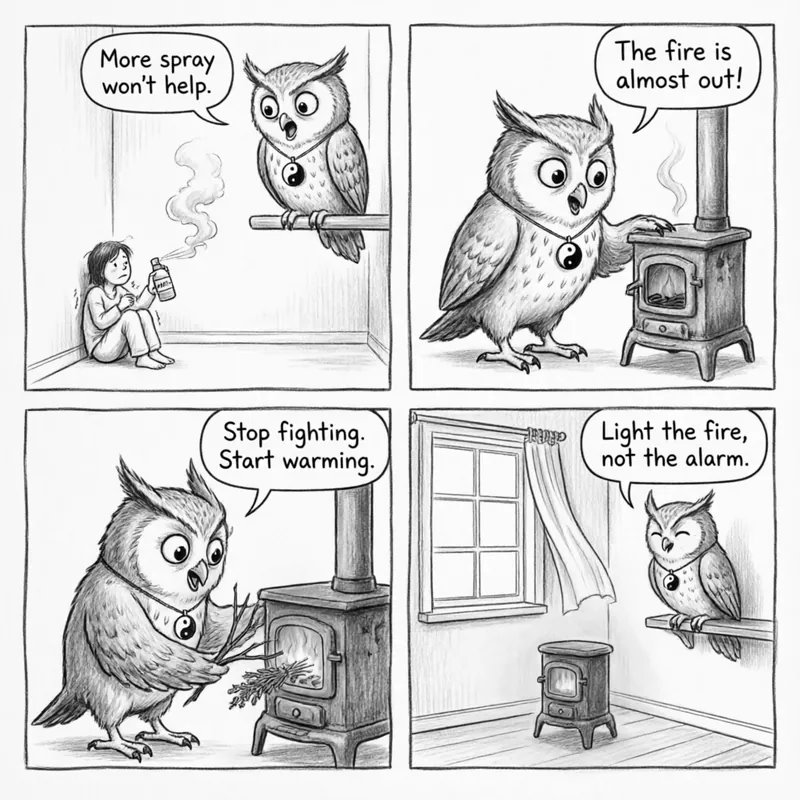
Modern medicine often sees the mold and, quite logically, prescribes an anti-fungal to kill it. It sees the “frozen pipes” of inflammation and prescribes an anti-inflammatory to suppress the symptom. It’s trying to manage the problems appearing in the cold house. TCM, however, walks down to the basement, sees the dying embers in the furnace, and says, “The problem isn’t the mold; the problem is the *cold*.” The solution isn’t to spray bleach on the walls; it’s to restart the furnace.
This is the entire principle behind “warming” herbs. They aren’t “heating” you in the way a chili pepper or a shot of whiskey does. They aren’t designed to raise your core body temperature. They are metabolic power-starters, designed to refuel your body’s own furnace—your Yang Qi.
Stop Fighting, Start Warming
This brings us to a huge paradigm shift. The Western approach to many chronic illnesses is a fight. We use “anti-” medications: anti-inflammatories, anti-depressants, anti-pyretics (fever reducers). We are attacking the symptom, trying to force it into submission. And sometimes, that’s exactly what’s needed! But for chronic conditions rooted in deficiency, this constant fighting can be like trying to put out a fire with gasoline.
Let’s take chronic inflammation—a condition that now seems to be at the root of nearly everything. The Western view is that inflammation is the enemy, a fire that must be extinguished with drugs like ibuprofen or steroids. These are powerful tools, but they’re like yanking the battery out of a smoke detector. You’ve stopped the annoying noise, but the house is still full of smoke.
The TCM approach asks a different question: *Why* is there inflammation? While some inflammation is due to excess heat, a surprising amount, especially the chronic, nagging kind, is caused by what’s called “Cold Stagnation” (寒凝, hán níng). When the body’s furnace is low, circulation slows down. Fluids congeal. Things stop moving. This blockage, this traffic jam of Qi and Blood, creates pain and inflammation.
Forcing it down with a “cold” anti-inflammatory drug only adds more cold to a system that’s already freezing. It might provide temporary relief, but it can weaken the digestive fire and drive the underlying cold deeper. The TCM solution? Warm it up. By introducing warming herbs, you encourage the vessels to dilate, the fluids to move, and the traffic jam to clear. You resolve the stagnation, and the pain goes away.
This logic can seem completely backward, but it’s a cornerstone of classical Chinese medicine. The famous *Shang Han Lun* (伤寒论), or *Discussion of Cold Damage*, written nearly two thousand years ago, states: “太阳病,发热恶寒,热多寒少,宜桂枝汤” (Tàiyáng bìng, fārè wù hán, rè duō hán shǎo, yí Guì Zhī Tāng). This describes a person with a fever (发热) but also a strong aversion to cold (恶寒). Even with a fever, because the root of the problem is an invasion of Wind-Cold, the correct strategy is to use the warming formula Gui Zhi Tang. The goal isn't to suppress the fever but to help the body generate enough warmth and circulation at the surface to push the pathogen out. You’re helping your body win its own fight, not fighting *against* your body’s response.
Three Key Soldiers of Warmth
When a practitioner decides your internal furnace needs stoking, they don’t just throw a log on the fire. They have a whole army of herbal formulas, each with a specific mission. These are not something you cook up at home; they are precise prescriptions for complex conditions. Let’s meet three of the most famous “Yang-warming” soldiers.
1. Gui Zhi Tang (桂枝汤 / Cinnamon Twig Decoction): This is the gentle warmer, the first responder. Its main ingredient is Gui Zhi (cinnamon twig). Think of it for the early stages of a cold, where you feel achy, have a slight fever with chills and sweat, and a headache. Gui Zhi Tang works on the surface of the body to harmonize your defensive Qi and release the Wind-Cold that’s trying to get in. It’s like giving your body a warm, protective sweater.
2. Si Ni Tang (四逆汤 / Frigid Extremities Decoction): This is the emergency restart button. A powerhouse formula for when the furnace has almost gone out completely. This is a state of deep, internal cold collapse, marked by dangerously cold limbs, a faint pulse, and exhaustion. Its chief herb is the incredibly powerful (and carefully processed) Fuzi (aconite). Si Ni Tang is like a defibrillator for your Yang Qi, jolting the system back to life. It’s a powerful, life-saving formula used in serious situations under strict professional guidance.
3. Li Zhong Wan (理中丸 / Regulate the Center Pill): This formula is the digestive rekindler. Its star player is Gan Jiang (dried ginger). It’s prescribed when Cold has attacked your digestive system—your Spleen and Stomach. The signs are clear: watery diarrhea, nausea or vomiting of clear fluid, a lack of appetite and thirst, and a dull abdominal pain that feels better when you press on it or apply a heating pad. Li Zhong Wan is like putting a warm fire back in the stove to properly cook your food and absorb its nutrients.
What Does This Mean For You?
So, how do you know if your furnace might be running low? You don’t need to guess. Your body sends signals all the time.
Pay attention to them. Do you have hands and feet that are cold to the touch, and putting on socks doesn’t really help warm them up from the inside? Do you often feel more tired *after* you eat a meal? Is your lower back, the area of your kidneys, often cool or even cold to the touch? Is your urine usually clear and copious? Do you feel an aversion to cold weather, cold foods, and cold drinks?
These aren’t just personality quirks. They aren’t “just how you are.” They are classic signs of Yang deficiency. They are little postcards from your body’s furnace room saying, “Help! We’re running out of fuel down here!”
If this sounds familiar, the next time you see a TCM practitioner, you can mention these things. Ask them, “Could my issues be related to a cold pattern?” It opens up a whole new line of inquiry. And remember, it’s all about diagnosis. Not all inflammation is from cold; true heat conditions absolutely exist and require cooling strategies. That’s why you can’t just read a blog and start taking warming herbs. A qualified practitioner is the only one who can tell if your house is on fire or if it’s freezing over.
Hoo boy. If you’ve only been fighting the symptoms, you haven’t tried everything. You’ve just been fighting. If your furnace is out, no amount of Febreze is going to fix the damp, musty smell in the house. You have to go to the source.
Think of these warming herbs like adding kindling to a fireplace. You don’t just chuck a giant, wet log onto a few dying embers—that would smother it completely. You start with small, dry, carefully chosen twigs. You gently blow on the embers to give them oxygen. You build the warmth gradually, respectfully. That’s what a good practitioner does with formulas like Gui Zhi Tang or Li Zhong Wan. They are coaxing your fire back to life, not blasting it with a flamethrower.
It’s getting late, and my big owl eyes are starting to feel heavy. But before I tuck my head, I’ll leave you with this thought: Stop fighting shadows on the wall. Turn around and light a candle.
"Can I just eat more ginger and cinnamon from my kitchen?"
Culinary spices like the ginger and cinnamon in your pantry do have gentle warming properties and are great for daily wellness! However, they are not a substitute for therapeutic-grade herbs used in a prescribed formula. The dosage, part of the plant used (e.g., cinnamon twig vs. cinnamon bark), and combination with other herbs in a formula create a specific and much more powerful effect than simply spicing up your food.
"How do I know for sure if I have a cold pattern?"
The most common signs include a persistent feeling of cold, especially in the hands, feet, and lower back; fatigue; an aversion to cold temperatures and foods; a pale face; a pale, swollen tongue, possibly with a white coating; and frequent, clear urination. However, these can overlap with other patterns. The only way to know for sure is to get a differential diagnosis from a qualified TCM practitioner, who will use pulse and tongue diagnosis to confirm the underlying pattern.
Huang, Huang. *Ten Key Formula Families in Chinese Medicine*. Eastland Press, 2009.
Maciocia, G. *The Foundations of Chinese Medicine*. 3rd ed., Elsevier, 2015.
Zhang, Zhongjing. *Discussion of Cold Damage (Shang Han Lun)*. Circa 200 CE.
I’m fluffing my feathers up and adjusting the little yin-yang pendant my grandmother gave me. My ear tufts always twitch when I hear someone say, “I’ve tried everything.”
— Ollie (adjusts his grandmother's yin-yang pendant, ear tufts drooping with contentment)
FAQ
Is aconite (Fuzi) poisonous?
Yes, in its raw, unprocessed form, Fuzi (aconite) is highly toxic. However, in Chinese medicine, practitioners use processed Fuzi (制附子, zhì fù zǐ). This herb undergoes a lengthy, specialized preparation process to neutralize its toxicity while preserving its powerful therapeutic warming effects. It is only ever used under the prescription and careful supervision of a trained herbalist and is never sold over the counter.
Sources
- Bensky, D. et al. *Chinese Herbal Medicine: Materia Medica*. 3rd ed., Eastland Press, 2004.
— Ollie
Enjoyed this?
Subscribe via RSS — new articles delivered to your feed reader.
Have a question? Reply by email — good questions become future articles.