
Why the Ancients Said "Don't Hate the Sun" — and What We Lost When We Started Hiding From It
We live in a culture that has declared war on the sun. We’re told to slather on SPF 100, seek shade, and stay inside our air-conditioned homes. The message is clear: the sun is the enemy, a dangerous force to be avoided at all costs.
And yet, an ancient voice from over two thousand years ago offers a completely different perspective. In the Huangdi Neijing (The Yellow Emperor's Inner Canon), the foundational text of Chinese medicine, the sages give us this radical advice for summer: “Do not tire of the sun.”
It’s a startling contradiction. What did the ancients know that we’ve forgotten? What have we lost by hiding from the most powerful source of life in our solar system? Open the second chapter of the Neijing Suwen and rediscover the lost art of living in harmony with summer.
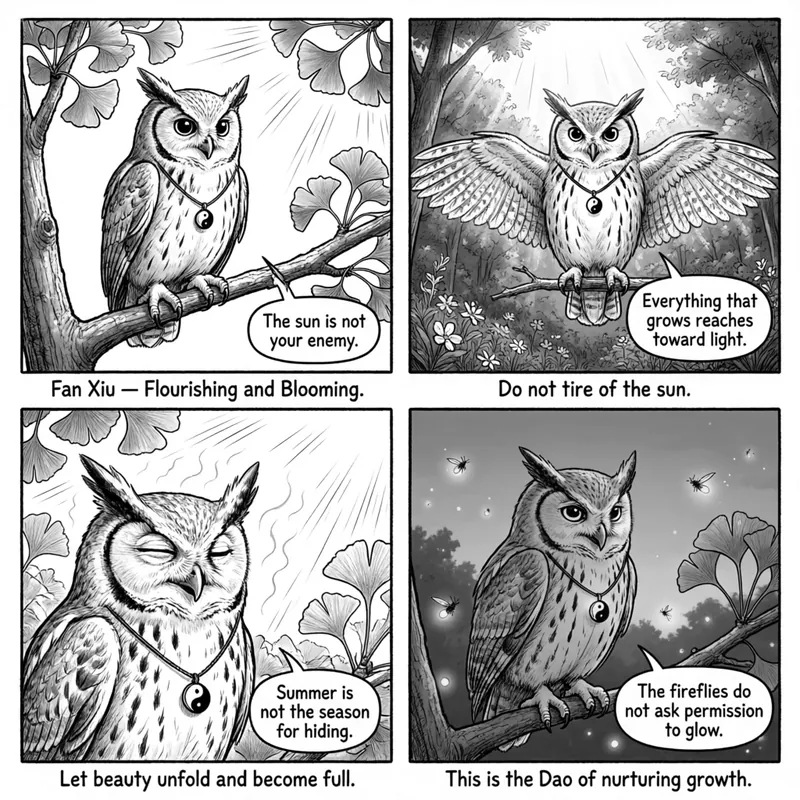
Ollie the screech owl, who spends his summers perched on the highest ginkgo branch, knows something about this. From up there, the whole forest is showing off — every leaf turned toward the light, every bird singing at full volume. "Summer is not the season for modesty," he once told me. "It's the season for being fully, unapologetically alive."
The text begins by giving the season a name and a purpose:
"The three months of summer, this is called Fan Xiu."
Fan Xiu (蕃秀) is a beautiful, poetic term that translates to “flourishing and blooming” or “luxuriant growth.” It describes nature at its absolute peak. Think of a garden in July: roses unfurling their petals, tomato plants heavy with fruit, everything vibrant, lush, and unapologetically alive. This is the energy of Fan Xiu.
The Neijing continues, "Heaven and Earth exchange qi; the ten thousand things flower and bear fruit." In summer, the relationship between Heaven (Yang) and Earth (Yin) is at its most intimate and productive. Their interaction creates the abundance we see all around us. The world isn’t just growing; it’s showing off.
Ollie, who hunts through the long summer dusk, has a simpler way of putting it: "The fireflies don't ask permission to glow. Why should you?"
This isn’t just a nature documentary. According to this ancient philosophy, we humans are a part of the “ten thousand things.” We are not separate from this cosmic dance. Summer is our season to flourish and bloom, too.
Summer: The Season of the Heart
In the framework of Five Element theory, each season is connected to an organ system, an emotion, and an element. Summer belongs to the Fire element, and its corresponding organ is the Heart. The emotion of the Heart is joy.
The Heart in Chinese medicine is more than just a pump. It’s the “Emperor” of the body, housing the Shen (our consciousness, spirit, and mind). It governs our capacity for connection, passion, and joy. When the Heart is balanced, we feel open, loving, and mentally clear. When it’s out of balance, we can experience anxiety, restlessness, insomnia, or a lack of joy.
Summer is the Heart’s home season. The abundant Yang Qi of summer naturally nourishes the Fire of the Heart. This is why we often feel more social, more optimistic, and more alive in the summer. We are physiologically primed for joy and connection.
So, how do we align with this vibrant, heart-centered energy? The Neijing gives us a clear set of instructions.
The Dao of Nurturing Growth
The ancient sages laid out a simple, powerful guide for how to live during the summer months to nurture our "growth" and protect our Heart.
"Sleep late at night, rise early."
This is a direct response to the movement of the sun. In summer, the days are long and the nights are short. The Neijing advises us to follow this natural rhythm. Going to bed a little later and waking up with the early morning sun synchronizes our internal clock with the world around us.
This isn’t a prescription for sleep deprivation. It’s about shifting our schedule to welcome the light. The abundance of Yang Qi in the environment naturally fuels our desire to be more active. Fighting this by forcing an early bedtime or sleeping in late can create a sense of grogginess and disconnection.
"Do not tire of the sun." (无厌于日, wú yàn yú rì)
Here it is—the most counter-cultural advice of all. This phrase doesn’t mean you should bake in the midday sun until you get a burn. The ancients were wise, not reckless. It means don’t develop an aversion to the sun. Don't hate it. Don't treat it like a poison.
It means allow yourself to be outside. Feel the warmth on your skin. Take a walk in the early morning or late afternoon light. Let the sun’s rays, the ultimate expression of Yang Qi, enter your system. Modern science has confirmed what the ancients knew intuitively: morning sunlight is essential for setting our circadian rhythm, boosting mood, and synthesizing Vitamin D.
Hiding in a dark, air-conditioned box 24/7 is the ultimate expression of "tiring of the sun." It starves our bodies of the very energy that defines the season.
"Let the mind be without anger."
Summer is the Fire season. Anger is a "hot" emotion. You can see where this is going. When you combine the external heat of summer with the internal heat of frustration and anger, you create an internal firestorm. This can easily injure the Heart and lead to symptoms like agitation, palpitations, headaches, and insomnia.
Summer calls for a joyful, open-hearted attitude. It’s a time to let minor frustrations roll off your back. If you feel anger bubbling up, find a healthy way to express and release it. Don’t let it simmer and cook your insides.
"Let beauty unfold and become full. Allow qi to flow out, as if what you love is outside."
This is perhaps the most beautiful advice in the chapter. In winter, we are told to conserve our energy, to turn inward and store our Qi. Summer is the exact opposite.
It’s a time for outward expression. “Let beauty unfold” is a call to be generous, expansive, and creative. It’s a time to say “yes” to social invitations, share your talents with the world, and let your inner spirit shine. The energy should flow *out* of you, like a fountain.
The phrase “as if what you love is outside” encourages an external focus. Connect with friends. Spend time in nature. Engage with your community. Your energy, your love, your attention should be directed outward, participating in the grand, blooming expression of life.
The Cost of Hiding from Summer
The Neijing is very clear about the consequences of ignoring this wisdom. It’s not just about missing out on some summer fun. The choices we make in one season have a direct impact on our health in the next.
"This is the summer response to qi — the Dao of nurturing growth. If you go against it, you wound the Heart. By autumn it becomes malaria. The harvest is poor. By winter solstice, severe illness breaks out."
Let's break that down. When you go against the expansive, outward, joyful nature of summer—by hiding inside, suppressing your emotions, and avoiding the sun—you "wound the Heart." The Fire element doesn't get nourished, and the Emperor is weakened.
This creates a cascade of problems. By autumn, the season of the Lung (Metal element), your body can’t properly "harvest" and consolidate its energy for the coming winter. The text mentions malaria, which we can interpret as a vulnerability to recurring, feverish illnesses. Your immune system is compromised, and your "harvest" of health is poor.
And when winter arrives, the season of ultimate storage and conservation, your reserves are already depleted. This is when a weakened constitution can lead to a serious breakdown. The "severe illness" that breaks out in winter often has its roots in the summer we spent hiding from life.
Living the Neijing in the Modern World
So how can we apply this ancient philosophy without being totally impractical? No one is suggesting you quit your office job to frolic in a field all day.
It’s about small, conscious shifts. Can you take your lunch break outside in a shady park instead of at your desk? Can you wake up 15 minutes earlier to have a cup of tea on your porch and greet the morning sun? Can you open the windows to let fresh air and birdsong in, instead of sealing yourself in with the A/C?
Constant air conditioning is a big one. From a TCM perspective, the cold air causes our pores and the surface capillaries to constrict. This can trap our Defensive Qi (Wei Qi) and make it harder for our body to properly regulate temperature and sweat. This is why so many people catch "summer colds"—the cold air weakens our surface defenses, making us vulnerable.
And if you experience "summer sadness," consider if it might be a symptom of this seasonal disconnect. When the whole world is in a state of Fan Xiu, of joyful blooming, feeling withdrawn or depressed can be a sign that your Heart Qi is struggling to express itself. The cure might not be to hide further, but to gently and safely engage with the season: a walk with a friend, tending to a small plant, or simply sitting near a sunny window.
Welcoming summer isn't about ignoring modern safety. Remember: we are creatures of nature. Hiding from the sun is like a flower refusing to open its petals. We deny ourselves the very energy that helps us bloom.
 Ollie's Take
Hoo-hoo! The humans are funny. They build dark caves with cold air and then wonder why they feel so sluggish when the sun is calling. From my branch, I see the whole world wake up in summer. The squirrels are feisty, the cicadas are singing their hearts out, and the fireflies are putting on a party every night. They all know what to do. They let their energy out! The longest days are for living, not for hiding. Maybe we owls have it right—we rest during the hot peak, but we sure don't miss the beautiful, long evenings when the world is buzzing with life.
FAQ
Does the advice “do not tire of the sun” mean I shouldn’t use sunscreen?
Not at all. This ancient wisdom is about mindset and balance, not recklessness. The Neijing encourages us not to develop an aversion to the sun or hide from it completely. It's about sensible, respectful engagement. The ancients didn't have sunscreen, but they also used clothing, hats, and common sense to avoid burning in the harsh midday sun. The key is to avoid the extremes: don't bake for hours, but also don't live in a cave. Enjoying gentle morning or late afternoon sunlight, which helps set our circadian rhythm and boosts mood, is perfectly in line with this philosophy.
What are some simple ways to align with summer energy if I work in an office?
Even with a desk job, you can make small, powerful shifts. Start by taking your lunch break outside, even if it’s just for 15 minutes in a nearby park or plaza. Instead of driving straight home, take a short walk in the evening to connect with the long daylight hours. On weekends, prioritize activities that get you outdoors. Inside the office, try to sit near a window if possible. Welcome summer's social nature by organizing a team lunch or after-work gathering. And incorporate cooling, hydrating foods like watermelon, cucumber, and mint into your diet to balance the summer heat.
Why is the Heart so important in the summer according to Chinese medicine?
In TCM, the Heart is considered the "Emperor" of all the organs. It corresponds to the Fire element, which reaches its peak expression in summer. The Heart houses our consciousness and spirit (Shen) and governs our capacity for joy, connection, and enthusiasm. Summer is the Heart's most vibrant season, a time when its energy naturally wants to expand and express itself. By aligning with summer's joyful, outward energy, we nourish our Heart. When we go against it by being isolated or suppressing our feelings, we can "wound the Heart," leading to anxiety, poor sleep, and emotional imbalance later.
Sources:
- Huangdi Neijing Suwen (The Yellow Emperor's Inner Canon, Basic Questions), Chapter 2. Translation and interpretation by various scholars.