Gui Zhi — The Cinnamon Twig That Changed Medicine
 Ollie's Take
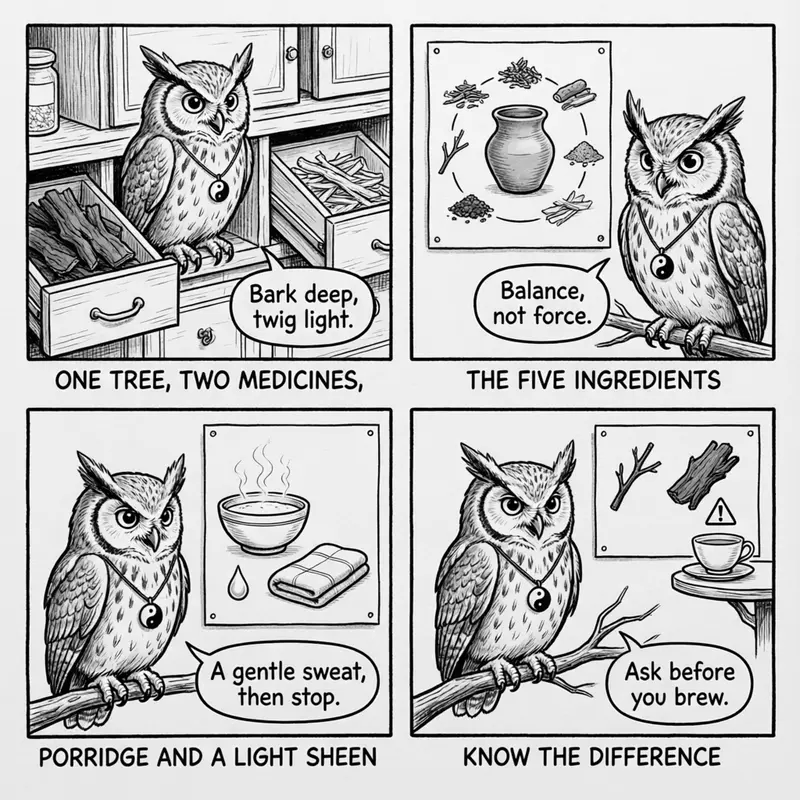
Ollie's take: Hoo-hoo! Same tree, two jobs. The twig travels; the bark stays home. Pick your company the way the old doctors did.
Pull open a spice cabinet on a cold morning and the scent of cinnamon hits first — winter baking, mulled cider, breakfast toast. In a Western kitchen that fragrance comes from rolled tubes of dried bark in glass jars. We grind it, drop whole quills into simmering pots, and think of it as one comforting flavor.
Step into a Chinese herbal pharmacy and you will see something different. The drawers hold cinnamon, but not as one uniform item. Heavy brown bark sits in one bin; another holds pale, thin slices of young twig.
In Chinese medicine that twig has its own name, its own nature, and an eighteen-hundred-year career at the top of classical formula design. The tradition calls it gui zhi. Ollie, our resident screech owl, watches from the top of the cabinet, jade pendant catching the morning light.
Two Parts of the Same Tree
The classical materia medica associates both medicines with cassia cinnamon trees — Cinnamomum cassia and close relatives — which grow in the warm hills of southern China and Southeast Asia. Commercial sourcing mixes several species, so the kitchen and the herb cabinet do not map onto each other neatly. Classical herbalists didn't treat a tree as one substance. They saw an architecture in which different tissues carry different qualities of Qi.
The bark becomes rou gui. The tradition reads it as dense, heavy, and deep, warming the interior reservoirs of Yang.
Gui zhi moves the other way. Cut from young branches into thin cross-sections that look like wooden coins, it is read as light and dispersing.
Where the bark anchors warmth deep inside, the twig sends it up and out through the limbs and surface. In traditional theory the twig is associated with surface patterns — a chill, a stiff neck, cold hands — and the bark with deeper ones, in the core, the low back, or the digestion. That mapping belongs to the tradition; it is not a guide to picking your own herbs. Supermarket cinnamon is almost always the dried bark, and it may be cassia, Ceylon cinnamon, or another relative — close in scent, distinct in traditional mechanics.
By splitting the tree into two medicines, the old doctors gained two tools: one for the deep interior, one for the surface.
The Formula That Opens the Book
The Shang Han Lun (Treatise on Cold Damage) is traditionally attributed to the physician Zhang Zhongjing and dated to roughly the turn of the third century CE. In the preface long attached to the book, he describes epidemics carrying off many members of his own clan. From that loss came a manual on how external cold enters the body stage by stage, and how to answer it.
Gui Zhi Tang (Cinnamon Twig Decoction) stands near the opening of the text; in many editions it is the first prescription a reader meets. Not an obscure mixture at the back of the scroll, but the benchmark against which later formulas are measured and modified.
The recipe uses five common ingredients: - Gui zhi (cinnamon twig) - Bai shao (white peony root) - Sheng jiang (fresh ginger) - Da zao (jujube) - Gan cao (licorice root; usually honey-fried in modern dispensaries)
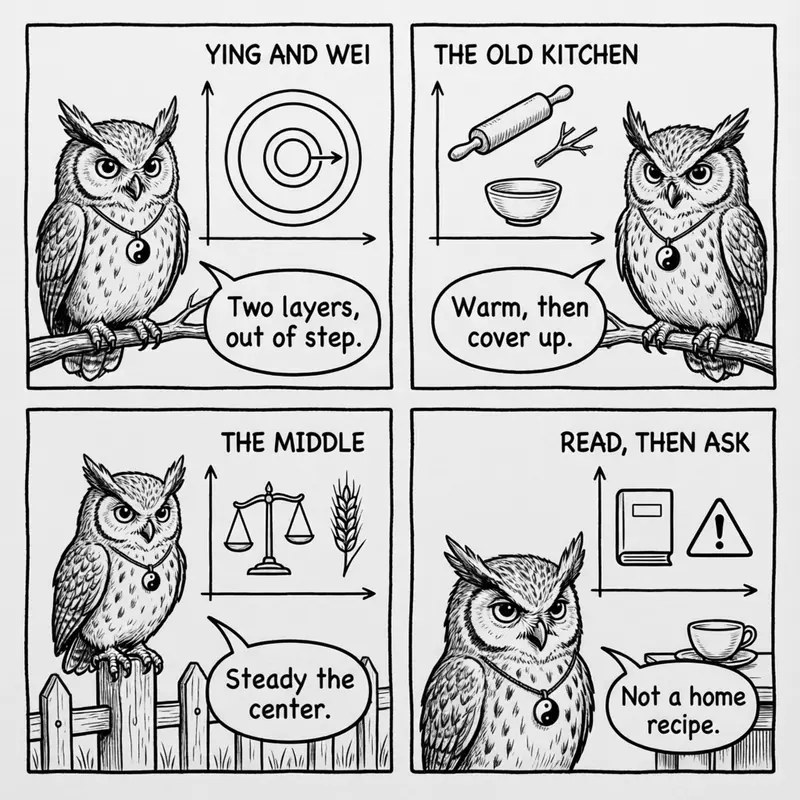
The combination is built for balance rather than force. Traditional theory divides the body's surface defenses into two layers: wei qi, moving along the skin to regulate temperature and resist cold, and ying qi, circulating inside the vessels to nourish tissue.
In the classical model, a draft striking a person whose defenses are thin knocks those layers out of step: the defensive layer floats open into spontaneous sweating and chills, while the nutritive layer loses its anchor.
Gui zhi and sheng jiang push outward, warming the defensive layer. Bai shao pulls inward, sour and astringent, protecting the nutritive layer and holding fluids. Zhi gan cao and da zao steady the center.
Instead of attacking an illness with brute force, Gui Zhi Tang aims to restore rhythm between the interior and exterior.
Rice Porridge and a Light Sweat
The passage after Gui Zhi Tang contains the most detailed protocol in the classic. Zhang did not tell people to drink the tea and hope. He wrote a ritual.
The decoction was taken warm, then followed by a bowl of hot rice porridge, xi zhou — fluid and starch for the stomach to turn into quick warmth.
Then: lie down, cover up, and stay covered a while, aiming for a faint, uniform moisture over the whole skin rather than a sweat.
The text warns against a soaking sweat: in its framework that drains fluids and Yang and leaves the person weaker. What the passage values is observation rather than force: the classical sequence watches for that faint sheen and responds to what it finds, instead of pushing toward a fixed amount.
It reads like a nursing manual. Warm liquid, digestible starch, quiet rest, and measured warmth were treated as active parts of the prescription — the metabolic room the herb walked into.
Ollie ruffles his feathers at the mention of porridge. He is more of a field mouse kind of owl, but he can appreciate a good nap under a warm blanket.
What the Tradition Says the Twig Does
Across centuries of practice, the traditional Materia Medica built a defined profile for gui zhi, listing three primary functions that explain why it appears in so many historical formulas.
The first action is releasing the muscle layer (jie ji). In the classical diagnostic framework, external cold invasions show up in two distinct ways. If the pores slam shut, producing high fever, severe body aches, and zero perspiration, the old texts called for strong diaphoretics like ma huang (ephedra).
However, if the person feels stiff and chilly yet has a light, leaky sweat that fails to break the fever, ma huang is considered too harsh. Gui zhi is the remedy of choice for this "deficient exterior" pattern, because its warming, sweet-spicy nature warms the flesh without blasting the pores wide open.
The second action is warming and unblocking the channels (wen tong jing mai). Classical physiology views cold as a contracting, freezing influence that slows down circulation. When cold settles into the shoulders, fingers, or chest, dull aches and stiffness follow. Because gui zhi is thin and branch-like, the doctrine of signatures and historical observation linked it to the extremities. It was used to guide warmth into the fingers, toes, and joints, encouraging smooth flow through the pathways.
The third action is assisting Yang to transform Qi (zhu yang hua qi). Traditional theory states that body fluids require the heat of Yang to move and transform properly. If the internal fire burns low, fluids can pool, creating feelings of heaviness, urinary difficulty, or a sensation of fluid sloshing in the upper torso. Later commentaries describe pairing it with water-regulating herbs, reading the twig as the spark that sets pooled fluids moving again.
Later teaching texts also pair the twig with heavy mineral substances in patterns of upward-rushing Qi, such as palpitations or heat rushing from the lower abdomen to the chest. That pairing is an interpretive reading of the classics, not a fixed rule.
What Modern Labs Have Looked At
Modern phytochemistry has spent decades pulling cinnamon apart in search of active compounds. Researchers have isolated several dozen volatile oils and polyphenols from Cinnamomum cassia, with cinnamaldehyde making up the vast majority of the essential oil fraction. The twigs also contain cinnamic acid, coumarin, and various flavonoids.
Laboratory work in cell cultures and animal models has investigated these components for several biological effects: mild vasodilatory activity, antimicrobial and anti-inflammatory activity in laboratory settings, and interactions with insulin signaling and cellular glucose uptake. All of that is preclinical.
Human trials of Gui Zhi Tang and modified versions exist — mostly small, mostly from a single region, and mostly on upper respiratory symptoms, allergic rhinitis, or circulation complaints. Some report improvements; the designs have been criticized for small samples and weak controls.
Yet a clear, objective look at the literature requires caution. The clinical evidence base remains limited. Most human trials have had small sample sizes, brief observation windows, and variable methodological quality. Extracting an isolated compound in a petri dish does not confirm the complex system of ying and wei Qi described eighteen centuries ago.
The traditional literature on the cinnamon twig is expansive, nuanced, and structurally coherent within its own paradigm, but it exists in a different intellectual universe than modern pharmacological consensus. We can appreciate the classical records for their historical depth without mistaking them for finished clinical proofs.

The Bitter Bark Problem and Real Safety
Because cinnamon is a household baking staple, people often assume that all forms of the plant are completely benign in any quantity. The botanical reality is more complicated.
The central safety issue with Cinnamomum cassia involves coumarin, a naturally occurring chemical compound found in high concentrations in cassia species. In standard culinary settings, tiny pinches of ground cinnamon pose little concern for healthy individuals. However, regular intake of high-dose cassia bark extracts can deliver significant amounts of coumarin, which has documented hepatotoxic potential in sensitive individuals and can place stress on liver function.
Coumarin and related aromatic fractions can also interact with blood-thinning medications and antiplatelet drugs. In European food-safety frameworks, tolerable daily intakes for cassia-derived coumarin are strictly monitored for commercial food manufacturing.
Here the twig makes an interesting contrast, though not a clean one: coumarin levels vary widely with species, plant part, origin, and preparation, so the twig is not automatically exempt; food-safety attention has focused mainly on cassia bark used in large culinary amounts. In the herbal tradition, the twig is decocted in water rather than consumed raw as ground powder, which alters the extraction profile of various lipid-soluble versus water-soluble compounds.
Classical texts list clear contraindications for gui zhi: excess heat patterns (high fever with thirst, a red tongue, a rapid pulse), yin deficiency with night sweats, and active bleeding. Pregnancy gets a more careful line: traditional sources advise caution and, in some formulas, use the twig under professional supervision. The consistent thread is that a warming, moving twig can aggravate heat patterns, so those cases belong with a practitioner rather than the kitchen.
These botanical realities highlight why ancient herbalism treated kitchen spices with the seriousness of prescription drugs. A twig from an evergreen tree is still a biologically active agent, carrying chemical realities that demand informed, professional guidance rather than casual self-experimentation.
Modern readers often view ancient herbalism as primitive folk medicine, imagining early healers throwing random leaves into pots. The story of gui zhi shows the opposite: a system of startling anatomical precision. The physicians of the Han dynasty looked at a single tree, separated the thick bark from the young twigs, and assigned them completely different physiological trajectories based on careful observation.
They saw that force is not always the answer to an external shock. The formula that opens the oldest clinical manual in East Asia does not blast the system; it warms the perimeter, feeds the center with hot rice, and waits for a gentle, restoring moisture to appear.
Ollie Speaks: Hoo there! Let me tell you something about that spice rack in your kitchen. Humans think cinnamon is just for holiday cookies and sugary rolls. Every time my human opens that jar of ground bark, the dust tickles my beak and makes me sneeze. It is too heavy, too sweet, and far too loud for a small screech owl with sensitive ears.
The twigs, though? Those I can appreciate. When a bundle of gui zhi gets sliced on the wooden cutting board, the smell is clean, woody, and bright. It does not hit you like a hammer; it drifts upward like a cool breeze moving through pine needles. I like to perch right above the cutting block, letting the aroma warm the tips of my feathers while I tap my jade pendant against my chest.
And do not get me started on the rice porridge routine. Humans are always rushing around looking for an aggressive shortcut, popping pills and running out into the cold rain. The Shang Han Lun simply describes the old sequence: the warm decoction, the bowl of porridge, the blanket, the long rest. Patient, sensible, and deeply civilized. Take a lesson from the birds — when the weather turns rough, you puff your down, tuck your feet in, and let the day pass.
FAQ
Is kitchen cinnamon the same thing as the gui zhi used in Chinese medicine?
They come from related botanical sources, but they are not identical. Most ground cinnamon sold in grocery stores is the dried inner bark of Cinnamomum cassia or Cinnamomum verum. Gui zhi refers specifically to the slender, young tender twigs of the tree, harvested and sliced into small rounds. In traditional theory, the thick bark warms the deep interior and lower organs, while the light twig directs warmth outward toward the skin, muscles, and limbs. They have different classical functions, extraction profiles, and chemical concentrations.
Why did the original text recommend drinking hot rice porridge after taking the herbs?
Zhang Zhongjing included hot rice porridge (xi zhou) as an active part of the treatment protocol in the Shang Han Lun. The warm broth supplied fluids, warmth, and easily digestible starches to the digestive tract. Traditional theory held that this extra nourishment helped the body generate defensive Qi and produced the gentle steam needed to open the exterior. The goal was to coax a light, uniform moisture across the skin rather than forcing a heavy, exhausting sweat that could deplete fluids and weaken the individual.
Can I use the cinnamon sticks from my grocery store instead of gui zhi?
They are close relatives, but not the same medicine. Grocery-store cinnamon is usually thick bark, and it may come from several species; in the materia medica, rou gui is a specific medicinal bark category — dense, warming, aimed at the deep interior. Gui zhi is the thin, pale twig of younger branches: light, outward-moving, toward skin and limbs. In a classical formula the distinction matters, and the two are not swapped freely. Coumarin content also varies by species and plant part, which is one more reason the tradition keeps the twig and the bark apart.
Sources
- Zhang Zhongjing, Shang Han Lun (Treatise on Cold Damage), c. 200 CE — the Gui Zhi Tang passage and its instructions.
- Huangdi Neijing, Suwen — qi, ying and wei, and the seasonal framework.
- Deadman, P., Al-Khafaji, M., & Baker, K. A Manual of Acupuncture. Journal of Chinese Medicine Publications, 2007 — herb and channel terminology conventions.
- Bensky, D., Clavey, S., & Stöger, E. Chinese Herbal Medicine: Materia Medica. Eastland Press, 3rd edition — the standard English reference for gui zhi, rou gui, and traditional cautions.
- Bencao Gangmu (Compendium of Materia Medica) by Li Shizhen, 1596 — classical entries on cassia.