Blood Is Not Just Red Liquid
A project manager pushes through a launch week on four hours of sleep, grabbing lunch between meetings. By week three, her face looks sallow by 2 p.m. At 2:30 a.m., she wakes with her heart pounding. Her period comes four days late and lasts two. Her blood count is normal. So why does she feel like this?
That mismatch is the point. A normal count does not explain every symptom or establish a TCM pattern. Traditional Chinese medicine describes Blood, or Xue, as a material, nourishing substance that circulates in the vessels, moistens tissue, supports the Heart and Shen, and gives the Liver its material basis for housing Hun. Qi helps generate, move, and contain it.
A nurse ties a tourniquet, finds a vein, and fills a lavender-topped tube. An analyzer counts its cells in under a minute. The numbers are exact. They are not the whole story.
Ollie perches on the lab bench, both ear tufts alert, copper yin-yang pendant against his chest. His claws grip the oak; his amber eyes follow the tube. "That tube holds part of the story," he says. "In the old medicine, Blood means more than what fits in a vial."
 Ollie's Take
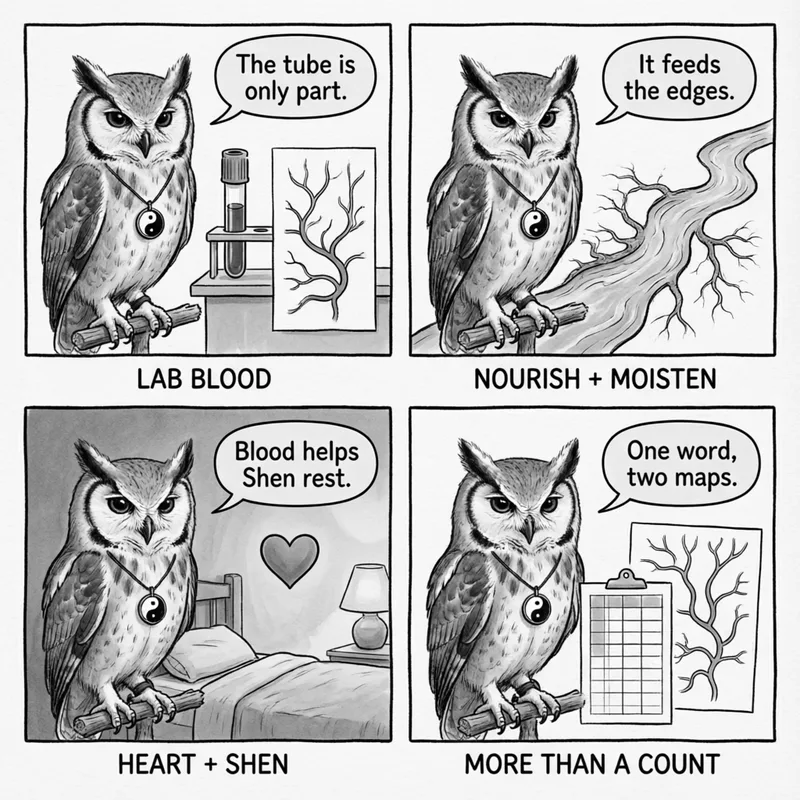
Ollie's take: a number can describe blood without explaining what it nourishes.
What Modern Hematology Measures, and What Xue Represents
An adult body holds about five liters of blood. Red cells use iron-rich hemoglobin to carry oxygen from the lungs to tissue. White cells fight infection, platelets help clotting, and plasma carries water, proteins, nutrients, hormones, and waste.
Bone marrow replaces these cells continuously through hematopoiesis, drawing on iron, vitamin B12, and folate. If marrow output slows, or chronic bleeding drains the system, hemoglobin falls below reference range. A physician identifies anemia and looks for the cause.
TCM does not replace that biology; it describes another layer. Xue is material, nourishing, and moistening: not a laboratory count or a mystical ether. Blood feeds tendons, organs, skin, hair, and sensory tissue. Qi drives it; Yang Qi mainly provides warmth.
A blood test measures cells, hemoglobin, and other markers in a small sample. Pattern observation asks whether tissue is receiving nourishment and moisture, and whether awareness feels settled or unanchored.
How Blood Nourishes, Moistens, and Supports the Organ Networks
Press your thumbnail until it blanches, then release. The pink floods back in a second or two. That is capillary refill, a biomedical sign of circulation, and not a test for Blood Deficiency. In the TCM model, Xue nourishes and moistens tissue throughout the body. Eyes, tendons, skin, hair, and nails draw on Xue, and they may show strain when it runs thin.
Chapter 10 of the Huangdi Neijing Suwen, "Wu Zang Sheng Cheng" (Generation and Completion of the Five Viscera), links Blood with the Heart and the Liver. In paraphrase, when a person lies down, Blood returns to the Liver. The same chapter also says the eyes, feet, palms, and fingers perform their functions when they receive Blood.
After a long day at a screen, your eyes may burn, your calves may cramp, and your skin may feel less supple. A practitioner asks what else has gone dry: skin, hair, nails, sleep.
Why Classical Texts Connect Blood with Shen and Hun
Classical texts link Blood with emotional stability and mental clarity. We often describe the mind as software running independently of digestion, sleep, and physical reserves. This older map refuses the split.
Chapter 8 of the Huangdi Neijing Lingshu, Ben Shen or Root of the Spirit, places Shen with the Heart and Hun with the Liver. Later clinical interpretation describes Shen as conscious awareness and clear presence, while Hun covers dreaming, planning, imagination, and intuitive movement. Neither is treated as separate from the body. In this map, the Heart houses Shen, while the Liver stores Blood and houses Hun; later language often says Heart Blood helps anchor or nourish Shen.
When Blood is plentiful and calm, awareness has a quiet bed. The Suwen says that when a person lies down, Blood returns to the Liver; later clinicians connect that phase with rest and sleep. When the material base is thin, attention may flutter. People describe broken sleep, vivid dreams, jumpiness, palpitations, or a hollow anxious feeling at the desk. A practitioner weighs those clues with the full pattern.
Ollie turns toward the dark window, ear tufts flattening as his pupils widen. His pendant catches the desk lamp. "Hun works the night shift," he says. "Mine goes hunting whether I invite it or not. It still needs something to run on."
The Functional Relay: Production, Storage, Movement, and Command
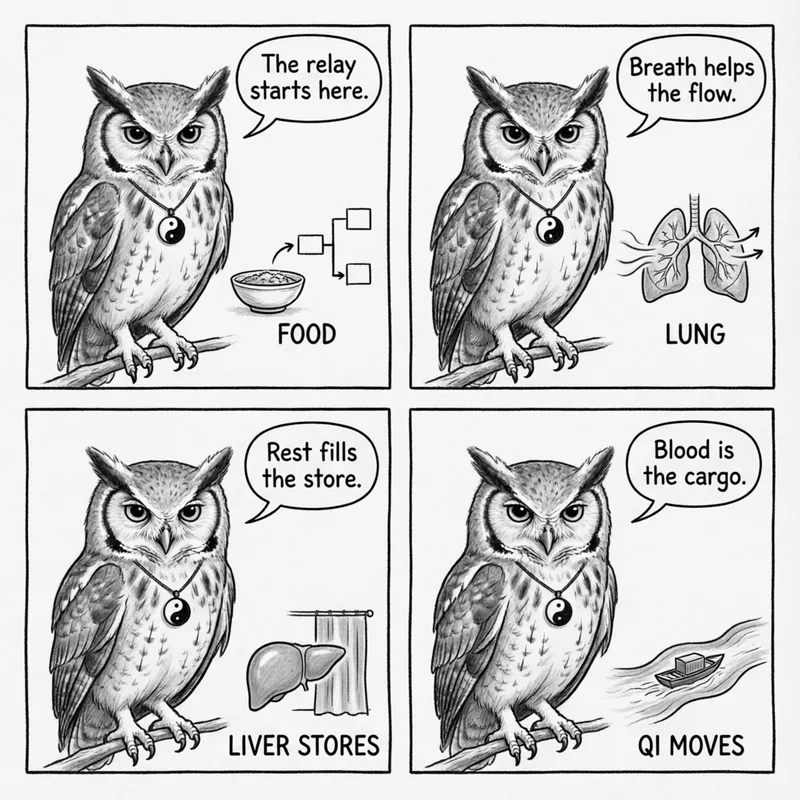
TCM describes Blood formation as a relay, not the work of one organ. Lingshu Chapter 30 says the middle burner receives the Qi of food and drink, extracts its fluids, and transforms them into red Blood. Chapter 18 adds that refined food essence rises to the Lung vessels and becomes Blood. In later theory, the Spleen and Stomach provide raw material; Lung Qi assists distribution, with Suwen 21 describing the Lung as facing the hundred vessels; the Heart governs Blood and vessels; the Liver stores and regulates Blood; and Kidney Essence supports marrow and Blood formation.
Later gynecological theory calls the Chong Mai the Sea of Blood. The Ren Mai, uterus, Kidney Essence, Liver, and Spleen also contribute to menstrual regulation; a fuller treatment belongs in another essay.
In many Chinese kitchens, a thermos of red dates and goji berries is refilled through the workday. Color is a cultural cue, not a blood test. Digestion, rest, and regular meals do the quieter work.
Ollie tucks his wings in and swivels his head ninety degrees, ear tufts lifting. "Blood is the cargo. Qi is the freight train," he says. "You can lay all the track you want. Nothing arrives without an engine."
Later clinicians compressed the relationship into an aphorism: Qi is the commander of Blood; Blood is the mother of Qi. Qi moves and contains Blood. Blood gives Qi a material base. Without Qi, delivery stops; without Blood, there is nothing to deliver.
Blood Deficiency: Not Enough to Go Around
Blood Deficiency is a supply failure with two routes. Production may fall short through weak Spleen transformation, inadequate nourishment, or chronic illness. Reserves can also drain through bleeding, childbirth, or sustained overwork. Signs can look similar; the route changes the interpretation.
- Pale, dull, or yellowish facial complexion without a healthy natural sheen.
- Pale inner eyelids, nail beds, or lips.
- Lightheadedness or dizziness when standing up quickly from a chair.
- Mild palpitations, especially late in the day.
- Dry, brittle hair, flaking skin, and thin fingernails that split easily.
- Light, easily disturbed sleep with restless, drifting dreams.
- Muscle twitches, night cramps, or stiff tendons.
- Scanty, delayed, or absent menstrual flow.
Blood Deficiency shares fatigue and pallor with Qi Deficiency. Blood patterns tend to show more tissue dryness: brittle nails, flaking skin, dull hair, cramps, and poor sleep. Qi Deficiency leans toward a weak voice, breathlessness on exertion, easy sweating, and a lack of strength. Both differ from biomedical anemia, which needs laboratory assessment. The opening project manager has two relevant clues: the sallow afternoon face and the short, late period. Her 2:30 a.m. waking belongs in the broader sleep history but does not point to one pattern by itself.
Ollie side-steps along the desk, claws clicking on oak, one eye half-closed, ear tufts drooping. "Both can leave you tired," he says. "Qi Deficiency is an engine problem: you run out of go. Blood Deficiency is a supply problem: you run out of moisture, and the dry bits complain first. They overlap, so no single clue gets the final hoot."
Qi and Blood Deficiency often arrive together. Weak Spleen Qi can leave Blood without enough material, so a practitioner may read one combined pattern rather than choosing a single box.
Blood Deficiency and Yin Deficiency both produce dryness. Blood Deficiency runs pale and quiet: a pale tongue, sometimes slightly dry, and a thin pulse. Yin Deficiency runs dry and warm: night sweats, palm-and-sole heat, afternoon flushing, and a red tongue with little coating beside a thin, rapid pulse. Liver Blood leans toward dry eyes, cramps, brittle nails, and scanty periods; Heart Blood toward palpitations, poor memory, and insomnia.
Some later traditions associate 1:00 to 3:00 a.m. with the Liver channel. That idea is distinct from Suwen 10's statement that Blood returns to the Liver when a person lies down. Repeated waking at 2:30 a.m. is nonspecific and cannot establish a Liver or Blood pattern, though a practitioner may note it within a broader sleep history.
Blood Stasis: Present but Stuck
Blood Stasis means Blood is present but not moving freely. Clues sometimes include:
- Stabbing, fixed pain that stays in one exact spot rather than wandering.
- A dark or purplish tongue, or distended veins beneath it.
- A dark or dull complexion.
- Dry, scaly skin in fixed patches.
- Dark or brown menstrual flow with distinct clots and sharp cramps.
Mechanism outranks the list. Qi moves Blood. Constrained Liver Qi may slow it first, producing moving, distending discomfort; later, fixed, stabbing pain can mark the shift into Blood Stasis. Cold congeals Blood, so warmth may ease it. Qi Deficiency may contribute to stasis when Qi is too weak to propel Blood. Chronic Blood Deficiency may also impair nourishment and vessel filling and can coexist with stasis, but the patterns are not interchangeable.
Blood Heat: Moving Too Hot
Blood Heat means Heat agitates Blood and may cause rapid or reckless bleeding. Clues include bright-red bleeding, heavy menstrual flow, nosebleeds, inflamed red eruptions, a crimson tongue, and a rapid pulse. Spleen Qi failing to contain Blood tends toward chronic bleeding, fatigue, poor appetite, and a pale tongue; Stasis toward dark clotted bleeding and fixed pain. Blood Heat also differs from Yin Deficiency heat, which tends toward night sweats, dryness, and palm-and-sole heat.
Qing warm-disease physicians, such as Ye Tianshi, mapped febrile illness through Wei, Qi, Ying, and Xue. Heat reaching Xue may bring high fever, agitation, confusion, or bleeding and needs prompt medical care.
Ollie Speaks
Ollie settles on the arm of the chair, his copper pendant swinging once against his chest feathers. He blinks slowly and tucks one wing in.
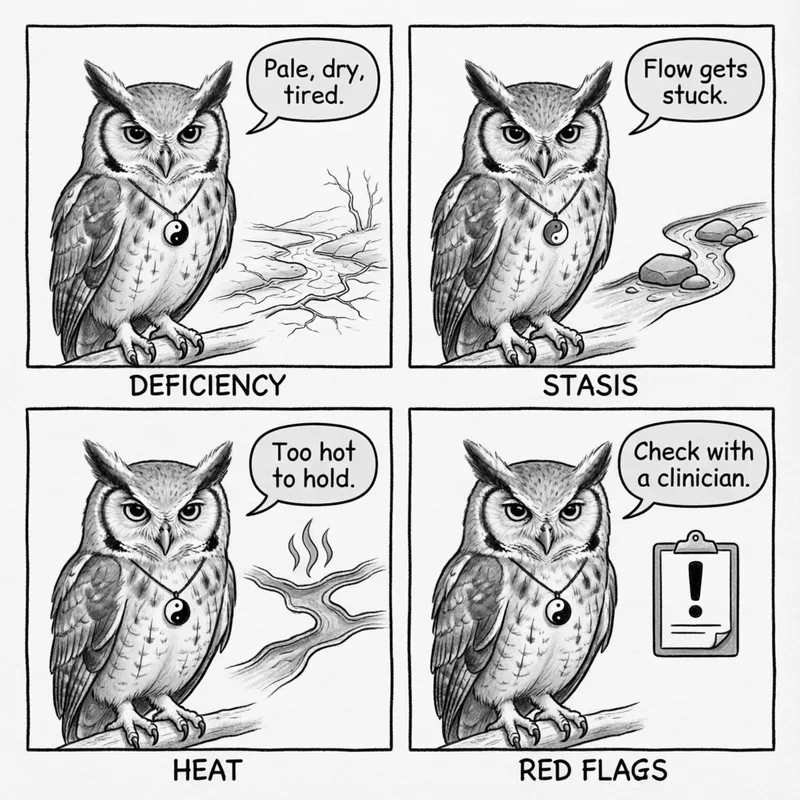
"I watch people stare at one lab number until their eyes glaze over, while meals vanish and sleep crumbles around them. That number still matters." He fluffs his chest feathers and shifts from talon to talon. "I am an owl, not a physician, so I would ask a healthcare professional to interpret it alongside your symptoms. I also notice when someone stops treating meals and sleep as optional."
"The old physicians had no centrifuges. They relied on close observation over time, tracing how food, digestion, rest, illness, and bleeding affected the signs they associated with Blood. I once slept through supper after a particularly good nap, so I am not claiming perfection. I try to eat before hunger sharpens and tuck my head under a wing before worry starts circling. Some nights worry wins anyway, and I am still awake at four, blinking at shadows."
What You Can Do This Week
The project manager needed more than another number: her meals were disappearing, sleep was borrowed, and her cycle had changed. Traditional support for Blood emphasizes regular nourishment and adequate protein, iron, vitamin B12, and folate. Later clinical interpretation also emphasizes adequate rest. A private log can connect those observations without naming a pattern.
- Food rhythm: note which meals disappear when the day gets crowded.
- Sleep pattern: note bedtime, waketime, and how rested you feel.
- Tissue signs: note dry eyes, cramps, brittle nails, or unusual hair shedding.
- Cycle: note timing, duration, heaviness, and any significant change.
- Energy: note when fatigue arrives and what changes it.
Persistent or crushing fatigue, breathlessness during light activity, unexplained chest pain, fainting, black or tarry stools, blood in urine, bruising without trauma, yellow skin or eyes, fever with confusion, or severe prolonged bleeding need prompt medical assessment. A symptom log can provide context, not a replacement for a blood test or medical evaluation.
FAQ
Should I take iron supplements if I have Blood Deficiency signs?
Do not self-select iron. Iron helps when a person is genuinely deficient, and that needs blood testing rather than a symptom list. Unnecessary iron can cause constipation, nausea, and stomach upset. It can also hide the search for a source of blood loss that needs attention. Start with a healthcare professional who can interpret a complete blood count, ferritin, and the wider context. If iron deficiency is found, ask how food-based sources and any traditional supportive practices fit alongside the medical plan. The color of your food or a traditional pattern does not replace that assessment.
Can someone have normal blood tests and still show a TCM Blood pattern?
Yes. A complete blood count checks red cells, hemoglobin, and hematocrit against reference ranges. Those values can look normal while a person notices dry skin, brittle nails, muscle twitching, postural lightheadedness, or restless sleep that tradition may group as Blood Deficiency. The reverse also happens: laboratory anemia needs medical evaluation even if the traditional pattern looks mild. A count is one snapshot; pattern observation follows changes across meals, rest, activity, and the menstrual cycle. Both deserve attention when symptoms persist or worsen.
What does it mean that Blood houses the Shen?
Strictly speaking, the Heart houses Shen; Blood nourishes the Heart and provides material support that helps Shen remain settled. Classical medicine treats awareness as rooted in the living body. When Heart Blood is described as sufficient, attention can rest, sleep feels more continuous, and mental presence feels steady. When Blood runs low or becomes agitated by heat, later clinical language describes Shen losing that support. People may report palpitations, poor memory, racing thoughts, vivid dreams, jumpiness, or evening anxiety. These are traditional descriptions, not a verdict about the mind or a substitute for medical assessment.
Sources
- Huangdi Neijing Suwen, chapter 10, Wu Zang Sheng Cheng.
- Huangdi Neijing Suwen, chapter 21, Jing Mai Bie Lun.
- Huangdi Neijing Lingshu, chapter 8, Ben Shen.
- Huangdi Neijing Lingshu, chapter 18, Ying Wei Sheng Hui.
- Huangdi Neijing Lingshu, chapter 30, Jue Qi.
- Ye Tianshi and the Qing warm-disease tradition, Wei-Qi-Ying-Xue.
- MedlinePlus / NIH, Blood.
- MedlinePlus / NIH, Red Blood Cell (RBC) Count.
- NHS, Iron deficiency anaemia.
This article is cultural education, not medical advice. See the Medical Disclaimer.