
Cold Feet Are More Than Poor Circulation
You've been at your desk two hours. Your sweater is warm, but your toes are cold enough to make you check the window. It isn't open. Under a duvet, your chest warms while your heels stay cold.
People often call it "poor circulation." Traditional Chinese medicine (TCM) starts elsewhere: how much warmth do you make, and what stops it reaching your toes?
Up on the window perch, Ollie swivels his head to follow your feet under the desk, ear tufts tipping forward. His copper pendant taps the window frame. "Feathers help," he murmurs, "but warmth starts deeper than your slippers."
 Ollie's Take
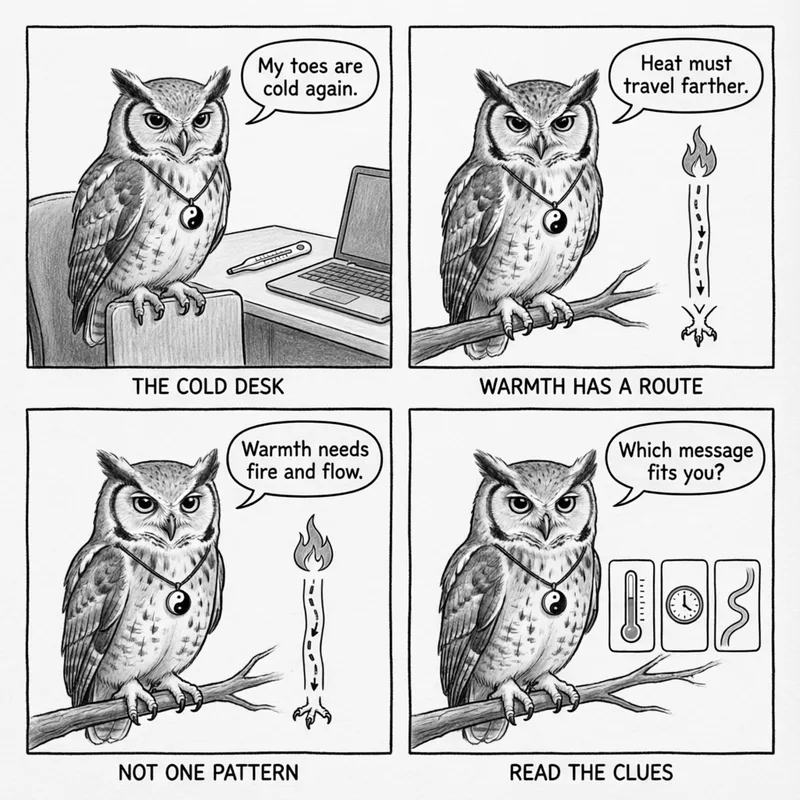
Ollie's take: a cold toe is a clue, not a diagnosis.
Red Flags: When Cold Feet Need a Doctor, Not a Pattern
- Call emergency services if: one foot suddenly turns cold, pale, or blue with severe pain, numbness, or weakness; or you have chest pain, breathlessness, fainting, face or arm weakness, or speech difficulty.
- Get same-day care if: a foot wound won't heal, redness is spreading, tissue looks black, or feeling is gone, especially with diabetes.
- Get urgent assessment if: one calf is swollen, warm, red, or painful, including new one-sided swelling in pregnancy.
The Woodstove in the Hallway
Most of the time, cold feet are just feet responding to cool air: vessels near the skin narrow, and warm blood pulls toward the core. Inactivity, fatigue, hunger, and varying vascular tone can leave toes cool without cardiovascular disease. Sitting worsens it: calf muscles pump blood upward; a still leg doesn't. A TCM practitioner reads those details alongside digestion, sleep, energy, stress, and cravings for warmth.
Pattern reading and vascular testing answer different questions. Pattern language came from centuries of clinical observation, but it cannot measure an artery. Healthy arteries can coexist with cold feet, and narrowed arteries can chill them regardless of sleep, diet, or stress. Only medical testing can tell them apart.
A woodstove in the hallway doesn't warm the back bedroom. Something must carry the heat down the hall. Yang is the fire, Blood carries warmth, and Qi keeps it moving. Yang and Qi aren't two substances; Yang Qi is Qi doing its warming work. Chapter 3 of Huang Di Nei Jing Su Wen (Yellow Emperor's Inner Classic, Basic Questions) compares Yang Qi to the sun. Break any link, and distant rooms grow cold while the hallway stays comfortable.
Blood (Xue) nourishes and moistens tissue while carrying Yang's warmth outward. In TCM it's a functional category broader than a laboratory blood count. Blood Deficiency means there isn't enough Blood to go around; the hands and feet, farthest from the center, run short first.
Qi supplies movement. Even with heat and fluid, Qi must distribute them. Chapter 5 says clear Yang reaches and fills the four limbs. When external Cold or internal tension slows that movement, the farthest outposts feel the drop first.
Five Traditional Patterns Behind Cold Limbs
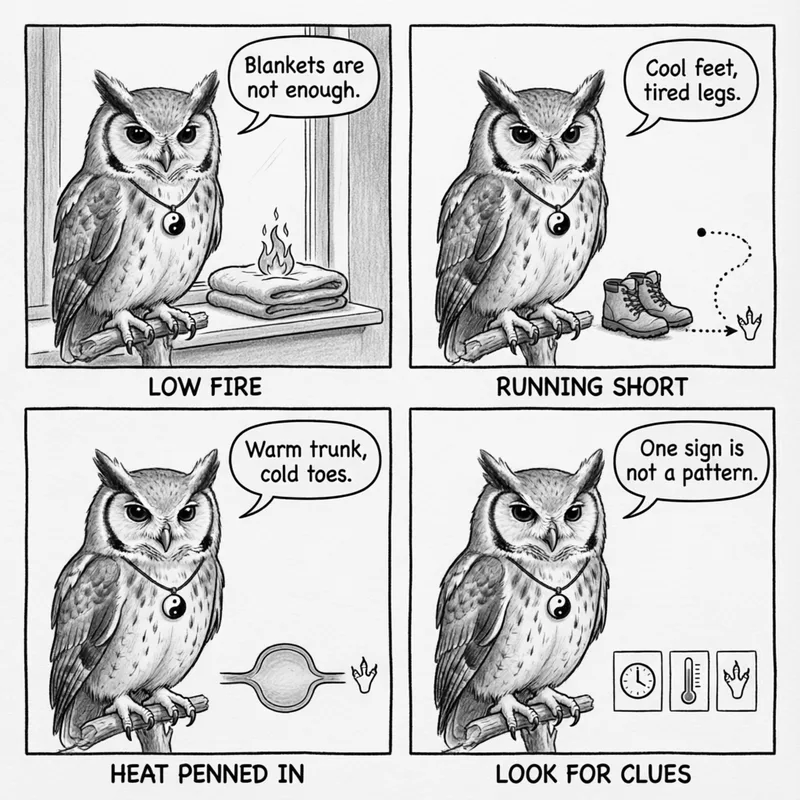
Ollie hops down beside the desk lamp, close enough that his shadow swallows half the page. "Several ways to end up with cold toes," he says, closing one eye. "Not enough fire, not enough Blood to carry it around, or a kink in the hose somewhere higher up."
Cold feet rarely fit one pattern; most people land between two.
1. Yang Deficiency
This is the pattern with little fire. The feet don't just feel cold; they refuse to warm, even after socks and blankets. Clues include cold intolerance, low stamina, cold hands, a pale complexion, a pale puffy tongue with a moist white coating, and a deep, slow pulse that goes weak and forceless under pressure. Practitioners read pulse force: a weak, forceless pulse points to Yang Deficiency; one that pushes back suggests Cold obstruction.
Spleen Yang shows in digestion: loose stools, bloating after cold food, or heaviness after meals. Kidney Yang runs lower: a cold low back, night urination, and a chill blankets cannot reach. The Kidneys store pre-heaven Essence (Jing); Kidney Yang is its warming face. The Spleen makes Qi daily from food and fluid (post-heaven Qi). Ming Men Fire warms the Spleen so it can do its job. When Spleen Qi covers daily needs, the body draws less on stored Essence. Ming Men, the Life Gate, sits between the Kidneys; Zhang Jingyue later called it the source of Yuan Qi and ministerial fire. No single sign defines the pattern; cold toes alone are not enough.
Qi Deficiency is often mistaken for Yang Deficiency. Both cause fatigue and cool hands, but Qi Deficiency lacks cold aversion, heat craving, and the pale moist tongue. If you're tired but not cold, warming targets the wrong problem.
Classical sources describe long-term rebuilding. You Gui Wan is the formula most often cited. The classical formula contains prepared Fu Zi and Rou Gui, both hot, so it is the wrong choice for anyone with heat signs or Yin Deficiency. Commercial versions vary in whether Fu Zi is included, one more reason not to self-select. Pattern confirmation and dosing need a practitioner. Practitioners may use moxibustion at Ming Men (GV4) and Guan Yuan (CV4), or salt-partitioned moxa at Shen Que (CV8). Moxa burns skin; do not self-apply it over the lower abdomen in pregnancy or anywhere sensation is reduced.
2. Blood Deficiency
Your feet feel cool rather than icy. Your heels crack, your calves cramp, and standing up too quickly leaves you graying out for a second. There isn't enough Blood for the outer edges. In TCM, the Spleen and Stomach build Blood from food and fluid; the Liver stores it. Poor appetite, long-term undereating, heavy periods, or a strained Spleen can all contribute.
Other clues include lightheadedness on standing, restless sleep, palpitations, or scanty periods. The tongue looks pale with a thin coating; the pulse is thin or fine. Blood Deficiency isn't a laboratory diagnosis of anemia; your iron panel can be normal.
Anemia can share those sensations; persistent numbness, breathlessness, or unusual fatigue needs assessment.
3. Constrained Qi: Warmth That Cannot Get Out
Here the heat exists, but its movement is held up. Cold, clammy feet may accompany warmth, tightness, or flushing in the head and chest. This pattern often appears in people under sustained stress who also sit all day.
Classically the Liver governs free flow. Stress pens Yang into the trunk instead of the limbs. The feet aren't short of heat; they're downstream of a traffic jam.
Shang Han Lun (Discussion of Cold Damage), compiled by Zhang Zhongjing around 200 CE, explains jue as Yin and Yang Qi failing to connect smoothly (Jue Yin section, Song-edition line 337), then treats cold extremities as more than one situation. In some cases warmth is gone; in others it remains but is penned in, leaving a warm trunk with cold hands and feet. This section is about the second picture.
For this picture, Shang Han Lun lists Si Ni San (line 318, Shao Yin chapter): mild cold limited to the hands and feet, not collapse. It is not Si Ni Tang.
Traditional pattern descriptions may consider whether cold extremities change with movement or warmth. That response is one observation, not a way to identify a pattern or rule out vascular disease.
4. Cold-Damp Obstruction in the Channels
When a front moves in, your ankles feel packed in wet sand: heavy, achy, stiff. Dry heat helps more than a blanket. Cold contracts; Damp lingers and blocks the channels like silt.
Damp gathers when Spleen Yang can't transform fluids, often following Yang Deficiency. Warming is right here, but Damp needs movement and draining; rich, sweet tonic foods feed it. Clues include a white greasy tongue and a pulse that feels slippery or soggy, often deep and slow where Cold predominates.
5. Blood Stasis
Here the cold has a color. Toes look dusky, purplish, or mottled rather than simply pale, and discomfort may be fixed, stabbing, or worse at night. The tongue may look purple or show distended sublingual veins. Blood Deficiency means there isn't enough carrier to begin with. Blood Stasis means the carrier is present but isn't getting through. The overlap with vascular disease is why dusky or mottled feet belong in front of a clinician.
Ollie drops to the back of your chair, cranes his head down past his feet until it's nearly upside down, and studies your toes. His pendant swings forward and bumps his chin. "Dusky purple is a different question," he says. "That one's for someone with a stethoscope, not a bird."
Two Patterns This Isn't: Yin Deficiency and Exterior Cold
Yin Deficiency runs in the other direction. Depletion of cooling and moistening fluids allows empty heat to rise: night sweats, dry throat, warm palms and soles, a red tongue with little coating, and a thin, rapid pulse. Someone can feel cool skin over a hot, restless core. Heavy warming routines can worsen this pattern, so the distinction belongs with a trained practitioner.
Exterior Cold is different again. It arrives suddenly after a specific exposure and eases when you warm up. Yang Deficiency is a longer-standing baseline, and temporary warmth helps only while it lasts.
When Cold Limbs Are an Emergency: Why Si Ni Tang Isn't a Home Formula
Cold past the knees with collapse, a faint pulse, and no returning warmth is an emergency. Fu Zi-based formulas like Si Ni Tang belong in trained hands. Fu Zi (aconite) is toxic. Even processed, dosing and decoction require supervision. Never buy, dose, or add it yourself. Call emergency services first.
Si Ni San, discussed earlier, is a different formula for a different problem. Despite the similar names, neither is for self-ordering.
Ollie Speaks
I'll admit birds have it easy. On cold nights my down keeps my chest warm. When wind picks up, I fluff out until I'm twice my real size and sleep through the squall. My pendant goes cold against my chest on nights like that, and I don't mind it. It warms again when I tuck my head under a wing.
Humans have a harder job than I do. You sit for ten hours with ribs barely moving, then your feet complain, and you can't blame one part of the day. Warmth has to be fed. Trapping it only gets you so far. Hot meals. Legs that move. Sleep you come out of on your own, the way I do when the light changes. I'm better at the sleeping than the moving, and I won't pretend otherwise. Hoo.
A Seven-Day Observation Exercise
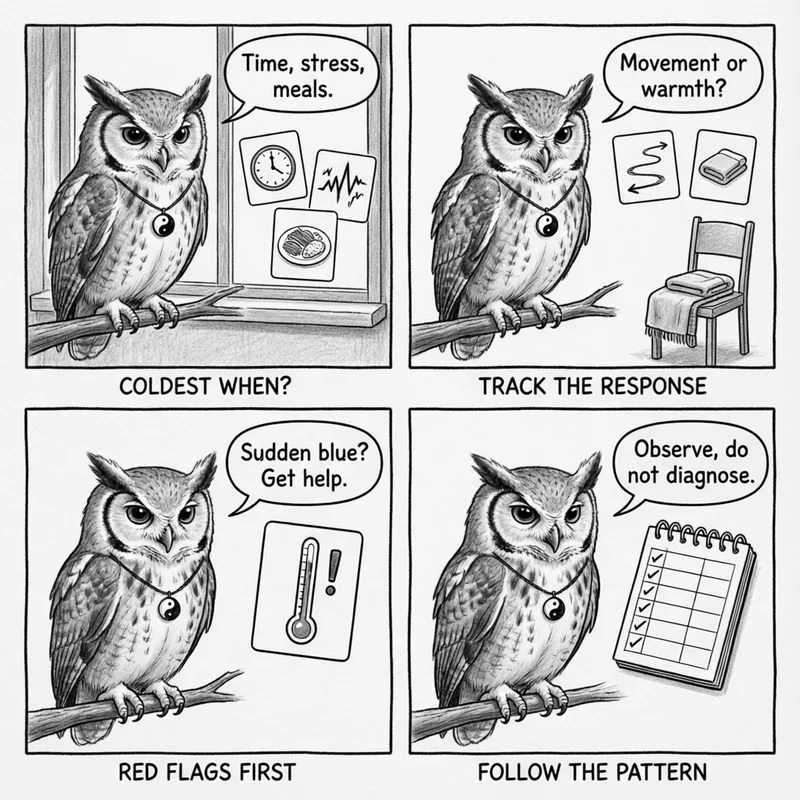
Most people can't say when their feet are coldest. A week of two-line notes fixes that. "Coldest at 4 p.m., after skipping lunch, warm after walking home" is a finding. "My feet are always cold" is a shrug.
- Timing and symmetry: When do the feet feel coldest, how long does it last, and are both sides equally cool?
- Color and sensation: Note pallor, bluish or mottled skin, numbness, tingling, burning, or pain.
- Daily context: Record long sitting, missed meals, stress, fluid intake, medications, or known health conditions.
- Response to warming: Does walking, dry socks, a warm drink, or a blanket restore warmth quickly?
The log isn't a diagnosis. It gives a clinician something concrete to work with if the chill persists.
Ask a clinician about these specifically: fingers or toes that blanch white, then blue, then flush red (Raynaud's); cold intolerance with fatigue or weight change (thyroid); numbness in the feet with diabetes (neuropathy); or unexplained anemia.
What Helps on a Cold Day
Dry feet are the first household comfort: wool or moisture-wicking socks resist clammy chill, and slippers keep bare skin off cold floors. The same routine is also a chance to check for cracks, blisters, swelling, or an unexplained sore.
In TCM, movement is what keeps Qi and Blood flowing toward the limbs. Ankle circles, toe flexes, calf raises, a short walk: these are ordinary ways people notice a change ten minutes later.
Ollie lifts one foot off the perch, tucks it into his feathers, and sets it down again. "How long since you stood up?" he says. "I shift feet every few minutes while standing still, and I'm asleep for most of it."
Chinese kitchens reach for congee with fresh ginger, chicken soup with jujube and goji berries, or winter lamb stew. Fresh ginger (Sheng Jiang) is traditionally warming, not a circulation cure. Cinnamon bark (Rou Gui) is hotter and avoided during pregnancy or with heat signs.
If sensation is normal, a 10- to 15-minute soak at 37–40°C feels pleasant. Dry your feet thoroughly afterward.
Anyone with diabetes, neuropathy, reduced sensation, circulation concerns, or a foot wound should skip hot soaks and seek care. Damaged nerves can't judge temperature.
FAQ
Why do my feet stay cold even under three heavy blankets?
Blankets don't make heat. They hold the heat you give off. If skin vessels stay narrowed from sitting still, fatigue, or stress, warm blood stays in your core and there's little for the blanket to hold. A practitioner might describe that as Yang warmth having trouble reaching the body's outer edges, or as tension keeping circulation inside. Walking, ankle circles, or a warm foot bath may help the feet warm faster. One-sided color, numbness, pain, or weakness needs prompt assessment.
Do cold feet mean my kidneys are weak?
Not in the way you're picturing. Kidney Yang names a function: warmth, drive, and baseline metabolism, not the kidney organs. The pattern a practitioner might describe is Kidney Yang Deficiency. Cold feet are one clue among many, and a cold low back or night urination carries more weight than cold toes alone. Blood or urine tests measure how well the kidney organs filter, which is separate from Kidney Yang. If those symptoms persist or worsen, ask a qualified professional for assessment.
My feet are freezing, but I kick the covers off at night. Which pattern is that?
That mix usually isn't one label. Cold feet with a hot, restless core can fit Yin Deficiency, especially with night sweats, dry throat, or warm palms and soles. It can also fit constrained Qi, where heat sits in the trunk and doesn't reach the toes. Heavy warming doesn't always help and can worsen empty heat. Bring both halves of the pattern to a practitioner rather than treating the feet alone. New symptoms can also accompany thyroid changes or perimenopause, so persistent or worsening nights deserve medical assessment.
Sources
- Huang Di Nei Jing Su Wen (Yellow Emperor's Inner Classic, Basic Questions), chapters 3 and 5.
- Zhang Zhongjing, Shang Han Lun (Discussion of Cold Damage), c. 200 CE; Song-edition lines 318 and 337.
- Zhang Jingyue, Jing Yue Quan Shu, Ming dynasty.
- AHA, "Peripheral Artery Disease."
- Mayo Clinic, "Raynaud's disease."
- CDC, "Diabetes and Your Feet."
- Mayo Clinic, "Hypothyroidism."
This article provides cultural education on traditional concepts and everyday comfort measures; it isn't medical advice, and any persistent or alarming symptoms deserve a qualified medical assessment.