
Your Poop Is a Morning Report — TCM's Most Revealing Question
Most people flush without looking. Modern culture treats waste as an embarrassment, something plumbing carries off before you think about it. Yet a first visit to an acupuncturist or herbalist often begins with a blunt question: What does your bowel movement look like, how often does it happen, and how much effort does it take?
That question startles people expecting talk of stress, sleep, or back pain. In traditional Chinese medicine, the morning bathroom trip is not embarrassing; it is data. Stool shows clues about digestion, fluids, warmth, and direction: clear Yang rises, turbid descends. Ollie, our resident screech owl, pokes through cast pellets every morning, ear tufts flat and pendant swinging. He cannot work out why the rest of us look away. “It's the only report you get for free,” he says.
 Ollie's Take
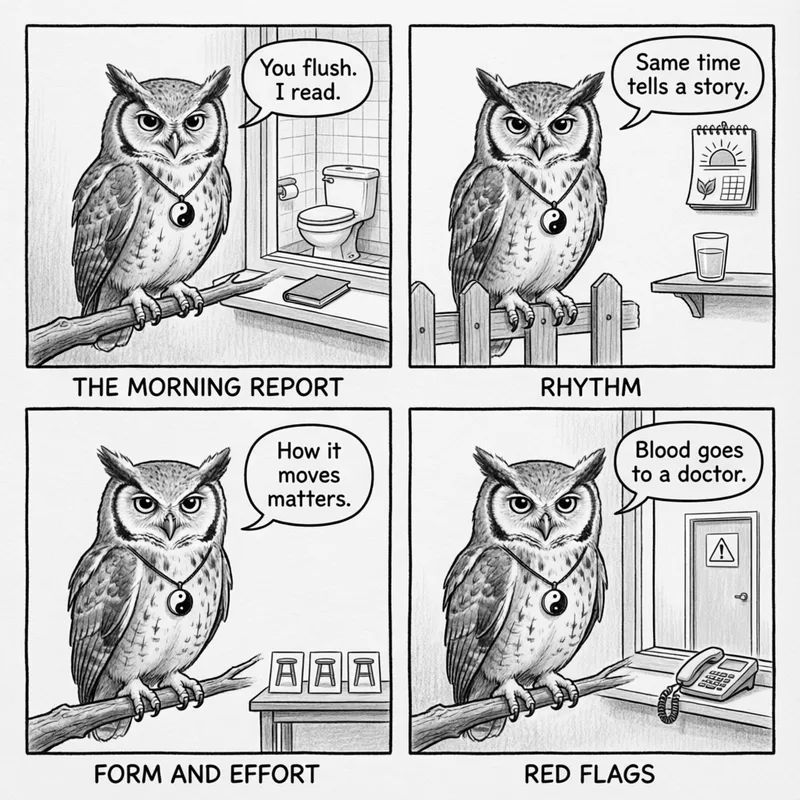
“I read pellets, not blood,” Ollie says. “If the report turns dark, take it to a doctor.”
Why an Old Medical Tradition Asked About Waste
A physician in 1600 had no lab, only eyes, fingers, and questions. Zhang Jingyue (1563–1640) set them to verse in Jingyue Quanshu (The Complete Works of Jingyue), so students would not forget. The verse moved through cold and heat, sweat, head and body, stool and urine, food and drink, chest, hearing, and thirst, then closed with pulse, complexion, Qi, and bearing. Later physicians added prior illness, cause, medicines already taken, and menstruation; modern textbooks add sleep and mood.
The song compressed a diagnostic interview developed over centuries. The ideas trace back to the Huangdi Neijing (The Yellow Emperor's Inner Classic), a layered corpus assembled by many hands, not the work of one author. Observation carried the diagnostic weight because clinicians had no blood panels, endoscopy cameras, or ultrasound. They read the outside of a living body to infer the inside.
The Body Map Behind the Question
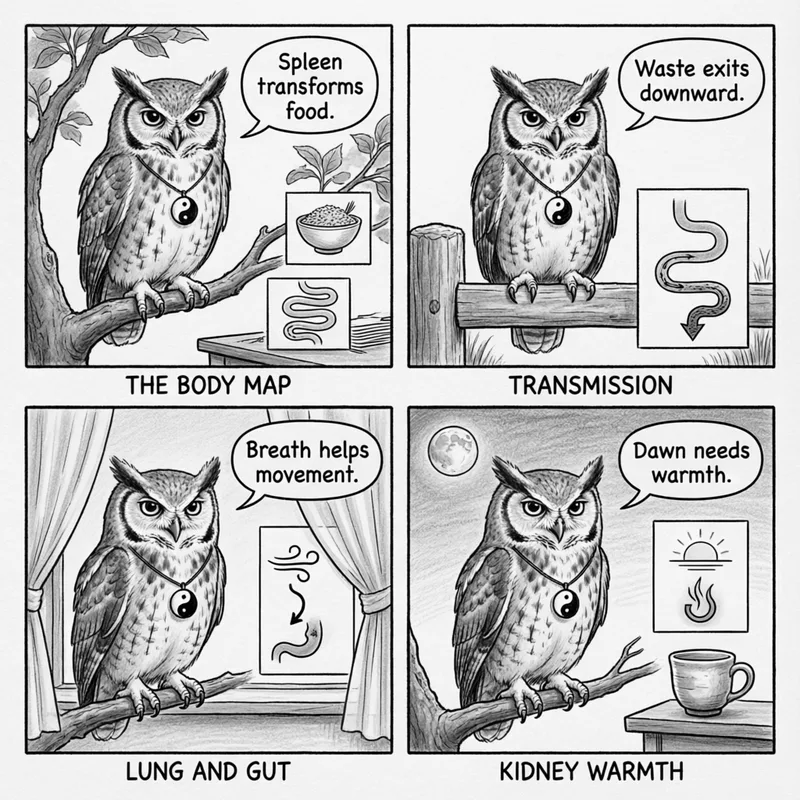
To follow the classical logic, step away from modern anatomy for a moment. When traditional Chinese medicine speaks of the Spleen, Stomach, Lung, Large Intestine, or Kidney, it is not describing only the organs in a surgical tray. It is describing functional spheres: what a system does and which other systems it depends on.
The Stomach receives and ripens food; the Spleen transforms and transports it, sending nutritive essence upward and distributing fluids. When that work is steady, waste moves without waterlogging the lower gut. This is the functional image behind the person who eats a reasonable salad and still feels it sitting in the abdomen two hours later.
Next comes the Large Intestine. The Su Wen, chapter 8, calls it the “official of transmission,” the organ through which transformation exits. It receives solid residue after the Small Intestine separates clear nutrients from turbid waste, reclaims the fluids it governs, and transmits the rest downward.
The Lung and Large Intestine are an interior–exterior Metal pair. The Lung governs respiration, descending Qi, and the water passages. When grief tightens the chest and breathing goes shallow, that descent stalls; the Large Intestine loses momentum, moisture falters, and constipation can arrive with chest tightness.
The Kidney governs Water, stores Essence, and controls urination and defecation. Kidney Yang warms Spleen Yang, and digestion depends on that warmth. When it declines, some people wake before dawn with urgent, watery diarrhea. Zhang Jingyue described this as waning Ming Men fire, the ministerial fire between the Kidneys and root of Yuan Qi and basal warmth. Prolonged illness or aging may deplete Kidney Yin, leaving the bowel undernourished and under-lubricated, often with night dryness, a red scant-coated tongue, and a thin rapid pulse. Ordinary dehydration can harden stool without establishing that pattern.
The Four Things a Practitioner Traditionally Listens For
A practitioner listens for four things: rhythm, form, effort, and what else the body is doing. No single finding decides alone. A loose stool at dawn only means something once you know how warm that body runs, whether the low back aches, and what the rest of the morning is like.
1. Rhythm and Frequency
Is it once a day, three times, or once every four days? Morning regularity suggests Yang Qi rising on schedule. The organ clock assigns 5 to 7 a.m. to the Large Intestine; it fits the habit, but neither idea proves the other. Fixed predawn diarrhea, called fifth-watch diarrhea, is traditionally tied to Kidney Yang failing to warm Spleen Yang. Consistent timing with cold limbs, a cold low back, fatigue, or a deep weak pulse strengthens that reading.
2. Form and Texture
The Bristol scale types waste from hard lumps to liquid. Classical medicine makes similar distinctions: dry pellets point to a fluid shortfall or lingering heat; loose stools suggest Spleen dampness or cold; recognizable food suggests incomplete transformation, and with cold signs practitioners look to Spleen or Kidney Yang. Corn hulls and spinach bits alone mean little.
3. Effort and Sensation
Passing stool should not feel athletic. A runner can eat vegetables daily and still strain fifteen minutes over something soft, which the tradition reads as Qi deficiency: moisture, but not enough push. Cold-deficiency constipation may involve infrequent or difficult stool because Yang cannot warm and move the intestines, with cold limbs or low back, fatigue, clear abundant urine, a pale swollen tongue, and a deep weak slow pulse. Markedly dry stool still needs differentiation from fluid, Blood, Yin, and heat patterns. Yin deficiency brings a red tongue with little coating, thin rapid pulse, and night dryness; Blood deficiency brings a pale tongue, thin pulse, and dizziness on standing. Excess heat brings a red tongue with thick yellow coating, full rapid pulse, foul breath, dark urine, and thirst for cold drinks.
Incomplete evacuation may suggest Qi stagnation: the urge starts, then snags. Fiber can worsen fullness, and straining tightens the exit. Look for rib-side tightness, sighing, or a braced chest. Weak, sinking Spleen Qi produces the same sensation by the opposite path, with heaviness that worsens with fatigue. Stress-triggered loose stool that eases on vacation may reflect Liver Qi overacting on the Spleen. Identical stool can mean different things. Ollie puts it in one line, ear tufts twitching on his cedar perch. “Pushing harder on a stuck door rarely helps,” he says, “when the latch is the frozen part.”
Gastroenterologists reached the same place from the other direction. Rome IV does not judge functional constipation by stool count alone. At least two of six findings must recur: straining, hard lumps, incomplete evacuation, blockage, manual help, or fewer than three spontaneous movements a week. Each qualifying finding among the first five must occur in more than a quarter of bowel movements. Symptoms must span three months, with onset six months earlier, and not fit IBS.
4. Accompanying Physical Symptoms
The stool itself is only half the story. Does it relieve lower abdominal bloating, or does the cramp linger? Do you crave cold water, or sip warm tea because cold drinks hurt? Sleep and appetite belong in the same picture. A person who wakes at 4 a.m., cannot fall back asleep, and skips breakfast without hunger tells a different story from one who sleeps nine hours and wakes groggy with a thick tongue coating. Same stool, different pattern.
Ollie tips his head upside down to inspect. His weight shifts, and the pendant clicks once against the perch as he leans. He is not squeamish about it, and neither were the old practitioners. To them, stool was one more thing a body told you about itself.
What a Stool Pattern Cannot Tell You
Search “green stool” and you will be told your Liver is congested. Post about one loose morning and someone will diagnose Spleen Qi deficiency. Neither holds. Green usually means greens, food dye, or fast transit. Loose stool points to the Spleen only when fatigue after meals, pale tongue, and low appetite agree.
Color alone does not map onto a single organ. Classical texts read it in context, mostly to judge heat, cold, or blood. It also shifts with dinner, beetroot juice, iron supplements, and bile movement. Color matters when it points to blood, which is why bright red and black tarry stools sit on the red-flag list below.
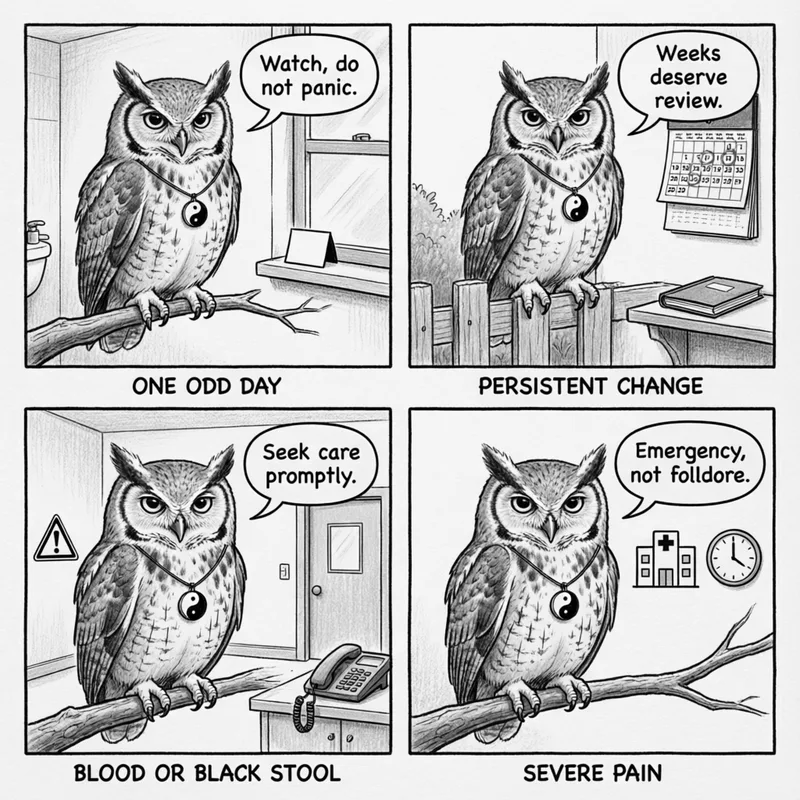
An unusual bowel movement is not automatically a sign of disease. A single loose stool after spicy food or a long flight can be temporary. One strange day matters far less than a persistent change that does not resolve.
Pattern work also has a hard ceiling. It describes function, not what is physically there. When these warning signs appear, medical evaluation comes first:
- Bright red blood in the stool or on toilet paper that does not quickly resolve
- Black, tarry, sticky stools, which can indicate bleeding higher up in the digestive tract
- Unexplained, unintentional weight loss accompanying digestive changes
- A persistent, unexplained change in bowel habits lasting more than three weeks
- Severe, sudden, or unremitting abdominal pain
- Fever, chills, or persistent vomiting alongside abdominal distress
- Signs of dehydration, such as dizziness, dry mouth, or dark, sparse urine
Seek emergency care for severe acute symptoms. Persistent red flags need prompt medical review; pattern work never justifies delaying tests.
Ollie Speaks
I spend my nights in the branches, and not one creature below me has ever been embarrassed about what it left behind. They eat, they digest, they move on. I cough up a pellet of fur and bones most mornings and inspect it, because that is how an owl checks the work. I nudge my small yin-yang pendant straight against my chest feathers and tuck one foot into them, talons curled. If your report looks sideways this week, write it down. A week of plain notes tells a professional more than a month of worrying at three in the morning. I would know. Three in the morning is my shift.
A Seven-Day Morning Report You Can Keep
You will forget. Three weeks from now, in an exam room, you will be asked when this started and you will say, “A while, maybe since the summer?” The conversation stalls there. A week of notes turns that into dates your doctor or practitioner can use.
You do not need a complicated spreadsheet or specialized software. A small notebook kept beside the sink is enough. Each day, jot down seven practical elements:
- Time: When did elimination occur? Was it spontaneous, or did you wait hours after waking?
- Form: Use simple terms. Was it dry and hard, smooth like a soft sausage, loose and ragged, or liquid?
- Effort: Did it pass easily within a couple of minutes, or did you strain? Did you feel completely finished afterward?
- Discomfort or blood: Was there cramping, burning, rectal pain, or any visible blood?
- Dietary shifts: Did you eat something unusual, skip meals, drink extra alcohol, or consume very little water?
- Medications and supplements: Note any antibiotics, pain medications, antacids, or iron tablets taken recently.
- Stress and sleep: Did you sleep poorly, face a heavy deadline, or travel?
After a week, patterns may appear: loose stool after broken sleep, or hard pellets after dry afternoons. The log diagnoses nothing; it replaces vague anxiety with dates. Ollie scratches notes into the wood until, by Thursday, he has run out of room. He blinks, rouses, and lets the pendant settle. “Seven mornings is plenty,” he says. “After that you're just staring, and staring is what I'm built for. Take the notebook to someone who can read it.”
FAQ
Does classical Chinese medicine consider daily bowel movements mandatory for good health?
Classical theory cares about rhythm and ease, not a daily tally. A woman who has gone every other day since her twenties with no straining and no bloating is not constipated. A man going twice a day in loose, urgent bursts with undigested food has a problem, even though his number looks better. Consistency, easy passage, and feeling fully evacuated matter more than a count. The classical question isn't whether someone meets a universal schedule, but whether the body moves waste without effort or distress.
What does it mean when stool clings stubbornly to the side of the toilet bowl?
Sticky stool can reflect two patterns. Damp-heat often brings a yellow greasy tongue coating, strong odor, burning at the anus, and dark scanty urine. Damp from Spleen deficiency can bring a pale tongue, thick white coating, fatigue after eating, and no burning. Sticky residue is not evidence of a dirty colon, and the fix is not a punishing cleanse. It is worth describing to a practitioner, tongue coating and all. One sticky clue rarely settles the question on its own.
I wake between 3 and 5 a.m. with loose, urgent stool. What might that be?
Later clinical literature names this fifth-watch diarrhea and ties it to Kidney Yang failing to warm the Spleen before dawn. Additional signs may include a cold low back, pale swollen tongue, dislike of cold, and slow pulse. Spleen Qi deficiency can also produce loose stool, but without the fixed predawn clock, cold lower back, or aversion to cold. Early-morning IBS with diarrhea, bile-acid diarrhea, and infection also need assessment. The red-flag list still applies. A new or worsening pattern needs a medical workup before any remedy, herbal or otherwise.
Sources
- Zhang Jingyue. Jingyue Quanshu (The Complete Works of Jingyue), “Ten Questions” chapter. Ming dynasty. Original verse on clinical history-taking.
- Chen Xiuyuan. Yixue Shizai Yi (Medicine Made Truly Easy), juan 1, “Questioning Patterns Poem.” The heading attributes the revised verse to Zhang Xinzai, drawing from Jingyue Quanshu. It adds prior illness, cause, medicines taken, and menstruation.
- Huangdi Neijing Su Wen, chapter 8 (Ling Lan Mi Dian Lun). On the Large Intestine as the “official of transmission” through which transformation exits.
- National Institute of Diabetes and Digestive and Kidney Diseases (NIDDK). “Symptoms & Causes of Constipation.” U.S. Department of Health and Human Services.
- National Health Service (NHS). “Symptoms of bowel cancer.” Clinical guidance on persistent changes in bowel habits and red flag indicators.
- Wang Kentang. Zheng Zhi Zhun Sheng (Standards of Patterns and Treatment), 1602. Discussion of pre-dawn diarrhea and Kidney Yang failing to warm the Spleen.
- Rome Foundation. “Rome IV Diagnostic Criteria for Functional Gastrointestinal Disorders.” Guidelines for assessing functional constipation and bowel irregularities.
This article is cultural education, not medical advice. See the Medical Disclaimer.