The Kidney Essence Bank: Why TCM Treats Vitality as a Long-Term Reserve
You sleep eight hours, wake up, and still feel as if you are dragging a second body around. One good night does not cancel months of broken ones. We call it burnout: depleted, running on fumes.
Classical Chinese medicine used a larger frame. Beneath daily energy, it recognized a deeper reserve tied to growth, maturation, and aging. That reserve is called Kidney Essence, or Jing. In TCM, Jing offers a way to discuss growth, reproduction, and aging. It cannot tell you why you are exhausted after a difficult week.
Ollie shifts on his perch and fluffs his chest feathers. “Owls have the same problem,” he says, one ear tuft angled toward the window. “A short night is one thing. A whole season of short nights is another.”
 Ollie's Take
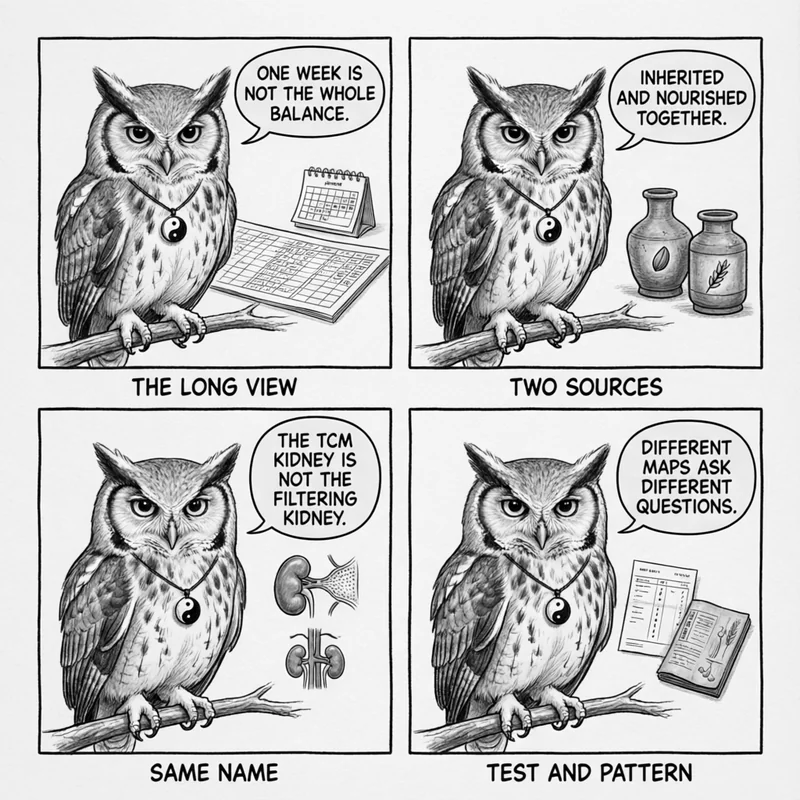
“A rough week is not the whole balance,” Ollie says. “It is one entry.”
1. What Jing and Kidney Essence mean in TCM
Jing is usually translated as Essence. It provides a foundational basis for growth, reproduction, and development. Qi is not its opposite. Qi supports movement, warmth, protection, transformation, and the holding of substances in place. In classical theory, Essence can transform into Qi, while Qi helps sustain and conserve Essence.
The Kidney network is associated with bone and marrow, teeth, hair, hearing, memory, and reproduction. These are links inside a traditional pattern model. Gray hair or one missed appointment does not prove an Essence deficiency. A practitioner considers development, reproductive history, and a constellation of signs together.
Jing is not a measurable substance. It is not a synonym for hormones, stem cells, sperm, DNA, or any single biomarker. When a supplement label promises to boost it, classical vocabulary has been pasted onto a modern product claim. No laboratory can report a Jing level, and no pill has been shown to add a measurable account balance.
Classical sources list several causes of depletion: chronic illness, prolonged overwork, repeated childbirth without recovery time, and, in some texts, excessive sexual activity. Those are historical claims about depletion, not a modern scorecard for anyone’s life.
2. Inherited Essence and nourishment after birth
The classical texts describe an inherited, or prenatal, foundation and an acquired, or postnatal, supply. The Spleen and Stomach transform food and drink into refined nourishment. That nourishment helps maintain the Kidney's stored Essence, while Kidney Yang supports the warmth and transformation involved in digestion. This reciprocal relationship is not a meal replacing inherited endowment unit for unit.
A savings-account analogy is ours, not Zhang Zhongjing's. It traces what many people notice over decades: the body takes longer to bounce back, and hair, joints, hearing, and stamina begin to show the mileage.
The metaphor captures how recovery can take time. Its limit matters too: TCM offers no numerical Jing balance, so a product cannot demonstrate that it has refilled yours. The bank remains a metaphor, not a bank statement.
3. Growth, bones, marrow, ears, and the long arc of a life
The Huangdi Neijing, or Yellow Emperor's Inner Classic, is a layered corpus assembled by many hands over centuries. It is not a single book dictated on one afternoon. Its Suwen, or Basic Questions, includes a chapter called Shang Gu Tian Zhen Lun, “On the Natural and True in High Antiquity.” That chapter follows Kidney Qi as it rises and declines through a human life.
For women, it counts in sevens: changing teeth and growing hair around seven, the arrival of Tian Gui and menstruation around fourteen, and fuller development, including wisdom teeth, around twenty-one. The male sequence begins with teeth and hair around eight, reproductive maturation around sixteen, and strong bones with wisdom teeth around twenty-four. These are traditional developmental cycles, not clinical age standards. The numbers matter less than the shape: maturation and aging belong to one long movement of Kidney Qi and Essence.
Suwen chapter 9, Liu Jie Zang Xiang Lun, associates the Kidney with stored Essence and the bones. Other classical passages connect the Kidney with hearing, while Lingshu chapter 33 calls the brain the sea of marrow. These are related traditional associations, not one anatomical pathway. That is why later patterns may group lower-back ache, knee weakness, and hearing changes under the Kidney network.
A modern reader may wonder why ears and lower backs share a theoretical root. Western anatomy describes separate structures and distinct medical problems. Classical texts associate the Kidney with bones, marrow, and hearing, and a practitioner may ask about them together. The texts do not reduce them to one anatomical mechanism, and a backache plus ringing does not prove one shared cause.
4. Kidney Essence is not the same as Kidney Yin, Kidney Yang, or your laboratory kidney function
Early medical texts already discuss Yin and Yang. Later physicians elaborated theories of Kidney Yin, Kidney Yang, and Mingmen, with different authors giving each idea different emphasis.
Kidney Yin is associated with cooling, moisture, and structure. Kidney Yang is associated with warmth, activity, and transformation. Classical writers placed Jing beneath both as a deeper material substrate from which Yin and Yang differentiate. Kidney Yin deficiency often includes dryness and deficiency heat, such as night sweats, a red tongue with little coating, and a thin, rapid pulse. Kidney Yang deficiency more often includes coldness, a preference for warmth, a pale tongue, and a deep, weak, often slow pulse.
Kidney Essence deficiency is considered in patterns involving development, reproduction, or premature aging, alongside other signs. It is not just a fancier label for feeling tired. The three patterns can overlap, and no single symptom establishes one.
Classical theory links Essence with Marrow, which fills the bones and spine. Lingshu chapter 33 calls the brain the sea of Marrow. Later patterns connect depleted Marrow with poor memory, poor concentration, dizziness, and wear in the bones and teeth. These remain traditional associations, not a modern explanation of cognition.
Mingmen appears in Nanjing Difficulty 36, which discusses the right Kidney as Mingmen and its relationship to Essence and reproduction. Later Ming-dynasty writers developed ideas of Mingmen fire and sometimes pictured a gate between the Kidneys. These are related historical layers, not one timeless doctrine. Mingmen is a theoretical center of warming and vitality, not a second organ or a button that a pill can press.
None of these terms describes your modern anatomical kidneys. Those two bean-shaped organs filter waste, regulate blood pressure, balance electrolytes, and produce urine. Clinicians assess them with blood and urine tests. The overlap in English creates confusion because the TCM Kidney and the biological kidney are not the same object.
A traditional Kidney pattern cannot establish kidney disease, and normal kidney tests do not prove or disprove a TCM pattern. A person may feel persistently tired and have a normal eGFR; another may have early kidney disease and no recognizable traditional pattern. When symptoms point toward the organs, testing comes first.
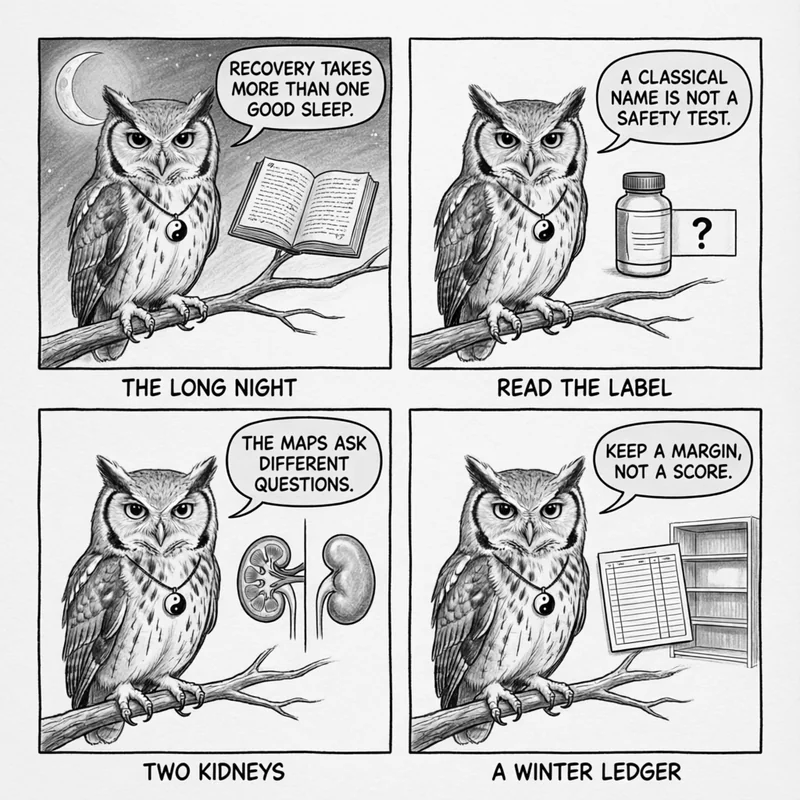
Ollie tilts his head so far that one ear tuft nearly brushes his shoulder, his pendant swinging out from his chest. “That shared name had me confused for longer than I’d like to admit,” he says. “The maps answer different questions. A Kidney pattern cannot tell you how well your kidneys filter blood.”
5. Why winter became the season of storage
Traditional Chinese culture did not draw a hard border between the body and the season. Suwen chapter 2, Si Qi Tiao Shen Da Lun, associates winter with storage and the protection of Yang. The advice follows the season's rhythm: as daylight shortens and temperatures fall, protect warmth and make time for rest.
The seasonal advice was to go to bed early, rise after sunrise, stay warm, and avoid excessive exertion. Trees went bare. Animals withdrew into dens and burrows. The old advice asked people to do the same, not because nature holds medical secrets, but because the rhythm made sense: gather inward, protect warmth, stop spending every reserve.
The household economy was concrete. Families stored grain, salted vegetables, dried fuel, and repaired the house before cold arrived. A winter rhythm made sense because food and warmth were finite. The body entered that same seasonal story. Storage was not only a private health habit; it was how a household survived.
That seasonal focus was cultural and theoretical. Sleeping longer in December does not repair kidney disease, and there is no measurement showing that winter rest deposits Essence. A practical adaptation is to protect sleep, stay comfortably warm, and adjust activity to your health and circumstances.
6. Supplements, symptoms, and when to seek care
The savings-account metaphor endures because it catches one stubborn fact: humans do not recover instantaneously. A late night can be repaid. A long stretch of short sleep, illness, or relentless output may not vanish after one quiet Sunday.
The metaphor breaks when it becomes a product story. A pill cannot be measured as a deposit into Jing. “Kidney support,” “Life Gate,” and “vitality tonic” sell well because they borrow the authority of an old map without accepting its limits.
Some herbal products contain heavy metals, hidden drugs, or compounds that can interact with prescription medicines. Others may add avoidable strain on the biological kidneys. That risk is serious enough that kidney organizations warn people to check unverified supplements with a clinician rather than treating “natural” as automatically safe.
Ollie shuffles along the curtain rod above the desk, pulls one wing half-open, and tips his beak toward the supplement bottle below. “I recognize the old word,” he says. “I would still want to know what is inside, whether it helps, and whether it is safe with someone’s medicines.”
The useful question is whether you have had enough time to recover from months of poor sleep, illness, or heavy demands. If exhaustion persists, it deserves medical assessment. It will not be diagnosed from a bottle decorated with a classical word.
The bank is also a bad excuse for blame. Illness, disability, grief, and aging are not moral failures caused by careless withdrawals. A person can do all the sensible things and still become sick or exhausted. The metaphor helps explain why a culture placed value on rest and continuity. It should never become a scorecard for who managed their life correctly.
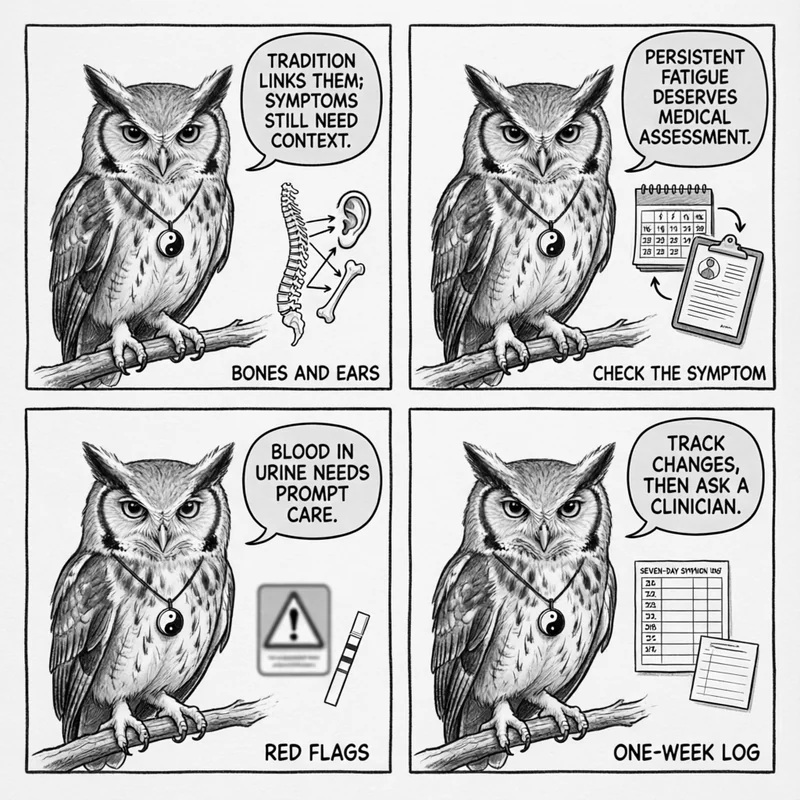
New or severe symptoms do not belong in a metaphor. Sudden confusion requires emergency care. Sudden hearing loss requires urgent assessment, even if the ear merely feels blocked or the change comes with ringing. Seek prompt care for visible blood in the urine, markedly reduced urine output, sudden swelling, or severe flank pain, especially with fever. Arrange an appointment for persistent fatigue, unexplained weight loss, ongoing ringing, or fertility concerns. Normal kidney tests do not explain every cause of those symptoms.
Ollie Speaks
I spend my nights on this oak branch, my feathered ear tufts twitching at every rustle in the grass. My small yin-yang pendant clicks against my chest when I turn. The old books say winter is for holding back. I once flew straight through three cold fronts and hunted badly for a week. I cannot tell you whether that was Jing or just poor planning. I know I slept longer, hunted better, and stopped pretending winter was optional.
7. What to notice this week
This week, protect a consistent sleep schedule where possible, leave recovery time after demanding days, and record symptoms that persist. These steps support a clearer conversation with a healthcare professional; they are not a test or treatment for Jing deficiency.
- Notice whether your fatigue followed one poor night's sleep or persisted through months of disrupted sleep, illness, or heavy demands.
- Write down persistent changes in sleep, energy, pain, hearing, urine, appetite, or weight.
- Check every supplement and herbal product with a pharmacist or clinician, especially when you take medicine.
- Take new, severe, or worsening symptoms to medical care rather than assigning them to a TCM pattern.
It is a quieter promise than “restoring vitality” implies. The classical tradition can offer a vocabulary for depletion, rhythm, and aging. It cannot read your kidneys from a metaphor.
FAQ
Does feeling exhausted mean I have permanently depleted my Jing?
No. Fatigue alone does not establish Kidney Essence deficiency, and one stressful week does not prove permanent depletion. Within TCM, a practitioner considers development, reproductive history, aging, and the whole pattern rather than one symptom. Persistent fatigue also has many medical causes, including anemia, thyroid disease, sleep disorders, depression, medication effects, and kidney problems. A normal basic test does not explain every case either. Seek medical assessment when fatigue persists or interferes with daily life, and do not assume that a fixed inner reserve has already run out.
My TCM practitioner asked about my hearing when I mentioned lower-back pain. What’s the connection?
Your practitioner was not being eccentric. Classical texts associate the Kidney network with bones, marrow, teeth, hair, and hearing, so several apparently separate complaints may enter the same pattern discussion. A practitioner might ask when the back pain began, whether the knees feel weak, and whether hearing changed gradually. Those details help assess a broader pattern; they do not establish a shared cause. A hearing change or painful back is not proof of Essence deficiency. Sudden hearing loss still needs urgent medical assessment.
Are commercial kidney supplements safe to take if I feel exhausted?
Do not assume so. Supplements are regulated differently from medicines, and products marketed for kidney support may contain unlisted ingredients, heavy metals, or compounds that interact with prescription drugs. Some can also place extra strain on the biological kidneys. Persistent fatigue has many possible causes, including anemia, thyroid disease, sleep disorders, depression, medication effects, and kidney problems. A product label cannot sort those apart. Ask a qualified healthcare professional or pharmacist before using a supplement, especially if you take medicine or have known kidney disease. A classical-sounding name is not evidence of safety or effectiveness.
Sources
- Huangdi Neijing Suwen, chapter 1, Shang Gu Tian Zhen Lun.
- Huangdi Neijing Suwen, chapter 2, Si Qi Tiao Shen Da Lun.
- Huangdi Neijing Suwen, chapter 9, Liu Jie Zang Xiang Lun.
- Huangdi Neijing Lingshu, chapter 17, Mai Du, on the Kidney and hearing.
- Huangdi Neijing Lingshu, chapter 33, Hai Lun, on the brain as the sea of marrow.
- Nanjing, Difficulty 36, on the right Kidney as Mingmen and its relationship to Essence and reproduction.
- Zhang Jingyue, Jingyue Quanshu, Chuan Zhong Lu, on Mingmen, Yin, and Yang.
- National Kidney Foundation, “How Your Kidneys Work,” for anatomical and functional distinctions.
- NHS, “Chronic kidney disease: Symptoms”; NHS, “Sudden hearing loss”; NHS, “Confusion.”