
Don't Zip Up Yet: The Old Chinese Rule for Autumn
 Ollie's Take
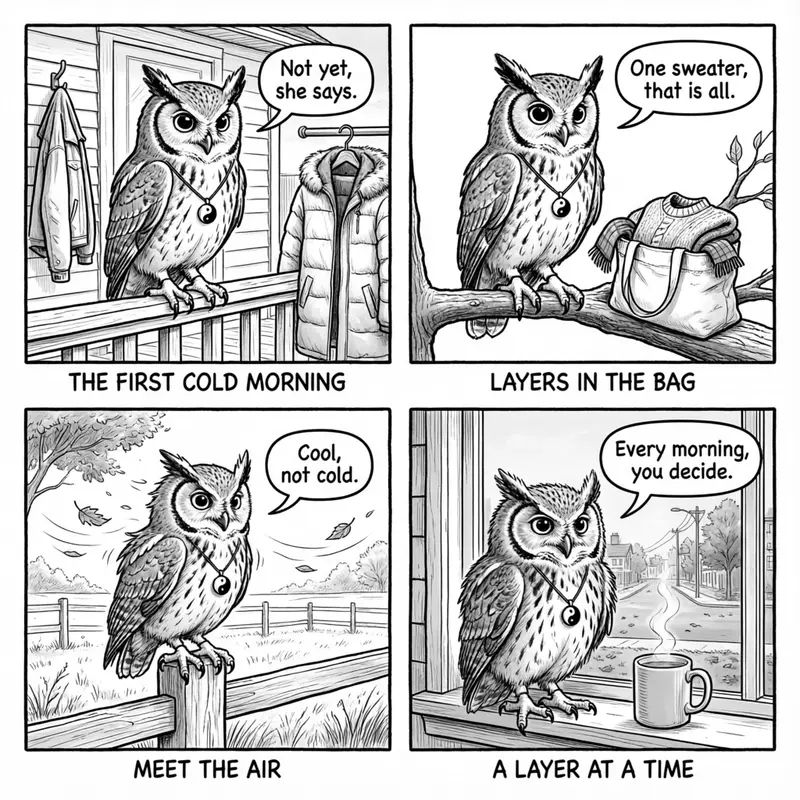
Ollie's take: Hoo-hoo! One coat, no decisions. You have a closet and a thermostat; use them.
The first sharp breeze of mid-September cuts across the porch. It is 14 degrees Celsius, and your hand reaches for the fleece.
Before the zipper goes up, an older voice calls from the kitchen table: "Not yet." Ollie, from the windowsill, agrees and refuses to say why.
The Phrase
The habit rests on a four-character saying: chun wu qiu dong, "in spring, keep covered; in autumn, stay a little cold." A companion proverb adds: qiu bu mang tian yi, "in autumn, do not hurry to add clothes." Walk any Chinese street now and you see the result: er ba yue luan chuan yi, "in the second and eighth months, everyone dresses at random": down jackets beside T-shirts.
You hear it around the solar terms White Dew (bai lu) and Autumn Equinox (qiu fen): mornings demand hot tea in both hands, and by two in the afternoon the sun still carries summer warmth.
Why Autumn Asks You to Wait
In the traditional reading, summer draws the body's Qi outward; autumn reverses the direction, gathering Yang for the cold ahead.
The Suwen (Basic Questions), one of the oldest seasonal texts, calls autumn rong ping, "calm and settled": a season for retiring early, keeping the spirit quiet, shou lian shen qi, gathering inward. Nothing there is about toughening up.
Folk wisdom turns that mood into laundry advice: seal yourself in a heavy coat at the first yellow leaf and the skin stays warm and sweating.
The classical worry has a name: han chu dang feng, sweating then meeting a draft. Walk ten minutes in a coat you did not need, and the tradition reads damp skin as an open door for cold air. Autumn is the season of shou, astringing; the body is meant to gather, not be held in July.
What It Is Not
Ollie, our resident screech owl, perched on a low branch outside the window, his small jade yin-yang pendant catching the morning light, and gave a quiet clack of his beak.
"There is a grand difference," Ollie noted, "between letting a brisk breeze wake you up and shivering on a train platform to prove a philosophical point."
The rule was never an endurance contest: grandmothers who quote it also pack the layers.
The tradition drew boundaries. Infants, the elderly, frail people, and anyone managing a chronic condition were never asked to practice qiu dong; they were dressed warmly right away. So was anyone who runs cold all year, what the tradition calls yang xu — yang deficiency, the pattern of never quite warming up. Nobody was meant to get wet, shiver, or suffer for the sake of a phrase.
The Spring Half
The mirror rule, chun wu, arrives six months later: when March turns warm, keep the layers on longer than you think you need to. Ollie, who wears the same feathers all year and was never consulted about it, ruffles his wings, knocks his jade pendant on the branch, and blinks. "You own forty shirts and still argue with the sky," he says.
Taken together, the two halves form a gentle buffer. They suggest lagging slightly behind the weather rather than rushing to match the calendar.
Not Only a Chinese Instinct
The instinct is not only Chinese: Nordic parents let babies nap in strollers in the brisk air. "For me it is simple," says Ollie, feathers fluffed on the sill. "I have one coat. You have to decide every morning what the sky is offering." Let the season arrive on its own terms.
FAQ
Is there any science behind letting yourself feel the cold?
There is real physiology here, if a modest amount: bodies acclimatize over days and weeks, which is why September's first cold morning feels harsher than the same temperature in November. What the saying adds is a posture rather than a protocol: meet the season gradually instead of fighting it. It is a folk habit, not clinical advice, and comfort should always have the final vote.
How cold is too cold?
The folk line is simple: cool is fine, cold is not. Stiff hands, shivering, or wet clothes mean the useful zone is behind you; put the layer on. The tradition singles out damp plus chill as the combination to avoid. And the saying does not apply to infants, the elderly, or anyone unwell; they dress for warmth from the start.