
6 Signs You're Actually Healthy
(And Why Your Lab Results Don't Tell the Whole Story)
Here's an uncomfortable thought: modern medicine is incredible at detecting disease. It can find a tumor before you feel it. It can flag cholesterol that might cause a heart attack in twenty years. It is genuinely one of humanity's greatest achievements.
But here's what it's not great at: telling you whether you're actually thriving. "Normal range" means you're not sick yet. It doesn't mean you're well. There's a vast territory between "not diseased" and "vibrantly healthy," and most of us have been living in it for so long we've forgotten there's anything else.
Two thousand years ago, Chinese physicians faced the exact same problem — minus the blood tests and MRI machines. They couldn't peer inside the body with instruments. So they did something clever: they learned to read the body's external signals like a language.
 "Think of it this way: your car's dashboard has warning lights for everything — oil pressure, engine temperature, battery. But imagine if the only thing your mechanic checked was whether the engine could still turn on. 'Yep, it starts. You're good!' Meanwhile, the temperature gauge is pegged in the red and the check engine light has been blinking for six months. That's the gap between 'normal lab results' and actual health."
The Six Signs: A 2,000-Year-Old Health Checklist
What follows comes from a lineage of Chinese physicians who spent careers observing patterns in thousands of patients. The framework I'm sharing was systematized by Ni Haisha (倪海建), a Taiwanese practitioner widely regarded as one of the most influential classical Chinese medicine teachers of the modern era. He didn't invent these signs — they're woven through classics like the Huangdi Neijing (皇帝内经) — but he brought them together into a practical, everyday diagnostic framework that any person can use.
These aren't alternative-fact wellness tropes. They're functional benchmarks. Each one reflects how well a specific organ system is doing its job. Let's walk through them.
Sign #1: You Sleep Through the Night
Not "you spend eight hours in bed." Not "you take melatonin and pass out." You fall asleep reasonably easily, and you stay asleep until morning.
In TCM, this is about Yang entering Yin (阳入阴). During the day, Yang energy (active, warm, outward) dominates. At night, it needs to withdraw inward so your body can switch into rest-and-repair mode. If Yang can't settle into Yin — because of stress, heat, deficiency, or emotional turbulence — you get the classic pattern: tired but wired, falling asleep late, waking at 2 or 3 AM, or sleeping lightly and waking unrefreshed.
Sign #2: You Have a Normal Appetite
Not "you force yourself to eat breakfast because articles say you should." Not "you could eat or not eat and wouldn't notice either way." You get hungry at mealtimes, food sounds appealing, and you feel satisfied after eating.
In TCM, appetite is the barometer of the Spleen and Stomach system — your body's digestive power plant. The classics call these organs "the foundation of post-natal Qi" (后天之本). Everything else depends on them. If your digestion isn't transforming food into usable energy properly, nothing downstream works right. No amount of superfood can fix a weak digestive fire.
Sign #3: Your Thirst and Sweat Are Balanced
You're not excessively thirsty all the time. You don't wake up with a dry mouth. You sweat when it's hot or when you exercise — but you don't sweat randomly when everyone else is comfortable, and you don't fail to sweat when you should.
This one's about Yin-Yang balance (阴平阳秘). Thirst relates to Body Fluids (Yin). Sweating relates to Yang Qi's ability to regulate pores. When they're in proper proportion, you barely notice thirst or sweat — they just work quietly in the background, as physiology should.
 Ollie's Take
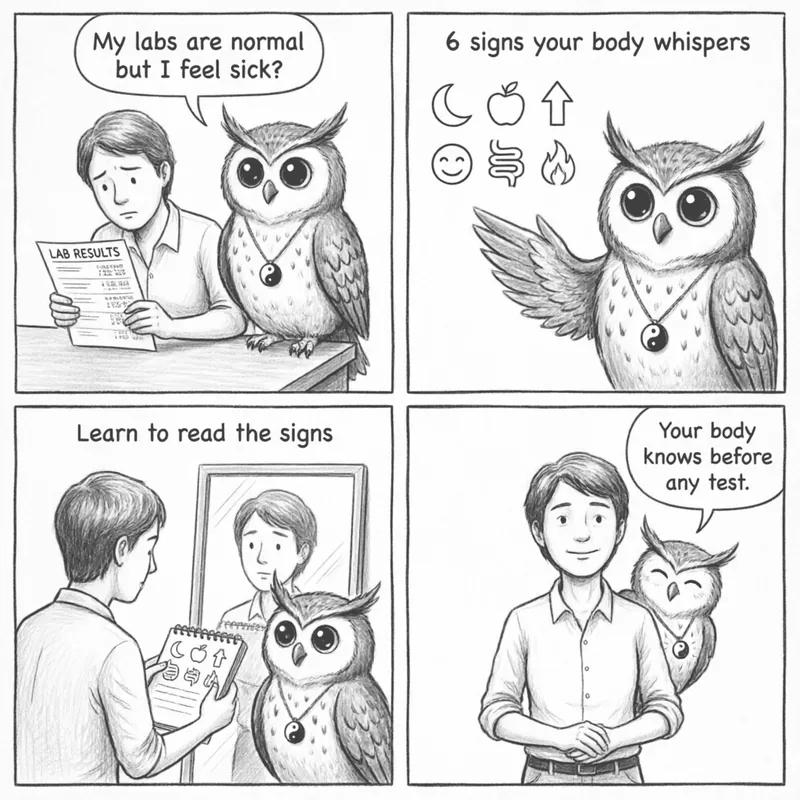
Lab numbers are one sign. They're not the only six.
Sign #4: Your Bathroom Habits Are... Boringly Normal
Bowel movements: regular, neither too loose nor too hard, no pain, no undigested food visible. Urination: normal frequency, pale yellow to straw-colored, no urgency, no burning. If you never think about your bathroom habits, that's actually a good sign.
This reveals more than you'd expect. Regular bowel function tells you your Small Intestine temperature is adequate — which directly determines whether your hands and feet are warm (more on that next). In TCM clinical thinking, treating the Liver often requires treating the Large Intestine — they're connected through the meridian system. Constipation or irregularity can be a downstream effect of stress, emotional holding, or Liver Qi stagnation.
Sign #5: You Have Energy When You Wake Up
Not "you need three cups of coffee before you can speak to another human." Not "you hit snooze four times and drag yourself out of bed." You wake up and — within reason — feel ready to start the day.
Morning vitality is the ultimate functional test of your body's energy reserves. Ni Haisha used specific physiological markers: in men, morning erection; in women, breast sensitivity around menstruation. These aren't being gratuitous — they're objective indicators that your Kidney Qi (your body's deep energy reserve system) is sufficient. If those feel too personal to track, here's a simpler version: do you feel like getting out of bed? Or does staying under the covers feel like the only viable option?
Sign #6: Your Head Is Cool, Your Hands and Feet Are Warm
This one surprises almost everyone who hears it for the first time. Your head should feel cool. Your palms and soles should be warm. If it's the other way around — hot face, cold extremities — that's a significant finding.
Here's why: the head is where all the Yang channels meet ("the gathering place of all Yang"). If Yang Qi is rising upward instead of circulating properly, you get a hot head, flushed face, maybe headaches or dizziness — while your limbs starve for warmth. Warm hands and feet mean your Yang Qi is reaching the extremities — it's circulating all the way out to the fingertips, which is exactly where it should go.
Cold hands and feet are one of the most common complaints in TCM clinics worldwide, and they're almost never "just poor circulation" in the Western sense. They signal that your internal furnace isn't generating or distributing heat effectively.
The Practical Toolkit: What to Do About Each Sign
Knowing is half the battle. The other half is doing something about it. For each of the six signs, here's one simple thing you can try — starting today. (None of these require supplements, expensive equipment, or a degree in biochemistry.)
💤 For Sleep (Sign #1)
No screens for 60 minutes before bed. It's the most boring advice you'll ever hear, and also the most effective. Your Liver meridian peaks between 1–3 AM — if you're staring at blue light until midnight, your body hasn't had time to wind down and Yang can't enter Yin. Replace the scrolling with a book, a warm(not hot) foot soak, or just lying still. Give it three nights.
🍽 For Appetite (Sign #2)
Eat a warm breakfast within an hour of waking. Cold cereal, smoothies, and yogurt straight from the fridge are four-alarm fires to a sluggish Spleen. Switch to warm oatmeal, congee, or even just scrambled eggs. The Spleen likes warmth the way an engine likes oil. This single change is the most effective move for digestive energy.
💧 For Thirst & Sweat (Sign #3)
Drink room-temperature water, not ice water. Iced drinks douse your digestive fire and confuse your body's fluid regulation. Herbal teas (chrysanthemum, mint, or just warm water with a slice of lemon) support balanced hydration without the shock. If you sweat excessively without exertion, reduce spicy foods and alcohol for a week and see what changes.
🚽 For Bathroom Habits (Sign #4)
Pay attention to your morning routine — and leave it alone if it's boringly normal. In TCM, your digestion and elimination together tell the story of your Spleen and Stomach Qi. If things are regular, formed but not hard, and you don't dread the bathroom — that's a green flag. If things are urgent, painful, or absent for days, start with warm (not iced) drinks and cooked (not raw) vegetables for one week.
⚡ For Morning Energy (Sign #5)
Check how you feel in the first 30 minutes after waking — before coffee. You don't need to leap out of bed like a cartoon character. But you also shouldn't feel like you've been hit by a bus. If you need caffeine to become a functional human, your Kidney Yang and Spleen Qi are asking for support. Try a 10-minute morning walk outside (yes, before coffee) for three days.
🦶 For Warm Hands & Feet (Sign #6)
Check your hands and feet right now. Press your palm — does color come back quickly? Are your toes warm? If yes, your Yang Qi is circulating all the way to the extremities. If no, your body's furnace needs stoking. Simple move: end your shower with 30 seconds of lukewarm (not cold) water on your feet, then dry and put on warm socks. It sounds silly. It works.
One last thing: these signs aren't a scorecard. They're a conversation. Your body is always talking — these six signs are just the beginning of learning its language.
FAQ
My lab results are normal but I feel terrible. Does that mean I'm healthy?
Not necessarily. Lab tests measure specific biomarkers — they don't capture how your systems are functioning together. The Six Signs approach looks at whole-body function: how you sleep, eat, digest, and regulate temperature. These reveal patterns labs can miss.
How do I know if my appetite is "healthy"?
A healthy appetite means you feel hungry at meal times (not ravenous, not indifferent), you can eat a full meal without discomfort, and you don't crash or bloat afterward. Cravings for specific foods, especially sweets or salt, can signal underlying imbalances.
Can cold hands and feet really mean something serious?
Cold extremities are one of the most reliable early warning signs in TCM. They often indicate that your Heart Yang — the body's internal furnace — isn't reaching the periphery. Left unaddressed, this can progress from a minor comfort issue to a systemic energy deficit.
Sources & Further Reading
- Huangdi Neijing (The Yellow Emperor's Inner Classic) — Suwen chapters on the fundamental signs of health and the relationship between organ systems and external indicators.
- Ni Haixia (1954–2012) — Ren Ji lectures on diagnostics. The "Six Signs of Health" framework draws directly from his clinical teaching on normal physiological benchmarks.
- Shanghan Lun (Classic on Cold Damage) by Zhang Zhongjing — Establishes the diagnostic framework for reading external signs as windows into internal organ states.
Enjoying TCM Way?
New letters every week. No spam, no hype — just classical Chinese medicine, told warmly.
Subscribe →