
Why Your Cold Hands
Are Warning You
You know that thing where you put on gloves indoors? And your partner jokes about your "ice block feet" at night? And every doctor you've ever seen says "oh, some people just have cold hands — it's normal circulation"?
I'm going to tell you something that might annoy you: they're wrong.
Your body isn't "just like that."
It's waving a red flag and you've been taught to ignore it.
The "Check Engine" Light You're Ignoring
Here's the analogy that finally made it click for me: If your car's "check engine" light turns on and you ignore it because "some cars just have that light," you're going to end up on the side of the highway. Eventually.
Cold hands and feet are your body's "check engine" light. And in Traditional Chinese Medicine (TCM), that light is very specific about what's wrong.
In TCM, cold extremities aren't a "type." They're a signal. And if you know how to read it, it tells you everything about where your health is headed.
 Ollie's Take
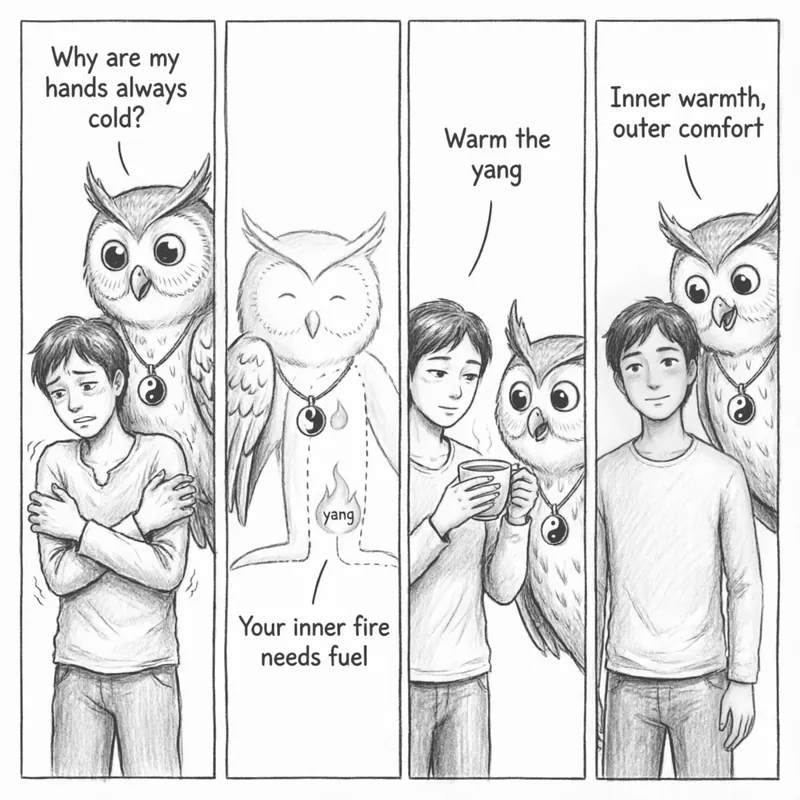
Panel 1: Your hands go cold. You shrug it off. But your body is sending you a signal.
Panel 2: Qi and blood are not reaching your extremities. That is not "normal" — that is a blockage.
Panel 3: Your heart is meant to be a furnace — pumping warmth to every finger and toe. When the fire dims, the cold settles in.
Panel 4: Warm hands are a sign of life. Cold hands are an early-warning system you were never taught to read.
🖐️ Cold Hands Self-Check: What Your Temperature Says About Your Qi
Are your cold hands a circulation problem — or something deeper? Take the free self-check →
The "Cancer Environment" Warning
There's a teaching from classical TCM that stopped me in my tracks when I first encountered it:
The most important cancer prevention indicator is simple:
- "Are your hands and feet warm all year round?"
- If the answer is NO → you're living in what TCM calls a "cancer cell environment."
- If the answer is YES → your body has enough "fire" to prevent stagnation.
Cancer cell environment? Yes. Let me explain, because this is the part that matters.
Why Cold = Danger (The "Yin Shi" Theory)
Here's the core insight that changed how I think about cold hands:
Cancer = Yin Shi (Yin Excess (yin shi)) + Yang Bu Zu (Yang Deficiency (yang xu))
- Yin Shi (Yin Excess (yin shi)) = "Solid Yin" = Cold, stagnant fluid accumulation. Think: refrigerated leftovers sitting for three weeks. Things grow in that.
- Yang Bu Zu (Yang Deficiency (yang xu)) = "Insufficient Yang" = Not enough metabolic "fire" to evaporate that stagnant fluid.
Cancer cells need TWO things to grow: (1) Water (cold, stagnant fluid) and (2) Nutrition (food, vitamins, supplements). If you take away the cold and the excess nutrition, cancer cells cannot survive.
And here's the simplest test you'll ever take:
The Feet Test
At night, before bed, touch your own feet.
Warm? Good. Your "fire" is on.
Cold? Warning sign. Your "fire" is going out.
If you or someone you love has cancer and is getting treatment —
check their feet EVERY DAY.
Feet getting WARMER = treatment working. 🔥
Feets getting COLDER = STOP and rethink. ❄️
I'm not being dramatic. In TCM clinics, practitioners check patients' feet every single day. They'd walk into the room, touch the feet first, then look at lab results. The feet tell you everything.
Why Western Medicine Misses This
Here's the fundamental difference:
- Western medicine looks at numbers. Blood test normal? Great. But you still feel terrible. Your hands are still cold. Your sleep is still broken.
- TCM looks at signals. Your body is always communicating. Cold hands aren't "just a thing." They're a sentence. Ignore them long enough and they become a paragraph. Then a chapter. Then a whole book called "Chronic Disease."
Modern people spend thousands on cancer scans and blood tests. But the earliest detection system is FREE and AVAILABLE 24/7: your own two hands and two feet.
What Causes Cold Hands? (It's Not Just "Poor Circulation")
In TCM, cold extremities usually mean one (or more) of these:
1. Yang Deficiency (Yang Deficiency (yang xu)) — Your "heating system" is underpowered.
Common causes: overwork, chronic stress, too many iced drinks/salads (yes, really), too much antibiotic use (kills gut "fire"), aging (natural yang decline after 35).
2. Qi Stagnation (Qi Stagnation (qi zhi)) — The "pump" is weak. Energy isn't moving.
Common causes: sedentary lifestyle, emotional suppression ("keeping it all inside"), constant stress ("always on alert").
3. Blood Deficiency (Blood Deficiency (xue xu)) — Not enough "fuel" for the fire.
Common causes: heavy menstruation, poor diet, chronic illness.
4. Internal Cold (Internal Cold (li han)) — You've made your insides cold.
Common causes: too much cold/raw food, too many iced drinks, living in cold/damp environments, overusing "cooling" herbs or supplements.
⚠️ SPECIAL WARNING FOR WOMEN:
- Cold hands + painful periods + clots = classic Blood Stasis (Blood Stasis (xue yu)).
- This is a major red flag. In TCM, Blood Stasis is considered a pre-cancerous state.
- Don't ignore this combination!
What To Do About It (Practical Steps)
Okay, so your hands are cold. Now what? Here's your action plan:
STEP 1: Stop Making It Worse
- Cut the iced drinks. No more iced coffee. No more cold water. Room temperature or warm only.
- Cut the raw foods. Salads are cold. Eat cooked vegetables instead. Soup is your friend.
- Stop the "cooling" supplements. Vitamin C, wheatgrass, "detox" teas — many are cooling. Ask a TCM practitioner before taking any supplement.
STEP 2: Warm Yourself Up (Literally)
- Drink ginger tea. Fresh ginger slices in hot water. Warming, moving, and cheap.
- Eat warming spices. Ginger, cinnamon, black pepper, garlic. Yes, it's that simple.
- Soak your feet. Hot water (not scalding!) for 15 minutes before bed. Add ginger or mugwort if you can.
- Move your body. Walking, qigong, yoga — anything that gets energy flowing.
STEP 3: Get Professional Help
- See a TCM practitioner. They can diagnose your specific pattern and prescribe the right formula.
- Acupuncture works wonders. It "wakes up" the Yang and gets energy moving.
- Moxibustion (moxibustion). Like acupunture but with heat. Perfect for cold hands.
The goal isn't to transform overnight. It's to stop attacking the system that's already struggling — and give it conditions under which it can recover.
Ollie Speaks
Cold hands aren't a personality trait. They're a signal. Your body prioritizes your core organs over your extremities — which means if your fingers are ice, your body has made a decision: "We can't afford to heat the suburbs right now." The question isn't "how do I warm my hands?" It's "what's consuming so much energy at the center that the perimeter got cut off?"
— Ollie
FAQ
Are cold hands always a Chinese medicine concern?
Not always. Some people naturally run cooler. The concern arises when cold hands are persistent, accompanied by fatigue or a weak pulse, and don't warm up with movement. That's when it signals an underlying Yang or Blood deficiency pattern.
Can I just wear gloves?
Gloves treat the symptom, not the pattern. Warming foods — ginger, cinnamon, lamb — plus exercise address the root. But yes, also wear the gloves. Chinese medicine is pragmatic: treat the root and manage the branch simultaneously.
Sources & Further Reading
- Ni Haixia (Ni Haixia (1954–2012, modern TCM master)). Ren Ji Series (Ren Ji (Human Benchmark) lecture series): Shang Han Lun (Shanghan Lun). The 1,800-year-old classic on Cold Damage patterns — a foundational teaching text on Yang deficiency and cold-related disease.
- Maciocia, Giovanni. The Practice of Chinese Medicine. Churchill Livingstone, 1994. Chapter 13 ("Yang Deficiency") — the clearest English-language reference for Western readers.
- Kaptchuk, Ted. The Web That Has No Weaver: Understanding Chinese Medicine. Contemporary Books, 2000. Chapter 6 ("Cold and Heat") — explains why "cold" is a fundamental diagnostic category in TCM.
Enjoying TCM Way?
New letters every week. No spam, no hype — just classical Chinese medicine, told warmly.
Subscribe →