
10 Questions Ancient Chinese Doctors Asked
— That Yours Never Will
When was the last time a doctor asked you whether your hands are usually warm or cold?
Whether you feel genuinely hungry at mealtimes — or eat because the clock says so?
What time of night you wake up, if you wake up, and what's on your mind when you do?
If you've never been asked these questions, you're not alone. The modern medical encounter has shrunk to an average of seven minutes — enough time for a prescription, not enough for a conversation. But a conversation, it turns out, was the primary diagnostic tool of Chinese medicine for two thousand years. Specifically: ten questions, asked in a deliberate order, each answer lighting up a different organ system on an internal map.
Blood tests catch what's already broken. Imaging finds what's already grown. But the Ten Questions of classical diagnosis were designed to catch dysfunction before it becomes disease — by listening to the body's early-warning system in a language your doctor was never trained to translate.
This isn't an alternative to lab work. It's a different instrument entirely — one that measures function rather than chemistry, process rather than aftermath. And the beautiful thing is: you don't need a license to start listening. You just need to know what to ask.
"Imagine your car's dashboard. The 'check engine' light tells you something has already failed. But a good mechanic listens to the engine before the light comes on. She hears the subtle knock, the rough idle, the hesitation on acceleration. That's what the Ten Questions do — they listen to your engine before the light comes on. And Chinese medicine has been training its ears for 2,000 years."
— Ollie
The Diagnostic Gap Nobody Talks About
Modern diagnostics excel at what they measure. But they have a blind spot: they measure structure, not function. A lab panel tells you your thyroid hormone level — not whether your thyroid is struggling to produce it at the rate your body demands. It tells you your iron count — not whether your digestive system has the energy to transform food into blood in the first place. It's a snapshot of the aftermath, not the process.
Classical Chinese medicine asked a fundamentally different question. Instead of "what chemical is out of range?", it asked "how is each organ system functioning?" And the tool it developed was breathtakingly simple: a structured conversation — ten questions, asked in a deliberate order, with each answer illuminating a specific organ's performance.
The Ten Questions (Ten Questions Song (shi wen ge)): A Diagnostic Framework Older Than English
The Ten Questions Song (Ten Questions Song (shi wen ge), shí wèn gē) was formalized during the Ming Dynasty by Zhang Jingyue (Zhang Jingyue (1563–1640, Ming dynasty physician), 1563–1640), one of the great systematizers of Chinese medicine. But its roots go much deeper — to the diagnostic conversations recorded in the Huangdi Neijing (~200 BC), where physicians are shown questioning patients about their sleep, appetite, temperature, and pain patterns before ever reaching for a needle or herb.
In modern clinical training, Ni Haixia (Ni Haixia (1954–2012, modern TCM master), 1954–2012) placed enormous emphasis on mastering these questions. His teaching was blunt: "If you ask the right questions, the patient will tell you their diagnosis. If you don't know what to ask, you'll prescribe blindly."
Here are the ten questions, grouped into four domains that map directly to organ systems:
 Ollie's Take
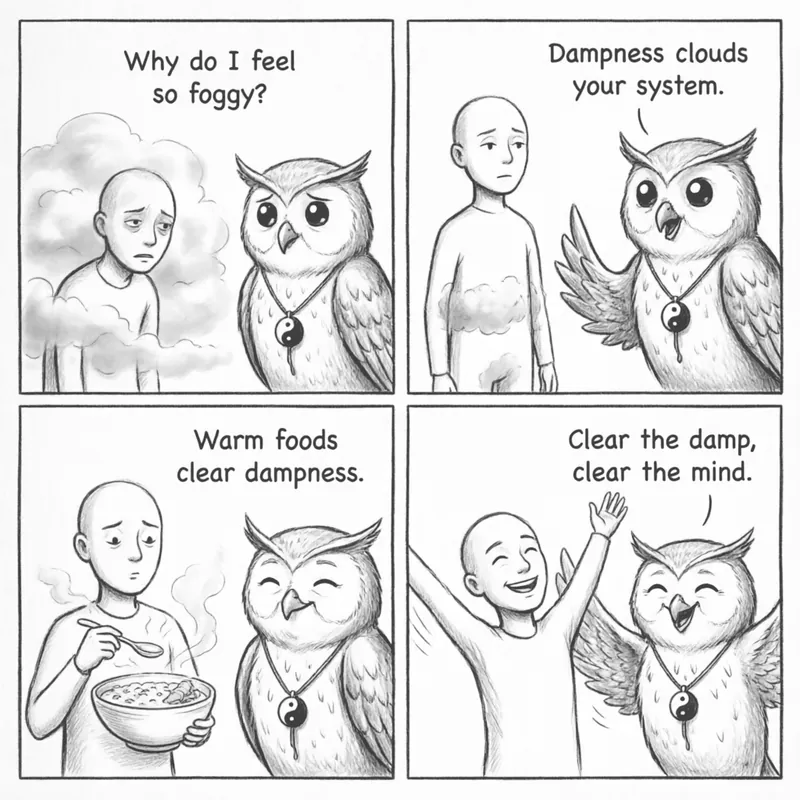
Ancient doctors asked ten questions before touching your pulse. Modern medicine skips straight to the lab.
Domain 1: Temperature & Sweat — Your Internal Thermostat
These are your body's thermostat readings. If you're always cold — especially hands and feet — your Yang Qi (your metabolic furnace) is underperforming. This often points to Kidney Yang deficiency. If you're always hot, especially at night, your Yin (cooling, moistening energy) is depleted — often a Liver or Kidney Yin issue.
Sweat tells an equally precise story. Never sweating even during exercise means your pores aren't opening — Lung Qi is weak and can't regulate the surface. Night sweats (waking up soaked) is a classic Yin deficiency sign — your body is leaking fluids because it can't hold them. Spontaneous sweating during the day with minimal exertion points to Qi deficiency — your defensive barrier has holes in it.
None of this shows up on a blood test. Your thyroid panel will be normal. But your body has been telling you for months that your furnace needs attention.
Domain 2: Head, Body, & Elimination — The Structural Report
Pain location in Chinese medicine is not random. It's a map. Headaches on the sides (temples) point to the Gallbladder channel. Headaches on the top of the head point to the Liver. Lower back pain is almost always Kidney-related — the Kidneys "govern the lower back" in classical theory. Wandering joint pain suggests Wind invasion. Fixed, stabbing pain suggests Blood stasis.
Then there's the question Western doctors rarely ask in detail: how are your bowel movements? Not "are you constipated?" but: What's the consistency? Is it formed or loose? Does it stick to the toilet bowl? What time of day? How often?
A formed, once-daily bowel movement (ideally in the morning) tells you the Spleen and Large Intestine are working. Loose stools = Spleen Qi deficiency. Hard, pellet-like stools = Heat or fluid deficiency. Sticky stools that cling to the bowl = Dampness. Urination tells you about the Kidney and Bladder: clear, copious urine = Kidney Yang not transforming fluids; dark, scanty urine = Heat; frequent nighttime urination = Kidney Qi not holding.
Domain 3: Appetite, Thirst, & Chest — The Inner Engine
Appetite is one of the most reliable windows into digestive health. No appetite at all = Stomach Qi is weak. Ravenously hungry but thin = Stomach Fire (burning through food without absorbing). Craving sweets = Spleen Qi deficiency (the Spleen "governs the sweet taste" — it craves what it needs energy from). Craving salt = Kidney involvement.
Thirst patterns are equally revealing. Never thirsty = internal Cold or Dampness — your body has enough fluid but it's not moving. Always thirsty, drinks in large gulps = true Heat depleting fluids. Thirsty but only sips, or only wants warm drinks = Yin deficiency with internal Heat. Thirst with dry mouth but no desire to swallow = Blood stasis.
And the ears? This one surprises people. In Chinese medicine, the Kidneys open into the ears. Tinnitus (ringing in the ears), hearing loss, and chronic dizziness all point toward the Kidney system — often Kidney essence deficiency, which is the gradual depletion of your body's deepest energy reserves. This is why so many tinnitus patients have normal hearing tests but still suffer: the ear structure is fine. The Kidney energy feeding it is not.
Domain 4: History & Trigger — The Story Behind the Symptoms
The final two questions separate Chinese medicine from modern diagnostics most dramatically. A blood test doesn't care why your numbers are off. Chinese medicine cares deeply — because the cause determines the treatment.
Did your insomnia start after a stressful event? That's the Liver. After a prolonged illness? That's the Heart and Spleen. After a course of antibiotics? That's cold damage to the Spleen Yang. Did your digestive issues begin after you started taking a certain medication? That's iatrogenic — the treatment caused the problem, and treating it as "just another digestive issue" will fail.
This is the diagnostic principle of root (root cause, běn) vs. manifestation (symptoms, biāo). Treating symptoms without understanding the trigger is like mopping the floor while the pipe is still leaking. The Ten Questions are designed to find the pipe.
🔗 Related read: 6 Signs You're Actually Healthy — the companion checklist to these questionsFrom Answers to Pattern: How the Pieces Fit Together
The power of the Ten Questions is not in any single answer — it's in the pattern they form together. Two or three answers pointing the same direction confirms a diagnosis in a way no single lab value can.
Take a common presentation: cold hands + loose stools + no morning appetite + lower back ache that started after a major life event. Four separate answers. One unified picture: Kidney-Spleen Yang deficiency with Qi and Blood depletion. Each piece is subtle on its own. Together, they're unmistakable.
This is fundamentally different from how most people experience healthcare today — chasing one symptom at a time through different specialists who rarely compare notes. The Ten Questions are designed to show you the full pattern, not just the loudest complaint.
Your 5-Minute Self-Check
You don't need a practitioner to start listening to your body. Here are five questions you can answer right now. Write down your answers. Check them again in a month. Patterns that persist are the ones that matter.
📝 The Simplified Self-Check
- Temperature check: Are your hands and feet warm right now? If not, how often are they cold? Daily cold hands/feet → investigate Kidney Yang.
- Sleep check: Do you sleep through the night without waking? If you wake, what time? 1–3 AM = Liver; 3–5 AM = Lung.
- Appetite check: Do you feel genuinely hungry at mealtimes? Never hungry → Stomach Qi weak. Hungry but full after a few bites → Spleen Qi deficiency.
- Bathroom check: One formed bowel movement daily? Less is constipation (multiple causes); loose is Spleen deficiency; sticky is Dampness.
- Energy check: Do you have steady energy through the day, or do you crash at a specific time? 3 PM crash = Bladder/Kidney time — your adrenals are flagging.
🦉 Ollie's One-Week Tracking Challenge
For the next seven days, spend 60 seconds each morning answering the five questions above. Rate each on a scale of 1–5:
- 1 = This is a problem every day
- 3 = It happens occasionally
- 5 = Never an issue
Anything scoring 1–2 across the full seven days is a pattern. Patterns are your body's way of asking for help before it's forced to scream. Listen while it's still whispering.
What These Questions Reveal That Even the Best Wearable Can't
You might be thinking: I have an Oura ring. My Apple Watch tracks sleep. My WHOOP tells me my recovery score. Why do I need ancient questions when I have modern sensors?
Because sensors measure output. They tell you that your sleep was disrupted. They don't tell you why. The Ten Questions tell you why. Waking at 1 AM is not the same as waking at 4 AM. One points to the Liver. The other to the Lung. A sleep tracker can't distinguish between them — but the question "what time do you wake up?" can.
And beyond sleep: sensors can't tell you whether your cold hands are from poor circulation (which a doctor might test for) or Kidney Yang deficiency (which requires a fundamentally different approach). They can't tell you whether your afternoon energy crash is blood sugar (eat a snack) or Kidney-adrenal fatigue (rest and rebuild). The data tells you what's happening. The questions tell you what to do about it.
This is not an argument against wearables. It's an argument for adding the oldest diagnostic tool in medicine to your toolkit: asking the right questions, and listening to the answers.
"The Ten Questions are not a test you pass or fail. They're a language class — teaching you to understand what your body has been trying to tell you since the day you were born. And the first lesson is simpler than you think: the right question, asked at the right time, is worth a thousand lab results."
When to Use These Questions — And When Not To
The Ten Questions are a screening tool, not a replacement for medical care. They are designed to catch dysfunction early — before it becomes disease. They are not designed to diagnose existing illness or replace laboratory testing for conditions that require it.
Use them when:
- Your tests are normal but you don't feel right
- You want to understand your body's baseline before something goes wrong
- You're tracking a chronic pattern and want to see if lifestyle changes are helping
- You're curious about how Chinese medicine sees health
Do not use them when:
- You have acute, severe, or worsening symptoms — see a doctor immediately
- You're trying to self-diagnose a serious condition
- You want to stop prescribed medication based on your answers
The goal is awareness, not self-treatment. The Ten Questions exist to help you hear what your body is saying. What you do with that information should always involve a qualified practitioner.
— Ollie
Enjoying TCM Way?
New letters every week. No spam, no hype — just classical Chinese medicine, told warmly.
Subscribe →