
Your Tongue Knows Before Your Blood Test Does
A woman walked into a TCM clinic. She handed over a stack of lab results — CBC, metabolic panel, thyroid, iron studies, inflammation markers. All normal. Every single page, stamped with the same word: normal.
"But I'm always tired," she said. "My digestion is a mess. I wake up exhausted. My doctor says there's nothing wrong."
The practitioner didn't look at the papers. He said: "Stick out your tongue."
He looked at it for about ten seconds. Then he said: "Your Spleen can't transform food into energy. You're generating Dampness faster than your body can clear it. And your Blood is thin — your Heart isn't getting enough nourishment."
She stared at him. "How could you possibly know that from my tongue?"
"Because," he said, "your tongue has been telling this story for months. Your blood test just wasn't listening."
The Dashboard You Never Checked
Your car has a dashboard. Fuel gauge, temperature gauge, oil pressure warning. You don't need to open the hood to know something's off — the dashboard tells you before the engine breaks.
Your body has a dashboard too. It's just not made of lights and dials. It's made of one thing: your tongue.
Chinese medicine has been reading this dashboard for over 2,200 years. The Huangdi Neijing — the foundational text of TCM, compiled around 200 BC — established tongue diagnosis as one of the four pillars of clinical assessment, alongside looking, listening, and asking. By the Song Dynasty (960–1279 AD), tongue diagnosis had become a formal discipline with its own illustrated manuals, mapping every color, shape, and coating to specific organ patterns.
The logic is simple, even if the practice takes years to master: your tongue is the only internal organ you can see without a scalpel or a scanner. It's richly supplied with blood vessels, covered in papillae that respond to fluid levels, and connected to every major organ system through the meridian network. When something changes inside your body, your tongue changes first — because it's a living tissue that reflects your internal environment in real time.
A blood test, by contrast, is a chemical snapshot. It tells you what your blood contained at the moment the needle went in. It's precise, but it's also narrow — it only measures what it's designed to measure, and only after the imbalance has grown large enough to cross a defined threshold. By the time your iron drops low enough to flag on a CBC, your tongue may have been pale for months.
"Think of blood tests like a security camera that only records after the break-in has already happened. Your tongue is the motion sensor — it detects the footsteps in the hallway while the intruder is still downstairs."
— Ollie
 Ollie's Take
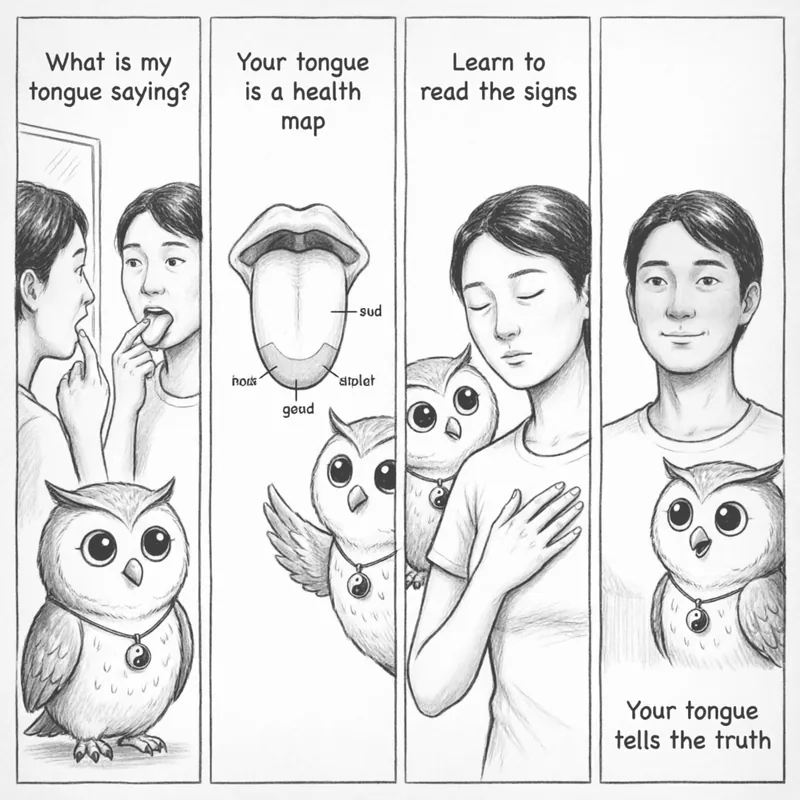
Your tongue is the only internal organ you can see without a scalpel — and it's been telling your health story for months.
Four Things Your Tongue Is Trying to Tell You
TCM reads the tongue through four lenses. Together, they create a picture that no single lab test can match.
1. Color — The Story of Your Blood and Your Heat
A healthy tongue is a soft, pale pink — not too red, not too pale, not purple, not blue. Color tells you about two things: the quality of your Blood, and the temperature of your internal environment.
- Pale tongue. This means your Blood is deficient — not necessarily anemic (your hemoglobin might still be within "normal" range), but not abundant or rich enough to nourish your tissues properly. It can also indicate Yang deficiency — your metabolic furnace isn't generating enough warmth. Pale tongues often come with cold hands, dizziness on standing, and pale lips. Your blood test probably won't catch this until it becomes clinical anemia.
- Red tongue. This means Heat — your body is running too hot. Not a fever (your thermometer reads normal), but an internal excess of Yang energy. Think of it as a pot boiling over on the inside while the kitchen looks fine from the outside. Red tongues often come with insomnia, irritability, dry mouth, and feeling too warm at night.
- Dark red or crimson tongue. This is Heat that has progressed deeper — often into the Blood level itself. It can indicate severe Yin deficiency (your cooling system has broken down) or systemic inflammation that hasn't yet produced lab-detectable markers.
- Purple tongue. This is the most visually striking — and the most important to catch early. Purple means Blood stasis: your Blood is not flowing freely. It's pooling, stagnating, creating micro-blockages. Western medicine calls this "poor microcirculation." Chinese medicine calls it the precursor to many chronic problems — from chronic pain to menstrual clots to cardiovascular issues. A purple tongue is your body's way of saying the river is damming up, long before the flood.
2. Shape — The Story of Your Fluids and Your Energy
A healthy tongue fits comfortably in your mouth — not too big, not too small, smooth-edged without indentations.
- Swollen tongue with teeth marks. This is the most common abnormal shape — and one of the most useful. The tongue is enlarged from retained fluids (Dampness), and the teeth press indentations into the edges. This is a textbook Spleen Qi deficiency sign: your digestive system can't transform and transport fluids properly, so they accumulate. These people often feel heavy, bloated, and tired after eating. Their stool may be loose or sticky. And their blood work? Usually normal.
- Thin, small tongue. This indicates deficiency — typically Yin or Blood deficiency. The tissue itself is undernourished, shrinking like a plant in dry soil. These people are often thin, easily fatigued, and prone to dry skin and poor sleep.
- Deviated tongue. If the tongue veers to one side when extended, it can indicate Wind or a meridian imbalance — and in some cases, it's an early warning sign of cerebrovascular risk that deserves prompt medical evaluation.
3. Coating — The Story of Your Digestion
A healthy tongue has a thin, white, even coating — like a light frost on a window. The coating reflects the state of your Stomach Qi and digestive function.
- Thick white coating. Cold and Dampness in your digestive system. Your Stomach is sluggish, and food is sitting there like a wet log that won't catch fire. These people often have no appetite, feel nauseated, and complain that everything they eat "just sits there."
- Thick yellow coating. Heat and Dampness. Now the wet log is smoking. There's stagnation plus inflammation. Acid reflux, bitter taste in the mouth, and a heavy, sticky sensation are common companions.
- No coating at all (peeled or mirror tongue). This is serious. It means your Stomach Yin is damaged — the moistening, cooling layer of your digestive system has been stripped. This often follows chronic illness, long-term medication use, or years of eating irregularly. The tongue looks raw and shiny, like skin without its protective barrier. These people often have burning stomach pain, dry mouth, and a gnawing hunger that eating doesn't satisfy.
- Geographic tongue (patchy coating). Patches of coating with bare spots. This suggests Stomach Qi and Yin deficiency alternating — an inconsistent digestive fire that flares up and then dies down. It's common in people under chronic stress with irregular eating habits.
4. Moisture — The Story of Your Fluid Balance
A healthy tongue is slightly moist — not dripping, not dry. It reflects the state of your body's fluid metabolism.
- Overly wet, glistening tongue. Your body is holding too much fluid — Dampness is accumulating. The Spleen and Kidney aren't transforming fluids properly.
- Dry tongue. Your fluids are depleted — either from Heat (which evaporates them) or Yin deficiency (which means you can't generate enough in the first place). Dry tongue often goes with dry eyes, dry skin, and constipation.
The Map on Your Tongue
Here's where it gets really interesting. Different zones of the tongue correspond to different organ systems. It's a topographic map of your internal organs, drawn in living tissue.
This is not speculation. Modern research has found correlations between tongue features and measurable health markers — a 2020 systematic review in the Journal of Integrative Medicine identified significant associations between tongue diagnosis findings and conditions including diabetes, cardiovascular disease, and gastrointestinal disorders. The tongue's blood supply, papillary structure, and mucosal surface make it uniquely responsive to changes in circulation, hydration, metabolic function, and the gut microbiome.
🔗 Related read: 10 Questions Ancient Chinese Doctors Asked — the diagnostic conversation that pairs with tongue readingThe Lab Blind Spot
Let me be clear about something: I'm not anti-lab-work. Blood tests are extraordinary tools. They've saved millions of lives. If you have acute chest pain, I want an EKG and troponin levels, not a tongue reading.
The issue is that blood tests were designed to detect disease — structural damage, chemical imbalances, pathological changes. They were not designed to detect dysfunction — organs that are struggling but haven't broken yet. That's a different question entirely, and it requires a different instrument.
Consider: your thyroid is working at 60% capacity. It's producing enough hormone to stay within the "normal" reference range on your lab panel. But you feel cold all the time, your digestion has slowed, you're gaining weight despite eating less, and your tongue is pale and swollen with teeth marks. The lab says you're fine. Your tongue says your Yang is fading. Who's right?
Both of them, in a way. The lab is right that you don't have clinical hypothyroidism. The tongue is right that your metabolic fire is underperforming. The question is: do you want to wait until it becomes clinical — or do you want to do something about it now, while it's still easy to fix?
This is the space where tongue diagnosis shines. It's not competing with blood tests. It's reading a different layer of the same body — the layer where problems begin, long before they show up on a printout.
What Your Tongue Might Be Telling You Right Now
Here are five common tongue patterns and what they usually mean. If you're reading this in the morning, you can go check the mirror after this section.
📝 Five Common Tongue Patterns
- Pale, swollen, teeth marks, thin white coating. Spleen Qi deficiency with Dampness. Translation: your digestion is underperforming, and fluids are pooling. You feel tired after eating, bloated, and "heavy." Action: warm, cooked foods; avoid raw and cold; regular meal times.
- Red tip, thin yellow coating. Heart Fire. Translation: your Heart is overheated — often from emotional stress, worry, or poor sleep. You can't fall asleep, your mind races, and you might get canker sores. Action: address the stress first; reduce caffeine and spicy food; go to bed before 11 PM.
- Red sides, normal coating. Liver Fire or Liver Qi stagnation converting to Fire. Translation: your Liver is overheated from pent-up frustration or chronic stress. Irritability, temple headaches, and a short fuse are the emotional companions. Action: movement (walk, stretch, anything); express what you've been swallowing; reduce alcohol.
- Pale, thin, little or no coating. Blood and Yin deficiency. Translation: your reserves are low. This isn't about one bad night — it's a pattern of depletion over months or years. Dry skin, poor sleep, dizziness, and brittle nails often accompany this. Action: nourishing foods (bone broth, dark leafy greens, red dates); more rest; less screen time before bed.
- Purple body or dark veins underneath. Blood stasis. Translation: your circulation is impaired. Blood is pooling somewhere. This can show up as chronic pain in a fixed location, menstrual clots, or varicose veins. Action: gentle movement is essential; warmth over the painful area; this pattern often benefits from professional treatment.
🦉 Ollie's Mirror Test
Tomorrow morning, before coffee, before breakfast, before brushing your teeth — go to a window with natural light. Stick out your tongue. Look at four things: color, shape, coating, moisture. Write it down. Do this for seven days.
A one-day observation is a data point. Seven days of the same observation is a pattern. Patterns are where the story lives. Don't diagnose — just listen.
Why Your Doctor Never Looked at Your Tongue
In Western medicine, the tongue is examined for a handful of specific conditions: oral thrush (white coating from fungal infection), glossitis (smooth, red tongue from B-vitamin deficiency), and "strawberry tongue" (a sign of scarlet fever or Kawasaki disease). That's about it.
Chinese medicine examines the tongue as a systemic diagnostic instrument. Not "is there a disease on the tongue?" but "what is the tongue reflecting about the whole body?" It's the difference between checking the windshield for cracks and reading the dashboard gauges.
This gap exists because Western diagnostics were built on a different paradigm: identify the pathogen, measure the chemical, image the structure. It's a paradigm that excels at answering "what is the disease?" but struggles with "why doesn't this person feel well when nothing is measurably wrong?"
That second question is where millions of people live — in the gray zone between "normal" labs and genuine suffering. The tongue is a lantern in that gray zone. It doesn't replace the lab. It illuminates what the lab can't see.
The Ancient Who Made Tongue Diagnosis a Science
The earliest written records of tongue diagnosis appear in the Huangdi Neijing, but the discipline truly came into its own during the Song and Yuan Dynasties (10th–14th centuries). The landmark text was Ao's Cold Damage Golden Mirror Record of Tongue Diagnosis (Ao Shi Shanghan Jinjing Lu (Ao's Golden Mirror of Cold Damage)), written in 1341 by Du Ben (Du Ben (Yuan dynasty, tongue diagnosis pioneer)). It was the first illustrated tongue diagnosis manual — 36 tongue images, each mapped to a specific clinical pattern.
By the Qing Dynasty, tongue diagnosis had evolved into a sophisticated system with over 100 documented tongue types. Practitioners understood that the tongue could change within hours — reflecting the progression of disease in real time, like a weather map updating every few minutes.
This was 700 years before the first modern blood test. The ancients couldn't see inside the body, so they learned to read the only internal organ that shows itself. And they got remarkably good at it.
What the Tongue Can't Do
A few important caveats — because honesty matters more than persuasion.
The tongue cannot diagnose cancer. It cannot replace imaging for structural problems. It cannot tell you your blood sugar level or your vitamin D status. It is not a magic window that makes all other diagnostics obsolete.
What it can do is something equally valuable: it can tell you that something is shifting — weeks or months before your blood test catches up. It can tell you which direction the shift is heading (toward Cold or Heat, deficiency or excess, stagnation or depletion). And it can tell you whether the changes you're making — the warmer food, the earlier bedtime, the daily walk — are actually working.
That last point is underrated. When you make a lifestyle change, your blood work might not budge for months. But your tongue? Your tongue can change in days. A thick yellow coating that starts thinning. A pale body that starts regaining color. Red sides that begin to soften. These are real-time feedback from your body's dashboard — and they're immensely motivating when you're wondering if anything is actually changing.
"Your tongue doesn't lie. It can't. It's too close to the source — fed by the same blood, bathed in the same fluids, connected to the same organs. It's the most honest part of your body, and it's been waiting for you to look at it."
When to Look — And When to See a Doctor
Tongue self-observation is a powerful awareness tool. But it has limits, and they matter.
Use tongue observation when:
- Your lab results are normal but you don't feel right
- You want a daily feedback tool for lifestyle changes
- You're curious about what Chinese medicine might see in you
- You want to track whether a pattern is improving, stable, or worsening
See a doctor when:
- Your tongue suddenly changes dramatically (new persistent redness, sores that don't heal, white patches that can't be scraped off)
- You have severe, acute, or worsening symptoms
- You suspect a serious condition — tongue observation is not a substitute for medical evaluation
The tongue is a conversation partner, not a doctor. Listen to what it says. Then decide — with proper guidance — what to do about it.
— Ollie
FAQ
Can I read my own tongue at home?
You can get surface-level information — check the color (pale pink is ideal), coating (thin white is normal), and any cracks or tooth marks. But professional tongue diagnosis integrates shape, moisture, sublingual veins, and regional mapping to specific organs. DIY tongue reading is a starting point, not a replacement for clinical diagnosis.
How often does my tongue change?
Faster than you'd expect. The tongue coating can shift within 24–48 hours in response to diet, sleep, illness, or medication. The tongue body itself changes more slowly — over weeks or months — reflecting deeper, more structural patterns. TCM practitioners compare visits to track treatment progress.
Do conventional doctors ever use tongue diagnosis?
Some do, indirectly. A very red tongue can indicate B-vitamin deficiency or geographic tongue. A thick white coating can signal oral thrush. But conventional medicine doesn't map tongue regions to internal organs the way TCM does. That said, the tongue IS a mucus membrane that reflects systemic health — both systems agree on that, even if they interpret the data differently.
Sources & Further Reading
- Huangdi Neijing (The Yellow Emperor's Inner Classic) — Suwen and Lingshu. The earliest systematic discussion of tongue observation as a diagnostic window into organ states.
- Ao Shi Shanghan Jinjing Lu (Ao's Golden Mirror of Cold Damage) by Du Ben (Yuan dynasty) — The first specialized tongue diagnosis text, with detailed mappings of tongue regions to organs.
- Ni Haixia (1954–2012) — Ren Ji lectures on diagnostics. Clinical tongue-reading methodology and case studies linking tongue signs to Shanghan Lun patterns.