
The Season Your Body Is Actually In (It's Not The One On Your Calendar)
If you've been feeling extra irritable this July, find yourself snapping at loved ones, or are tossing and turning at night, I'm going to let you in on a secret: it's not the heat. It's your Heart.
That might sound strange, but in the world of Traditional Chinese Medicine (TCM), our bodies are deeply connected to the rhythm of the seasons. And your body doesn't run on the same calendar that's hanging on your wall.
Our wise little mascot, Ollie the screech owl, knows something about seasons that most humans forget. We tend to think of ourselves as separate from nature, living in climate-controlled boxes. But our internal wiring, thousands of years old, is still synced to the sun, the soil, and the sky.
Let's start with a mind-bender. In TCM, the year isn't divided into four neat quarters. It's divided into five seasons: Spring, Summer, Late Summer, Autumn, and Winter.
"Hold on," you might be thinking. "Late Summer?"
Exactly. Late Summer is the secret fifth season. It's a special, transitional period of about 18 days at the end of summer, right before autumn truly kicks in. Think of it as the humid, heavy, harvest-time of the year. This season is associated with the Earth element, and it governs your Spleen and Stomach—the bedrock of your digestive system.
Each of these five seasons corresponds to an element and a pair of organ systems. Understanding this map is like getting a user manual for your own body.
- Spring: Wood Element, governs the Liver and Gallbladder.
- Summer: Fire Element, governs the Heart and Small Intestine.
- Late Summer: Earth Element, governs the Spleen and Stomach.
- Autumn: Metal Element, governs the Lungs and Large Intestine.
- Winter: Water Element, governs the Kidneys and Bladder.
When you feel "off" during a particular time of year—anxious in summer, weepy in autumn, or exhausted in winter—it’s not a character flaw. It's your body speaking the language of the seasons. Your organ systems are responding to the dominant energy of that time, and they're sending you a message.
Right Now: Living in the Season of the Heart
Since we're in the middle of July, we are in the peak of the Summer season. In TCM, Summer is the season of the Fire element, and its corresponding organ is the Heart.
The Heart in TCM is more than just a pump. It's the emperor of all the other organs. It houses the "Shen," which translates to our mind, consciousness, and spirit. It's the seat of our joy and emotional radiance.
When your Heart Qi and Heart Fire are balanced, you feel joyful, calm, and connected. You sleep soundly and have a special kind of charisma. But when Summer's heat becomes excessive, it can agitate the Heart, creating what's called "Heart Fire."
Symptoms of excess Heart Fire include:
- Irritability and agitation (that "summer grumpiness")
- Insomnia or restless, vivid dreams
- Anxiety or heart palpitations
- A red or flushed face
- Mouth or tongue ulcers
- A feeling of mental restlessness
Sound familiar? That short fuse you have in traffic on a 95-degree day isn't just you being "difficult." It's a physiological response. The excessive Fire energy of the season is flaring up in your body's "emperor," the Heart.
I used to think my summer irritability was just a personality quirk. I'd get so impatient and snappy. Then I learned in TCM that the Heart channel "opens to the tongue." That means the state of your Heart energy directly affects your speech. When excess fire rises, it comes out of your mouth as sharp, cutting words. It was a total lightbulb moment for me.
I started drinking cooling teas like Chrysanthemum Flower, or Ju Hua, in July. It’s a gentle herb known to clear heat from the head and soothe the Liver (which can also contribute to irritability). A note of caution: Chrysanthemum is slightly cold in nature. If you tend to have loose stools or feel cold easily — signs your Spleen may be on the weaker side — use it sparingly, or add a slice of ginger to balance it. My wife noticed the difference before I did. I was calmer, more patient, and just easier to be around. It wasn't about changing my personality; it was about balancing my body's response to the season.
Ollie once told me that before he learned this, he spent an entire July biting the branch he was sitting on. "The tree wasn't the problem," he said. "My Heart Fire was." I think about that every summer now.
 Ollie’s Take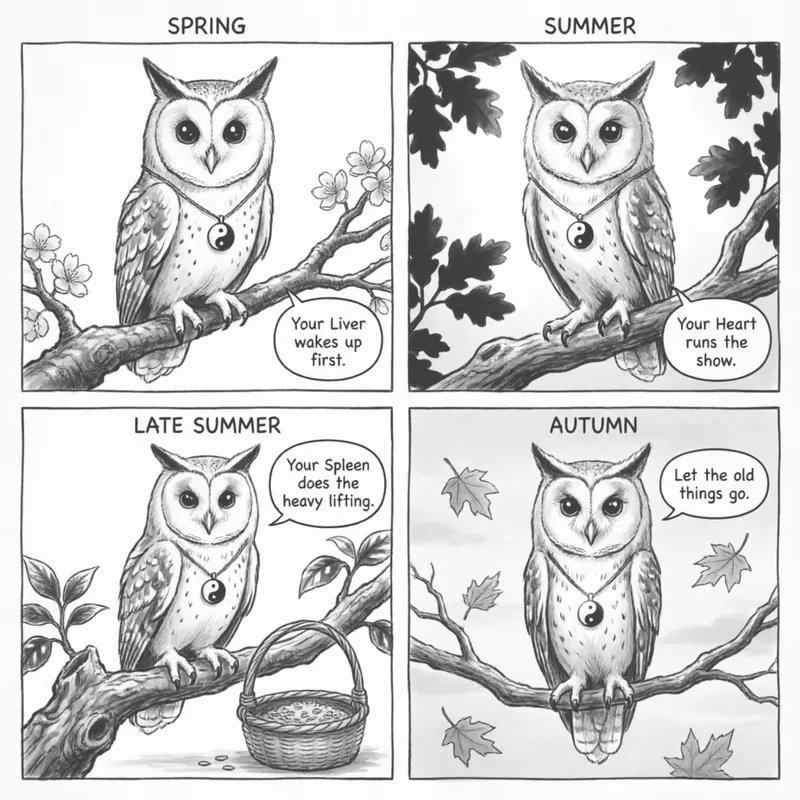

Hoo. Let me tell you a secret. Owls don't get summer grumpiness. Want to know why? We're nocturnal. We sleep through the Fire. You diurnal humans—you walk straight into the midday blaze and then wonder why you're snapping at people. The Heart organ doesn't like being roasted. Try a 20-minute rest after lunch. Your coworkers will thank you. — Ollie (adjusts his pendant, red ear tufts twitching in the Karachi heat)
🌿 Which Season Is Your Body Really In?
The calendar says one thing. Your body might say another. Take the free 2-minute self-check →
How to Align With Each Season
So, how do you work *with* the seasons instead of against them? The ancient classic, the *Huangdi Neijing* (The Yellow Emperor's Inner Canon), gives us a clear plan. It's all about aligning your diet, activity, and sleep with the energy of the season.
Here’s a quick-glance guide:
| Season | What Your Body Needs |
|---|---|
| Spring (Wood) | Rise early, take brisk walks. Eat foods that are slightly sour and green to support the Liver, like leafy greens, sprouts, and a little lemon. Stretch! |
| Summer (Fire) | Go to bed later, rise early. Rest at midday. Eat bitter and cooling foods like cucumber, watermelon, Mung beans (Lu Dou), and bitter greens. Stay hydrated. |
| Late Summer (Earth) | Focus on nourishing the Spleen. Eat naturally sweet, yellow/orange foods like squash, carrots, and sweet potatoes. Avoid cold, raw foods that tax digestion. |
| Autumn (Metal) | Go to bed a bit earlier. Protect your Lungs from dryness with pungent and moistening foods like pears, radishes, onions, and almonds. |
| Winter (Water) | Go to bed early, rise late. Conserve your energy. Eat warm, salty foods to nourish the Kidneys, like bone broths, root vegetables, seaweed, and beans. |
The simplest rule of all? Eat what grows locally in that season. Your body evolved to expect the cooling crunch of a cucumber in summer and the grounding substance of a root vegetable in winter. This isn't a "diet." It's an ancestral blueprint for health.
Beware the "Seasonal Transition" Danger Zones
Have you ever noticed you tend to get sick right when the weather changes? That’s not a coincidence. The 18-day period at the end of each of the four main seasons (which collectively form the "fifth season" of Late Summer) is when our bodies are most vulnerable.
During these transitions, the energy is shifting from one element to the next. Your body is working hard to recalibrate. The Spleen and Stomach (the Earth element) are in charge of this transition, acting as the pivot point for the entire system. If your digestive health (your Spleen Qi) is weak, you're more susceptible to catching whatever is going around. This is the time to be extra kind to your digestion: eat warm, cooked foods and avoid stress.
Don't Fight the Season, Flow With It
The modern Western approach is often to fight the season. When it's hot, we blast the air conditioning, chug ice water, and eat ice cream. When it's cold, we crank the heat and stay indoors.
The TCM approach is one of adaptation and harmony. Instead of fighting the heat, we adapt to it. This means allowing your body to sweat a little (it's your natural cooling system!). It means eating foods that are energetically cooling, not just physically cold.
Here’s a classic example: eating warm foods and drinking warm liquids, even in summer. This sounds crazy to many Westerners, but it's brilliant. Your digestive system is like a "cauldron" that needs to stay at a certain temperature to "cook" your food. When you dump ice water into it, you put out the digestive fire. This weakens your Spleen Yang and can lead to poor digestion, bloating, and the formation of Dampness in the body. A cup of warm mint tea, on the other hand, is energetically cooling without shocking your system.
Living seasonally isn't about rigid rules. It means listening. It means noticing how you feel and giving your body what it’s asking for. This summer, if you feel that fire rising, don't just blame the heat. Acknowledge your Heart. Take a moment to rest in the shade, sip some chrysanthemum tea, and find a moment of joy. Your whole body will thank you.
FAQ
Why do I get sick every time the season changes?
This is a classic sign that your Spleen Qi is struggling. In TCM, the Spleen (part of the Earth element) is responsible for helping your body transition between seasons. These 18-day transitional periods put extra strain on the Spleen. If it's already weak from poor diet, stress, or overwork, it can't manage the shift effectively, leaving your immune system (Wei Qi) vulnerable. Supporting your digestion with warm, cooked foods during these times can make a huge difference.
Is it really bad to drink ice-cold water in summer?
From a TCM perspective, yes, it can be. While it feels good momentarily, ice-cold drinks extinguish your "digestive fire," the Spleen Yang needed to break down food and absorb nutrients. Over time, this can lead to digestive issues like bloating, loose stools, and fatigue. It's better to drink room-temperature or warm liquids. For a cooling effect, choose energetically cool herbs like mint or chrysanthemum in your water or tea.
What if I live somewhere with no "real" seasons, like a tropical climate?
This is a great question! Even in places without dramatic seasonal shifts, the principles still apply. There are always subtle changes in temperature, humidity, rainfall, and the length of the day. A "dry season" might be more aligned with Autumn's dryness, affecting the Lungs, while a "monsoon season" brings Dampness that challenges the Spleen. Pay attention to these subtle shifts and what foods are locally available. The core idea is to live in harmony with your specific environment, whatever it may be.
Sources
- Maoshing Ni (Translator). The Yellow Emperor's Classic of Medicine: A New Translation of the Neijing Suwen with Commentary. Shambhala, 1995. (Specifically Chapter 2, "On the Heavenly Truth in High Antiquity")
- Leggett, Daverick. Recipes for Self-Healing. Meridian Press, 2005.
- General principles of circadian biology and its influence on organ function.