
Jing, Qi, Shen — The Three Treasures That Make You You
If you bought a computer, you'd want to know three things: what hardware is in the box, whether the operating system runs smoothly, and whether you — the user — can get anything done with it.
Classical Chinese medicine has been using the same three-layer model for over two thousand years. It just uses different words.
 I've found this three-layer framework to be the single most useful mental model I've ever encountered — and I say that as someone who spent years thinking about systems architecture before I ever picked up a medical text.
The Huangdi Neijing calls them the San Bao (Three Treasures (san bao)) — the Three Treasures: Jing (Jing (Essence)), Qi (Qi), and Shen (Shen (Spirit)). Think of them as hardware, software, and user. Or, if you prefer old-world metaphors: treasure in a chest, the servant who carries it, and the master who gives the orders.
Here's why this matters. Modern medicine is excellent at examining your hardware — your Jing, more or less. Blood tests, scans, genetic panels. It is decent at tracking your software — your Qi, if you squint — through metabolic panels and hormone levels. But it has almost no framework for the user layer: your Shen. Your presence. Your spark.
And yet, ask any physician what they notice first when someone walks in. They won't say "lab values." They'll say: how the patient looks. Bright eyes. Clear speech. The quality of being there. That's Shen. And classical Chinese medicine built an entire diagnostic system around it.
Jing (Jing (Essence)) — The Hardware You Were Born With
Jing is your constitutional essence. You inherit it from your parents at the moment of conception. It's stored primarily in the Kidney and governs growth, development, reproduction, and aging.
Think of Jing as the trust fund you received at birth. Some people get a generous one. Others get a modest one. Either way, the fund has a balance — and every withdrawal counts. Late nights. Overwork. Excessive sexual activity. Chronic illness. Each one makes a withdrawal.
Unlike Qi, which you can replenish daily through food and breath, Jing is finite. Classical physicians put this bluntly: you can protect your Jing, but you cannot manufacture more of it. This is why the Neijing spends so many chapters on lifestyle cultivation — not as wellness trends, but as Jing conservation strategies.
The physical signs of Jing are concrete: strong bones and teeth (Jing produces marrow), thick hair (Jing manifests in the head hair), sharp hearing (the Kidney opens into the ears), and healthy reproductive function. When someone ages prematurely — graying early, losing teeth, hearing declining — classical diagnosis points to Jing depletion.
Qi (Qi) — The Operating System That Runs Everything
If Jing is your hardware, Qi is your operating system. It's the energy that keeps the machine running — the invisible force that transforms food into blood, moves blood through vessels, warms your limbs, defends against illness, and holds your organs in place.
Qi is everywhere and does everything. The Neijing describes multiple types: Yuan Qi (original Qi, derived from Jing), Gu Qi (food Qi, extracted by the Spleen from what you eat), Zong Qi (chest Qi, formed from food Qi plus air from the Lungs), and Wei Qi (defensive Qi, circulating at the surface to repel invaders).
What's remarkable about this model is how observable it is. When Qi is deficient, you feel tired, catch colds easily (Wei Qi is weak), have poor digestion (Gu Qi isn't being extracted properly), and your voice is weak (Zong Qi is low). When Qi is stagnant, you feel distended, irritable, achy — the sensation of energy that should be flowing but isn't.
Unlike Jing, Qi is renewable. Eat well, breathe deeply, move regularly, sleep soundly — and your operating system stays optimized. Neglect these basics, and the system slows to a crawl. The Neijing calls this Qi Hua (Qi transformation) — the transformation of Qi — and it's the central process of health maintenance.
Shen (Shen (Spirit)) — The User Sitting at the Keyboard
This is where Western and classical models diverge most dramatically. Shen is your spirit, your consciousness, your presence — the quality of you that cannot be reduced to biochemistry.
The Neijing says Shen is housed in the Heart and nourished by Blood. When Blood is abundant, Shen is calm, clear, and present. When Blood is deficient, Shen becomes restless — anxiety, insomnia, scattered thinking. A classical physician examining a patient looks first at the Shen: Are the eyes bright? Is the speech clear? Is the mind responsive? If Shen is intact, even serious illness has a good prognosis. If Shen is scattered, even mild illness warrants caution.
This is not mysticism. It's observation. Anyone who has seen a person with depression knows that something beyond neurotransmitter levels has changed. The eyes dull. The presence withdraws. The spark dims. Classical Chinese medicine simply has a word for this: Shen disturbance (Shen (Spirit)disturbance). And it treats it not by targeting the brain directly, but by nourishing the Heart Blood that houses the Shen.
 Ollie's Take
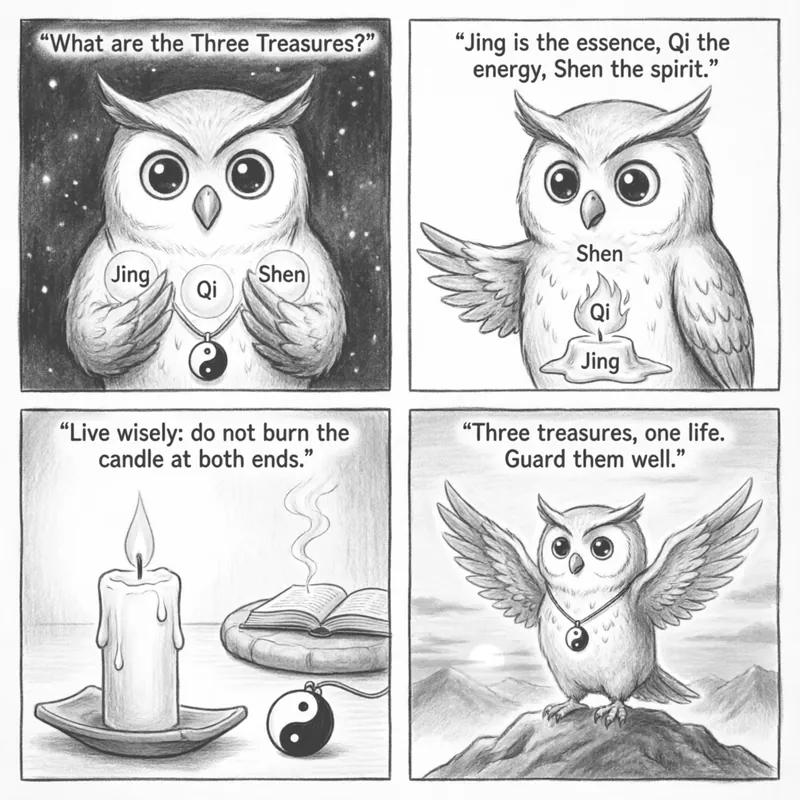
You have three treasures. You're spending one of them like it's unlimited.
How the Three Layers Actually Work Together
Here's the model in practice:
The Three Treasures — A Quick Map
| Treasure | Modern Analogy | Stored In | Renewable? | Signs of Deficiency |
|---|---|---|---|---|
| Jing Jing (Essence) | Hardware / BIOS | Kidney | Limited | Premature aging, weak bones, hair loss, infertility |
| Qi Qi | Operating System | Lung + Spleen | Daily | Fatigue, weak digestion, frequent colds, weak voice |
| Shen Shen (Spirit) | User / Consciousness | Heart | Indirectly (via Blood) | Anxiety, insomnia, dull eyes, mental fog |
Notice the hierarchy. Shen rests on Qi. Qi rests on Jing. A Shen disturbance (anxiety, insomnia) is often rooted in Qi deficiency (the Spleen isn't producing enough Blood to nourish the Heart). And Qi deficiency, if chronic, drains Jing. The three layers are nested, not separate — like Russian dolls, not like three jars on a shelf.
This is why classical physicians never treated isolated symptoms. The patient who can't sleep isn't a "sleep problem." They're a Shen-Qi-Jing relationship problem. The physician traces the signal down through the layers until they find the root.
The Jing is the foundation. The Qi is the movement. The Shen is the brightness. When the foundation is solid, movement is effortless, and brightness fills the eyes.
The Conservation Message Nobody Wants to Hear
There's a hard truth at the bottom of the Three Treasures model: Jing is finite, and modern life burns it fast.
Every late night studying or scrolling is a Jing withdrawal. Every period of chronic stress is a Jing withdrawal. Every cycle of overwork without rest is a Jing withdrawal. The body can compensate for years — borrowing from tomorrow's Jing to pay for today's demands. But the bill always comes due. It shows up as burnout in your thirties that feels disproportionate to your circumstances. It shows up as fertility problems that lab tests can't explain. It shows up as the gnawing sense, around age forty, that your body has aged ten years in the last two.
The Neijing's advice is painfully simple: protect what you have. Go to bed before midnight. Eat food that builds, not food that depletes. Move enough to keep Qi flowing, but not so much that you exhaust Jing. Manage your emotional life — because prolonged anger, grief, and fear each drain a specific organ's essence. And perhaps most countercultural of all: do less. Every unnecessary activity is a Jing expenditure you'll never get back.
This isn't living in fear. It's living with awareness. Your Jing is the deepest part of you. Treat it accordingly.
Your Jing is like the battery in a classic watch. It was sealed in at the factory — and once it runs down, no amount of shaking will wind it back up. But here's the bright side: you can make that battery last a very long time if you stop running unnecessary apps. Sleep is your power-saving mode. Good food is your charger. And every moment of genuine rest isn't laziness — it's Jing conservation. Your hardware thanks you.
— Ollie
FAQ
Can I replenish my Jing once it's depleted?
Jing is the most difficult treasure to replenish — it's your constitutional endowment. Lifestyle choices (sleep, diet, stress management) can slow depletion dramatically. Think of it as driving more efficiently with the fuel you have, not refilling the tank.
How is Shen different from the Western "mind"?
Shen is broader — it encompasses consciousness, emotional presence, and what we might call "radiance." The Heart houses the Shen, which is why Chinese medicine links emotional well-being so closely to cardiovascular health.
Sources
- Huangdi Neijing (Yellow Emperor's Inner Classic) — Suwen chapters 1, 4, 5, 8 on Jing, Qi, and Shen
- Unschuld, P.U. (2011) — Huang Di Nei Jing Su Wen: An Annotated Translation
- Maciocia, G. (2015) — The Foundations of Chinese Medicine, 3rd ed., Chapters on the Vital Substances
- Ni Haixia (Ni Haixia (1954–2012, modern TCM master)) — Ren Ji: Huangdi Neijing Lectures (Ren Ji (Human Benchmark) lecture series, Huangdi Neijing (The Yellow Emperor's Inner Classic))
- Kaptchuk, T. (2000) — The Web That Has No Weaver, Chapter on the Three Treasures
Enjoyed this?
Subscribe via RSS — new articles delivered to your feed reader.
Have a question? Reply by email — good questions become future articles.