
What Zhang Zhongjing Knew That Your Doctor Doesn't
 It's 200 AD. The mighty Han Dynasty, the China of silk-robed poets and sprawling palaces, is crumbling. Out in the provinces, a terrifying epidemic is tearing through the population, a mysterious illness that leaves no family untouched.
In the middle of this chaos is a man named Zhang Zhongjing, a local government official and a brilliant physician. He is watching, helpless, as this plague claims two-thirds of his entire clan—over two hundred relatives—in less than a decade.
His grief is unimaginable. But from that grief, he forges a weapon. He spends the rest of his life observing, recording, and testing, creating a medical masterpiece that would echo through the centuries: the Shang Han Lun, or "Treatise on Cold Damage."
Now, fast forward 1800 years. You feel a tickle in your throat. You get chills. You book a doctor's appointment, wait 45 minutes, and get a seven-minute consultation. The doctor listens to your chest, checks your throat, and gives you a diagnosis based on that single moment in time. It's a snapshot.
Zhang Zhongjing didn't do snapshots. He saw illness as a movie. He understood that sickness has a script, a predictable plot that unfolds in stages. And by knowing the script, he could predict the next scene and change the ending. This is the simple, deep insight that your doctor, for all their modern tools, might be missing.
 Ollie's Take
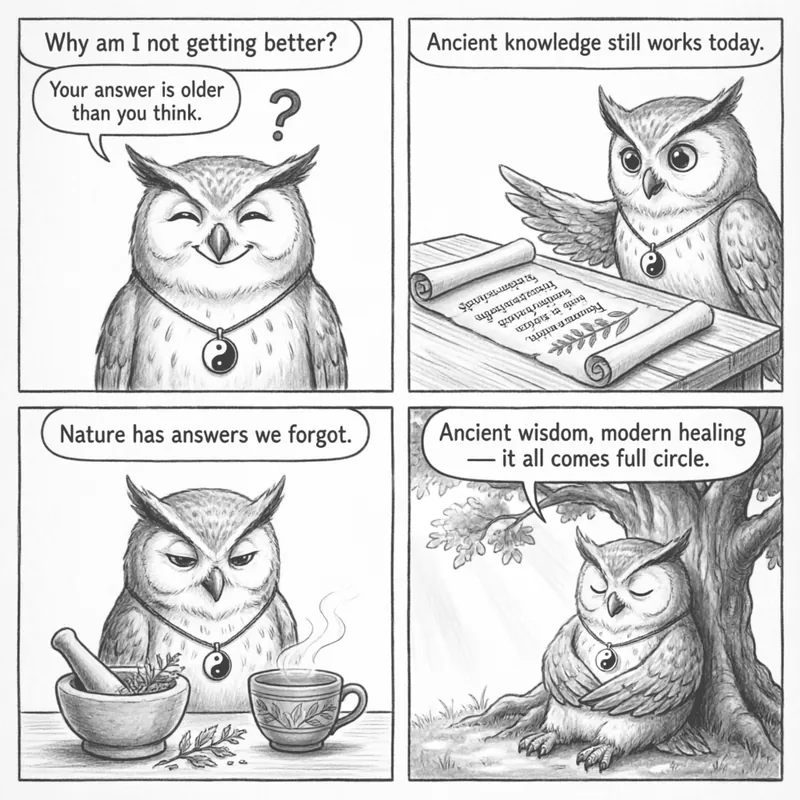
A Map Forged in Grief
It's easy to think of these old medical texts as dusty artifacts written by bearded sages in quiet libraries. The Shang Han Lun is anything but. It was written in the trenches, born from the kind of loss that either breaks a person or turns them into a legend. Zhang Zhongjing wasn't just curious about disease; he was at war with it.
At around the same time in the West, the Greek physician Galen was building on the work of Hippocrates. They were fantastic observers, brilliant at describing and categorizing diseases. They could tell you exactly what a lung infection looked like.
Zhang Zhongjing did something different. He wasn't just describing the "what"; he was mapping the "how" and "where next." He was less of a biologist and more of a detective, watching the trail of symptoms to see where the intruder—the illness—was headed.
He saw that a simple cold wasn't so simple. It could stay on the surface, or it could dive deep into the body, transforming and becoming more dangerous along the way. He created a map of this progression, a guide that is still so accurate it's used by Chinese medicine practitioners around the world today.
The Secret Script of Sickness: Following the Six Layers
So what is this incredible map? In TCM, it's called the Six-Channel Pattern Differentiation. That sounds complicated, but the idea is beautifully simple.
Imagine your body is a house, with a front porch, a living room, hallways, and deep, private bedrooms in the back. An illness, like an uninvited guest, usually tries to get in through the front door. Where the fight happens tells you everything about how serious the situation is.
These six layers, or stages, are:
1. Taiyang (Greater Yang): The Front Porch. This is where most external illnesses, like the common cold, begin. The pathogen is on the surface, and your body's defensive energy (Wei Qi) is fighting it at the gate. As the Shang Han Lun states in its very first clause, the classic signs are "a floating pulse, stiffness and pain in the head and nape, and a strong aversion to cold." You feel achy, chilled, and maybe have a headache. The battle is on!
2. Yangming (Yang Brightness): The Living Room. The intruder got past your defenses and is now raging in the main part of the house. This isn't a subtle fight anymore; it's an all-out blaze. This stage is characterized by what TCM calls the "Four Bigs": big fever, big sweat, big thirst, and a big, bounding pulse. The fight is hot and intense.
3. Shaoyang (Lesser Yang): The Hallway. Here, the illness is trapped—half in, half out. It's not fully on the surface, but it hasn't penetrated deep into the body's core, either. This is the classic "I feel sick, then I feel okay, then I feel sick again" stage. The key signs are alternating chills and fever, a bitter taste in the mouth, nausea, and discomfort on the sides of your ribs. The battle is a frustrating stalemate.
4. The Three Yin Layers (Taiyin, Shaoyin, Jueyin): The Back Rooms. If the body's energy, its Yang Qi, is weak, the pathogen can bypass the public areas of the house and sneak into the private bedrooms and basement. These are the deeper, more serious, and chronic stages.
- Taiyin (Greater Yin) involves the digestive system (the Spleen system in TCM) and is marked by cold, damp symptoms like diarrhea, vomiting, and abdominal fullness.
- Shaoyin (Lesser Yin) is a critical stage affecting the body's core battery pack (the Kidney and Heart systems). Here, the body is exhausted. As the Shang Han Lun describes in Clause 281, the person is utterly depleted, with "a faint, fine pulse and a desire only to sleep." This is a sign that the body's vital energy is failing.
- Jueyin (Terminal Yin) is the deepest and most complex layer, a chaotic mix of hot and cold as the body's Yin and Yang separate.
The beauty of this map is that a good practitioner can pinpoint exactly where you are and prevent the illness from moving to the next, more dangerous room.
The First Line of Defense: Why Formula #1 Is Still a Bestseller
Given this map, it's no surprise that the very first formula listed in the Shang Han Lun is Gui Zhi Tang, or Cinnamon Twig Decoction. It's designed specifically for that first stage—the Taiyang battle on the front porch.
Think of it this way: your body is trying to push the intruder out, but the door is stuck. The primary herb, Gui Zhi (Cinnamon Twig), is like a gentle but firm push on the door. It opens the pores and helps your body fight the pathogen on the surface.
But wait! If you just throw the door open, all your precious warmth and fluids (your Qi and Yin) might escape along with the bad guy, leaving you weak and depleted. That's where the second key herb, Bai Shao (White Peony Root), comes in. It's like a wise bouncer at the door. It nourishes your body's resources and makes sure that only the pathogen gets kicked out, while all your good stuff stays inside.
This is so much more sophisticated than just "take an ibuprofen and wait." An over-the-counter painkiller is like putting on noise-canceling headphones while a burglar is in your house. It masks the symptoms—the noise and discomfort—but it doesn't help your body win the actual fight. Gui Zhi Tang, on the other hand, helps your body's own security team do its job more effectively. One approach silences the alarm; the other helps you catch the thief.
Are You Chasing Symptoms or Solving the Puzzle?
This "movie vs. snapshot" thinking applies to far more than just the common cold. Let's take a modern condition like high blood pressure.
In a typical Western medical visit, the process is straightforward. Your blood pressure is high. The diagnosis is hypertension. The treatment is a pill that lowers blood pressure. It's a direct, symptom-focused approach that saves countless lives. It treats the number.
A practitioner thinking like Zhang Zhongjing would see the high blood pressure reading as just one clue in a much larger puzzle. They would ask, "Why is your blood pressure high?" The investigation would begin:
- Are you often irritable, with a red face, headaches, and a feeling of heat rising to your head? This points to a pattern of Liver Yang Rising.
- Do you also have a sore lower back, ringing in your ears, night sweats, and feel depleted? That sounds more like Kidney Yin Deficiency, where there isn't enough "coolant" to anchor the body's fiery Yang energy.
- Or perhaps you feel heavy, sluggish, have a foggy head, and carry extra weight? This might be a pattern of Phlegm-Dampness physically gumming up the works and obstructing the flow of Qi and Blood.
That's one Western diagnosis—hypertension—but three totally different TCM patterns. Each would require a unique herbal formula and treatment strategy. This is the power of pattern recognition. Instead of slapping a name on a disease, this approach seeks the unique pattern of imbalance within your body. It honors the ancient principle from the Huangdi Neijing (The Yellow Emperor's Inner Classic), which states in Suwen Chapter 2: "The sages did not treat those who were already ill, but instructed those who were not yet ill." They taught how to recognize the pattern before it became a full-blown crisis.
An 1800-Year-Old Book for Your 21st-Century Body
So, why should you, a modern person navigating a busy life, care about an ancient Chinese text? Because this knowledge is empowering.
First, it helps you become your own health detective. The next time you feel sick, you can start to notice the clues. Is your neck stiff and you have chills (Taiyang)? Or do you have a bitter taste and feel nauseous (Shaoyang)? Just by observing these details, you can understand where the illness is and communicate more clearly with your practitioner.
Second, it's far more precise than "boost your immune system." That advice is like telling a general to "go fight the war!" without giving them a map of the battlefield. The Six-Layer map shows you exactly where the battle is being fought and what kind of support your body needs. Support on the front porch looks very different from support in the basement.
Finally, these formulas are not museum pieces. They are living medicine. Practitioners use them every single day. Adapted versions of formulas from the Shang Han Lun were instrumental in treating patients during the SARS and COVID-19 outbreaks in Asia, because the patterns of viral illness—fever, aches, cough, exhaustion—are timeless. Zhang Zhongjing's map still works.
The wisdom of the Shang Han Lun isn't about rejecting modern medicine. It adds another, older, and incredibly insightful lens to how we view our own health. It reminds us that our bodies tell a story, and if we learn to listen, we can help write a healthier ending.
Hoot! Let me put this in terms even a sleepy field mouse could understand. Zhang Zhongjing wasn't some dusty sage nodding off over scrolls — he was the original pattern detective, and he didn't need a magnifying glass. Chills here, a weird taste in your mouth there, sweating or not sweating... every little clue told him exactly where the illness was hiding in the body's "house."
Here's what really gets my feathers ruffled: modern medicine often treats symptoms like an annoying alarm clock — just hit snooze and go back to sleep. But Zhang Zhongjing's formulas? They actually help your body's own security team catch the burglar. One approach silences the noise. The other solves the crime.
So the next time you feel that tickle in your throat, don't just reach for a pill and tune out. You're the director of this movie, not a passive extra. Pay attention to the script your body is showing you. Zhang Zhongjing figured this out 1,800 years ago — the least we can do is pay attention!
FAQ
Do I need to read the whole Shang Han Lun to get better?
Goodness, no! That's like trying to learn brain surgery from a textbook to cure a headache. The Shang Han Lun is a dense clinical manual for practitioners. Your job is much simpler and more important: to be the expert on your own body and notice the patterns it's showing you.
So, should I run out and buy Gui Zhi Tang for my next cold?
Absolutely not! Gui Zhi Tang is specifically for a Taiyang pattern where you have chills, fever, and sweating. If you have chills and fever but no sweat, that's a different pattern requiring a different formula (like Ma Huang Tang). This is why self-prescribing herbs is a bad idea. Always consult a qualified practitioner who can read the map correctly.
Is this a replacement for my doctor?
Not at all. Think of it as a powerful partnership. If you have a heart attack, a broken bone, or a bacterial infection, please go to the emergency room! Modern medicine is miraculous for acute crises. But for understanding the subtle shifts that lead to chronic illness, navigating the flu, or optimizing your day-to-day vitality, Zhang Zhongjing's movie-like perspective is priceless.
Sources
- Zhang, Zhongjing. Shang Han Lun (Treatise on Cold Damage). c. 200 AD.
- Huangdi Neijing (The Yellow Emperor's Inner Classic). c. 2nd Century BC.
- Scheid, Volker, et al. Shang Han Lun: On Cold Damage, Translation & Commentaries. Eastland Press, 2017.
- Bensky, Dan, et al. Chinese Herbal Medicine: Materia Medica, 3rd Edition. Eastland Press, 2004.
Enjoyed this?
Subscribe via RSS — new articles delivered to your feed reader.
Have a question? Reply by email — good questions become future articles.