Your Anxiety Is Not in Your Head — Understanding the Liver Qi Connection
You've tried therapy. You've tried the meditation apps. You've tried the deep breathing exercises, counting to ten, and maybe even a lavender-infused pillowcase.
But your anxiety keeps coming back. And it doesn't travel alone. It brings friends: a frustrating knot in your chest, a hair-trigger temper that surprises even you, and long nights spent staring at the ceiling, your mind racing like a hamster on a wheel.
The problem isn't just in your thoughts. What if the root of that feeling—that stuck, tense, overwhelming feeling—is actually physical? In Chinese medicine, we'd say it is. And we'd look straight to your Liver.
🌙 Can't Sleep? Your Body Knows Why.
Get the free 7-day guide — ancient Chinese wisdom for better rest. Download →
 Ollie's Take
The Liver You Don't Know
When you hear "liver," you probably think of a hardworking organ that processes last night's glass of wine and helps with detoxification. And you're not wrong! But in the world of Traditional Chinese Medicine (TCM), the Liver is so much more.
Think of the Liver as the General of your body's army. As described in classic texts like the Huang Di Nei Jing (Yellow Emperor's Inner Classic), the Liver is responsible for strategy and planning. Its most vital job is to ensure the smooth, free flow of Qi—your body's vital energy—to every single part of your system.
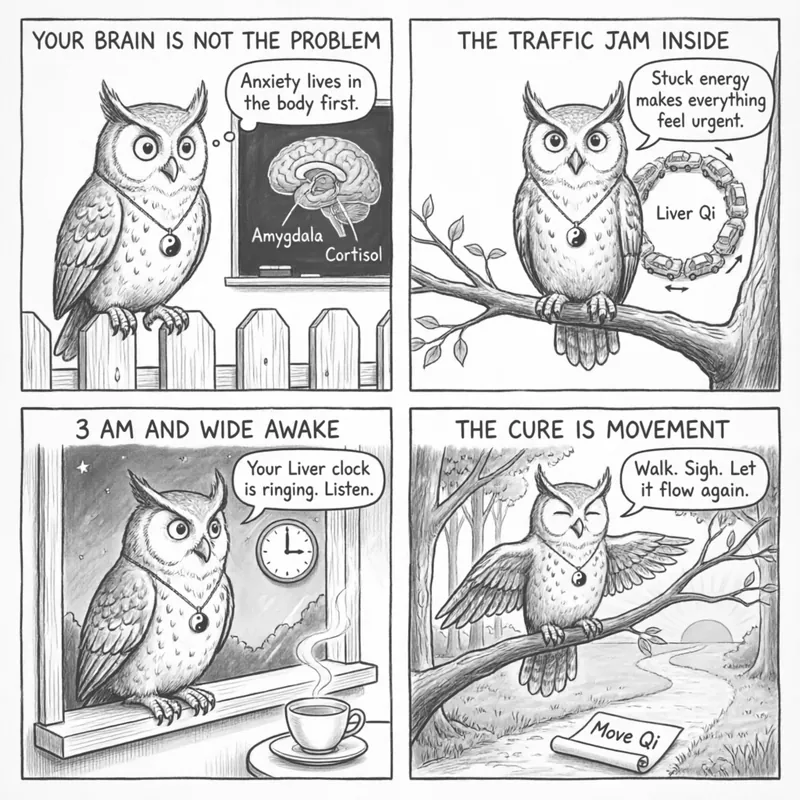
A better modern metaphor might be a city's traffic control center. When the Liver is functioning well, Qi and Blood move freely, like cars on an open highway. Nutrients get delivered, emotions are processed and released, and everything runs on time. You feel flexible, adaptable, and emotionally balanced.
But when the Liver gets overwhelmed by stress, frustration, or unprocessed emotions, it's like a city-wide power outage at traffic control. You get gridlock. Qi gets stuck. This is what we call Liver Qi Stagnation, and it's the pattern behind so much of the modern experience of anxiety.
This TCM Liver also has other jobs that explain a lot. It governs the tendons, which is why you feel stiff and tight when you're stressed. It opens into the eyes, which is why your vision can get a little blurry or your eyes feel dry when you're overwhelmed. And most importantly for your peace of mind, it houses the Hun, or Ethereal Soul, which plays a major role in your emotional equilibrium and your ability to sleep soundly.
Stuck Qi, Stuck Emotions
Here’s the vicious cycle that so many of us are trapped in: stress causes Liver Qi to stagnate. And Liver Qi Stagnation makes you feel even more stressed, irritable, and anxious. It’s a feedback loop that can be incredibly difficult to break with willpower alone.
You know the feeling. You're already tense from a long day. You're holding it together. Then someone cuts you off in traffic, or your partner leaves a dish in the sink, and you explode. That's not a character flaw; that's stagnant Qi desperately looking for an exit.
The primary emotion of the Liver is anger, but that doesn't just mean rage. It includes its more subtle cousins: irritability, resentment, frustration, and a general feeling of being "ticked off." When the Liver's Qi is stuck, these emotions bubble just below the surface, waiting for a trigger.
This "stuckness" manifests physically in very specific ways. Do any of these sound familiar?
- Frequent sighing: This isn't just for dramatic effect! It's your body's unconscious, intuitive attempt to move the stuck Qi in your chest and get things flowing again.
- Chest and rib-side tightness: A classic sign. It can feel like a band around your chest or a dull ache under your ribs, right where the Liver and Gallbladder channels run.
- A lump-in-the-throat sensation: You feel like you need to clear your throat, but nothing's there. In TCM, we have a beautifully descriptive name for this: Mei He Qi, or "Plum Pit Qi." It literally feels like you've swallowed a plum pit that's gotten stuck.
When you see these physical symptoms alongside anxiety, it's a huge clue that you're dealing with liver qi stagnation anxiety. The anxiety isn't just a mental state; it's a full-body experience rooted in a physiological traffic jam.
Ollie Speaks
🦉
From my perch on this stack of books, I see so many people blaming themselves. "Why can't I just relax?" "Why am I so irritable?" My little ear tufts twitch every time. Listen to me: You're not broken. You're stuck.
That feeling of being trapped, tense, and about to snap? That's not a failure of your personality. It's a traffic jam in your Qi, orchestrated by a stressed-out Liver. Instead of beating yourself up, try asking, "What does my Liver need to get things moving again?" It's a much kinder—and more effective—question. Now, if you'll excuse me, I need to adjust my yin-yang pendant.
The PMS Connection Your Doctor Never Mentioned
You might be a calm, reasonable person for three weeks out of the month, only to transform into a weepy, irritable, anxiety-ridden stranger the week before your period. You are not imagining things, and you are not "crazy." You're experiencing a textbook flare-up of Liver Qi Stagnation.
The Liver channel is like a superhighway that runs right through the center of your body, with major exits at the reproductive organs and breasts. When your Liver Qi is already a little stagnant—from work stress, from life, from just being a person in the 21st century—it's like having mild, everyday traffic.
Then, the week before your period, the hormonal shifts happen. In TCM terms, this is a massive surge of Qi and Blood moving toward the uterus. It’s like adding rush-hour traffic to an already congested highway system. The result? A total standstill.
This is why PMS symptoms map so perfectly onto Liver Qi Stagnation:
- Mood swings, anxiety, and irritability: The emotional gridlock is at its peak.
- Breast tenderness: The Liver channel runs through the breasts. When Qi gets stuck here, it creates distension and pain.
- Menstrual cramps: Stuck Qi leads to stuck Blood, causing sharp, stabbing pain as the uterus tries to do its job.
This is one of the most powerful examples of how anxiety TCM looks at the whole person. Your premenstrual anxiety isn't separate from your breast tenderness. They are two different symptoms of the exact same root cause: your Liver needs help moving Qi.
Why Sleep Won't Come (And What Your Liver Has to Do With It)
So, your day is a mess of anxiety and irritability, and you can't wait to finally fall into bed and escape. But then... you can't. Or worse, you fall asleep easily enough, only to jolt awake at 1:37 AM, wide-eyed and worried.
Sound familiar? You can thank your Liver for that, too.
According to the Chinese medicine body clock, different organ systems are in charge during different two-hour windows of the day. The hours between 1 AM and 3 AM belong to the Liver. Waking up consistently during this time is a huge red flag that your Liver is out of balance.
Remember the Hun, or Ethereal Soul, that the Liver houses? During the day, the Hun helps with planning and vision. At night, it's supposed to return to the Liver to rest peacefully. This grounding of the Hun in the Liver is what allows for deep, restorative sleep.
But when the Liver is in a state of chaos from stagnant Qi, it's not a very restful home. The Hun has nowhere to settle. It becomes restless and "wanders," leading to that classic 1-3 AM wake-up, often accompanied by a flood of anxious thoughts, vivid or stressful dreams, or difficulty falling back asleep. Your soul is un-sheltered.
Three Things That Actually Move Liver Qi
Okay, so your Liver is stuck. What can you actually do about it? The good news is that moving Liver Qi doesn't require a magic pill. It requires movement—in all senses of the word. When dealing with Chinese medicine stress, action is key.
1. Move Your Body (Especially with Twists)
Stagnation hates movement. Any form of exercise will help, but the Liver especially loves movement that compresses and releases the ribcage area where it resides. Think side stretches, gentle spinal twists (like in yoga), and hip openers. Even just reaching one arm up and over your head for a deep side-body stretch can provide immediate relief by "wringing out" the Liver and Gallbladder channels.
2. Add a Little Sour to Your Life
In Five Element theory, each flavor has an affinity for a specific organ. The Sour flavor enters the Liver. A small amount of a sour taste can help soften a hardened, stagnant Liver and encourage it to release. This doesn't mean eating a bag of sour candies! Think a squeeze of fresh lemon in your water in the morning, or using a good quality apple cider vinegar in your salad dressing. For more persistent stagnation, a TCM practitioner might recommend the classic herbal formula Xiao Yao San, whose beautiful name translates to "Free and Easy Wanderer Powder." It's the go-to formula for soothing the Liver and resolving the emotional and physical tension of Qi stagnation.
3. Move Your Emotions
The Liver hates repression more than anything. Holding back tears, swallowing your anger, and putting on a brave face are all surefire ways to create stagnation. Chinese medicine doesn't ask you to "think positive." It asks you to let the emotion move *through* you. This might mean journaling, having an honest conversation, yelling into a pillow, or having a good, cathartic cry. Giving your frustration a voice is one of the most powerful ways to tell your Liver it's safe to let go.
The next time you feel that familiar anxiety rising, that knot tightening in your chest, try one of these things. Take five deep breaths and do a gentle side stretch. Acknowledge the frustration you're feeling instead of stuffing it down. You might be surprised at how quickly your body responds when you finally give your Liver what it's been asking for: a little room to flow.
FAQ
What's the difference between Liver Qi Stagnation and just being stressed?
Think of it this way: stress is the external trigger, while Liver Qi Stagnation is the internal physiological response. Everyone experiences stress. But when that stress leads to a specific pattern of physical and emotional symptoms—like rib-side tightness, irritability, frequent sighing, PMS, and a "lump in the throat" feeling—TCM identifies this as a distinct syndrome called Liver Qi Stagnation. It's when stress gets "stuck" in the body's energy system, creating a self-perpetuating cycle of anxiety and physical tension.
Can I fix Liver Qi Stagnation with diet alone?
While diet is a powerful tool, it's usually just one piece of the puzzle. Adding sour flavors and avoiding greasy, heavy foods that can further congest the system is very helpful. However, since Liver Qi Stagnation is so tightly linked to emotions and stress, a multi-pronged approach is most effective. Combining dietary adjustments with physical movement (especially stretching and twisting), emotional expression (like journaling or talking it out), and potentially acupuncture or herbal medicine provides the most comprehensive and lasting relief.
Is the herbal formula Xiao Yao San safe for everyone?
No, you should never take herbal medicine without consulting a qualified TCM practitioner. While Xiao Yao San ("Free and Easy Wanderer") is a widely used and generally safe formula for Liver Qi Stagnation, it is not appropriate for everyone. A licensed acupuncturist or herbalist will perform a full diagnosis to ensure this is the correct pattern for you and that the formula won't interact with other conditions or medications. They can also recommend modifications to the formula to tailor it perfectly to your unique constitution and symptoms.
Sources:
- Huang Di Nei Jing Suwen (Yellow Emperor's Inner Classic, Basic Questions), Chapters 2 & 5.
- Zhang, Jiebin. Lei Jing (The Classified Canon). c. 1624.
- Maciocia, Giovanni. The Foundations of Chinese Medicine. Elsevier, 2015.
- Nanjing University of Chinese Medicine. Diagnostics of Traditional Chinese Medicine. People's Medical Publishing House, 2012.