
Your Fever Might Be Your Friend
The digital thermometer beeps. You squint at the little screen: 39.1°C. Your heart does a little flip-flop. Whether it’s you or your child, that number immediately triggers a cascade of modern instincts. Open the medicine cabinet. Find the Tylenol. Make the fever go away.
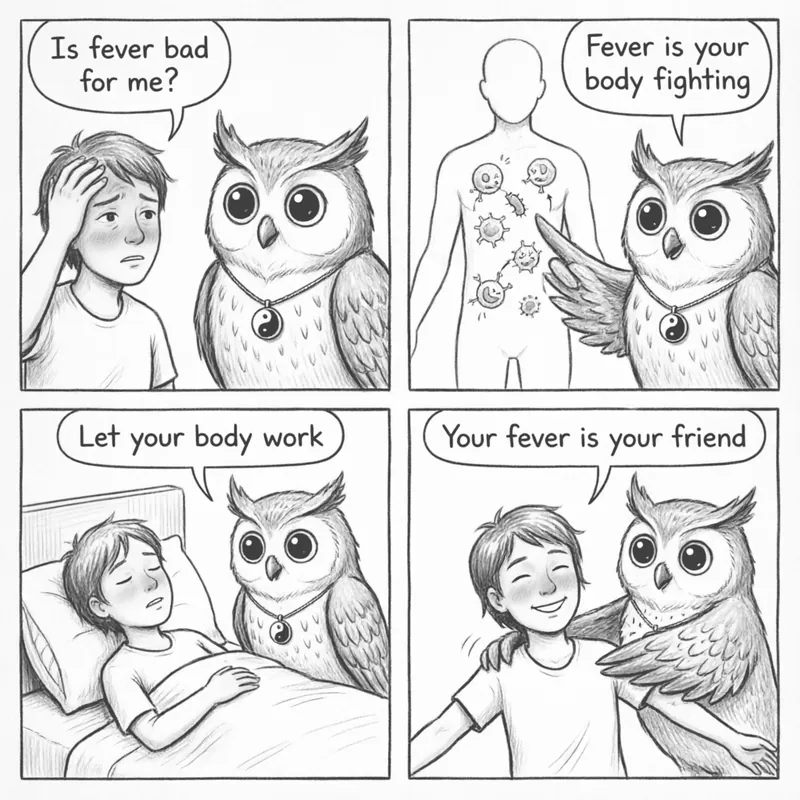
We’ve been taught to see fever as a malfunction, a sign that the body is broken and needs fixing. We treat the number on the thermometer as the enemy. But that high fever isn’t a sign of failure. It’s a sign that your body is fighting back with everything it’s got.
Here at the TCM Way, my little owl friend Ollie and I love looking at health through a different lens. Today, we’re peering through one of the most powerful lenses in Chinese medicine to reframe our relationship with fever.
The Body’s Battle Plan: The Shang Han Lun Lens
About 1,800 years ago, a medical genius named Zhang Zhongjing wrote the Shang Han Lun (Discussion of Cold Damage). It’s not just a book of remedies; it’s a brilliant field manual for understanding how an illness, like a cold or flu, invades the body and how the body fights back.
He mapped it out in six stages, showing how a pathogen moves from the surface deeper into the interior. One of the most dramatic stages is the Yangming (阳明病) stage. Yangming translates to "Bright Yang," and it’s exactly what it sounds like: the body's defensive Qi is blazing hot and at its absolute peak.
This isn't a quiet, smoldering fire. This is a full-on, five-alarm inferno. The Shang Han Lun describes this stage with a classic pattern known as the "Four Bigs": a high fever (big heat), profuse sweating (big sweat), intense thirst (big thirst), and a full, bounding pulse (big pulse).
From a Western perspective, this looks terrifying. It looks like the system is out of control. But from Zhang Zhongjing’s perspective, this is the body’s special forces unit, fully mobilized and engaged in an epic battle. The body has successfully lured the enemy into a specific zone (the Stomach and Large Intestine channels) and is throwing all its resources at annihilating it. This isn't collapse; it’s peak performance.
 Ollie's Take
Enter the White Tiger
So, if the body is doing exactly what it’s supposed to, what’s the role of herbal medicine? It’s not to shut the fight down. It’s to support the troops. This is where one of the most famous and elegant formulas in history comes in: Bai Hu Tang (白虎汤), or White Tiger Decoction.
Doesn't that just sound incredibly cool? The name is pure poetry. In the five-element system, the color white and the tiger are associated with the metal element and the season of autumn—a time of cooling, clearing, and descending energy. The name itself tells you its purpose: to bring powerful, autumn-like coolness to a blazing summer-heat condition.
Bai Hu Tang has only four ingredients, working together in perfect synergy:
- Shi Gao (石膏, Gypsum Fibrosum):: This is the undisputed general of the formula. A mineral, it’s intensely cold and is a powerhouse at clearing extreme heat from the Qi level of the body. Think of it as a massive fire hose aimed directly at the source of the blaze. It cools the inferno without harming the body’s own precious resources.
- Zhi Mu (知母, Anemarrhenae Rhizoma):: Shi Gao’s indispensable partner. Zhi Mu is also cold and clears heat, but it has an extra, vital job: it nourishes Yin. All that heat and sweating burns through your body’s fluids. Zhi Mu is the hydration crew, coming in right behind the firefighters to replenish the water supply and prevent you from drying out.
- Geng Mi (粳米, Non-glutinous rice):: Yes, just plain old rice! This humble ingredient is a stroke of genius. It protects the Stomach Qi. The other herbs are very cold, and a direct assault of cold can be a shock to the digestive system. The rice acts as a gentle, nourishing buffer, ensuring the stomach isn't damaged in the crossfire.
- Gan Cao (甘草, Glycyrrhizae Radix):: Baked licorice root is the great harmonizer of Chinese herbalism. Here, it helps the other ingredients play nicely together and further protects the stomach. It’s the diplomat ensuring the whole operation runs smoothly.
Together, these four herbs don’t suppress the fever. They address the reason for the fever—the raging pathogenic heat—while simultaneously protecting and restoring the body’s fluids. They help the body win the fight more efficiently, not call it off.
Fever Is Not the Enemy
This idea isn’t just some esoteric concept. Modern science is slowly coming around to what TCM practitioners have known for centuries. Fever is a highly evolved, effective immune response. Most viruses and bacteria reproduce more slowly at higher body temperatures. Meanwhile, your own immune cells, like T-cells, kick into a higher gear.
Suppressing a low-grade or moderate fever can sometimes prolong the illness. This has led many researchers to talk about "fever phobia," our culturally ingrained fear that drives us to medicate at the first sign of a rising temperature.
The TCM approach is more nuanced. It doesn’t let a fever rage unchecked. It correctly identifies the type of heat and its location, and then uses herbs to help the body clear it effectively. As the Shang Han Lun states in its chapter on Yangming disease, the pattern is characterized by "high fever, profuse sweating, great thirst, and a surging, big pulse." When a practitioner sees this specific picture, they know the White Tiger is ready to be unleashed.
The Danger Zone: When to Worry
Now, this is the really important part. I can see Ollie, my screech owl buddy, ruffling his red ear tufts with concern. We are not saying you should ignore every high fever. A Yangming-stage battle is intense, and if the body’s resources (its Yin and fluids) run out, the situation can become dangerous.
If a high fever is accompanied by any of the following, it’s time to seek immediate medical attention:
- Delirium, confusion, or extreme irritability
- A stiff neck
- Convulsions or seizures
- Difficulty breathing
- A weak, thready pulse instead of a strong, bounding one
- Cold hands and feet despite a hot torso
- Signs of severe dehydration (no urine, sunken eyes, dry mouth with no saliva)
These are signs that the body is no longer in a state of "Bright Yang" but is becoming exhausted. This is not the time for a home remedy; this is the time for a doctor or an emergency room. TCM is an incredible partner in health, but it is not a substitute for emergency medical care. The wisdom of TCM lies in learning to listen and differentiate. A Yangming fever is a sign of a strong constitution putting up a heroic fight. By supporting that fight with a formula like Bai Hu Tang, we’re not just managing a symptom; we’re helping the body achieve a swift and decisive victory. We're working with its wisdom, not against it.
---
Hoo-hoo! My grandma owl used to say there are two kinds of heat. There’s “strong fire heat,” where you feel hot all over, you’re thirsty for cold water, and you feel powerful even while you’re sweating. That’s your body’s good fight. But then there’s “empty fire heat,” where you feel exhausted, your palms and feet are hot but the rest of you is cool, and you’re just… wilting. That’s a sign your body’s fuel is running low. The first one is a battle cry. The second one is a call for help. Your body knows what it's doing. Let's listen.
FAQ
Should I always let a fever run its course?
Not necessarily. The goal isn't to be a hero and endure misery. You need to understand *what* the fever is doing. For low-grade fevers (under 39°C) in an otherwise healthy adult, simply resting and hydrating is often the best course. For very high fevers, or fevers in infants, the elderly, or immunocompromised individuals, medical guidance is essential. The key takeaway is to reframe fever as a process to be managed and supported, not an enemy to be instantly squashed.
Can I buy Bai Hu Tang (White Tiger Decoction) and use it at home?
Absolutely not without a proper diagnosis from a licensed TCM practitioner. Bai Hu Tang is an incredibly powerful and effective formula, but *only* for the specific Yangming pattern of the "Four Bigs." Using it for the wrong type of fever—for instance, one caused by Yin deficiency or one where the pathogen is still on the exterior (marked by chills and body aches)—could be ineffective at best and harmful at worst. Diagnosis is everything in Chinese medicine.
How is this approach different from taking a Western fever reducer like Tylenol or Advil?
Western fever reducers work by blocking the production of chemicals (prostaglandins) that tell the brain to raise the body's temperature. They effectively turn off the alarm system and lower the thermostat, regardless of the cause. Bai Hu Tang doesn't directly target the brain's thermostat. Instead, it goes to the source of the "fire"—the pathogenic heat in the Qi level—and powerfully clears it out, while also replenishing the fluids lost to the heat. One shuts down the body's response; the other supports the body in completing its response more efficiently. --- [Back to Home](link) | [Share on Facebook](link) | [Share on Twitter](link)
Sources
- Zhang, Zhongjing. *Shang Han Lun* (伤寒论). "Discerning Yangming Disease Patterns, Pulses, and Treatments" (辨阳明病脉证并治).
- Bensky, D., Clavey, S., & Stöger, E. (2015). *Chinese Herbal Medicine: Materia Medica* (3rd ed.). Eastland Press.
- Maciocia, G. (2015). *The Foundations of Chinese Medicine* (3rd ed.). Elsevier.
- Evans, S. S., Repasky, E. A., & Fisher, D. T. (2015). Fever and the thermal regulation of immunity: the immune system feels the heat. *Nature Reviews Immunology*, 15(6), 335–349.
Enjoyed this?
Subscribe via RSS — new articles delivered to your feed reader.
Have a question? Reply by email — good questions become future articles.