
When the Fire Won't Go Out — Understanding the Yangming Stage
Your fever hit 40°C an hour ago and it just won't come down. You're drenched, the sheets are soaked, and you can't seem to drink enough water to quench the desperate thirst in your throat. You feel like your entire body is a furnace someone forgot to turn off.
What is the Yangming Stage? The Body as a Battlefield
Imagine your body’s defenses—your protective Qi—as an army. In the Taiyang stage, the fight is at the country’s borders. In the Shaoyang stage, the enemy has infiltrated, and you’re fighting them in the suburbs, a messy guerrilla war. The Yangming Stage is when the enemy has reached the capital city, and your army has cornered them in the central square. The battle is ferocious, overt, and consuming all available resources. There’s no more back-and-forth, no more chills followed by fever. It’s just heat. All heat, all the time. This is the third layer in the Six Stage progression, where a pathogen has penetrated deep enough to trigger a massive inflammatory response. Your immune system is strong and fully engaged, generating a tremendous amount of heat in its effort to incinerate the invader. This is why, unlike the other stages, there are no chills in a true Yangming pattern. The body is fully committed to the fight, and the furnace is on full blast.The "Four Bigs": Reading the Signs of an Internal Inferno
Zhang Zhongjing didn’t need a thermometer or a lab test to identify this stage. He used his senses to observe a clear and dramatic clinical picture, which he brilliantly summarized as the "Si Da" (Four Bigs). If you see these four signs together, you’re looking at a classic Yangming picture:1. Big Fever (Da Re)
This isn't a low-grade, 37.5°C situation. This is a high, unrelenting fever that doesn't fluctuate much. In modern terms, your body has cranked its metabolic furnace to the absolute max. Your immune system is throwing everything it has at the pathogen, and the intense heat is a byproduct of that epic battle.2. Big Sweat (Da Han)
This isn’t just a little dampness. We’re talking profuse, drenching sweat that soaks your clothes and sheets. Why? Your body is desperately trying to vent the overwhelming internal heat. It’s like the radiator on a car that’s redlining—it’s working overtime to prevent a total meltdown. But this intense sweating comes at a cost, rapidly depleting your body’s precious fluids.3. Big Thirst (Da Ke)
With all that heat and sweat, you become incredibly thirsty. The internal fire is boiling away your body’s coolant—the Yin and Fluids. You’ll crave cold drinks, and you might feel like you can’t possibly drink enough to satisfy the thirst. Your body is screaming for replenishment.4. Big Pulse (Da Mai)
If a practitioner were to take your pulse, they wouldn't feel a weak or thready beat. They’d feel a pulse that is surging, flooding, and forceful. It feels like a powerful wave crashing against their fingertips. This reflects the heart working hard to pump blood throughout the body, delivering immune cells to the fight and trying to dissipate the intense heat. When these "Four Bigs" appear, it's a sign that the body is locked in a critical, high-stakes confrontation. Ollie's Take
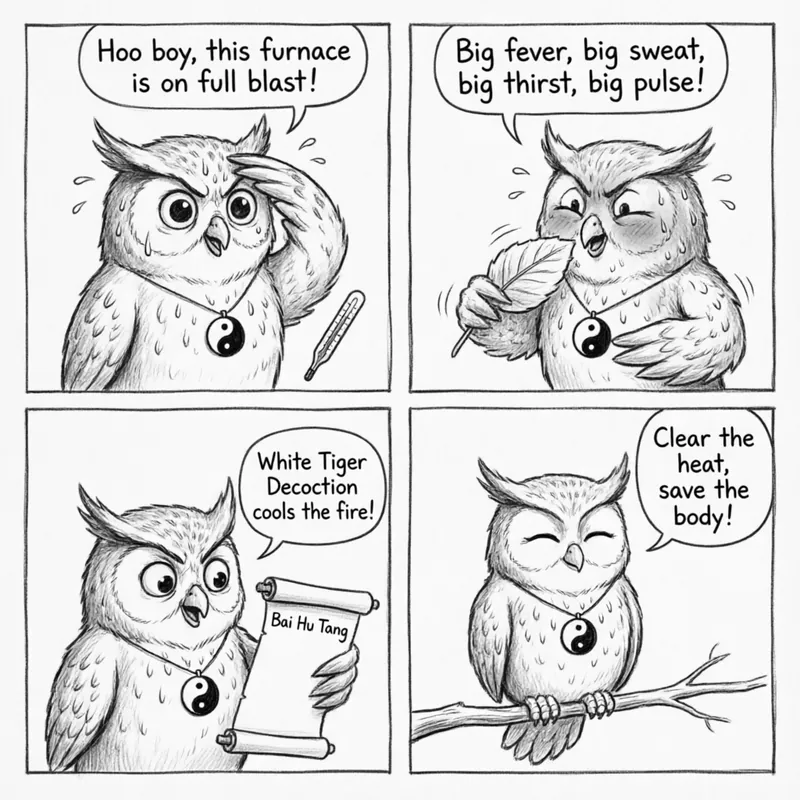
Hoo boy, when your inner furnace hits Yangming levels, even a screech owl needs to find some shade. I'm perched up here on a stack of books, fanning myself with a ginkgo leaf, and my little yin-yang pendant feels hot to the touch! My ear tufts are practically steaming. It's a powerful fight, but you gotta have the right plan to cool things down before you burn through all your fuel!
Bai Hu Tang: Nature's Fire Extinguisher
So, you have a five-alarm fire raging inside. What do you do? Zhang Zhongjing’s answer was clear, direct, and brilliant: *Bai Hu Tang*, the White Tiger Decoction. This formula is one of the most famous in the entire Chinese herbal pharmacopeia, and it’s a masterclass in treating acute heat conditions. It isn’t a gentle nudge; it’s decisive, powerful intervention. Let's look at the team: * Shi Gao (Gypsum Fibrosum): This is the undisputed hero of the formula. Shi Gao, or gypsum, is a mineral. It is intensely cold in nature and heavy. Its job is to plummet into the center of the fire and extinguish it directly. Think of it less like an herb and more like a block of celestial ice dropped into a volcano. It quells the fire at its source. * Zhi Mu (Anemarrhenae Rhizoma): Shi Gao's essential partner. Zhi Mu, or anemarrhena rhizome, is also very good at clearing heat, but it has a second, vital job: it replenishes fluids. While Shi Gao puts out the fire, Zhi Mu comes in right behind it, rehydrating the scorched earth and restoring the Yin that was burned away. * Zhi Gan Cao (Honey-fried Licorice Root): The diplomat. This herb harmonizes the actions of the other ingredients and, most importantly, protects the Stomach. Pouring that much cold energy into the body can be a shock to the digestive system. Gan Cao acts as a buffer, ensuring the fire-fighting effort doesn't damage the house. * Jing Mi (Oryzae Sativae Semen): This is simply non-glutinous rice. It might seem like a humble filler, but its role is vital. The rice further protects the stomach and helps generate new fluids, supporting Zhi Mu’s work. It’s a perfect example of how in Chinese medicine, even the simplest ingredient has a strategic purpose. Together, this team doesn't just mask the fever; it resolves the underlying pathology—the blazing Heat—while simultaneously protecting and restoring the body.Where Two Medical Systems Agree on the Same Fire
A person with a 40°C fever, sweating profusely, and showing signs of dehydration is a clear medical emergency in any system, East or West. This is one of those rare areas where the observation is identical. Both a TCM practitioner and an ER doctor would recognize the severity of the situation instantly. The difference lies in the approach. * Western Medicine typically uses antipyretics like acetaminophen or ibuprofen. These drugs work by telling the brain's thermostat (the hypothalamus) to turn down the heat. It’s effective at lowering the number on the thermometer. For dehydration, IV fluids are used to quickly rehydrate the system. * Traditional Chinese Medicine, using a formula like Bai Hu Tang, takes a different angle. It doesn’t just trick the thermostat. It clears the actual pathogenic factor—the "Heat"—that’s causing the thermostat to go haywire in the first place. By clearing the Heat and replenishing the body's own cooling fluids (Yin), it addresses the root cause and the resulting damage simultaneously. It's two different philosophies for the same problem: one focuses on controlling the symptom, the other on resolving the state that's creating the symptom.When Things Go Wrong: Yangming Channel vs. Organ Pattern
Correctly identifying the Yangming stage is critical, because getting it wrong can make things much worse. If you misdiagnose this blazing fire as a lingering chill from the Taiyang stage and use warming, sweat-inducing herbs, you’d be throwing gasoline on a fire. Even within the Yangming stage, there’s a vital distinction to be made: 1. Yangming Channel Pattern: This is the "Four Bigs" we've been discussing. The heat is raging throughout the body's channels and systems. The treatment principle is to clear the heat with cold herbs, and Bai Hu Tang is the go-to formula. 2. Yangming Organ (Fu) Pattern: This is what happens when the intense heat moves deeper and combines with food and waste in the Large Intestine. The heat bakes the stool, leading to severe constipation. The "Four Bigs" are still present, but now they're joined by abdominal fullness, hardness, and pain that gets worse with pressure. In severe cases, this can even lead to delirium. The *Huangdi Neijing Suwen* notes in Chapter 31, "When heat disease is in the yang brightness [Yangming], the person's body is hot, the eyes hurt, the nose is dry, and they cannot lie down." This inability to rest comfortably is a hallmark of the internal pressure and distress. For this Organ pattern, Bai Hu Tang isn't enough. The heat is trapped and needs to be purged downwards. This calls for a different class of formulas, the *Cheng Qi Tangs* (Order the Qi Decoctions), which use purgative herbs like Da Huang (Rhubarb Root) to flush the heat-bound stool out of the body. Using a purgative on a Channel pattern patient would be harmful, while just clearing heat for an Organ pattern patient would be ineffective. This is why the diagnostic precision of TCM is so essential.Your Takeaway
The Yangming stage represents the body’s most dramatic and powerful response to an invading pathogen. It’s a sign of a strong constitution mounting an incredible defense. But this internal inferno can quickly exhaust the body's resources if it isn't managed correctly. Zhang Zhongjing's map shows us how to support the body in this fight—not by simply suppressing the fever, but by extinguishing the fire and replenishing what was lost. Your actionable takeaway: A high fever with profuse sweating and intense thirst is a clear signal that your body is in a serious battle. Never guess. This is not the time for a home remedy you read about online. It’s a time to seek immediate guidance from a qualified practitioner who can read the signs and determine if you need a "White Tiger" to cool the fire or a different strategy altogether. ---FAQ
Is a Yangming-stage fever dangerous?
Can I just take Tylenol for a Yangming fever and drink a lot of water?
What's the difference between Yangming constipation and regular constipation?
Sources
- Zhang, Zhongjing. Discussion of Cold Damage (Shang Han Lun).
- Huangdi Neijing Suwen.
- Bensky, D., Clavey, S., & Stöger, E. (2015). Chinese Herbal Medicine: Materia Medica (3rd ed.). Eastland Press.
- Maciocia, G. (2015). The Foundations of Chinese Medicine (3rd ed.). Elsevier.
— Ollie
Enjoyed this?
Subscribe via RSS — new articles delivered to your feed reader.
Have a question? Reply by email — good questions become future articles.