
When Your Body Is Stuck Between Two Fires
You feel hot. Then you feel cold. Then you're hot again. Your mouth tastes like you've been chewing on a copper penny, and your throat is uncomfortably dry. You have zero appetite, and there's a weird, stuffy fullness along your sides, right under your ribs. What on earth is going on?
If you've been following our trek through the Shang Han Lun, Ollie and I have walked you through the initial Wind-Cold invasion at the surface (Tai Yang) and what happens when heat gets trapped deep inside the body (Yang Ming). But what happens when the pathogen gets stuck somewhere in the middle? Welcome to the strange, frustrating world of the Shao Yang stage.
The Great In-Between: Caught at the Hinge
Imagine your body is a house. The Tai Yang stage is like a burglar rattling the front door and windows — the problem is still on the exterior. The Yang Ming stage is when the burglar is inside, throwing a wild party in the living room — the problem is fully interior.
The Shao Yang stage is different. It's like the burglar is stuck in the doorway, half in and half out. He can't get all the way in, but he can't be pushed all the way out, either. This "half-exterior, half-interior" state is the defining feature of Shao Yang.
In Chinese medicine, we call this the "hinge" of the body. The Shao Yang channels, primarily the Gallbladder and the San Jiao (or Triple Burner), govern this key space. When a pathogen gets lodged here, it disrupts the body's ability to smoothly transition between inside and out, up and down, hot and cold.
This isn't a failure of your body's defenses. In fact, it's a sign of a pretty decent fight! Your righteous Qi (your body's protective energy) was strong enough to keep the invader from going straight to the core, but the pathogen was stubborn enough to get past the outer gate. Now, they're locked in a stalemate in the middle ground.
 Ollie's Take
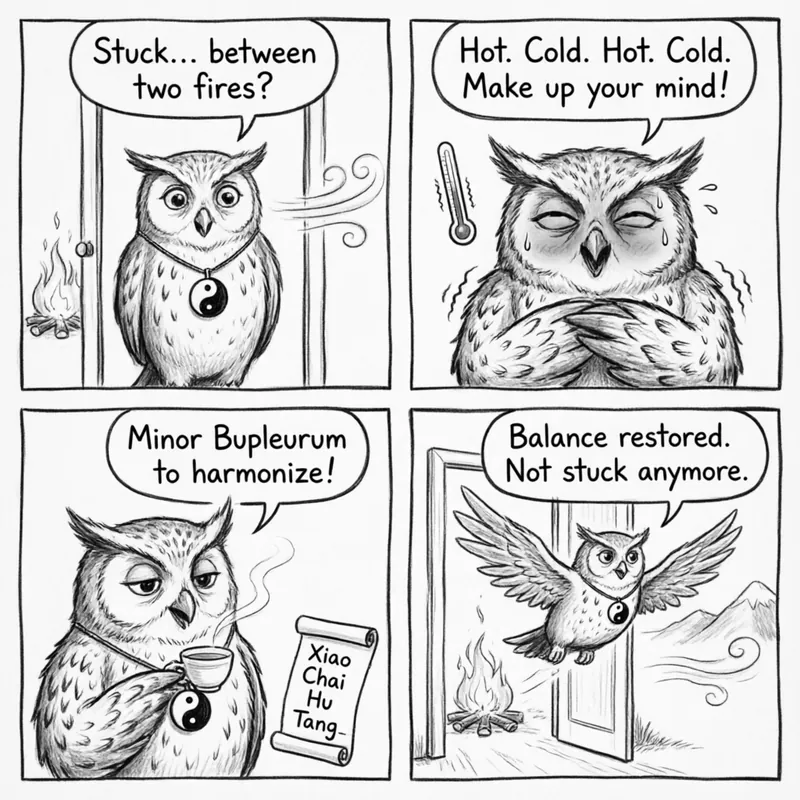
The Chills and Fever Rollercoaster
The most classic, tell-tale sign of a Shao Yang pattern is alternating chills and fever (寒热往来, han re wang lai). This isn't just feeling a little warm and then a little cool. This is a distinct, cyclical pattern of shivering chills followed by a pronounced, feverish heat, back and forth.
Why does this happen? Think of it as a tug-of-war. When your body's righteous Qi surges forward to fight the pathogen at this hinge, you feel hot and feverish. This is your immune system on high alert, creating heat as it battles.
But when the pathogen pushes back and your Qi retreats for a moment to regroup, you suddenly feel a bone-chilling cold. The front line of the battle has momentarily shifted, and your body's warming functions are disrupted. This back-and-forth wrestling match is what creates that signature roller-coaster feeling.
It's a frustrating experience, but it gives your practitioner a huge clue. This specific pattern tells us exactly where the fight is happening — not on the surface, and not deep in the interior, but right at the Shao Yang hinge.
The Telltale Signs: Bitter Taste, Dry Throat, and More
Beyond the alternating chills and fever, the Shao Yang stage comes with a very specific cluster of symptoms. Zhang Zhongjing, the author of the Shang Han Lun, pointed to a triad of signs: a bitter taste in the mouth (口苦, kou ku), a dry throat (咽干, yan gan), and dizziness or blurred vision.
Let's break that down. The Gallbladder channel is a key player in the Shao Yang. In Chinese medicine, the Gallbladder is not just about storing bile; it's associated with courage, decision-making, and the smooth flow of Qi. When its function is impaired by a pathogen, heat can build up in the channel, rising upward.
This upward-flaring "Gallbladder Fire" is what gives you that unmistakable bitter, metallic taste in your mouth. It's also what dries out the throat and can cause dizziness, vertigo, or even blurry vision as the heat affects the head and eyes.
You'll also likely experience a constellation of other symptoms. A feeling of fullness, pressure, or discomfort in the chest and rib-side area (胸胁苦满, xiong xie ku man) is common, as this is the physical location of the Gallbladder and Liver channels. You might feel irritable, moody, and just "stuck." Nausea, vomiting, and a complete lack of appetite are also classic signs, as the stuck Qi disrupts the digestive system's normal downward motion.
The Harmonizing Hero: Xiao Chai Hu Tang
So, what do you do when you're stuck between two fires? You don't want to use strong herbs that push outward (like for a Tai Yang cold), because that might leave the gate open for the pathogen to get in deeper. But you also don't want to use strong, cold herbs to attack heat on the inside (like for Yang Ming), because the pathogen isn't fully interior yet, and you could damage your body's own Qi.
This is where the genius of Zhang Zhongjing truly shines. He created a strategy called "harmonizing" (和解, he jie). The goal isn't to attack or to purge, but to gently restore balance and escort the troublemaker out the door.
The quintessential harmonizing formula is Xiao Chai Hu Tang (小柴胡汤), the Minor Bupleurum Decoction. It's a masterful seven-ingredient formula that works like a perfectly coordinated team.
The Leaders of the Pack: The chief herb is Chai Hu (Bupleurum root). Chai Hu is the star player here. It has a unique ability to vent pathogens from this half-in, half-out space, opening the door and showing the burglar the way out. It's paired with Huang Qin (Scutellaria root), a bitter and cold herb that clears the heat (the fever, bitter taste, and irritability) that has already started to build up on the interior side of the hinge.
The Support Crew: A battle takes energy. To ensure your body's core strength isn't depleted, the formula includes a powerful trio to protect your digestive system (your "Middle Burner"). Ren Shen (Ginseng), Da Zao (Jujube fruit), and Zhi Gan Cao (honey-fried Licorice root) work together to bolster your Qi, soothe your stomach, and keep your energy levels from bottoming out.
The Rebellious Qi Tamers: Finally, what about that nausea and lack of appetite? That's caused by "rebellious" stomach Qi that's going up instead of down. Ban Xia (Pinellia rhizome) and Sheng Jiang (fresh Ginger) are a classic pair that redirects this rebellious Qi, quelling nausea and warming the stomach to restore your appetite.
Together, this team doesn't just bulldoze the problem. It soothes, redirects, supports, and gently re-establishes the body's natural rhythm. It's one of the most elegant and widely used strategies in the entire Chinese herbal canon.
Shao Yang in the Modern World
You might be thinking, "This is interesting, but I don't get alternating chills and fevers." But the Shao Yang pattern is much more common than you'd think, often presenting in more subtle, chronic forms.
You've probably known someone with IBS whose digestion flip-flops between constipation and diarrhea. That's a Shao Yang-like pattern of the body being "stuck" between two extremes.
Post-viral fatigue is another example: you feel fine one day and completely wiped out the next, with a low-grade fever that comes and goes. That has Shao Yang fingerprints all over it. The initial virus was the pathogen, and now it's lingering in that half-in, half-out space, causing a chronic tug-of-war.
Even some forms of premenstrual syndrome (PMS) or cyclic mood disorders can be seen through a Shao Yang lens. The irritability, breast tenderness (along the Gallbladder/Liver channels), and fluctuating energy levels reflect that "stuckness" and disruption of the body's natural rhythm.
The beauty of this framework is that it gives us a way to understand and address these seemingly random, fluctuating conditions. It's not just "in your head"; it's a physiological pattern of imbalance that can be harmonized and resolved.
Hoo boy, does this sound familiar! Sometimes I get stuck on a fence post, not quite in the woods and not quite in the open field. My red ear tufts get all twitchy. I just have to adjust my grandmother's yin-yang pendant, take a deep breath, and wait for the right moment to fly. You can't just force your way out of "stuck."
— Ollie
The lesson of the Shao Yang stage runs deep. Sometimes, the best way to solve a problem isn't with brute force, but with gentle, intelligent redirection. Recognize when you're caught in the middle and choose a strategy that doesn't escalate the fight but instead restores harmony.
So if you're ever feeling hot then cold, irritable, and just plain "off," remember the Shao Yang stage. Your body isn't broken; it's just stuck at a very specific and important crossroads. And as Zhang Zhongjing showed us nearly two thousand years ago, there's a clear path back to balance.
Your key takeaway: When your body sends mixed signals like alternating chills and fever, don't just try to suppress one symptom. Listen to the rhythm. It's telling you exactly where the problem is, and that a "harmonizing" approach, not an aggressive one, is what's needed to get unstuck.
FAQ
Can I get a Shao Yang pattern from a regular cold?
Absolutely. A Shao Yang pattern often develops when a common cold (a Tai Yang invasion) isn't resolved properly. If the pathogen isn't fully expelled from the surface, but your body is strong enough to keep it from going deep into the interior, it can get lodged in this "half-way" stage. This can also happen if you take the wrong medicine that pushes the pathogen inward.
Is Xiao Chai Hu Tang the only formula for this stage?
Xiao Chai Hu Tang is the foundational formula for the classic Shao Yang pattern. However, a skilled practitioner will always modify it based on your specific presentation. For example, if there is more internal heat, they might increase the dose of Huang Qin. If there's more digestive upset, they might add other herbs to support the stomach. It's a flexible template, not a one-size-fits-all pill.
Why is it called the "Minor" Bupleurum Decoction? Is there a "Major" one?
Yes, there is! It's called Da Chai Hu Tang (Major Bupleurum Decoction). The "major" formula is used for a more complex pattern where you have a Shao Yang condition happening at the same time as a Yang Ming interior heat condition (like constipation and abdominal fullness). It's a stronger formula designed to tackle both problems at once.
Sources
- Zhang, Zhongjing. Shang Han Lun (Discussion of Cold Damage). c. 200 CE. Specifically, the sections detailing "Shao Yang Disease."
- Mitchell, Craig, Feng, Ye, & Wiseman, Nigel. Shang Han Lun: On Cold Damage, Translation & Commentaries. Paradigm Publications, 2004.
- Guo, zhi-qian. Warm Disease Theory (Wen Bing Xue). Shanghai University of Traditional Chinese Medicine, 2002.
Enjoyed this?
Subscribe via RSS — new articles delivered to your feed reader.
Have a question? Reply by email — good questions become future articles.