
How a Cold Becomes Cancer (Over Years)
You had a cold. A run-of-the-mill, annoying head cold with a low fever, a scratchy throat, and a stiff neck. So you did what we all do. You reached for that bottle of brightly colored pills that promised to knock it out fast.
And it worked. The fever broke, the headache faded, and you muscled through your week. But a few weeks later, you still felt… off. A little tired, a little irritable, with a weird, lingering cough. You never felt like you truly recovered.
What if taking that pill and "getting better" was actually the first step on a long, winding road—a road that, over decades of repeating that same pattern, can lead to the most serious diseases we face? The "cure" may actually just push the problem deeper inside.
This isn't a scare tactic. It's the core teaching of one of the most important medical texts ever written: the Shanghan Lun. It describes a six-stage progression of disease, and understanding it is the key to real, lasting health. This is the missing piece that explains everything.
 Ollie, perched on his favorite branch, adjusts his jade pendant and squints at the six walls diagram. "You humans keep patching the roof while the foundation is flooding," he mutters, ear tufts drooping. "Let me show you where the water actually comes in."
 Ollie's Take
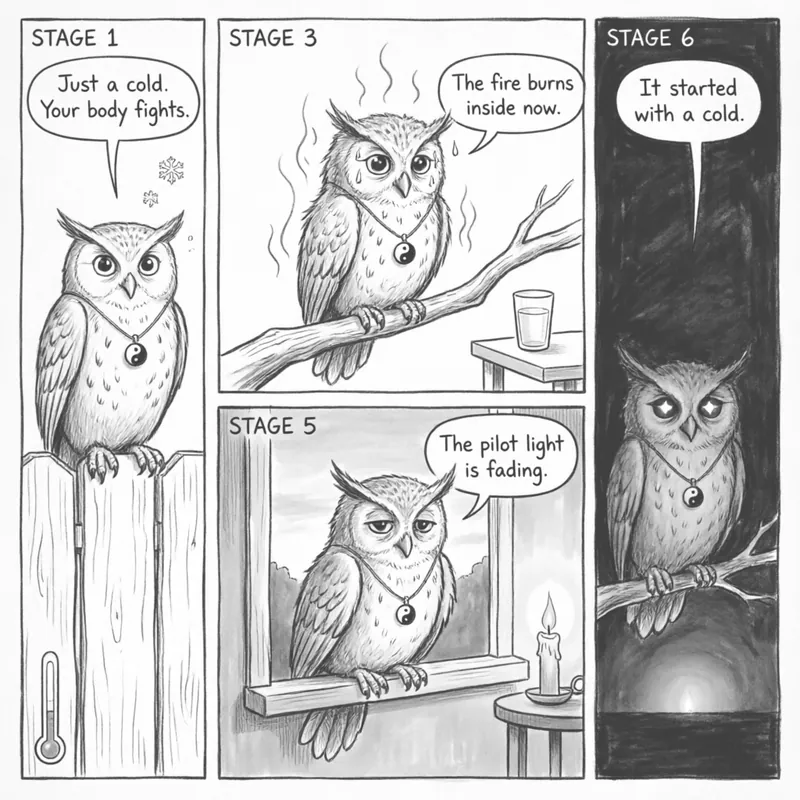
Your Body is a Castle With Six Walls
Think of your body as a magnificent castle. It has six concentric walls of defense, starting with the outer perimeter and moving all the way to the royal chambers at the very center. When an invader—like a cold virus—attacks, it first meets the outermost wall.
These six walls are the Six Stages of the Shanghan Lun: Taiyang, Shaoyang, Yangming, Taiyin, Shaoyin, and Jueyin. Your body's brilliant defense system is designed to fight the invader at each wall, pushing it back out.
But when we use the wrong treatments—specifically, treatments that suppress symptoms instead of supporting the body's fight—we don't defeat the invader. We just give it a key to the next gate. We invite it deeper into the castle, where it can do far more damage.
Let's walk through the gates, one by one, and see how a simple cold, mishandled repeatedly over a lifetime, can march its way to the deepest level of your system.
Stage 1: Taiyang (The Outer Wall)
This is your classic cold or flu. The invader has just breached the outer defenses—your skin and pores. Your body mounts an immediate, intelligent response.
The Symptoms: You feel chills and a low-grade fever. Your neck and upper back are stiff and achy. You might have a slight headache and a runny nose. That fever isn't the sickness; it's your body's primary weapon, raising its core temperature to cook the pathogen.
The Wrong Move: Taking a fever reducer like Tylenol or Advil. This is like telling your frontline soldiers to lay down their weapons and open the gates. The fever vanishes, but the pathogen wasn't defeated. It was simply allowed to sneak past the first wall, deeper into your territory.
The Right Move: The classic formula for this stage is Guizhi Tang (Cinnamon Twig Decoction). It doesn't suppress the fever; it works with it. It gently warms you, promotes a light sweat, and helps your body's own army (your Qi) physically push the pathogen out through the surface. The battle is won, not just postponed.
Stage 2: Shaoyang (The Courtyard)
The pathogen has slipped past the outer wall and is now in the "courtyard" between the exterior and the true interior of the body. It's half-in, half-out.
The Symptoms: This is a frustrating, confusing stage. You have alternating chills and fever—one minute you're bundling up, the next you're throwing the blankets off. You have a bitter taste in your mouth, low appetite, nausea, and maybe some rib-side tenderness. You don't feel acutely sick, just miserable and "stuck."
The Wrong Move: More suppressants, or maybe a round of antibiotics from a doctor who isn't sure what's wrong. These interventions further confuse the body's defenses, locking the pathogen into this halfway zone. This is how chronic, low-grade inflammatory conditions can begin.
The Right Move: The formula for this is the masterful Xiao Chai Hu Tang (Small Bupleurum Decoction), designed specifically for this half-exterior, half-interior state. It's a masterpiece of "harmonizing." It doesn't attack aggressively. Instead, it acts like a skilled diplomat, resolving the conflict in the middle and gently escorting the lingering pathogen out. It clears the path so your body can finish the job.
Stage 3: Yangming (The Barracks)
If the pathogen isn't resolved at the Shaoyang stage, it can be driven fully into the interior, where it transforms into pure, raging heat. This is the Yangming stage, a full-blown internal war.
The Symptoms: This is an honest, powerful fight. The body is throwing everything it has at the invader. The signs are known as the "Four Bigs": big fever (with no chills), big sweat, big thirst, and a big, bounding pulse. Often, there's constipation, too. The body is using immense heat to incinerate the enemy.
The Wrong Move: Suppressing the fever. At this stage, that's like pouring water on your own army's cannons. You're robbing your body of its most powerful tool right when it needs it most. The heat has nowhere to go and starts to burn up the body's precious fluids (the Yin).
The Right Move: Here, we need to bring in the fire department. The formula is Bai Hu Tang (White Tiger Decoction). It's intensely cooling, made with herbs like Shi Gao (Gypsum) that powerfully clear heat from the interior while replenishing the fluids lost to the fire. It helps the body win the war without burning down the castle in the process.
Stage 4: Taiyin (The Kitchens & Pantry)
After the raging fire of Yangming, if the body's resources (its Yang Qi) are depleted, the disease can flip into a cold, damp state. The invader has now attacked the digestive system—the Spleen and Stomach, which are the body's kitchens and pantry.
The Symptoms: The fire is out, and the core is cold. This looks like a complete digestive collapse: abdominal fullness, vomiting, chronic diarrhea with undigested food, no appetite, and deep fatigue. The body can't transform food into energy anymore; its supply lines have been cut.
The Wrong Move: Using over-the-counter anti-diarrhea medication. This is a disaster. It stops the symptom but traps the pathogenic cold and dampness deep within the digestive tract, setting the stage for chronic issues like IBS, Crohn's, and SIBO down the line.
The Right Move: We need to restart the pilot light. The formula is Li Zhong Wan (Regulate the Middle Pill). It's made of warming, drying herbs like dried Ginger and Ginseng that gently warm the digestive organs, expel the cold, and restore their function. It rebuilds the body's ability to create Qi and Blood from food.
Stage 5: Shaoyin (The Royal Chambers)
This is a critical, life-threatening stage. The cold has penetrated past the digestive system and is now threatening the very root of life: the Kidney and Heart systems. The body's core fire, its constitutional Yang, is flickering and about to go out.
The Symptoms: The king is dying. There is deep coldness that can't be warmed. The person is listless, weak, and wants to do nothing but sleep, curled up in a ball. The pulse is faint and thready. There may be clear, watery diarrhea. This is a state of systemic collapse.
The Wrong Move: Any kind of cooling therapy. Giving cold foods, raw juices, or cooling herbs here is like pouring a bucket of ice water on the last glowing ember of a campfire. It can be the final push that extinguishes the life-fire completely.
The Right Move: This calls for an emergency intervention to rescue the Yang. The formula is Si Ni Tang (Frigid Extremities Decoction), a powerful combination of herbs including prepared Aconite (Fu Zi). WARNING: Fu Zi is extremely toxic if unprepared and can be fatal. This formula requires expert preparation and supervision — never attempt to self-prescribe. It's like throwing a massive, resin-soaked log onto the dying fire, creating a powerful burst of heat to reignite the core Yang and pull the system back from the brink.
Stage 6: Jueyin (The Dungeon)
We've arrived at the final stage. The innermost sanctum. Jueyin is not a simple hot or cold pattern; it's a state of total chaos where Yin and Yang are beginning to separate. This is the terminal stage, and it is the environment that the great modern TCM master Dr. Ni Haisha famously stated is the root of cancer.
The Symptoms: A bizarre mix of extreme heat above and extreme cold below. The person might have intense thirst, a feeling of energy rushing up to the chest and head, vomiting, and mouth sores (heat above). At the same time, they have icy cold limbs and chronic diarrhea (cold below). The body's regulatory systems have completely broken down.
This "cold stagnation" in the lower body, where Qi and Blood cannot circulate, creates a swampy, de-oxygenated, and dysfunctional environment. It is in this cold, dark, stagnant dungeon that abnormal cells can begin to grow unchecked. Unlike Shaoyin collapse (pure exhaustion with consistent cold signs throughout) or Yangming heat patterns (consistent heat without the cold lower body), Jueyin specifically presents this chaotic split where burning thirst and mouth sores appear alongside icy limbs and watery diarrhea. The false heat flaring upwards is the last of the body's Yang Qi trying to escape a dying system.
The Wrong Move: Focusing only on the heat symptoms. Giving cooling herbs for the mouth sores or thirst will only worsen the deep, underlying cold, accelerating the fatal separation of Yin and Yang.
The Right Move: This requires a uniquely complex strategy. The representative formula is Wu Mei Wan (Mume Pill). It contains a strange mix of hot, cold, sour, and bitter herbs. It simultaneously warms the deep cold, clears the false heat above, pacifies internal "wind" (the chaos), and strongly pulls the energy back down to its root. It's a last-ditch effort to restore order to a system in complete disarray.
The Road Back: A Pattern of Suppression
Do you see the pattern? At every single stage, the "easy" way out—suppressing the symptom—was the wrong move. It offered temporary relief at the cost of pushing the problem deeper, allowing it to mutate into something far more serious.
A simple cold became a lingering cough, which became digestive trouble, which became deep fatigue, which ultimately created the cold, stagnant internal environment where the worst diseases thrive. The price for short-term convenience compounds over time, with devastating interest.
What You Can Do: Prevention is the Best Medicine
This progression doesn't happen overnight. It happens over years and decades of repeatedly making the same mistakes. But the good news is that you can break the cycle, starting today.
- Stop Fearing a Low-Grade Fever. A fever below 38.9°C in an adult is generally not dangerous. It's your body's best defense. Instead of crushing it, support it.
- Rest. Actually Rest. When you feel a cold coming on, cancel your plans. Your body needs all its energy to fight the battle at the outer gate. Pushing through is a form of suppression.
- Use Warmth and Hydration. Drink hot ginger tea, sip warm bone broth, and take a hot bath with Epsom salts. Help your body generate the sweat it needs to expel the pathogen.
- Consult a Practitioner Early. The best time to see a licensed acupuncturist or herbalist is at the very first sign of a cold. A simple, correct herbal formula at the Taiyang stage can resolve the issue in a day or two, preventing the entire cascade.
The most important takeaway from this entire series is this: Your body is not stupid. It knows how to heal. Our job is not to force it or override it, but to listen to its signals and give it the support it needs to win.
Ollie Speaks
*Ollie shifts on his perch, one talon absently gripping his jade pendant* After all this talk of castles and battles, it's pretty simple, isn't it? When you get a cold, your body is trying to kick an intruder out the front door. All those over-the-counter drugs? They just lock the front door and tell you to ignore the banging. But the intruder is still inside, looking for another way out... or another room to hide in. My advice? Help your body open that front door wide and give that pesky pathogen a good, strong boot! A little rest and some warm ginger tea go a long way. Trust your own defenses! *ear tufts twitching with conviction*
Frequently Asked Questions (FAQ)
Q: Does this mean every cold I suppress will lead to cancer?
A: Absolutely not. This is a worst-case scenario that illustrates a principle. It describes what can happen over a lifetime of repeated suppression, combined with a weakening constitution. A healthy body is incredibly resilient and can often clean up these messes on its own. The point is to stop making it harder for your body to do its job.
Q: This is fascinating! Can I just buy these formulas online and treat myself?
A: Please, do not do this. These are powerful medicines, not supplements. Correctly diagnosing the specific stage and pattern is a complex skill that requires years of training. Using the wrong formula, like a cooling one for a cold pattern, can make things much worse. Always consult a qualified, licensed TCM practitioner.
Q: I recognize some of these later-stage symptoms in myself. Is it too late?
A: It is never too late to start improving your health. Chinese medicine is all about restoring balance, no matter how far things have strayed. The first step is to find a good practitioner who can accurately assess where you are and create a strategy to help your body begin the long road back to balance and vitality.
Sources
- Zhang, Zhongjing. Shang Han Lun (On Cold Damage). c. 220 AD.
- Ni, Haisha. Classical teachings and lecture series on the Shanghan Lun.
- Scheid, Volker, et al. Formulas and Strategies. 2nd Edition.
Shanghan Lun Six Stages Series Index
- #20: What Zhang Zhongjing Knew
- #09: The Castle Inside You — Your Body's 6-Layer Defense System
- #22: Wind-Cold Is Not A Weather Report (Taiyang)
- #24: When Your Body Is Stuck Between Two Fires (Shaoyang)
- #23: Your Fever Might Be Your Friend (Yangming)
- #25: When the Fire Won't Go Out (Yangming)
- #26: When Food Stops Being Food (Taiyin)
- #27: The Most Dangerous Quiet (Shaoyin)
- #28: Stop Fighting — Start Warming (Shaoyin)
- #29: The Fire Inside You Is Going Out (Shaoyin)
- #30: When the Body Reaches Its Last Line (Jueyin)
- #31: How a Cold Becomes Cancer (Over Years) [You Are Here]