
How Ancient China Survived Summer Without Air Conditioning (And What That Teaches Us Today)
It’s that time of year. Outside, the pavement is shimmering and the thermometer is pushing 36°C. Inside, you’ve got the air conditioner blasting so hard you’re thinking about putting on a sweater. The hum of the machine is the soundtrack to your summer.
The Tang Dynasty, around 800 AD. The summers are just as brutal, if not more so. There’s no electricity, no freon, no remote control to tap. Yet, people are not just surviving—they’re thriving. They’re writing world-renowned poetry, building magnificent cities, and raising families. How on earth did they do it?
 Ollie's Take
They didn't have technology, but they had something else: a sophisticated operating manual for the human body, fine-tuned to the rhythms of nature. They understood that the world outside is mirrored by a climate inside us. And their guide was the 24 Solar Terms.
A small barn owl settles on my desk, jade pendant glinting in the afternoon light. "The ancients knew something we've forgotten," Ollie hoots softly, preening a wing. "They didn't fight the seasons—they danced with them."
Welcome to Minor Heat: Summer's First Warning Shot
Right now, we’re entering the 11th solar term: Minor Heat, or Xiao Shu (小暑). Don’t let the name fool you. The word “minor” isn’t a description; it’s a warning. It means the oppressive, steam-bath heat of Major Heat (Da Shu) is still to come. This is just the opening act.
Ancient observers, with no weather apps to consult, looked to nature for their updates. They divided each solar term into three five-day micro-seasons. For Minor Heat, the signals were clear:
- Warm winds arrive: The breezes are no longer refreshing. They start to feel like you’re opening a hot oven.
- Crickets move indoors: The crickets, seeking refuge from the heat, begin to appear in the cooler corners of homes.
- Young eagles learn to hunt: The intense Yang energy of the season fuels growth and activity, and even young predators feel the push to mature and practice their skills.
Think of it as nature’s bulletin board, posting daily updates on the changing season. For our ancestors, these weren't just quaint observations; they were direct instructions on how to adjust their own lives, diet, and daily rhythm to stay in balance.
🏯 5 Ancient Summer Hacks That Still Work
How people survived 40°C summers without air conditioning — and what still works today. Get the free cheat sheet →
The TCM Lens: Your Body's Internal Climate
So what’s happening inside your body during Minor Heat? According to Traditional Chinese Medicine, summer is a season of explosive Yang energy. Your internal Qi is doing the same thing the grass, trees, and animals are doing: expanding outward and upward.
This creates a few predictable patterns. First, your Yang Qi rushes to the surface of your body. This is why you sweat easily. Your pores are open, releasing heat to keep your core temperature stable. This is your body’s brilliant, built-in air conditioning system.
Second, this outward rush of energy can leave the interior, specifically your digestive system (governed by the Spleen and Stomach), relatively "cool" and deficient. This is why you might lose your appetite in the summer or feel sluggish after a heavy meal. The Spleen, which dislikes dampness, gets overwhelmed by both external humidity and too many iced drinks.
Finally, summer belongs to the Heart, the emperor of the organ systems and the house of our spirit, or Shen. When external heat is blazing, the internal Heart Fire can easily flare up. This doesn't manifest as a fever, but as restlessness, anxiety, insomnia, and a short temper. Ever felt inexplicably irritable on a scorching day? That's Heart Fire talking.
But not all summer discomfort is the same. If you're irritable with a red face and bitter taste, that's excess Heat in the Heart. If you have night sweats and feel hot in your palms and soles, that's Heart Yin deficiency needing nourishment, not just cooling. And if you feel heavy-limbed with poor appetite and nausea, that's Summer-Heat combined with Dampness — a different pattern entirely. TCM doesn't address "summer." It addresses the specific pattern you're manifesting.
The classic medical text, the Huangdi Neijing (Yellow Emperor's Inner Classic), gives us a clear directive for this season: "In the three months of summer, one should go to bed late and rise early, never be tired of the sun, and let the mind be free from anger." In other words, sync up with the long days, welcome the vibrant energy, and don't let the heat make you angry. Flow, not resistance.
Eat Your Air Conditioning
If you can’t turn on the AC, you have to find another way to cool down. For centuries, the primary method was food. But this isn't just eating "cold" foods from the fridge. It's consuming foods with a cooling energetic property, a concept TCM calls "clearing Summer-Heat" (清暑, Qing Shu).
This is different from the Western idea of "staying hydrated." Hydration is about replacing water. Clearing Summer-Heat (清暑) works through specific mechanisms: foods like mung beans promote urination to drain heat downward, watermelon generates fluids while cooling, and bitter foods like bitter melon purge heat through the intestines. This isn't just "cooling off" — it's strategic heat elimination through different pathways.
Here are some of the all-stars from nature’s pharmacy:
- Mung Beans (绿豆, Lu Dou): If there’s one food for a Chinese summer, this is it. Mung bean soup (Lu Dou Tang) is a staple. These little green beans are champions at clearing Heat from the body, resolving toxins, and quenching thirst. They are a gentle but effective way to cool the system from the inside out.
- Watermelon (西瓜, Xi Gua): No surprise here! Watermelon is so effective at clearing summer heat and generating fluids that it was nicknamed "Nature's White Tiger Decoction" in classical texts—a reference to a powerful herbal formula used for high fevers. It’s juicy, refreshing, and cools you down instantly for a reason.
- Bitter Melon (苦瓜, Ku Gua): The flavor is a giveaway. In TCM, bitter flavors have a draining, drying action. Bitter melon excels at draining Heart Fire and resolving Summer-Heat. It might be an acquired taste, but a little bit in a stir-fry or soup can work wonders for that overheated, agitated feeling.
- Lotus Seed (莲子, Lian Zi): While other foods clear Heat, lotus seeds do something more subtle and just as important: they calm the Heart. Remember that flared-up Heart Fire? Lotus seeds nourish the Heart Yin and quiet the Shen (spirit), helping to ease the anxiety and restlessness that come with extreme heat.
By incorporating these foods, you’re not just eating a meal; you’re actively managing your internal thermostat.

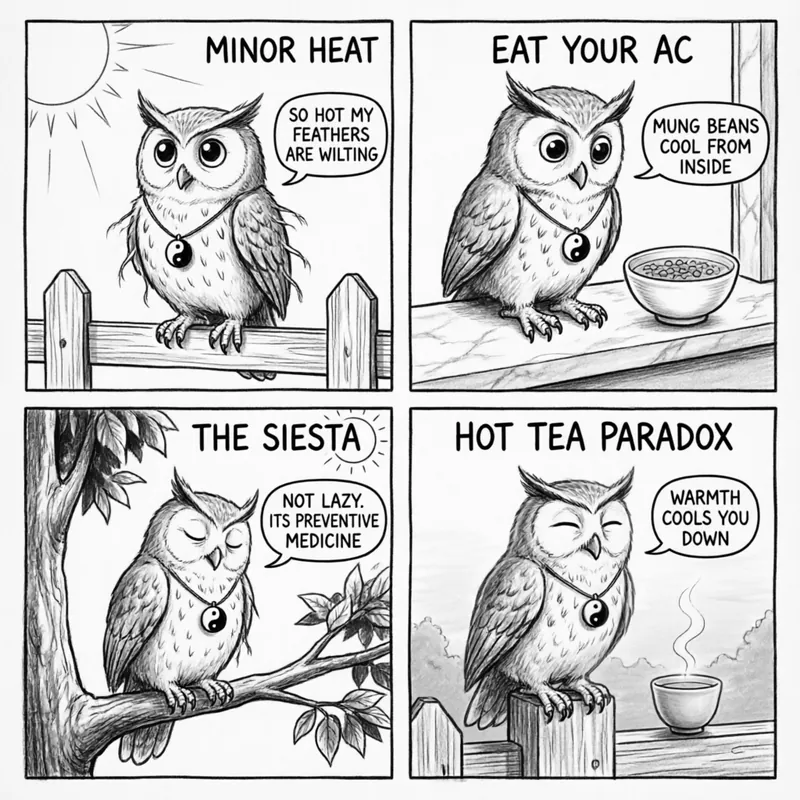
Hoo-hoo!Ollie here. I've found a nice, cool spot on a marble windowsill to watch the humans scurry about. My little jade pendant feels wonderfully cool against my chest feathers. It's a hot one today!
People get so busy in the summer, rushing here and there. But have you ever watched a cat? Or a dog? Or, well, an owl? When the sun is at its highest and hottest, we find shade and we get very, very still. I tuck my head under my wing, letting my jade pendant rest cool against my breast feathers. My ear tufts barely even twitch, and I can feel my heart rate slow to match the lazy afternoon breeze. My talons relax their grip on the marble, and I shift my weight from foot to foot, keeping each one cool in turn. We conserve our energy.
Humans think resting is unproductive. We animals know it’s the most productive thing you can do when the world is blazing. A little midday quiet isn't laziness; it’s wisdom. Now, if you’ll excuse me, this sunbeam is getting a little too close. Time for a pre-dusk nap. Hoo!— Ollie
The Hot Tea Paradox: Fighting Fire with… Warmth?
This is where things get counterintuitive. On a sweltering day, what’s your first instinct? To grab an ice-cold soda or a frosty beer, right? I learned this lesson the hard way myself.
Years ago, during a particularly brutal heatwave, I spent a week chugging ice water and smoothies. I thought I was being smart. But instead of feeling refreshed, I felt bloated, sluggish, and even more tired. My digestion came to a grinding halt. What was going on?
A TCM practitioner friend laughed and handed me a cup of hot chrysanthemum tea. I thought she was crazy. But I drank it, and within minutes, I felt a gentle wave of perspiration break out across my skin. Suddenly, I felt lighter and genuinely cooler.
Here’s the logic: Your digestive system is like a furnace. When you dump a bucket of ice water into it, the furnace has to work overtime to heat that liquid up to body temperature, consuming precious Qi in the process. This sudden cold shock also causes the blood vessels in your stomach to contract, trapping heat inside your core and hindering digestion.
Sipping a warm or hot beverage, however, does the opposite. It gently raises your core temperature just enough to signal your body to open the pores and sweat more efficiently. Sweating is your body's primary cooling mechanism. A warm drink works *with* your body’s natural process, helping it release heat instead of trapping it. It’s a beautiful paradox: a little warmth on the inside creates coolness on the outside.
The Midday Siesta: Not Laziness, but Strategy
In many cultures across the world’s hot climates, the afternoon nap is a sacred ritual. This isn’t a sign of laziness; it’s a brilliant piece of preventative medicine, perfectly aligned with the body’s clock in TCM.
The hours between 11 a.m. and 1 p.m. are the time of the Heart meridian. This is when the Heart’s Qi is at its peak, and it’s also, not coincidentally, the hottest part of the day. Pushing yourself with intense work or exercise during this window is like adding fuel to a potential fire. You’re asking the Emperor (the Heart) to run a marathon in the middle of a heatwave.
A short rest—even just 15 to 20 minutes of quiet time with your eyes closed—is incredibly restorative. It gives the Heart a chance to recharge, calms the Shen, and helps to prevent that Heart Fire from flaring up later in the day. It helps you digest your lunch properly and gives you a stable reserve of energy for the rest of the afternoon, rather than relying on a caffeine-fueled second wind.
So the next time you feel that post-lunch slump on a hot day, don’t fight it. See it as a signal from your body. Find a quiet corner and take a brief rest. You’re not wasting time; you’re investing in your well-being.
The wisdom of the 24 Solar Terms is not about predicting the weather. It’s a complete operating manual for the human body, reminding us every 15 days to pause, observe, and adjust. In our modern world of climate-controlled boxes, we’ve forgotten how to read the signals from nature and from our own bodies.
We’ve outsourced our comfort to a machine. But true, lasting balance comes from within. The teachings of Minor Heat remind us that we have a powerful, innate ability to adapt and thrive, no matter how high the thermometer climbs.
Your takeaway this week: Try making one small change. Swap just one of your icy drinks for a cup of warm mint or chrysanthemum tea. Or, carve out 15 minutes for a quiet rest after lunch. Don’t just do it; pay attention to how your body feels afterward. You might be surprised at the results.
Your Minor Heat Action Plan
- Swap one icy drink today: Replace your afternoon iced coffee with warm chrysanthemum or mint tea. Notice how your body responds over the next hour.
- Schedule a mini-siesta: Set a 15-minute timer after lunch tomorrow. Find a quiet spot, close your eyes, and let your Heart meridian recharge during its peak hours (11am-1pm).
- Cook with cooling foods: This week, try making mung bean soup or adding bitter melon to a stir-fry. Start with small amounts to let your palate adjust.
- Observe nature's signals: Step outside in the early morning. Can you feel the warm winds? Hear the crickets? These aren't just weather reports—they're your body's seasonal guidebook.
FAQ
Is it really that bad to drink cold water in the summer?
From a TCM perspective, while an occasional cold drink isn't a disaster, making it a habit can be detrimental. Icy drinks shock the digestive system (the Spleen and Stomach), forcing it to expend extra energy (Qi) to warm the liquid. This can lead to weakened digestion, feelings of bloating, and paradoxically, trapping heat within the body's core. Warm or room-temperature drinks support the digestive process and encourage sweating, the body's natural cooling mechanism.
What are some other "cooling" foods I can try?
Besides the ones mentioned, many other foods have a cooling energetic property. Try adding cucumber, celery, mint, lettuce, and fruits like pears and strawberries to your diet. Tofu is also considered cooling and is a great source of protein for summer meals. The key is to focus on foods that are hydrating and don't feel "heavy" in your stomach.
Why is the Heart so important in summer according to TCM?
In the Five Element theory of TCM, each season is associated with an organ system. Summer belongs to the Fire element, and its corresponding organ is the Heart. The Heart is responsible for circulating blood and is considered the "Emperor" of the body, housing the mind and spirit (Shen). The intense heat and vibrant energy of summer can easily over-stimulate the Heart, leading to what's called "Heart Fire," which manifests as anxiety, insomnia, palpitations, and irritability. Therefore, protecting and calming the Heart is a primary health strategy during the summer months.
Sources
- Huangdi Neijing (黄帝内经) - The Yellow Emperor's Inner Canon
- Yueling Qishi'er Hou Jijie (月令七十二候集解) - Collection of the 72 Pentads of the Monthly Commands
- Bencao Gangmu (本草纲目) - Compendium of Materia Medica
Enjoyed this?
Subscribe via RSS — new articles delivered to your feed reader.
Have a question? Reply by email — good questions become future articles.