
Surviving the Hottest Days on Earth: What Ancient China Knew About Major Heat (大暑)
Welcome back to the 24 Solar Terms. I’m here with our resident night-owl, Ollie, who’s looking particularly droopy in this heat — wings folded, eyes half-closed, clearly wondering why humans invented July. We’ve officially arrived at the 12th solar term of the year: 大暑 (Dà Shǔ), or Major Heat.
Running from roughly July 22nd to August 6th, this isn't just any summer heat. This is the main event. It’s the peak of the peak, the time when the sun feels like it’s sitting right on your shoulders. In ancient China, this 15-day period was recognized as the most intense and potentially dangerous time of the year, a fiery crucible that tested the body’s resilience.
But they didn't just endure it; they developed a sophisticated system for navigating it. Forget blasting the AC and chugging ice water. Their approach was far more nuanced, using food, timing, and a deep understanding of the body's energy to not just survive, but stay balanced. Here's what they knew.
The Boat They Sent Out to Sea
Imagine living in a coastal village in China’s Zhejiang province, centuries before air conditioning. The heat of late July is suffocating, the air thick with humidity. Sickness seems to spread more easily, and everyone feels sluggish and irritable. What do you do?
You build a boat.
This was the beautiful tradition of the “Da Shu Boat” (大暑船). Villagers would construct a special ceremonial boat, often elaborate and colorful. They would fill it with offerings—food, symbolic sacrifices, and items representing the afflictions of summer. Then, under the watch of the whole community, the boat would be paraded to the shore, pushed out to sea, and sometimes set ablaze, a fiery offering to the horizon.
Was this just superstition? Not at all. It was a powerful community ritual. Sending the boat out to sea was a way of acknowledging the collective burden of this intense season. It was a symbolic act of “sending away the heat,” a recognition that this was the moment when the body was most vulnerable to what Traditional Chinese Medicine (TCM) calls "Summerheat" and "Dampness." It marked the turning point, the very apex of summer’s power.
The TCM Lens: Your Body at 40 Degrees Celsius
So what exactly is happening inside your body during Major Heat? According to TCM, the environment outside is mirrored by the environment inside. When the world is blazing hot and sticky with humidity, your internal systems feel it, too.
First, we have to talk about the Heart. In the Five Element theory, Summer is the season of the Fire element, and its corresponding organ is the Heart. During Major Heat, the Fire element is at its absolute peak. This sounds powerful, but too much of a good thing can be a problem. An excess of Heart Fire can overheat your entire system.
This isn’t just a metaphor for feeling hot. Excess Heart Fire manifests as anxiety, restlessness, insomnia, and irritability. It’s that feeling of being hot-tempered and quick to anger on a sweltering day. Your mind feels scattered, and you can’t seem to calm down. That’s your Heart in overdrive.
At the same time, the Spleen is under attack. The Spleen in TCM is in charge of transforming the food and drink you consume into Qi and Blood. It likes to be dry and warm. But summer humidity is its worst enemy. This external "Dampness" invades the body and waterlogs the Spleen, making it sluggish and inefficient.
Think of your Spleen as a hard-working kitchen staff. Now picture a flood in the kitchen. Everything slows down. The result? You feel heavy, bloated, and lethargic. Your limbs feel like they’re filled with lead, you might have loose stools, and your mind is foggy. This is what TCM calls "Dampness obstruction."
Finally, all that heat makes you sweat. While sweating is a natural cooling mechanism, excessive sweating is a problem. In TCM, sweat is seen as a precious fluid that has the same source as Blood. More importantly, your Qi—your vital life force—escapes through the pores along with the sweat. This is why a day of heavy sweating leaves you feeling completely wiped out and depleted, not just dehydrated.
Why Ice Water Is Making You Hotter
So, you’re hot, depleted, and foggy. The most intuitive, modern-day reaction is to grab the biggest cup you can find and fill it with ice water. It feels like instant relief. But from a TCM perspective, this is one of the worst things you can do.
Remember our poor, waterlogged Spleen? It’s already struggling to do its job in the humid summer weather. Pouring a glass of ice water into your stomach is like throwing a bucket of ice on a flickering campfire you're trying to coax back to life. The extreme cold shocks the digestive system, further weakening the Spleen’s function and creating even more internal Dampness.
The temporary cooling effect is an illusion. By weakening your digestive fire, you make it harder for your body to process food and fluids, leading to more bloating and fatigue in the long run. It can even trap the heat inside instead of letting it out.
So what’s the alternative? Do what people in hot climates have done for centuries: drink warm or room-temperature liquids. A cup of warm tea might seem crazy on a hot day, but it gently encourages your body to sweat. It's the *evaporation* of that sweat from your skin that provides true, sustainable cooling.
This is the same principle behind why some of the world's spiciest cuisines—think Sichuan, Indian, or Mexican—come from the hottest climates. The capsaicin in chili peppers induces sweating, which is the body’s most effective air conditioning system. As the ancient classic text, the *Huangdi Neijing* (Yellow Emperor's Inner Canon), advises, one should harmonize with the seasons, not fight them. During summer, this means allowing the body's Yang energy to vent outwards.
The Two Foods That Save July
If ice water is out, what’s in? The answer lies in the wisdom of Chinese dietary therapy, which uses food as medicine. For Major Heat, two ingredients stand out as the ultimate summer rescue team: Winter Melon and Coix Seed.
You’ll often find them together in a simple, elegant soup called 冬瓜薏米汤 (dōng guā yì mǐ tāng), or Winter Melon and Coix Seed Soup. This isn’t just a random pairing; it’s a brilliant therapeutic formula.
Winter Melon (冬瓜, dōng guā) is nature’s perfect cooling agent. Despite its name, it's a summer squash. It's considered "cool" in nature, so it excels at clearing Heat from the body. But its real magic is its diuretic property—it helps you flush out all that excess Dampness that’s making you feel heavy and sluggish. It cools you down and lightens you up at the same time.
Coix Seed (薏米, yì mǐ), also known as Job's Tears, is the Spleen's best friend. Its primary function is to strengthen the Spleen and drain Dampness. While winter melon flushes out the water, coix seed goes to the root of the problem by fortifying the organ responsible for water metabolism. Together, they create a powerful synergy that tackles both the symptom (Heat) and the cause (Spleen deficiency leading to Dampness).
🧊 7 Days of Summer Cooling
Want the full plan — what to eat, drink, and do for all of Major Heat? Get the free 7-day guide →
Here is a simple, practical way to make this cooling soup at home:
Simple Winter Melon & Coix Seed Soup
- 450 g winter melon
- 1/2 cup coix seeds (Job's tears), rinsed
- 6-8 cups of water or unsalted chicken/vegetable broth
- A few slices of fresh ginger (optional, to warm the digestion)
- Salt to taste
- A sprinkle of white pepper and chopped scallions for garnish (optional)
Instructions:
- If you can, soak the coix seeds in water for at least an hour (or overnight) to shorten the cooking time. Drain before using.
- Peel the winter melon and remove the seeds. Cut the flesh into 1-inch cubes. You can even leave the skin on, as it has its own cooling properties!
- In a large pot, combine the rinsed coix seeds, winter melon cubes, ginger slices (if using), and water or broth.
- Bring to a boil, then reduce the heat to a simmer. Cover and let it cook for about 45-60 minutes, or until the coix seeds are soft and chewy and the winter melon is tender and translucent.
- Season with a little salt and white pepper. Serve warm, garnished with scallions.
This soup is light, hydrating, and incredibly effective at clearing that heavy, sticky feeling of a hot summer day. It's not meant to be a heavy meal, but rather a therapeutic broth to sip throughout the day.
Bitter Is Your Friend
There's one flavor most of us tend to avoid: bitter. But in TCM, every flavor has a purpose, and during the peak of summer, bitter is your best friend. The bitter flavor corresponds to the Fire element and the Heart. Its action is to drain and dry—it drains Fire and dries Dampness.
When you have that excess Heart Fire making you feel irritable and anxious, bitter foods are the antidote. They have a cooling, descending action that helps clear the heat from the Heart and calm the spirit (the *Shen*).
So, what should you be eating?
- Bitter Gourd (苦瓜, kǔ guā): This is the undisputed king of bitter foods. Its Chinese name literally means "bitter melon." A staple in many Asian cuisines, it’s incredibly effective at clearing summer heat. Try it stir-fried with egg or fermented black beans.
- Chrysanthemum Tea (菊花茶, jú huā chá): This gentle, fragrant floral tea is a classic for a reason. It cools the body, clears heat from the head (great for summer headaches), and brightens the eyes. A cup in the afternoon is a perfect ritual.
- Dandelion Greens: If you can find them at a farmer's market, these peppery greens are fantastic for clearing heat and detoxifying the Liver. Add a handful to your salad.
Leaning into the bitter flavor might feel strange at first, but your body will thank you. It’s a direct and powerful way to soothe the over-excited Heart and restore a sense of calm during the most fiery time of the year.
Ollie, who's been perched quietly through this entire discussion, ruffles his feathers at the mention of bitter gourd. "Humans and their taste preferences," he hoots softly, tilting his head. "You'll drink coffee every morning — one of the bitterest substances on earth — but complain about a little bitter melon in your stir-fry." He has a point. Your tongue already knows bitter. It just needs a new context.
Actionable Tips: Your Major Heat Survival Kit
Feeling overwhelmed? Don’t be. Here’s a simple, scannable guide to help you navigate the next couple of weeks with grace. Our friend Ollie thinks humans tend to overcomplicate things, so he helped us boil it down to the essentials.
What to Eat & Drink:
- Cooling & Dampness-Draining Foods: Winter melon, coix seed, cucumber, celery, lotus root, and watercress.
- Heat-Clearing Fruits: Watermelon and cantaloupe are great, but in moderation. They are very cooling and high in sugar, which can be hard on the Spleen if you overdo it.
- The Mung Bean Solution: Mung bean soup (绿豆汤, lǜ dòu tāng) is an iconic Chinese summer cooler. Mung beans are fantastic at clearing heat and detoxifying. However, a word of caution: they are very "cold" in nature. If you have a weak digestive system (you feel bloated easily or have loose stools), consume mung bean soup sparingly.
- Bitter Foods: A little bit of bitter gourd, a cup of chrysanthemum tea, or some arugula in your salad.
- Hydration: Stick to warm water, herbal teas, or room-temperature coconut water.
What to Avoid:
- Ice-Cold Anything: Ditch the iced drinks, smoothies, and ice cream. They shock your digestive system.
- Greasy, Fried Foods: These are hard to digest and create more Dampness and Heat in the body.
- Excessive Dairy & Sugar: Both contribute to phlegm and dampness, making you feel heavier.
- Heavy Meats: Lamb and beef are very warming. Opt for lighter proteins like fish, chicken, or tofu.
Lifestyle Adjustments:
- Take a Midday Nap: The time between 11 am and 1 pm is "Heart time" in the TCM organ clock. This is when the sun is at its highest and your Heart energy is at its peak. Resting during this window—even for just 15-20 minutes—helps preserve your Heart Qi and prevents burnout.
- Adjust Your Schedule: Follow the sun. Wake early to enjoy the cooler morning air, and stay indoors during the hottest part of the day. Do gentle exercise like walking or stretching in the early morning or evening.
- A Simple Daily Ritual: Brew a cup of chrysanthemum or mint tea around 3 pm, when the afternoon heat often peaks. Take five minutes to sit, sip slowly, and just breathe. This small act can reset your entire nervous system.
“Folks, drinking ice water on a 40-degree day is like throwing a bucket of cold water on a marathon runner right after they cross the finish line." Ollie's ear tufts droop slightly in the heat as he says this. "It's a shock, not a relief. Your internal engine is already working overtime. Give it warm water, let it sweat it out naturally. Why make summer harder than it has to be?”
— Ollie (adjusts his yin-yang pendant, already dreaming of the cooler autumn nights)
Major Heat is a test, there's no doubt about it. But by shifting your perspective from fighting the heat to working with it, you can move through this intense period with more energy and ease. The ultimate takeaway? Listen to your body and honor the season. Don't force it to do what the environment is already telling it not to.
Stay cool, stay balanced, and we'll see you for the next solar term: The Beginning of Autumn (立秋, Lìqiū)!
 Ollie's Take
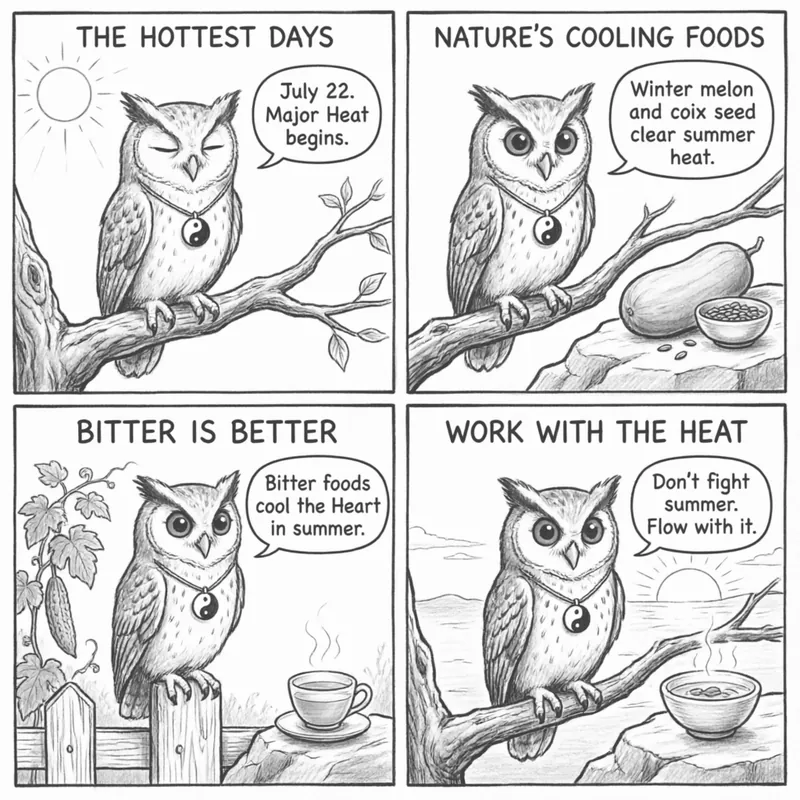
"The thermometer says 40°C, but your Spleen says 'please, no more ice.' Listen to the Spleen. It's been doing this for thousands of years longer than your refrigerator."
FAQ
I really hate bitter foods. Are there other ways to clear Heart Fire?
Absolutely. While bitter is the most direct flavor, you can also use gentle, cooling herbs and foods. Chrysanthemum and mint tea are excellent and much milder in flavor. Foods like celery and cucumber also have a cooling effect. Also, practices like meditation and deep breathing can help calm the mind and soothe the Heart spirit (*Shen*), which also helps to quell Heart Fire.
Is it okay to exercise during Major Heat?
Yes, but with caution and modification. Strenuous, high-intensity exercise during the hottest part of the day (roughly 10 am to 4 pm) is not recommended as it can lead to excessive sweating and depletion of Qi and fluids. Opt for gentle activities like yoga, Tai Chi, swimming, or walking during the cooler hours of the early morning or late evening. The key is to move your body without completely exhausting it.
Why is watermelon only good in moderation? I thought it was the perfect summer fruit.
Watermelon is fantastic for summer because it's incredibly hydrating and effective at clearing heat. However, in TCM, it's also considered very "cold" in nature and high in sugar. For someone with a strong digestive system, this isn't a problem. But if you have a weaker Spleen (prone to bloating, gas, or loose stools), eating too much cold, raw fruit can further dampen your digestive fire, leading to more Dampness. It's about balance—enjoy it, but don't eat a whole one by yourself every day.
Sources
- Liao, Xiang-Jun. Traditional Chinese Medicine for Women: A Guide to the Ancient Wisdom of Female Health and Wellness. Simon & Schuster, 2022.
- Ni, Maoshing. The Yellow Emperor's Classic of Medicine: A New Translation of the Neijing Suwen with Commentary. Shambhala, 1995.
- Lu, Henry C. Chinese Natural Cures: Traditional Methods for Remedy and Prevention. Black Dog & Leventhal, 2005.
Enjoyed this?
Subscribe via RSS — new articles delivered to your feed reader.
Have a question? Reply by email — good questions become future articles.