What TCM Can Learn From Sourdough
I killed my first sourdough starter in three days. It was the spring of 2020, and like half the planet, I was stuck at home with a bag of flour and a world of ambition. I named him "Clint Yeastwood." I fed him, I watched him, I whispered words of encouragement. For a glorious 48 hours, he bubbled with life. And then… nothing. Just a sad, watery, slightly boozy-smelling puddle in a jar.
My second attempt, "Dough-lly Parton," fared better. I learned the rhythm. The importance of warmth, the right kind of water, the precise feeding schedule, and the necessity of the "discard"—getting rid of some of the old to make room for the new. I'd stand at my kitchen counter, stirring the bubbly concoction, and my little screech owl mascot, Ollie, would watch from his perch on the bookshelf, head cocked as if he knew something I didn't.
And he did. One morning, as I was feeding my starter and simultaneously sipping a cold smoothie, it hit me with the force of a perfectly proofed loaf. This living, breathing, fermenting culture in my hands wasn't just a baking project. It was a perfect, tangible metaphor for the one part of my body Traditional Chinese Medicine (TCM) had been trying to get me to understand for years: my Spleen.
The Sourdough Revelation
In the world of sourdough, you don't just "make" bread. You cultivate an ecosystem. A starter is a symbiotic community of wild yeasts and lactobacilli bacteria, working together to break down complex starches in flour into simpler, more digestible components. This process is called fermentation.
The yeasts produce carbon dioxide, which makes the dough rise. The bacteria produce lactic acid, which gives the bread its signature tangy flavor and helps to neutralize phytic acid, making nutrients like magnesium and zinc more available to your body. It's a process of transformation.
In TCM, this exact process has a name: Yun Hua (运化), which translates to "Transformation and Transportation." And it's the primary job of your Spleen system. Your Spleen takes the food and drink you consume and, like a good starter, transforms it into Qi—the vital energy that powers every single function in your body—and Blood. It then transports these refined essences to the rest of your organs.
When you look at it this way, modern microbiome science and ancient TCM theory aren't just in the same ballpark; they're sitting in the same dugout, cheering for the same team. Both understand that digestion isn't a mechanical grinder. It's a living, breathing ecosystem.
Your Spleen Is a Starter Culture
First, let's get one thing straight. When a TCM practitioner talks about your "Spleen," they are NOT talking about the small, fist-sized organ nestled next to your stomach that the Western medical world sees as part of the lymphatic system. In TCM, "Spleen" refers to the entire functional system of digestion and energy production.
Think of your Spleen system as your body's internal sourdough starter. It’s the foundation of your energy and vitality. And just like the starter on your counter, it has very specific needs.
Spleen Qi is your starter's vitality. A healthy sourdough starter is bubbly, active, and doubles in size after a feeding. A healthy Spleen has strong Qi, meaning it efficiently transforms food into energy. You feel energized after meals, not sluggish. When your starter is weak and barely bubbles, that's Spleen Qi deficiency—you feel bloated, tired, and just plain "blah" after eating.
Regular meals are its feeding schedule. You have to feed a starter on a consistent schedule to keep it strong. Your Spleen is the same. It thrives on regularity. Skipping meals or eating at erratic times is like forgetting to feed your starter; it weakens the whole system over time.
Elimination is the "discard." Before you feed a starter, you discard a portion of it. This removes metabolic waste and keeps the culture from becoming too acidic and sluggish. For your body, this is proper elimination. A healthy Spleen function ensures that waste products are moved out efficiently. When this process falters, you get symptoms like bloating, water retention, and loose stools.
Ollie's ear tufts twitched with interest from his perch on the bookshelf, amber eyes blinking slowly. He shifted his weight from one taloned foot to the other, ruffling his spotted wing feathers, as if to say, "See? I told you. You feed the jar, you feed your belly. Same rules." He wasn't wrong. The most important rule of all was the one I learned the hard way with Clint Yeastwood.
Why Cold Kills Both
What's the fastest way to kill a sourdough starter? Drown it in ice water. The cold temperature will bring the yeast and bacteria activity to a screeching halt. The culture will go dormant, and if the cold persists, it will die.
Now, think about what many of us do to our digestive system every single day. We pour in iced coffee, ice water, cold smoothies, and straight-from-the-fridge salads. In the language of TCM, this is like pouring ice water directly onto your Spleen Yang—the metabolic fire that powers digestion.
TCM has said for centuries that cold and raw foods damage the Spleen. They require your body to expend a massive amount of its own energy (Spleen Yang) just to warm the food up to body temperature before digestion can even begin. It’s like asking your oven to preheat while the door is wide open in a snowstorm.
Modern science backs this up, just with different terminology. Your digestive enzymes—the proteins that break down food—work optimally at body temperature (around 37°C). When you introduce cold substances, you lower the temperature in your stomach and intestines, impairing enzyme activity. Cold also causes vasoconstriction (tightening of blood vessels), reducing blood flow to your digestive organs and slowing down peristalsis, the muscular contractions that move food through your gut.
The result? Food sits longer, ferments improperly, and leads to gas, bloating, and poor nutrient absorption. You're left feeling tired and heavy because your internal "starter" is too cold and sluggish to do its job.
Feeding Your Internal Starter: The "Sourdough Diet"
So, if your Spleen is a starter culture, how do you feed it properly? The answer is simple and deeply intuitive: treat it like one. Give it the warm, moist, easily digestible foods it craves. I call this the "Sourdough Diet."
The cornerstone of this approach is cooked food. Cooking is, in a way, a form of pre-digestion. It begins breaking down the cellular structures of foods, making them much easier for your Spleen to transform. Think warm, not cold. Think cooked, not raw. Think moist, not dry.
The ultimate Spleen-supporting food is Congee (粥, or *zhou*). This slow-cooked rice porridge is the TCM equivalent of a five-star meal for your digestive system. It's warm, hydrating, and so thoroughly broken down that your Spleen barely has to lift a finger to turn it into pure Qi. It’s like giving your weak starter a perfectly optimized meal of the finest flour and water at the perfect temperature.
But it doesn't stop at congee. Soups, stews, steamed vegetables, and roasted root vegetables are all fantastic choices. They are gentle on the system and provide deep nourishment.
And what about fermentation? Just like sourdough bread is easier to digest than regular bread, other fermented foods can be a wonderful support for your gut biome. Miso soup is a perfect example: it’s warm, savory, and full of beneficial enzymes and probiotics. Small amounts of kimchi or sauerkraut (ideally not ice-cold) can also be beneficial, adding flavor and microbial diversity.
Certain herbs and foods are also known to directly tonify Spleen Qi. Things like *Huang Qi* (Astragalus Root), *Bai Zhu* (White Atractylodes Rhizome), and *Shan Yao* (Chinese Yam) are often included in formulas to strengthen the digestive fire. Everyday foods like sweet potatoes, winter squash, carrots, and ginger are also excellent Spleen-nourishers.
When the Starter Dies: Reviving Spleen Qi
What happens when the system breaks down? When your internal starter is weak, sluggish, or nearly dead, you experience the classic signs of Spleen Qi deficiency. It’s a pattern I see in my clinic all the time.
Do any of these sound familiar?
- Feeling tired, especially after meals (the dreaded "food coma").
- Bloating and gas, no matter what you eat.
- A feeling of heaviness in your body and limbs.
- Loose stools or digestive irregularity.
- Intense cravings for sweets and carbs.
- Brain fog and difficulty concentrating.
- Easy bruising or poor muscle tone.
These symptoms indicate Spleen Qi deficiency. However, Spleen Yang deficiency presents differently — it's a deeper cold pattern. Look for cold limbs that don't warm up easily, watery diarrhea especially at dawn (a classic sign called "fifth-watch diarrhea" or 五更泻 in TCM), undigested food in stools, and abdominal cold pain that improves with warmth. While Qi deficiency shows fatigue and poor transformation, Yang deficiency adds actual cold manifestations to the picture. The two often overlap but require different approaches — treating Yang deficiency with Qi-tonifying herbs alone is like feeding a dying starter without first warming it up: it won't revive.
These aren't just random, annoying symptoms. They are the distress signals of a digestive ecosystem that's out of balance. Your internal starter is too weak to transform food into energy, so instead, it produces what TCM calls "Dampness"—a pathological accumulation of turbidity that weighs you down, clogs you up, and makes you feel foggy and heavy.
The great physician Li Dongyuan, who founded the "Earth School" of Chinese medicine, wrote an entire book on this in the 13th century called the *Pi Wei Lun* (脾胃论, "Discussion on the Spleen and Stomach"). In it, he delivered one of the most important lines in all of TCM:
"The Spleen and Stomach are the root of the postnatal constitution. When they are injured, the hundred diseases arise."
What he meant is that after we are born, our entire health, vitality, and immunity are built upon the foundation of what we can extract from our food. If that foundation—the Spleen system—is weak, everything else will eventually crumble. Almost any chronic health issue can be traced back, at least in part, to a compromised digestive fire.
The good news is that, just like a neglected sourdough starter, your Spleen can be revived. It takes patience and consistency. It starts with removing the things that harm it (cold, raw, processed foods) and lovingly re-introducing the things that nourish it: warmth, regularity, and simple, cooked meals. Ollie fluffed up his chest feathers and clicked his beak approvingly, his talons doing a little shuffle that looked suspiciously like the start of a slow-clap.
Ollie Speaks
Hoot. I watched my human stare at that bubbly jar for weeks from my perch. My jade pendant caught on my chest feathers as I swiveled my head a full 180 degrees to track her across the kitchen — these big amber eyes don't miss much, especially when my human's having one of her 'aha' moments. She'd feed the starter warm water and keep it away from the drafty window. Then she'd make her morning porridge, all warm and steamy. One day, she looked from the jar to the pot and back to the jar. Her eyes got wide. *Finally*, I hooted to myself. She gets it. One starter is for the counter. The other is in her belly. You gotta feed them both the same way.
Frequently Asked Questions
Q: So, are all fermented foods good for my Spleen?
A: Not necessarily! While fermentation is a great process, the Spleen's primary need is warmth. A big glass of fizzy, refrigerated kombucha or a bowl of cold yogurt can still be a shock to the system. Think of fermented foods as a condiment or a component of a meal, not the main event. A dollop of yogurt on warm oatmeal is better than a cold yogurt bowl. Miso soup is a perfect choice because it's both fermented and warm.
Q: Does this mean I can never eat a salad or a smoothie again?
A: Of course not! It's all about balance and constitution. If you have a very strong digestive fire (Spleen Yang), you can handle more raw foods. But if you're showing any signs of Spleen Qi deficiency (bloating, fatigue, etc.), it's wise to minimize them. Think of salad as a small side dish to a warm meal, not the entire meal itself. And if you love smoothies, try making them with room-temperature ingredients and adding warming spices like ginger or cinnamon to offset the cold.
Q: How is this "Sourdough Diet" different from just "eating healthy"?
A: The modern Western concept of "healthy eating" often focuses exclusively on *what* you eat (macros, vitamins, calories) but ignores *how* you eat. You could have a "healthy" kale salad that's full of nutrients, but if it's ice-cold and your digestion is weak, you won't be able to absorb those nutrients effectively. TCM and the sourdough metaphor shift the focus to the *process* of digestion. It prioritizes temperature, cooking methods, and ease of digestion, recognizing that your ability to transform food into energy is just as important as the food itself.
The lessons from my little jar of flour and water have stayed with me long after the lockdown ended. My starter, now named "The Yeastie Boys," is thriving. And my approach to food has fundamentally changed.
It's not about restriction or complicated rules. Remember that deep inside you is a living, breathing ecosystem that needs care. And recognize that your gut already knows what it wants. It wants warmth. It wants consistency. It wants to be nourished, not assaulted.
Start your day with something warm, cooked, and easy to digest—your Spleen starter culture will thank you.
Sources:
- Li, Dongyuan. Pi Wei Lun (脾胃论) "Discussion on the Spleen and Stomach." c. 1249.
 Ollie's Take
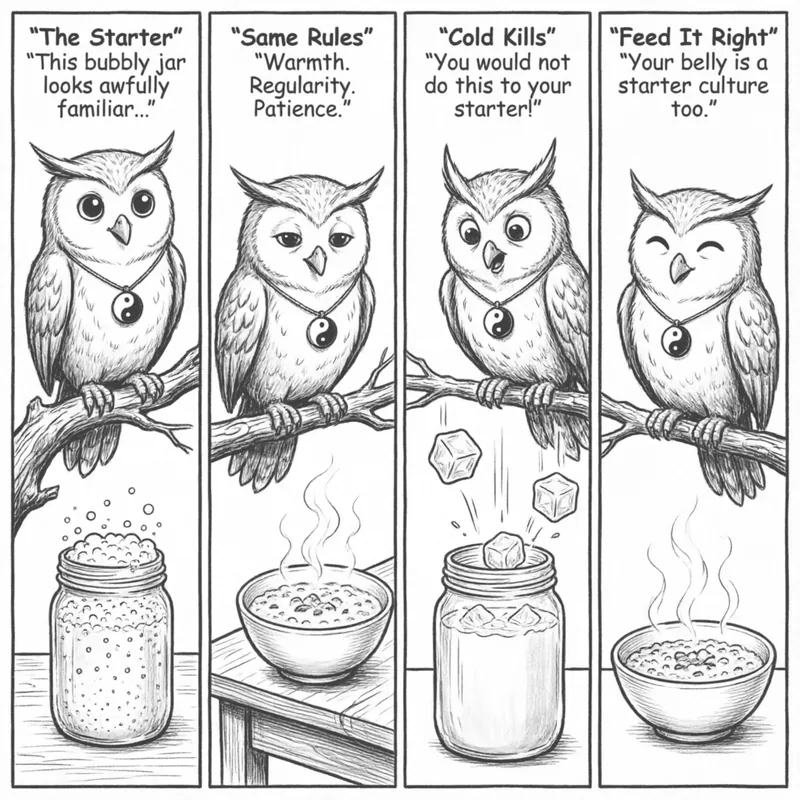
"One starter is for the counter. The other is in your belly. You gotta feed them both the same way. Warmth, regularity, patience — your Spleen starter culture knows exactly what it needs."
Enjoyed this?
Subscribe via RSS — new articles delivered to your feed reader.
Have a question? Reply by email — good questions become future articles.